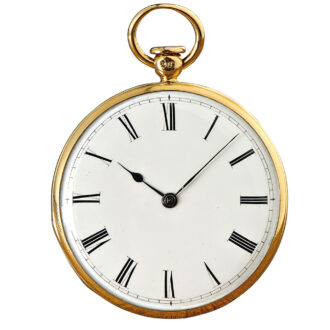
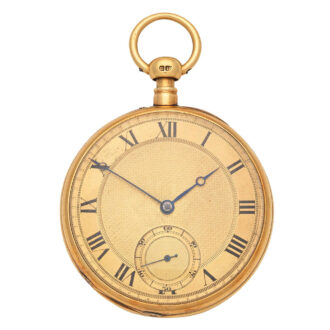
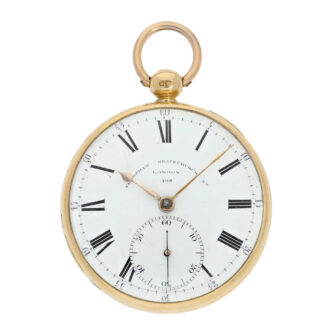
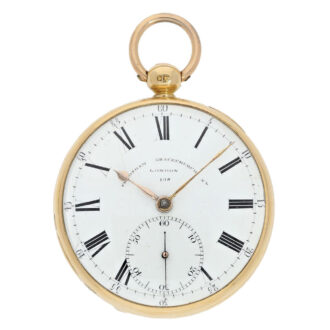
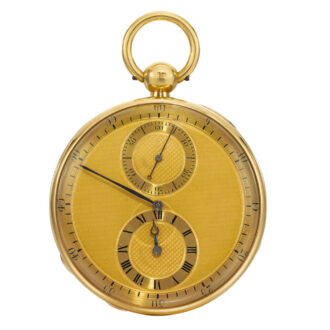
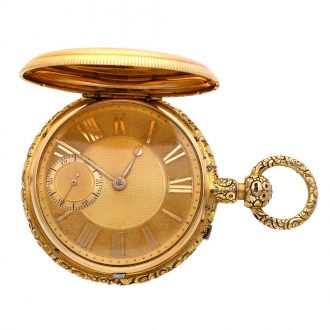
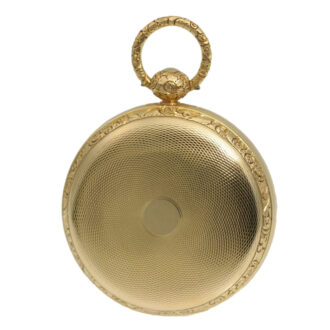
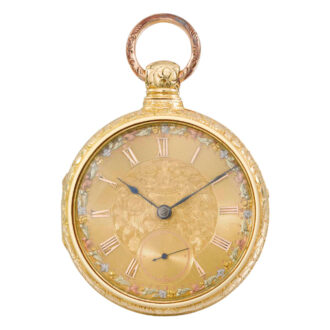
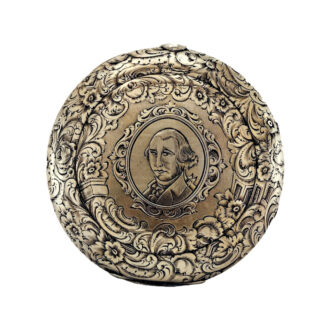
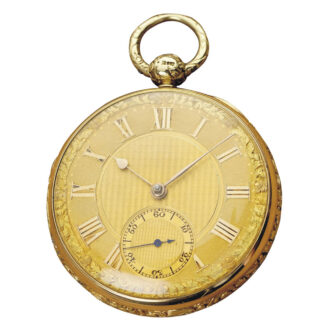
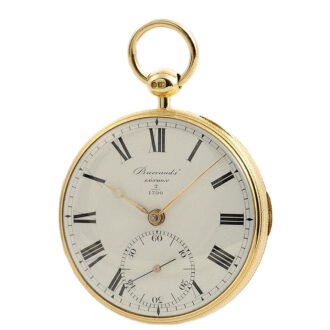
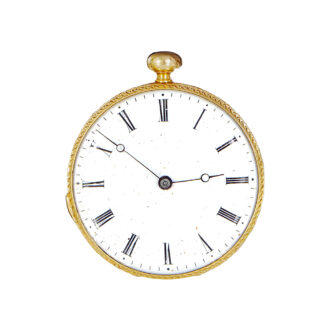
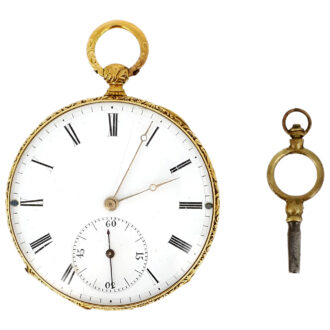
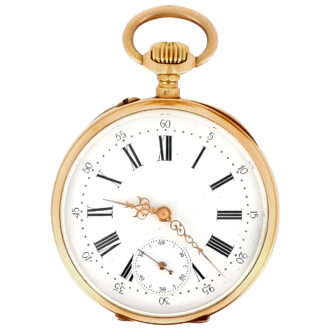
Early English gold keyless pull wind watch Circa 1824
- Kenmerk
- TA1920
- Diameter
- 48 mm
- Estimate
- € 3.500 - 6.000
- Price sold
- -
Gold open faced cylinder watch
–
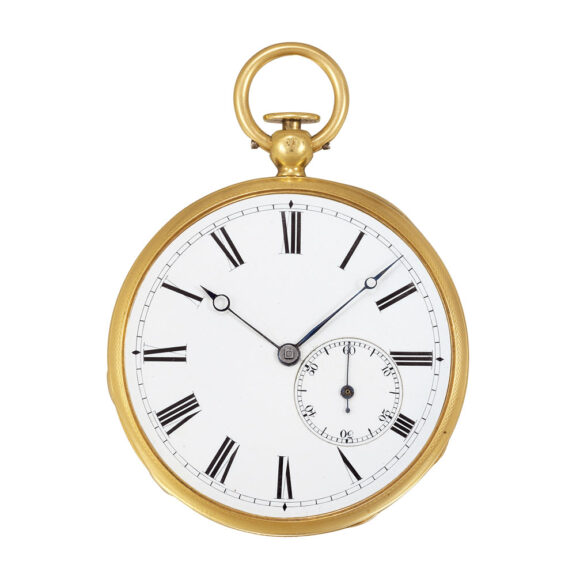
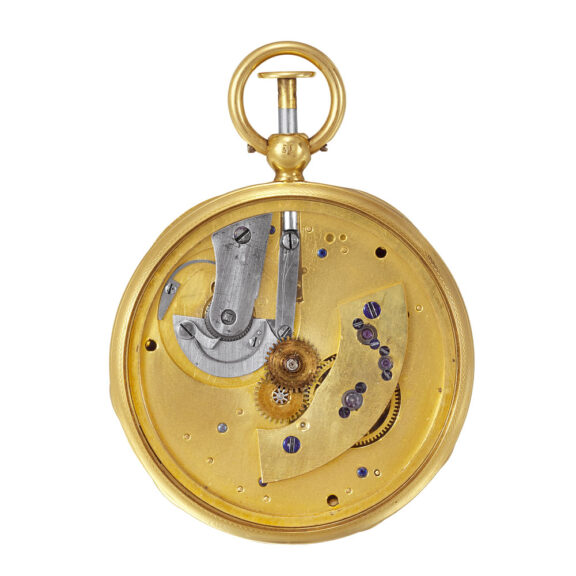
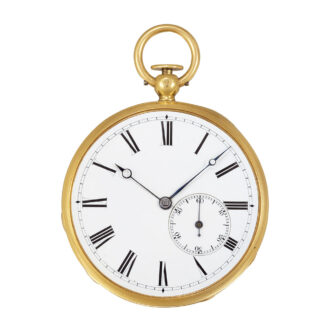
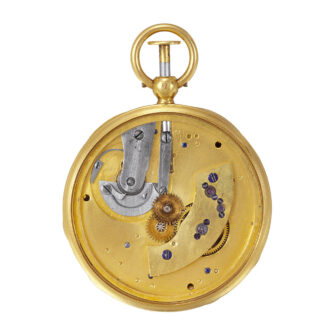
A fine English, 18 Carat gold keyless pull wind watch, circa 1824. Very Early keyless pull wind watch by Viner & Co., Inventors, 233, Regent Street & Royal Exchange, London. The case with London hallmarks for 1824-1825. The case is made by Louis Comptesse (master mark), engine-turned, pull wind button on the pendant. White enamel dial with radial Roman numerals, outer minute track, eccentric subsidiary seconds at 4 o’clock. Blued steel Breguet hands. A gilt brass movement, Lepine calibre with standing barrel, cylinder escapement, plain steel three-arm balance, blued steel flat balance spring, index regulator, Viner’s pull wind device by means of the flat cap, set on the pendant, winding when pulled outwards and to be pushed back manually. Movement signed case punched with master mark L.C. Property of an Italian Collector.
–
Diameter: 48 mm
–
Signed: Viner & Co. London
–
The case is slightly rusted and the movement has some scratches.
–
This watch belongs to the group of early keyless watches with pump winding. The earliest English patent (No.1970) for a pump winder was granted to Robert Leslie on December 13, 1793, in November 1814, Edward Massey of London was granted patent No. 3854 for the invention of a push-winding system. The present watch in principle uses the system invented by Joseph Berollas of London, Berollas’s system used a chain that was expensive to make and vulnerable to breakage, Viner’s system improved on this by using a push-rod, the only disadvantage is that the push-button has to be manually returned to its original position rather than springing back as in the Berollas system. For illustrations and discussion of the various early pump wind systems see Patek Philippe, Geneve, Huber & Banbery, 1993, p. 41-43.
–
Charles Edward Viner (1788-1875) was an eminent maker. He was apprenticed in 1802 to Thomas Savage, the inventor of the so-called Savage escapement. He became free of Clockmaker’s Company and was made a Liveryman in 1819. Between 1824 and 1835 he was in partnership with Hoskins. Viner is known for his excellent craftsmanship; some of the best British carriage clocks were made by him.
Signed: Viner & Co. London
Share this page: