Swiss 18 carat gold and enamel nanga form watch Circa 1820
- Kenmerk
- AL3473
- Diameter
- 32 mm
- Estimate
- € 8.000 - 16.000
- Price sold
- € 14.000
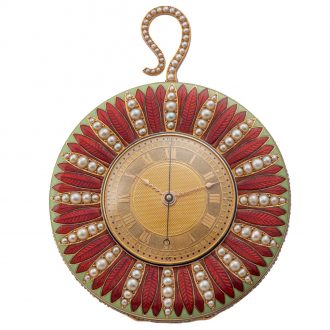
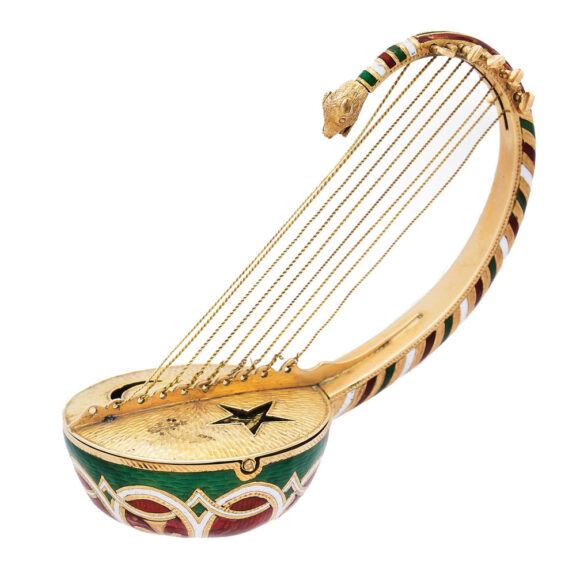
Large gold form watch The Nanga
–
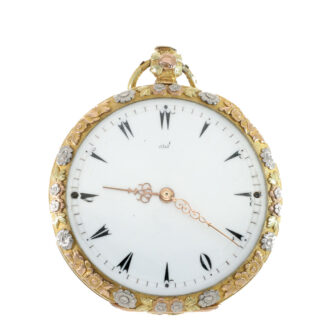
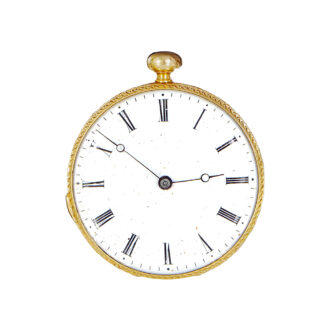
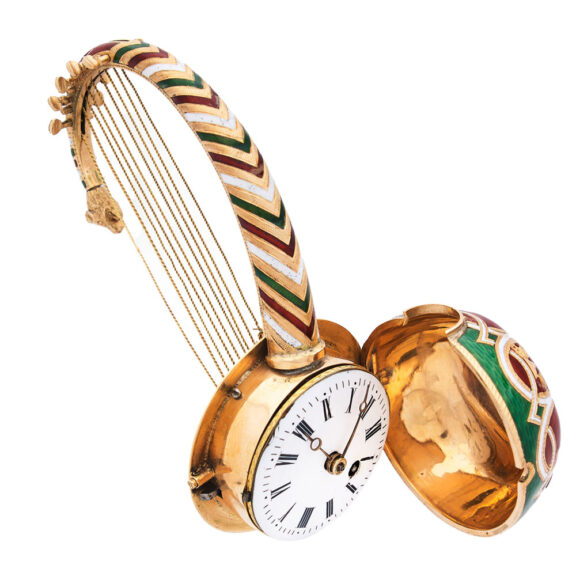
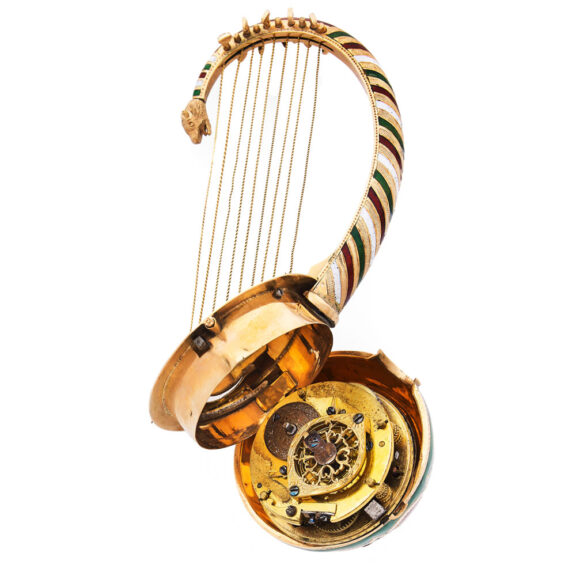
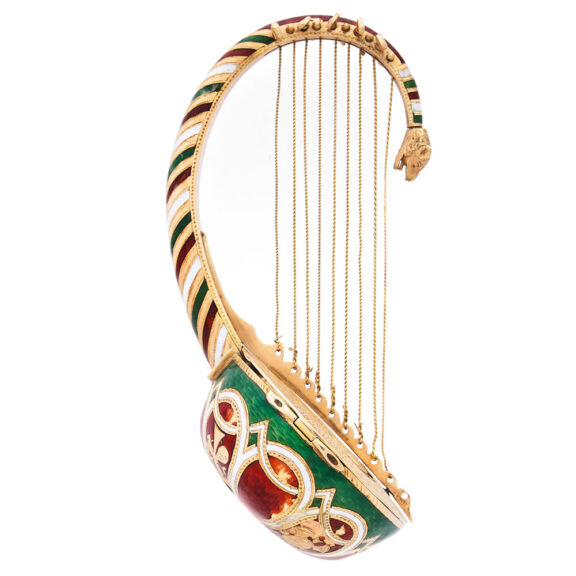
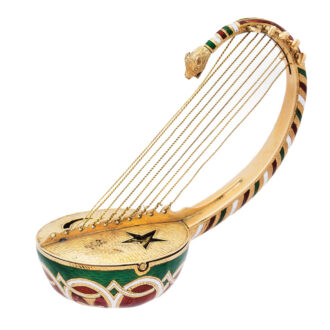
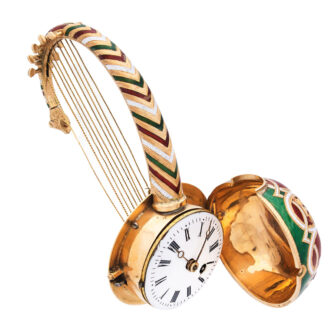
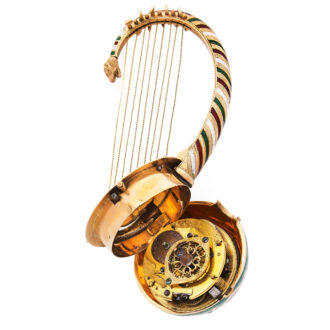
A magnificent Swiss 18 carat gold pocket watch known as The Nanga, shaped like an ancient harp and made for the Ottoman market around 1820. It features a mechanical key winding movement with a verge escapement, an intricately chased and pierced balance cock, a three spoke balance wheel, and an advance/retard adjustment regulator on the balance bridge. The concealed white enamel dial shows black Roman numerals for the hours and stylized hands, flanked by delicate decorative motifs.
–
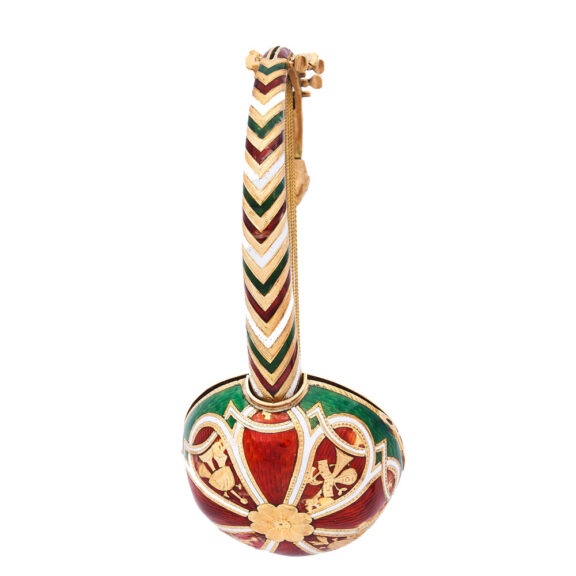
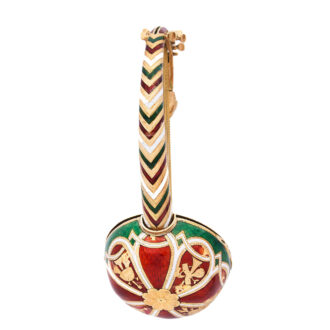
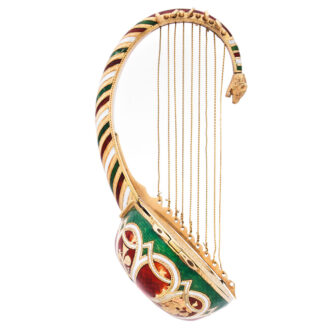
The timepiece is housed in a unique hinged large gold form case, richly decorated with translucent green, white, and red champlevé enamel on a red background. It is centred by a stylized gold flower and has panels depicting detailed music trophies. The yellow gold soundboard has a bark texture and is pierced with star and crescent symbols. It leads to a curved neck adorned with white, green, and red geometric enamel decoration. The neck is fitted with nine gold strings and ends in a finely detailed snake’s head. The middle of the case includes a built in corrector piece to open the mechanism.
–
Diameter: 32 mm
–
Length: 73 mm
–
Weight: 34.3 g
–
Signed: No name
–
In the Ottoman Empire, the Western harp was not a traditional instrument in classical Turkish music. However, plucked string instruments held a prominent place in regional culture. The qanûn (a plucked zither) and the oud (a fretless lute) were highly valued in imperial courts. The qanûn shared notable similarities with the harp in its plucked technique and timbre.
–
During the 19th century, especially under Sultan Abdülmecid I, the Ottoman Empire embraced Westernization. As European cultural exchanges expanded, the harp became a prestigious, sophisticated novelty. It appeared in elite court circles, embassies, and Western style classical concerts for European guests. This reflected the Empire’s broader drive toward modernization and artistic diversity. Though rare, the instrument was also depicted in Ottoman miniatures and European influenced artwork as a symbol of cultural openness.
–
Historically, the evolution of plucked harp like instruments dates back to ancient times with the Nanga, considered the most primitive form of the ancient Egyptian harp. The Nanga featured a boat shaped or arched wooden body with a parchment soundboard, an integrated central sound bar, and a curved neck holding pegs for three or four strings, each tuned to a single pitch.
Share this page: