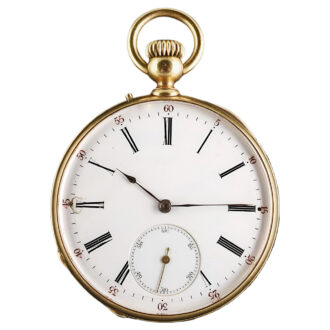
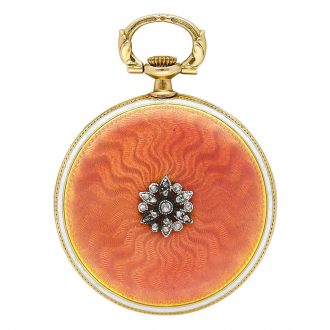
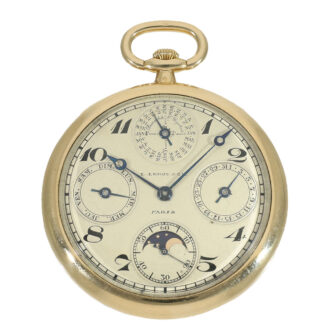
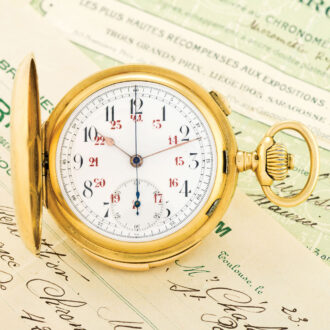
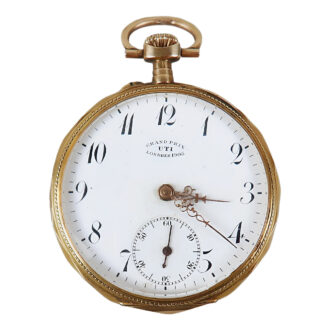
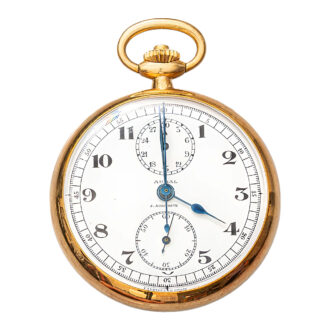
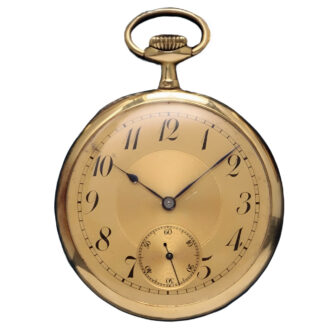
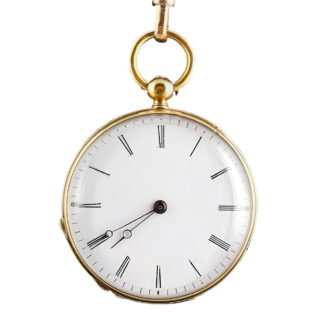
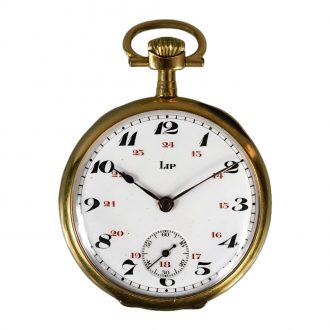
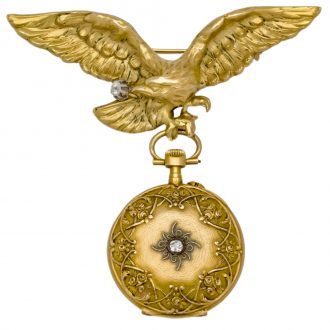
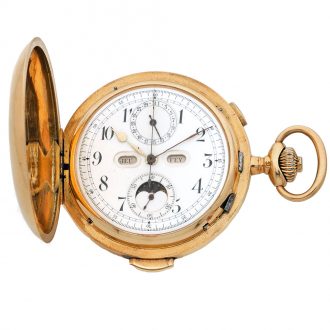
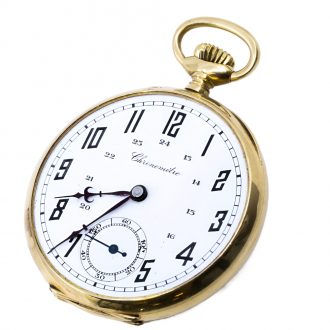
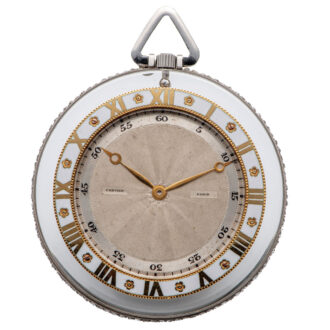
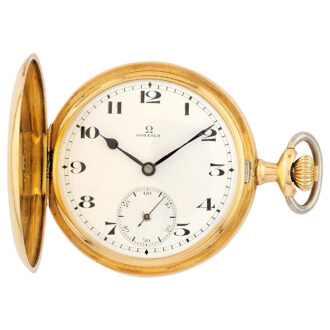
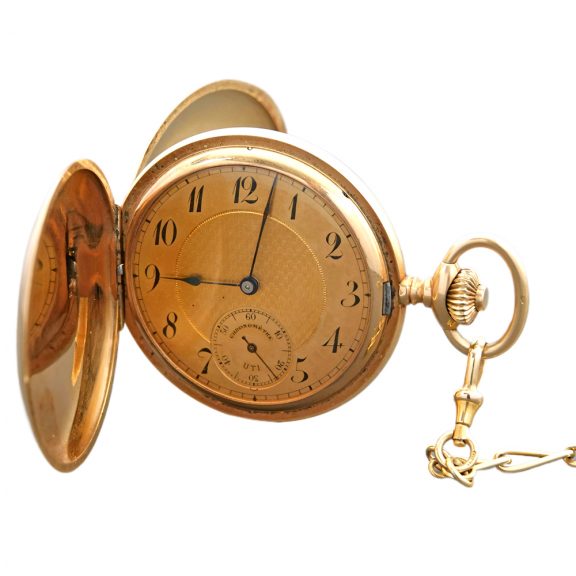
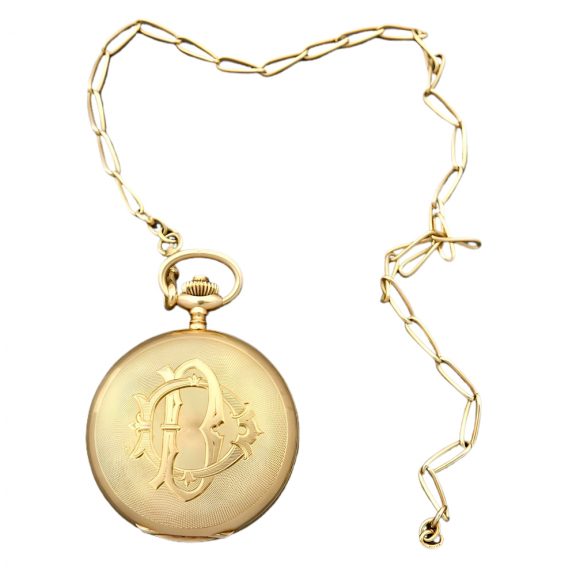
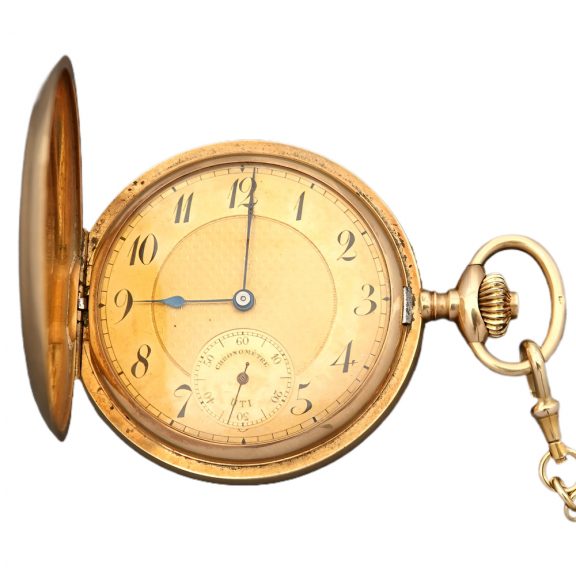
French 18K yellow gold UTI chronometer watch Circa 1910
- Kenmerk
- AL3004
- Diameter
- 49 mm
- Estimate
- € 3.250 - 4.500
- Price sold
- € 2.500
Gold hunting cased chronometer watch
–
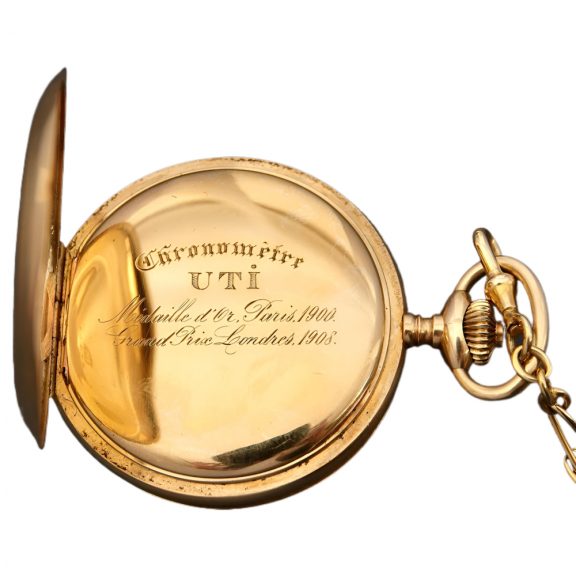
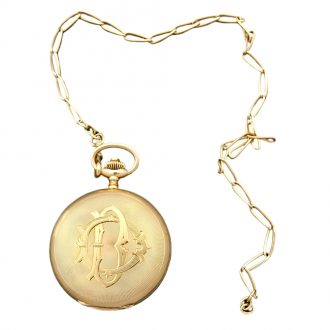
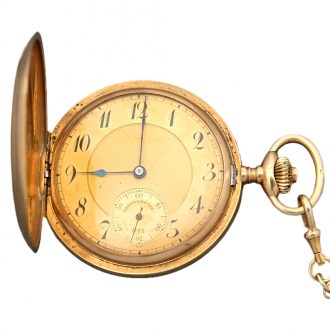
A fine French 18 carat yellow gold hunting cased chronometer pocket watch made by Cortébert and retailed by UTI in Paris, circa 1910. This watch features a hand wound mechanical lever movement. The gold dial displays a guilloché center, black Arabic numerals for the hours, a small seconds subdial at 6 o’clock and blued steel pear shaped hands. The round 18 carat yellow gold case is decorated with double barley grain guilloché engraving, with the front cover featuring a monogram DB. It includes a gold inner cuvette, also signed and numbered, an oval bow and a fluted crown. The case bears the French Tête de Cheval (horsehead) hallmark, used between 1838 and 1919 for 18 carat gold. The case and dial are signed by UTI and numbered.
–
Accompanied by an anonymous period case and an 18 carat yellow gold vest chain with twisted links and a lobster clasp.
–
Diameter: 49 mm
–
Weight: 111.2 g
–
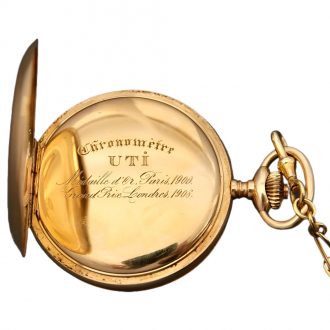
Signed: UTI Chronomètre
–
In 1906, engineer Georges Meyer founded UTI, short for UTINAM, a French horology manufacturer of precision watches, clocks, bedside and travel alarms and railway stopwatches. UTINAM was the motto of the city of Besançon, birthplace of French horology. UTINAM translates to “I wish”.
–
In 1912, UTI already had a very rich catalogue with pocket watches, wristwatches for men and women, form movements and luminous dials based on radium, an invention that had been developed in 1904, with Pierre and Marie Curie and the manufacturer LIP.
–
Georges Meyer retired from the company in 1936 and passed it to his son, Gilles, who employed Eugène Blum as technical director.
–
Until 1940, both names UTINAM or UTI and “Etablissements Georges Meyer” were used. In 1940, UTI S.A. was registered.
–
At the end of WWII, Jacques Meyer, grandson of Georges, took over the family business and focused on high end watches through a partnership with jewellers like Van Cleef and Arpels.
–
In the 1950s, strong partnerships were concluded with watchmakers like Breitling, Lemania, Glycine and Universal Genève.
–
With more than 450 employees in the 1970s, UTI would unfortunately not survive the quartz crisis and closed permanently in 1984.
–
In 1790, Switzerland, Abraham-Louis Juillard opened a small watch shop in the village of Cortébert between Saint Imier and Bienne. Although the Cortébert brand name was not registered until 1855, using the bottony cross as logo, this year is commonly used as the date of founding.
–
Cortébert was a premium watch brand that manufactured its own movements and supplied them to other brands such as Rolex.
–
The company became well known for its railroad watches. They supplied both the Turkish and the Italian railroad companies. In 1927, at Mussolini’s request, Cortébert started distributing watches in Italy under the brand name Perseo, as fascist Italy rejected foreign brand names. It is under this name that their timepieces were used by the Italian railway company.
–
By 1944, Cortébert had a lineup of 20 different calibers.
–
When the quartz crisis hit the watchmaking industry in the 1970s, the majority of prestige brands ceased production, including Cortébert. Their representatives in Italy bought the Perseo brand name and continue today as an independent company.
Signed: UTI Chronomètre
Share this page: