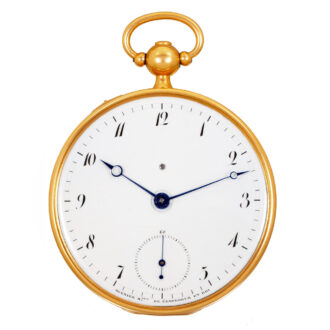
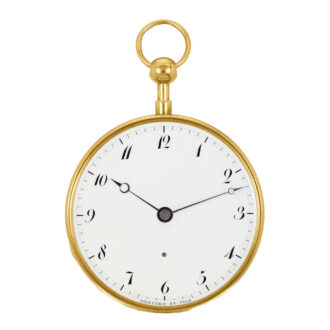
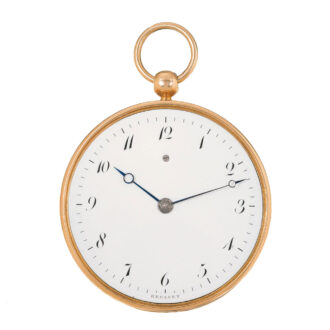
French gold “Montre Médaillon à Tact” watch Circa 1809
- Kenmerk
- FA0161
- Diameter
- 41 mm
- Estimate
- € 40.000 - 75.000
- Price sold
- € 70.250
Gold “Montre Médaillon à Tact” watch by Breguet
–
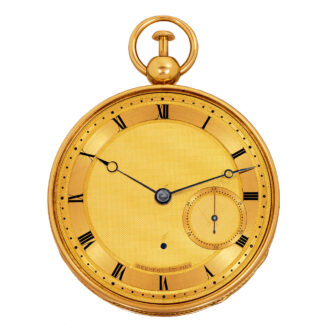
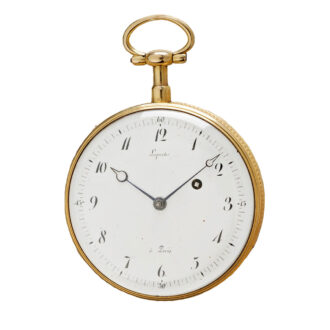
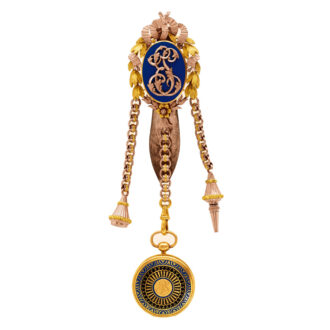
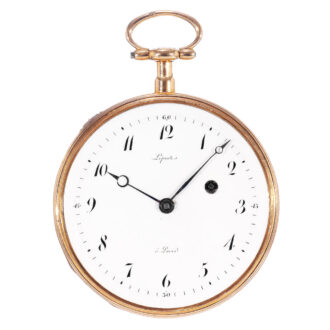
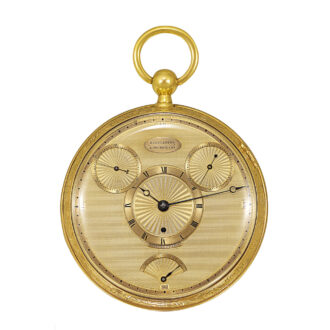
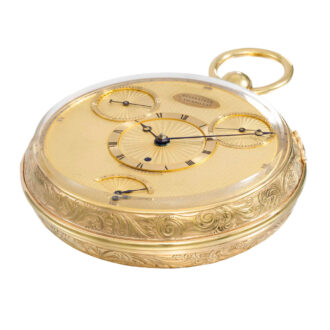
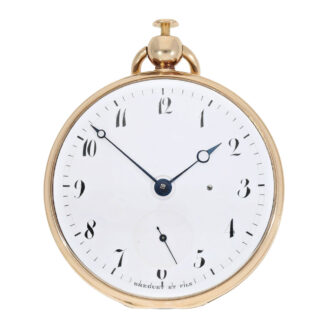
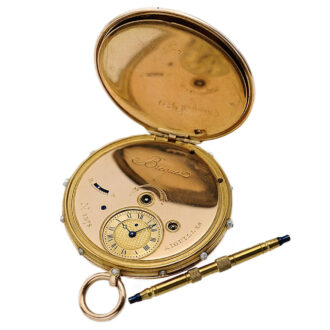
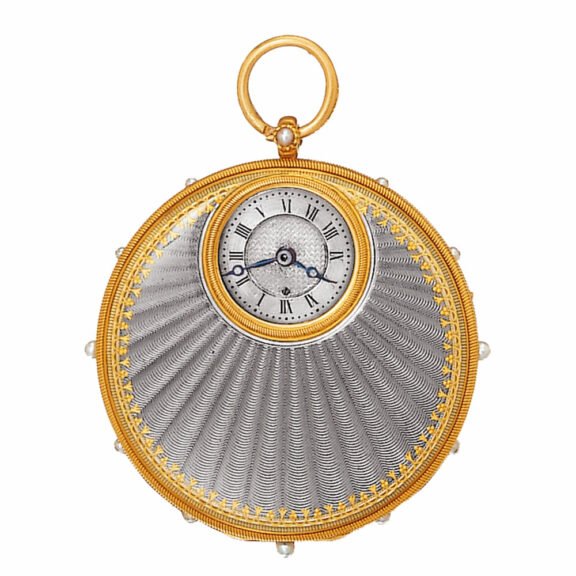
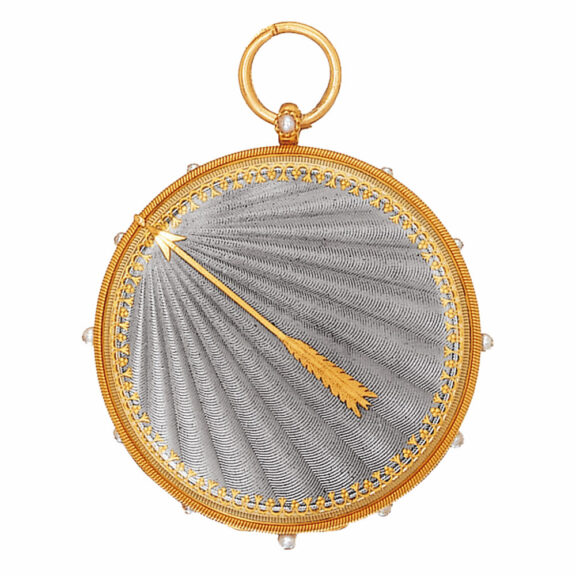
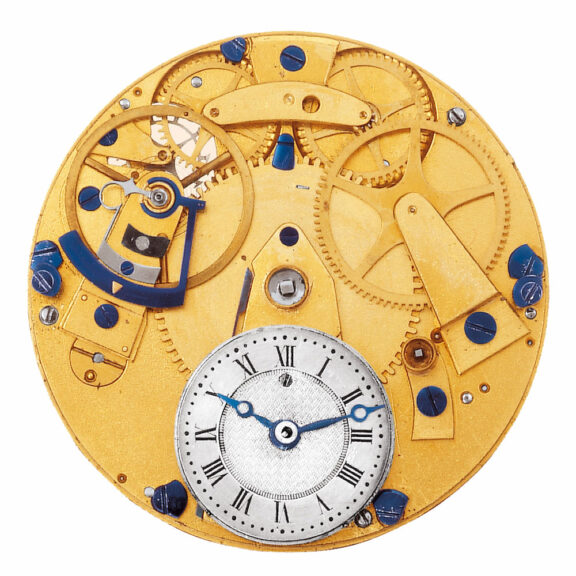
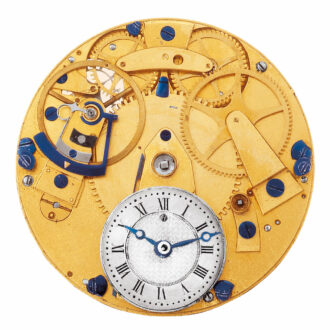
A very fine and rare French 18K gold and enamel, pearl-set Montre Médaillon à Tact, sold on October 28, 1809 to Monsieur Labouchère of Amsterdam for 1,500 francs, circa 1809. gilt brass, souscription caliber with central barrel and five-wheel train, ruby cylinder escapement, plain three-arm brass balance, blued steel flat balance spring, pare-chute on the top pivot.
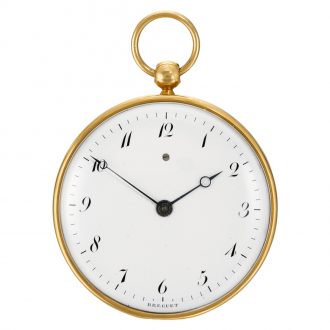
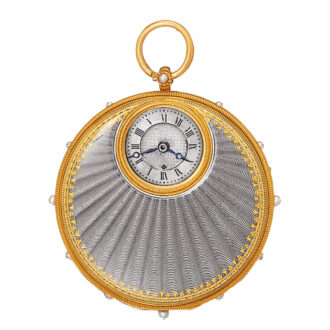
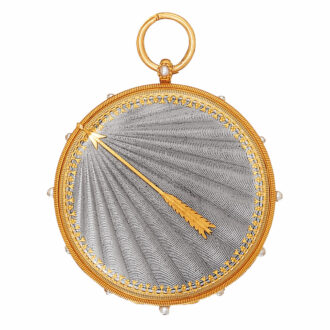
Both case covers with translucent pale gray enamel over sunburst engine-turning, gold paillon borders, front with small aperture for the dial, back with gold arrow flush with the enamel, pointing to a small knob, band with the same enamel decorated with gold paillon laurel-leaf wreath, twelve pearl touch pieces, detachable cuvette with apertures for winding, setting, regulating and the dial, with two small secret signatures, pendant set with two half-pearls, loose ring.
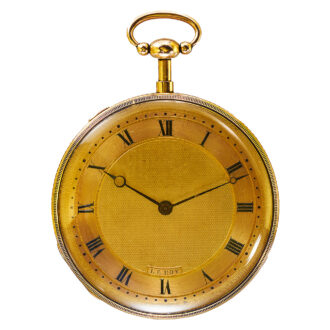
Silver small dial eccentric set in the front cover aperture, Roman numerals, outer minute dot divisions, engine turned center with basket pattern. Blued steel Baton hands.
–
Diameter: 41 mm
–
Signed: Breguet
–
This watch was chosen by the Maison Breguet to represent their achievements in the 1923 exhibition “Centenaire de A.L. Breguet”, in Paris? Musée Galliera. It was described and illustrated in the catalogue as No. 91, figure VI. It is also described in Prof. Engel?s book, p. 114. The watch with the preceding number, virtually the same, was bought by the Queen of Spain. It is rare to find two secret signatures on a cuvette. Pierre-César Labouchère, (1772-1839) Born in The Hague in 1772, he died in Chelmsford, Essex, England, in 1839. From an important Protestant family, his father being a wealthy cloth merchant who settled in Holland in the mid-17th century. After serving an apprentissage in Nantes with one of his uncles from 1785 to 1792, he entered into the Hope firm in Amsterdam, rising to a high position at a young age. While conducting negotiations with the Baring bank in London, he met Baring?s daughter Dorothy Elisabeth, whom he was to marry. Thus ties were establishment between the London bank and the Dutch one, with Labouchère?s brother-in-law Alexandre Baring becoming his associate in the Hope firm in 1796. At the beginning of the 19th century, he was called upon to play a role in French political affairs, negotiating a loan on the part of King Joseph of Naples, on the condition that the French government participate. After 1806, he became friendly with financier Gabriel-Julien Ouvrard, who introduced him to Fouché. Fouché attempted to take advantage of Labouchère’s English connections “he being the son-inlaw of Francis Baring, to whom Lord Wellesley, English Foreign Minister, owed his career” involving him in secret negotiations with Napoleon’s consent. These negotiations failed, however, Fouché contacted Labouchère in 1810, having decided to take up the negotiations again, but this time without the Emperor?s knowledge. Labouchère believed he was still acting on the Emperor’s orders, but when the affair came to light, Napoleon was furious. Labouchère was able to prove his innocence, however, and continued to be employed as negotiator for the Emperor, who sent him, in February 1811, to England for another difficult mission. After the fall of Bonaparte, Labouchère returned to Amsterdam, where he directed the Hope firm, in association with Baring’s bank. By 1821, Labouchère had abandoned the direction of the firm to his younger brother Samuel and retired to Chelmsford.
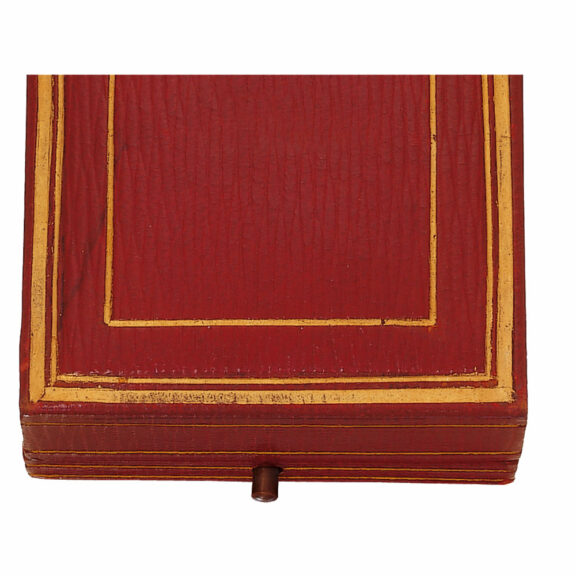
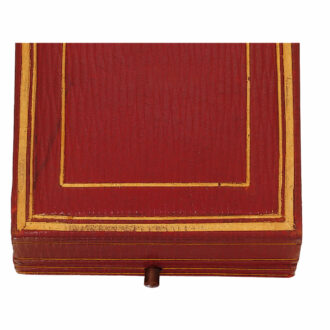
Accompanied by a Breguet certificate and original morocco fitted box.
Signed: Breguet
Share this page: