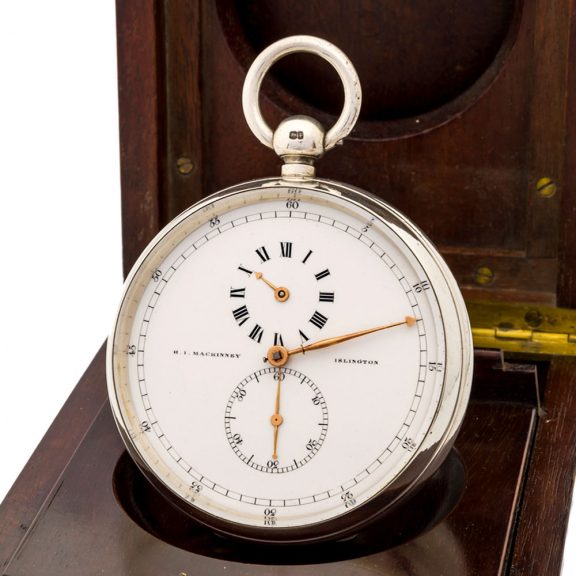
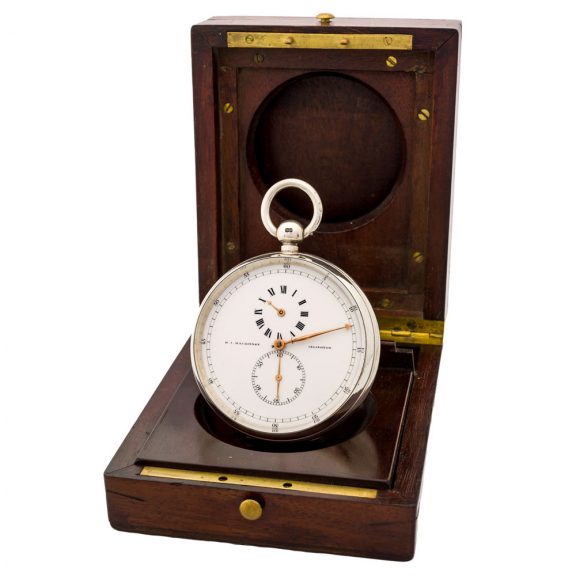
Important English silver chronometer pocket watch Circa 1831
- Kenmerk
- TA4927
- Diameter
- 71 mm
- Estimate
- € 6.000 - 12.000
- Price sold
- € 9.050
Silver watch retailed by H.I. Mackinney, Islington
–
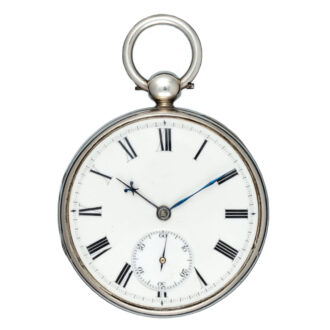
A very important English silver chronometer with an early lever escapement, circa 1831. Made by Gayetano Sanchez in London. Movement made circa 1790, later silver case with London hallmarks for 1831-1832. A consular, polished case, maker’s mark P.W., swivel pendant. White enamel dial, of regulator type with Roman chapter, outer Arabic minute ring, subsidiary seconds and gold spade hands. Gilt brass, full plate movement with cylindrical pillars, fusee with chair and maintaùning power, straight fine lever escapement derived directly from the model supplied by Thomas Mudge, the inventor.
–
The polished steel escape wheel with all the lift on the pallets, but without any draw. Safety action is provided by a gold dart and a steel roller with a rectangular slot to allow the dart to pass at the appropriate moment. Arnold double S type balance built on a gilt brass four am wheel, the bimetallic S pieces are each held by two rivets to a blued steel hollow lenticular shaped frame secured to the balance wheel itself by two screws, the free end of each S piece cannes a threaded rod and a gold quarter nut for poising and mean tune adjustnnent, two additional gold quarter screws are fitted in slotted brackets. Helical blued steel balance spring. Typical Emery gilt brass cock engraved with foliage, diamond endstone. Bayonet fit gilt brass dust cap signed by Gayetano Sanchez en Londres Ano 1792.
–
Diameter: 71 mm
–
Signed: Gayetano Sanchez London
–
Accompanied by a mahogany fitted display box
–
A rare example from the first series of watches with lever escapements ever made. The escapement was invented in the late 1750s by Thomas Mudge, who used it in at least two clocks and two or three watches. Cotunt von Bruhl, envoy at the English Court from the kingdom of Saxony, and Mudge’s patron and friend, asked him to make a model of the lever escapement to publicise it and to establish Mudge as the inventon Von Bruhl, who was aware of its potential, managed to persuade Josiah Emery to make a series of watches employing the escapement and was one of the first to own one. Mudge had left London for Plymouth in 1771 and was almost totally preoccupied with the construction of his marine timekeepers, so it was increasingly unlikely that he would use the escapement again himself.
–
Over the period from 1781 until 1795, Emery is thought to have made about thirty-six watches of this type, the earliest known is No. 806, made circa 1780, and the last one, No. 1379, in 1795. It is now established that the lever escapement was introduced to France via one of Emery’s lever watches. According to Ferdinand Berthoud, Sarron had one sent from London towards the middle of 1782. A model of the escapement was also obtained and is now in the Musée National des Techniques (C.N.A.M.) in Paris. Chabet and Puiségur each had one of these watches, which were copied by Robert Robin in about 1784. Louis Berthoud was also inspired by them for his first pocket chronometers.
Signed: H.I. Mackinney Islington
Share this page: