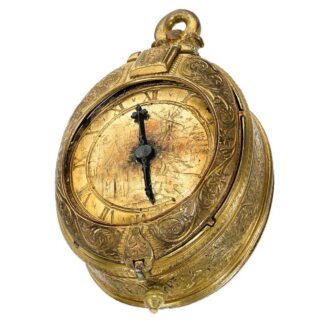
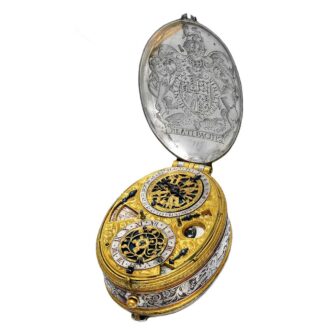
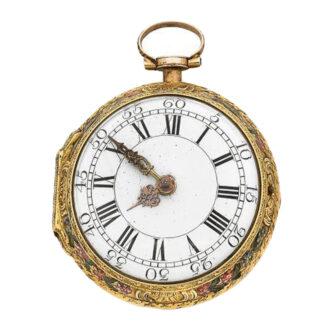
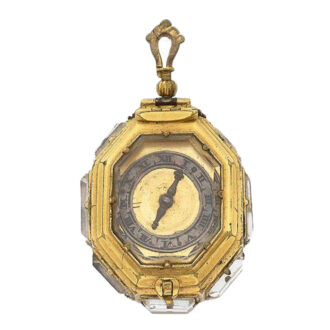
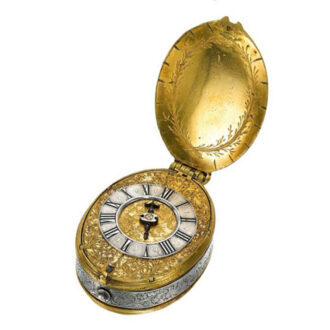
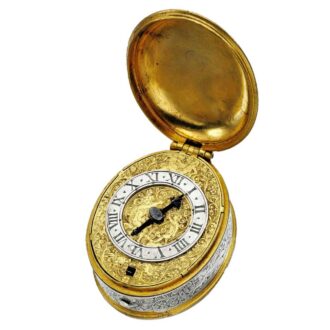
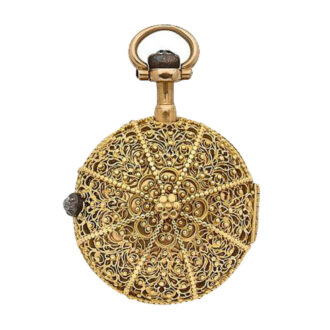
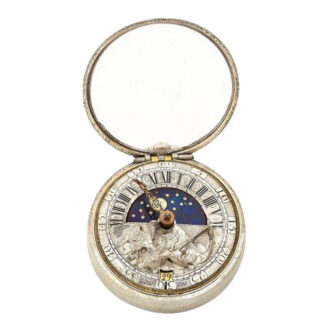
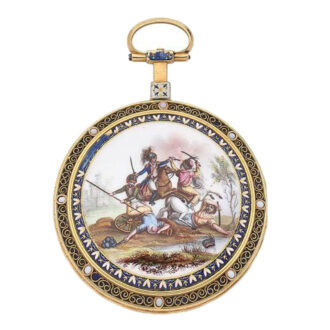
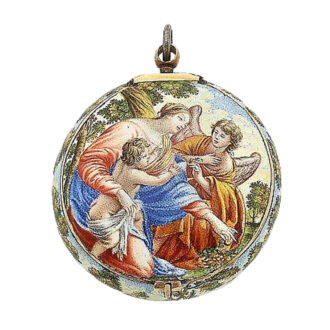
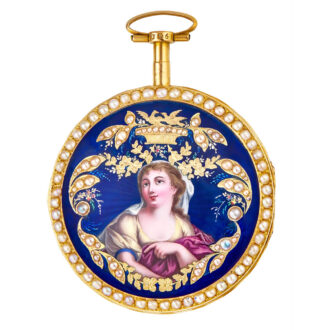
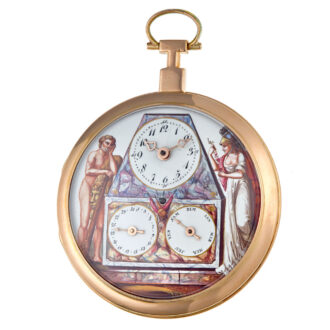
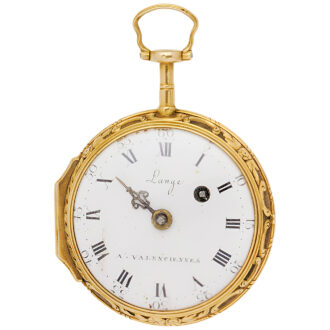
French Louis XV four colour pocket watch with original box Circa 1747
- Kenmerk
- HC0439
- Diameter
- 32 mm
- Estimate
- € 2.750 - 5.500
- Price sold
- € 2.800
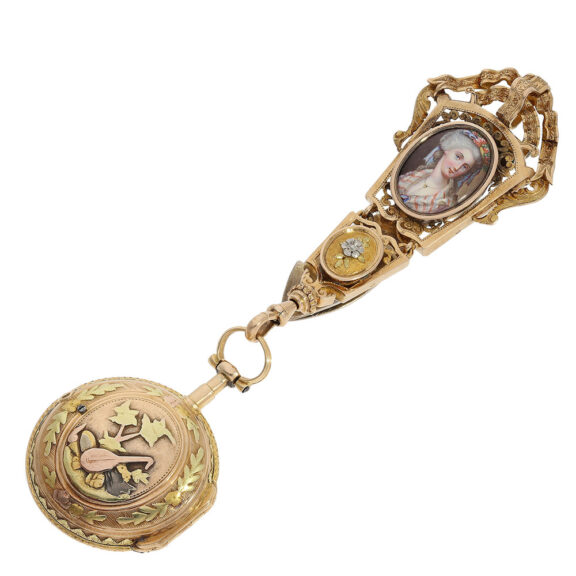
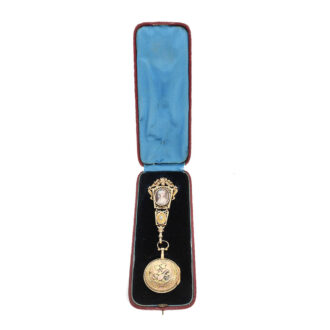
Verge watch with associated gold enamel chatelaine
–
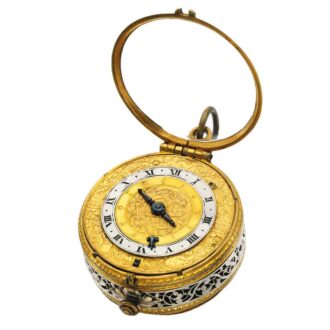
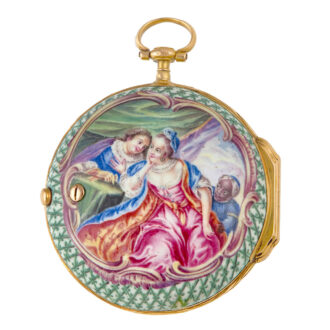
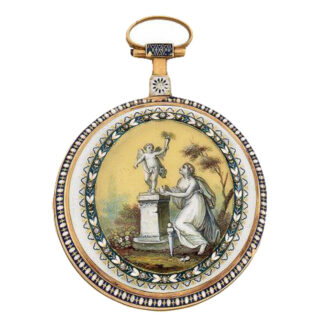
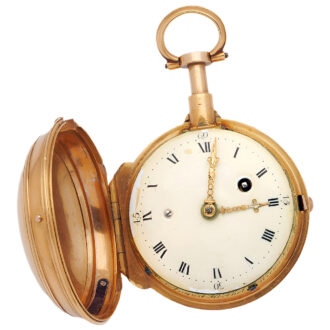
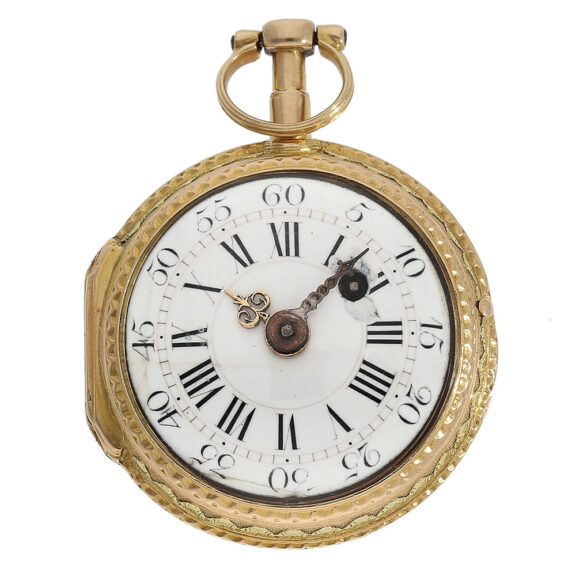
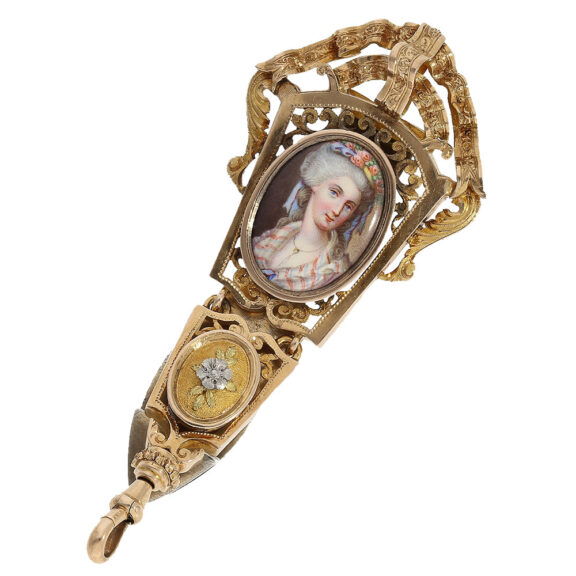
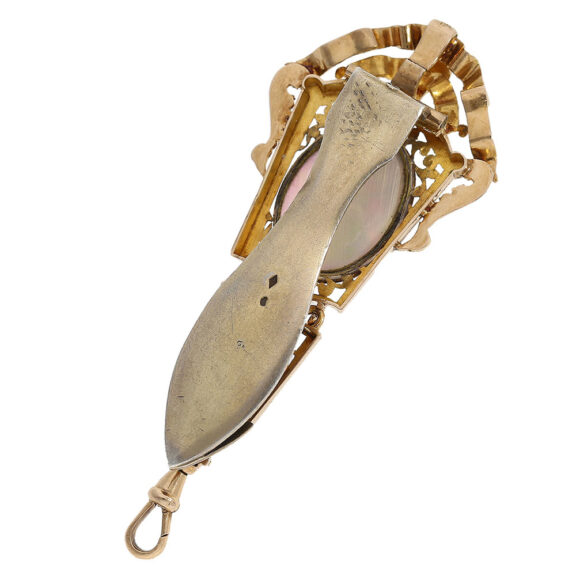
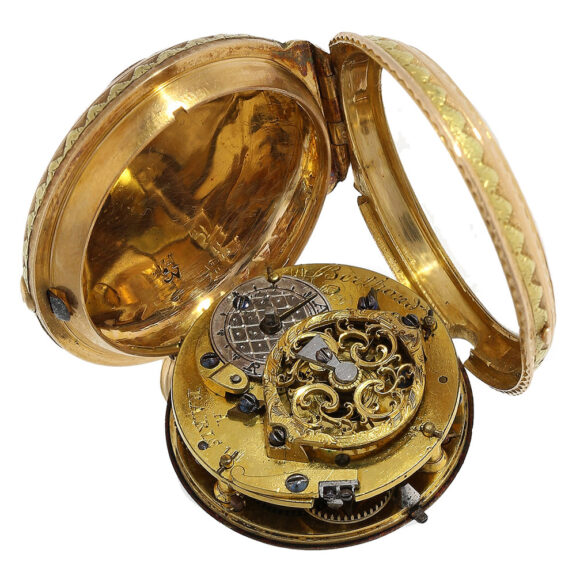
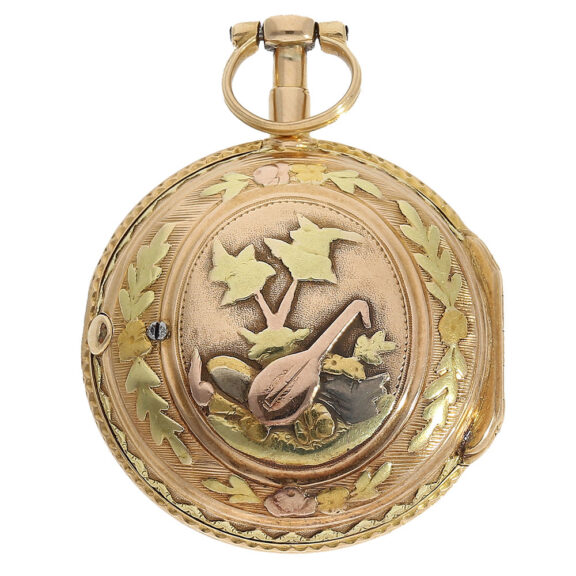
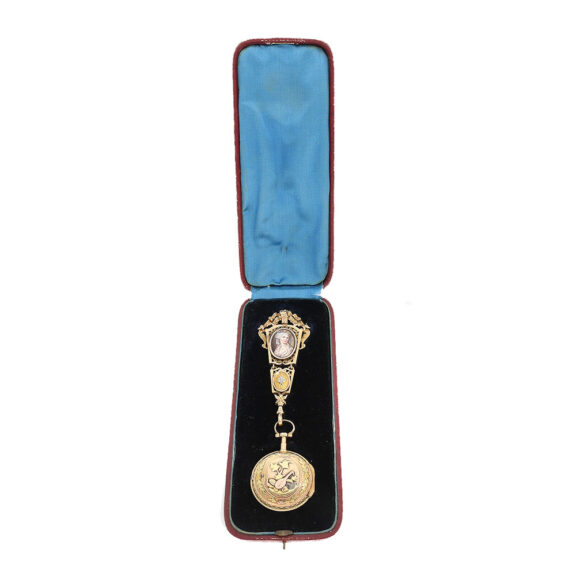
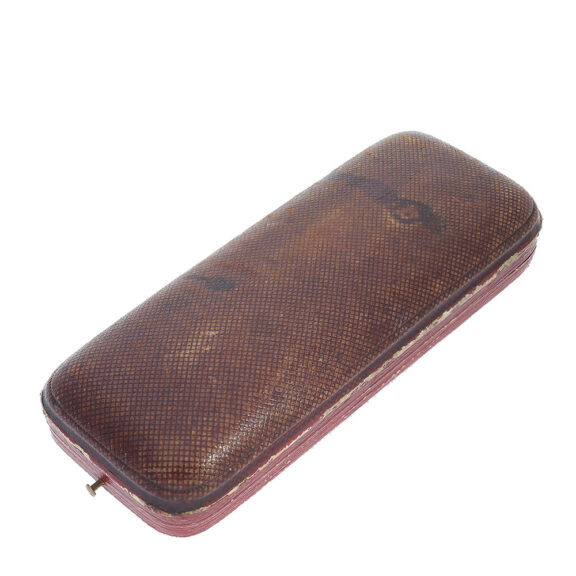
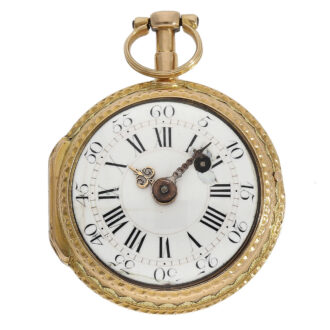
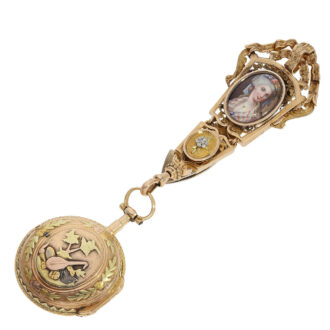
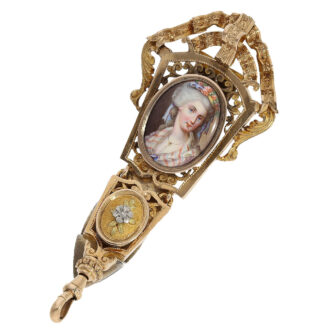
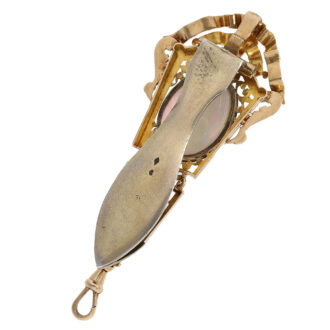
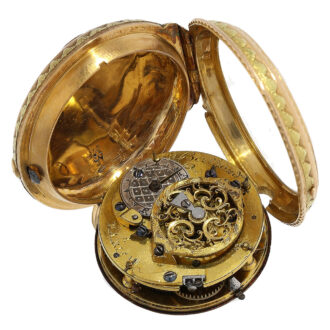
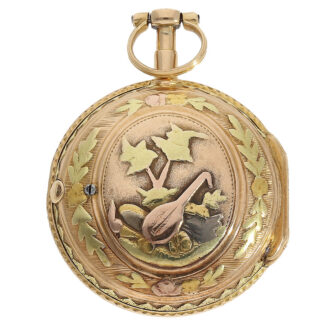
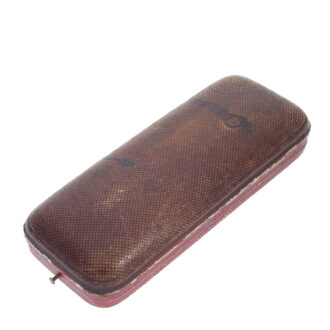
A museum quality Louis XV four colour verge watch with associated gold enamel chatelaine and original box, probably made by Ferdinand Berthoud in Paris, France, circa 1747. Crafted from 18 Carat gold, the chatelaine is of exceptional quality, very elaborately crafted and also in different gold colors. The upper part features an oval enamel plaque depicting a lady in the finest magnifying glass painting. The Louis XV open faced case is of very fine quality, with relief in four different gold colors and a high quality external hinge. The Louis XV white enamel dial has an inner ring of Roman numerals for the hours, an outer ring with Arabic numerals for the minutes and it features red gold hands. The spindle movement is signed and has a verge escapement.
–
Diameter: 32 mm
–
Weight: 25 g
–
Signed: Berthoud
–
The present clock was probably made by Ferdinand Berthoud (1727-1807) in Paris after he had emigrated from Switzerland in 1747. In Paris he founded the well-known company “Berthoud à Paris”.
Ferdinand Berthoud (born 18 March 1727, in Plancemont-sur-Couvet, Principality of Neuchâtel; died 20 June 1807, in Groslay, Val d’Oise), was a scientist and watchmaker. He became master watchmaker in Paris in 1753. Berthoud, who held the position of Horologist-Mechanic by appointment to the King and the Navy, left behind him an exceptionally broad body of work, in particular in the field of marine chronometers. His father, Jean Berthoud, was a master carpenter and architect. He was a burgher of Couvet, burgher of Neuchâtel, and justice of the peace for Val-de-Travers from 1717 to 1732. His mother, Judith Berthoud (1682–1765) was born in Couvet.
In 1741, when he was fourteen, Ferdinand Berthoud became a clockmaking apprentice to his brother Jean-Henry in Couvet, at the same time receiving a sound scientific education. On 13 April 1745, Ferdinand Berthoud finished his training and was awarded a watchmaking and clockmaking apprenticeship certificate.
In 1745, aged 18, Ferdinand Berthoud moved to Paris to improve his skills as a watchmaker and clockmaker. He exercised his talents as a journeyman, working with master watchmakers in the Paris community. There is some suggestion in the literature that Ferdinand Berthoud worked for a time for Julien Le Roy, where he is said to have made strikingly swift progress, alongside Pierre Le Roy, his master’s son, who later became his rival.
On 4 December 1753, by order of the French Royal Council, in an exception to guild rules and by special favour of the King, Ferdinand Berthoud became a master at the age of 26, receiving the official title of Master Watchmaker.
From 1755 onwards, Ferdinand Berthoud was entrusted with the task of writing a number of reference articles on watchmaking for the Encyclopédie méthodique, published between 1751 and 1772 under the direction of the writer and philosopher Diderot (1713–1784) and the mathematician and philosopher d’Alembert (1717–1783).
On 17 July 1804, Napoleon made Berthoud a Knight of the Legion of Honour, as a member of the Institute.
On 20 June 1807, Ferdinand Berthoud died childless at the age of 80. He was buried in Groslay, in the Montmorency Valley (Val d’Oise), where a monument commemorates him.
Signed: Berthoud
Share this page: