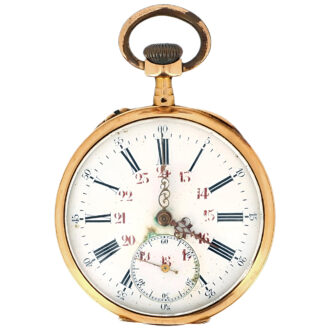
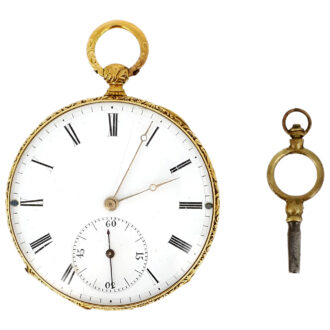
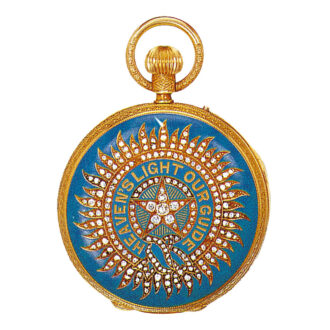
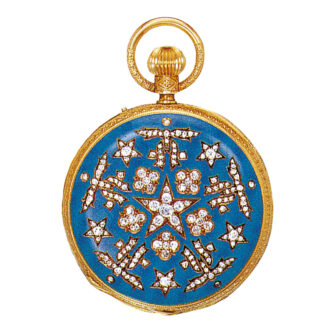
English gold, enamel and diamond repeating watch Circa 1889
- Kenmerk
- TA1696
- Diameter
- 51 mm
- Estimate
- € 22.500 - 35.000
- Price sold
- € 23.800
Gold hunting cased lever pocket watch
–
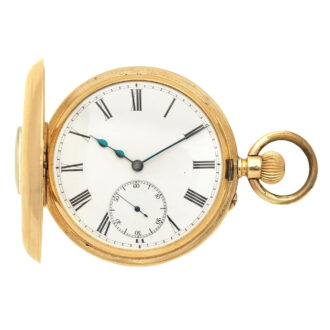
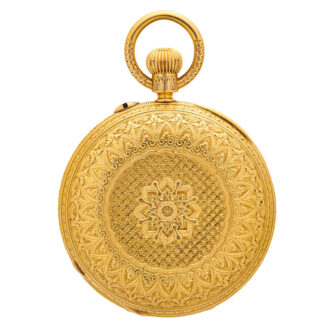
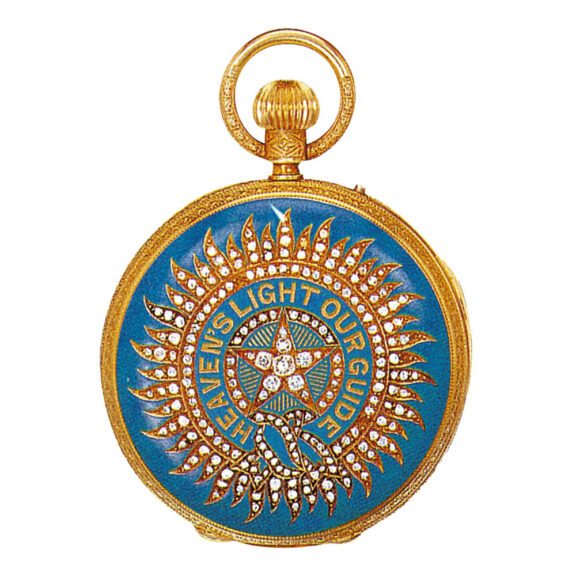
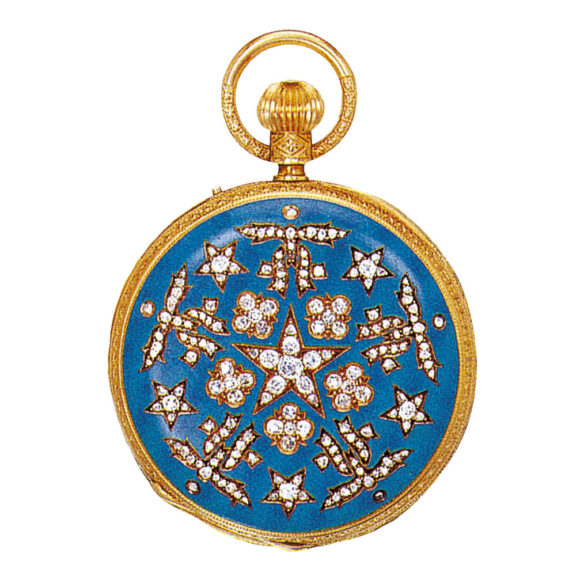
A very fine English, rare and important 18K gold and enamel, hunting cased, diamond-set, keyless minute repeating watch, circa 1889. Order of the Star of India by Frazer & Haws, 31, Regent Street, London. Case by master case maker Richard Macair Ball, with London hallmarks for 1889.
–
The band, bezels, pendant and bow with engraved decoration, turquoise enamelled front and back panels, the cover centred with Insignia of a Knight Grand Commander of the Order of the Star of India, comprising a rose-cut diamond-inlaid star within the motto Heaven’s light our guide, within a diamond-set sunburst frame, the back decorated en suite with star and ornaments, all diamond-set, gold, hinged cuvette entirely engraved and decorated with dark blue enamel.
–
Varicoloured gold dial with radial Roman numerals and sunk subsidiary seconds, fully engraved in a vermicelli pattern, the border with cast gold floral decoration. Blued steel fleur-de-lis hands. A frosted and gilt movement, three-quarter plate, English lateral lever escapement with lift on the pallets, cut bimetallic balance with diamond endstone, blued steel balance spring with a terminal curve. Repeating on gongs via a slide in the band. Movement signed.
–
Diameter: 51 mm
–
Signed: Frazer & Haws London
–
The Most Exalted Order of the Star of India is an order of chivalry founded by Queen Victoria in 1861. The motto of the Order is Heaven’s light our guide. The Star of India, the emblem of the Order, also appeared on the flag of the Viceroy of India. The Order is the senior order of chivalry associated with the Empire of India; the junior order is The Most Eminent Order of the Indian Empire. It is the fifth-most senior British order of chivalry, outranked by The Most Noble Order of the Garter, The Most Ancient and Most Noble Order of the Thistle, The Most Illustrious Order of St Patrick and The Most Honourable Order of the Bath. The British Sovereign was, and still is, Sovereign of the Order.
–
The next-most senior member was the Grand Master; the position was held, ex officio, by the Viceroy of India. When the Order was established in 1861, there was only one class of Knights Companions. In 1866, however, it was expanded to three classes. Members of the first class were known as “Knights Grand Commanders,” rather than “Knights Grand Cross,” so as not to offend the non-Christian Indians appointed to the Order. Former Viceroys and other high officials, as well as those who served in the Department of the Secretary of State for India for at least thirty years, were eligible for appointment. Rulers of Indian Princely States were also eligible for appointment to the Order. Some states were of such importance that their rulers were almost always appointed Knights Grand Commanders; such rulers included the Nizams of Hyderabad, the Maharajas of Mysore, the Maharajas of Jammu and Kashmir, the Maharajas of Baroda, the Maharajas of Gwalior, the Nawabs of Bhopal, the Maharajas of Indore, the Maharajas of Udaipur, the Maharaja of Cochin, the Maharajas of Travancore, the Maharajas of Jodhpur and the Maharaos of Cutch. Women, save the princely rulers, were ineligible for appointment to the Order. They were, oddly, admitted as Knights, rather than as Dames or Ladies.
–
The first woman to be admitted to the Order was HH Nawab Sikandar Begum Sahiba, Nawab Begum of Bhopal; she has created a Knight Companion upon the Order’s foundation in 1861. The Order’s statutes were specially amended to permit the admission of Queen Mary as a Knight Grand Commander in 1911. Appointments to the Order ceased after 14 August 1947. The Sovereign, Elizabeth II, is the only remaining member of the Order of the Star of India.
Signed: Frazer & Haws London
Share this page: