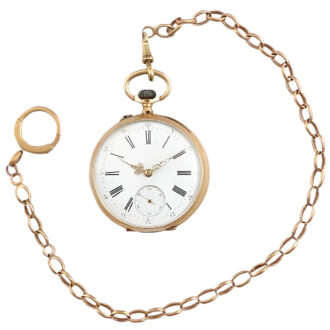
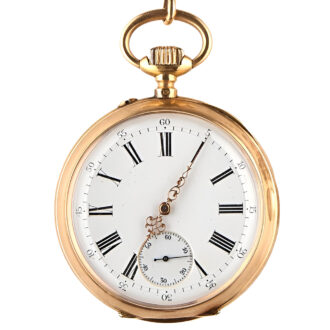
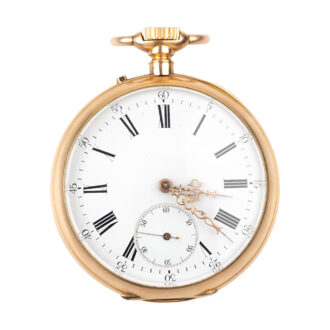
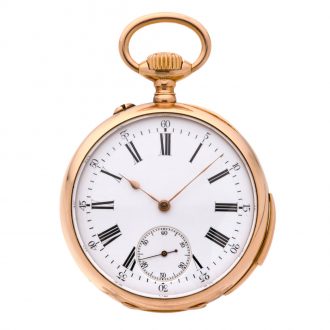
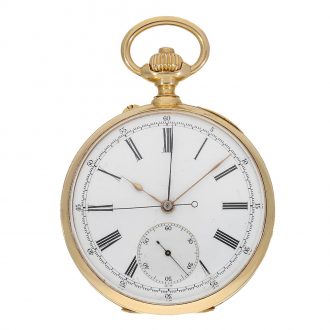
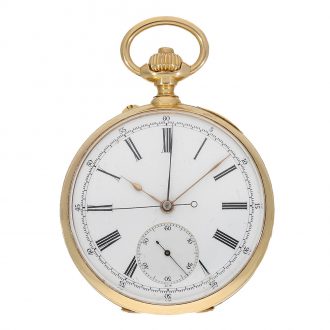
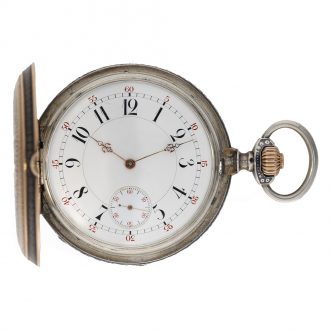
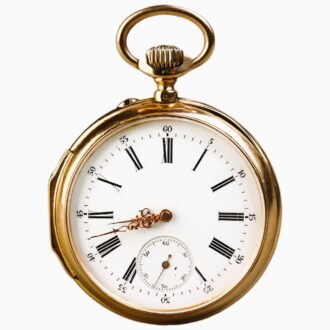
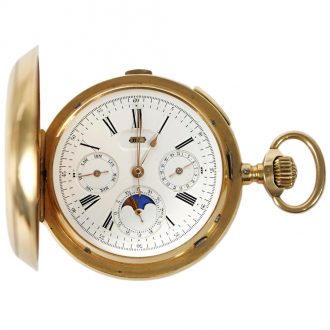
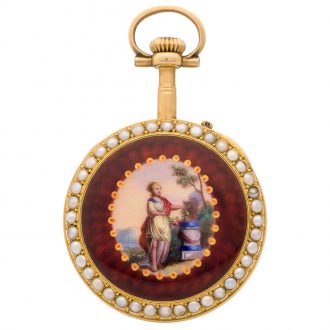
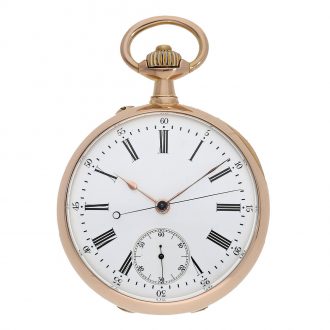
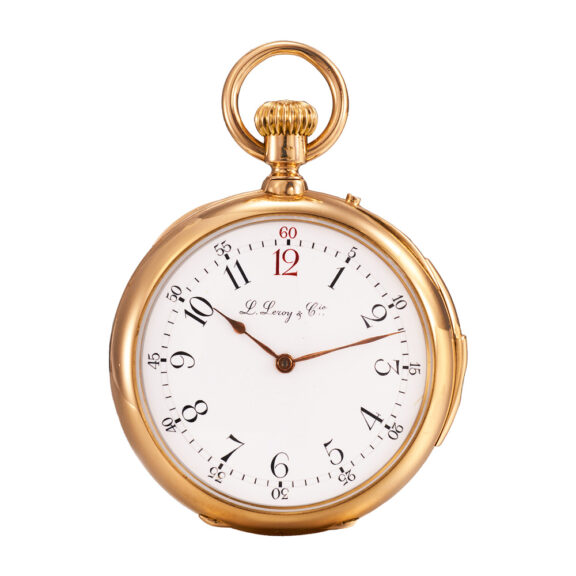
French rose gold quarter repeating lever pendant watch Circa 1890
- Kenmerk
- AA0378
- Diameter
- 39 mm
- Estimate
- € 2.500 - 5.000
- Price sold
- € 2.250
Rose gold open faced repeater by L. Leroy & Cie
–
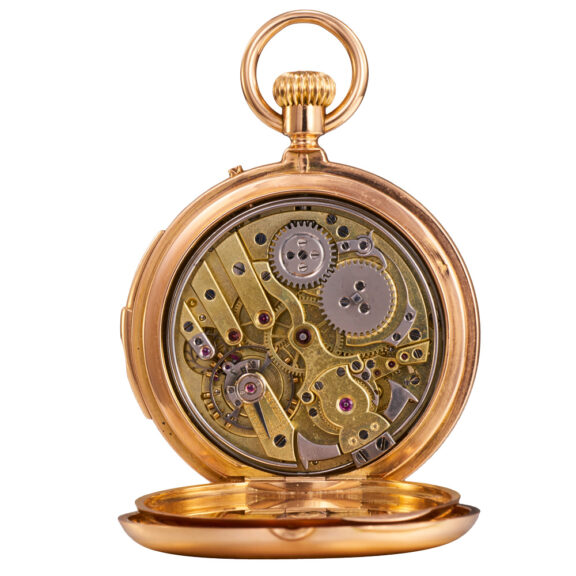
A fine, rare and small French rose gold open faced quarter repeating keyless-winding lever pocket watch, circa 1890. With one horological complication: – Quarter-repeater on two steel gongs (activated by the slide at 3 o’clock).
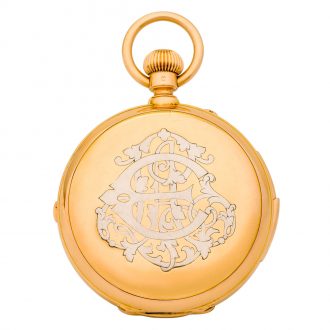
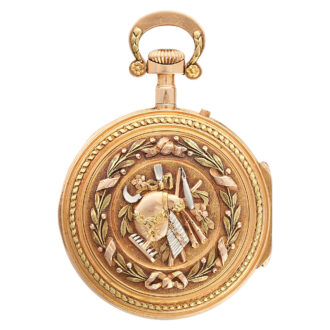
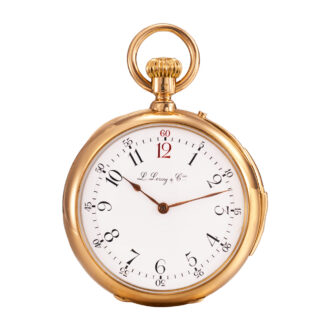
Gilded brass, rhodium plated movement, 23 jewels, going barrel, counterpoised straight-line lever escapement, cut bimetallic compensation balance, Breguet blued steel hairspring with a terminal curve, index regulator, repeating on gongs with two polished steel hammers. Round-shaped 18K pink gold polished case, back engraved in taille-douce (fine-cut) with the cypher L B., and inside case back engraved in taille-douce (fine-cut) with the name Mlle L. Barre. White enamel dial with black Arabic numerals, red 12, outer minute track and Arabic five-minute numerals, red 60, and original gold spade hands. Cuvette (dome) signed: L. Leroy & Cie Hgers de la Marine 13 & 15 Palais-Royal Paris 57 New Bond Street London. The dial of this watch is signed L. Leroy & Cie, who was the successors of Le Roy & Fils in Paris.
–
Diameter: 39 mm
–
Weight 53 g
–
Signed: L. Leroy et Cie
–
Leroy & Cie, French watch manufacture
Louis Leroy became a watchmaker at the famous Le Roy et Fils company in 1879. He took over the company with Jules Halley des Fontaines and changed the name of this company to L. Leroy & Cie. Louis’ brothers, Léon Leroy, joined him in 1895 and became business partners in 1914. In 1906 he was named Horloger de la Marine. Watch production was carried out in Besançon at 7 rue Mouillère. Director became Émile Léon Maillard-Salin . In 1901he made the Leroy 01 pocket watch. The most complicated clock of that time, with 975 parts, is now in the Zeit Museum in Besançon, Musée du Temps (Besançon). Functions: hours, minutes, seconds, time in 125 cities, day of the week, month, year, moon phases, seasons, solstices and equinoxes, the sky stood in 2 hemispheres, sunrise and sunset, grand sonnerie, chronograph. Plus, five non-clock related functions: hygrometer, thermometer, barometer, altimeter and compass. Some well-known Swiss watchmakers also worked on this watch, John César Piguet and his son Charles Émile Piguet, as well as Ulysse Capt and Marcel Capt, in l’Orient; Léon-Ernest Aubert made other parts in Le Brassus .
–
1900 Production of steel balls for journal bearings. 1904 Grand Prix at the International Exhibition in Saint-Louis. In 1908, 1910, 1922, 1923 and 1924 winner of the Besançon Chronometric Cup.
–
Leroy was already on the market in 1920 with an invention that can be seen as the forerunner of today’s fashionable >automatic<. Around 1922, his wristwatches bore the inscription: »Systems de remontage’automatique L. Leroy & Cie. 1922«. The Englishman John Harwood improved this system in 1924 and the A. Schild clock factory in Grenchen, Switzerland, was the first in the world to manufacture this type of clock.
Signed: L. Leroy & Cie
Share this page: