Important French gilded splendour coach clock Circa 1750
- Kenmerk
- AD0080
- Diameter
- 110 mm
- Estimate
- € 40.000 - 80.000
- Price sold
- € 42.200
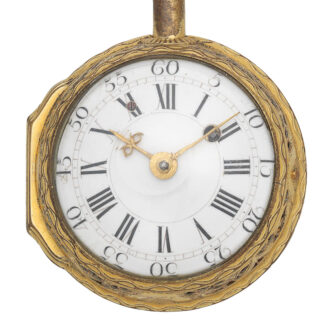
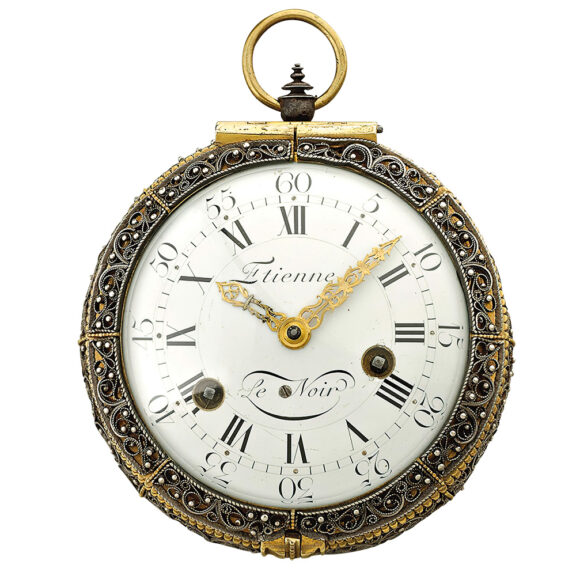
Gilt filigree coach clock with self-strike by Étienne LeNoir
–
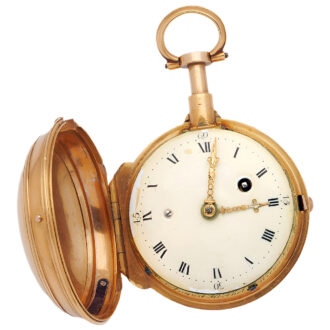
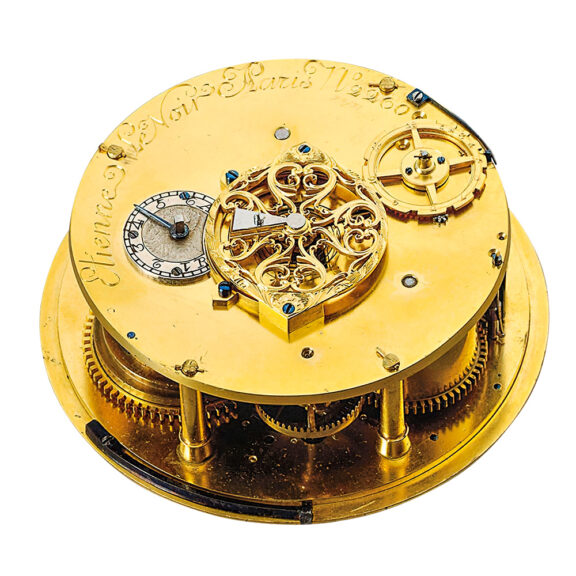
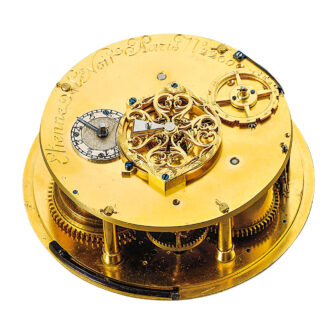
An important French gilt open faced verge splendour coach clock with hour and half-hour self-strike, circa 1750. Full plate movement with chain and fusee, 1 barrel, 1 hammer, verge escapement, count wheel and three arm brass balance.
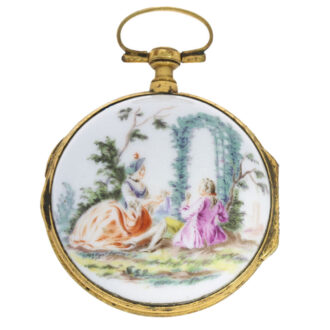
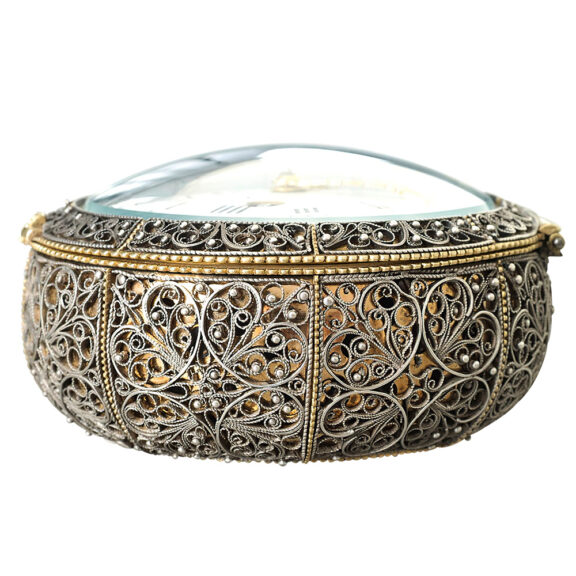
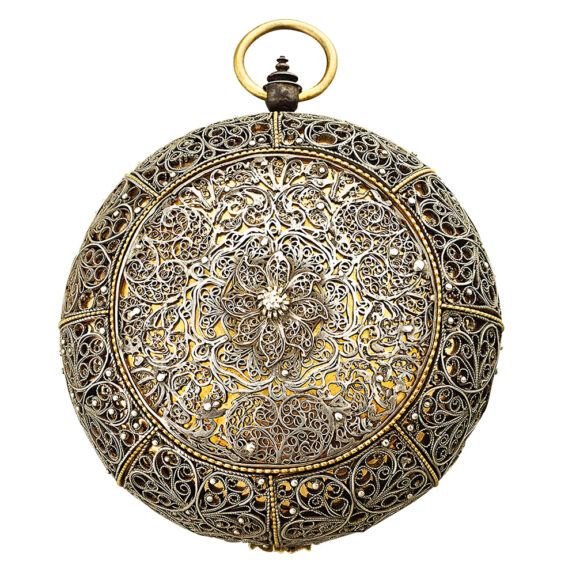
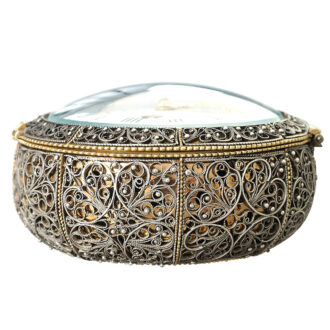
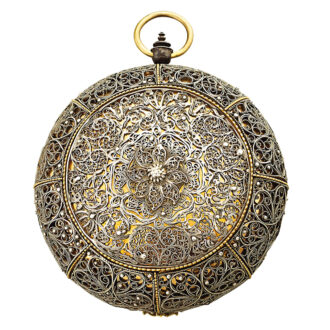
The case is intricately ornamented with silver filigree work, fine braided wires form graceful floral motifs and cover the whole surface area, the bezel and edge of the case are decorated with eight sections of gilded wire with delicate metal beads.
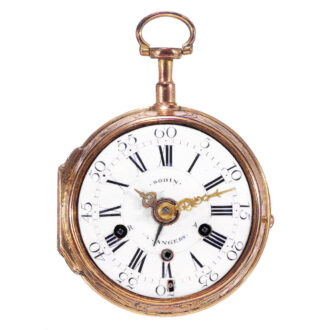
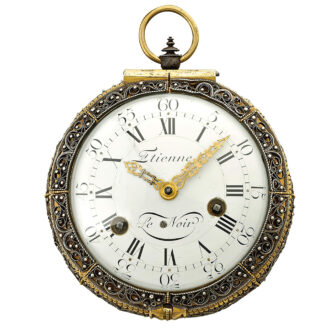
White enamel dial with Roman hours and Arabic five-minute numerals. Dial signed Coteau, Coteau is famous for his outstanding enamel and porcelain paintings, he probably created the most important and precise dials of his time.
–
Diameter: 145 mm
–
Weight: 2300 g
–
Signed: Etienne LeNoir Paris
–
Étienne LeNoir (also Lenoir or Le Noir) (1699-1778) was a French watchmaker and descendant of a watchmaking family based in Paris since the 16th century. Lenoir became a master in 1717 and was one of the most important makers of his time, he gained his reputation, not from his own inventions but from his ability to run a well-organized business that produced large numbers of timepieces of consistently high quality. His son Pierre Étienne LeNoir also signed his work with the high-profile signature of his father. The workshop existed until the 1820s. Many of Lenoir’s timepieces are today owned by important museums such as the Münchner Residenz, Schloss Wilhelmsthal in Calden, the Hermitage Museum in St. Petersburg and the J. Paul Getty Museum in Malibu.
–
Jean Coteau (also Cotau) (1739-1812) was born in 1739 in Geneva and received his title of “maître peintre-émailleur” from the Académie de Saint-Luc in Geneva. He devoted himself to allegoric illustrations but also painted portraits (he also brought Elisa Bonaparte to canvas). In the late 1760s, Coteau moved to Paris and opened a studio in the Rue Poupée. He soon had a reputation as an exceptional enamel and porcelain painter who most likely created the most important and intricate dials of his time. He developed a new and complicated process of creating ornaments with coloured pearls on small gold plates as well as a method enabling him to paint with gold alloys on a translucid royal blue background, which created a vivid and almost relief-like effect. The arts encyclopedia even mentions the “Coteau Email”. Hence it is not surprising that he also worked for the royal Manufacture de Sèvres from 1780 to 1784.
Signed: Etienne LeNoir Paris
Share this page: