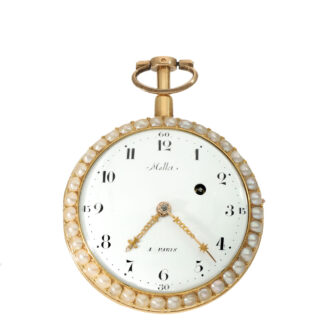
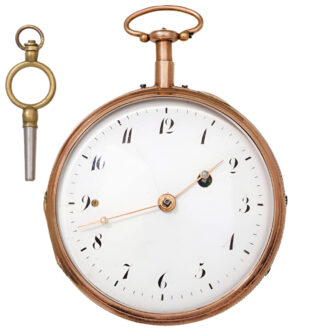
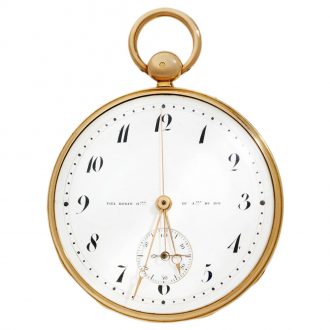
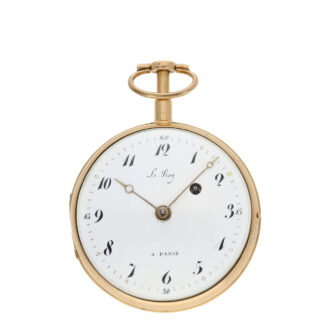
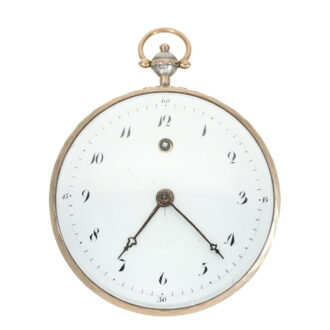
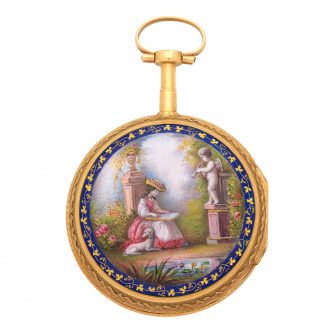
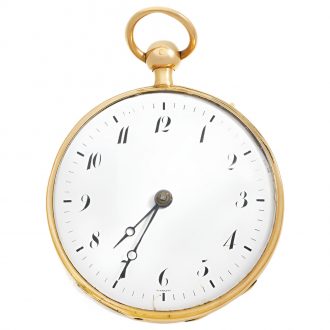
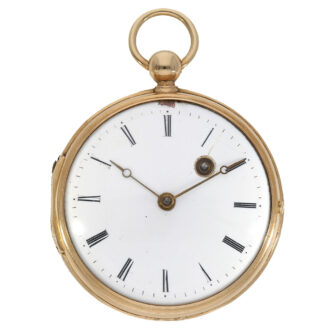
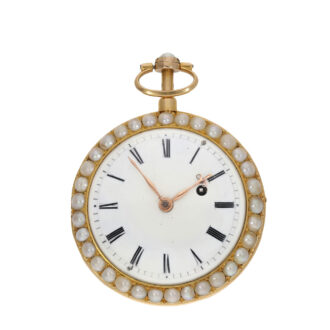
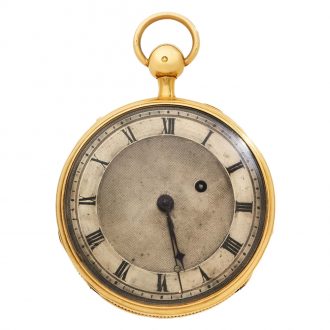
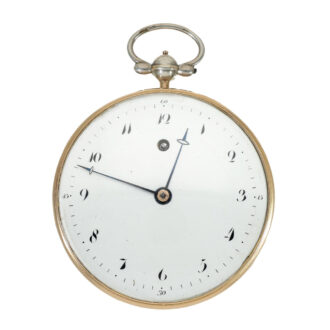
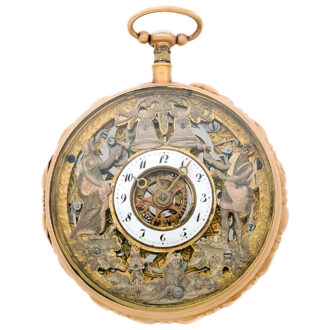
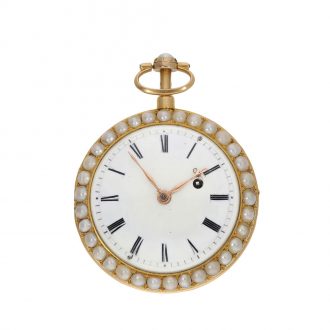
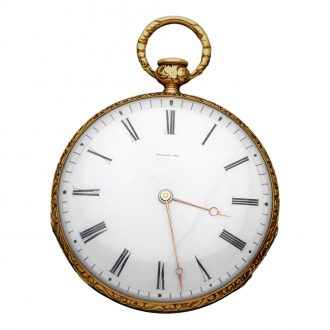
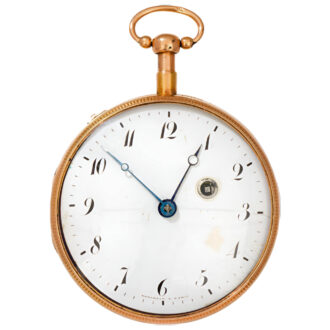
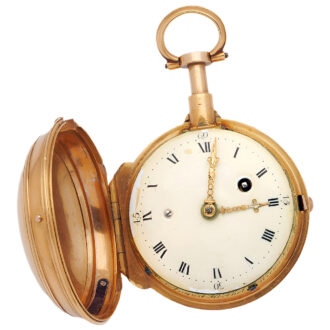
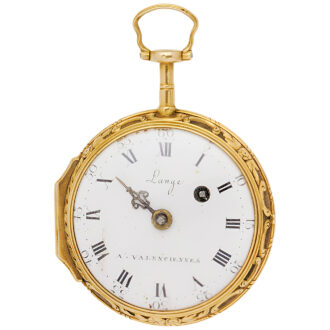
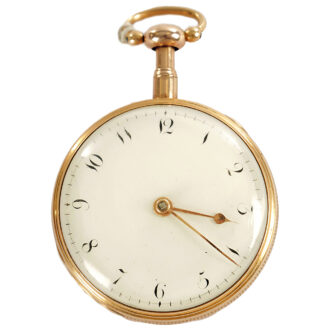
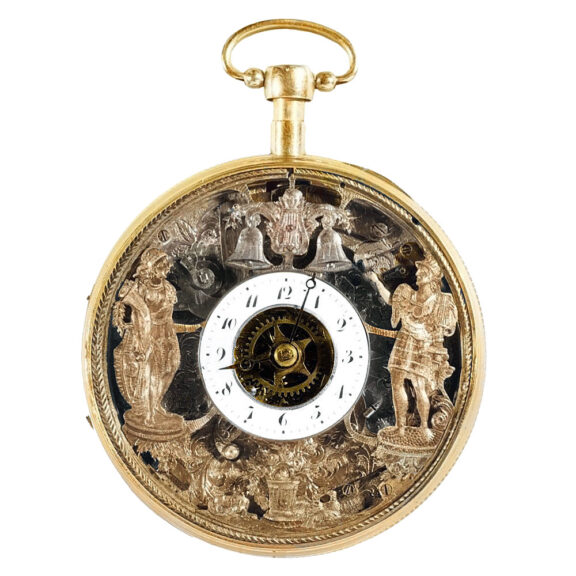
French verge watch with Jacquemart figure automaton Circa 1800
- Kenmerk
- AM0213
- Diameter
- 54 mm
- Estimate
- € 4.500 - 9.000
- Price sold
- -
Repeating skeletonized pocket watch by Ferdinand Berthoud
–
A fine French 18K gold quarter repeating pocket watch with a skeletonized Jacquemart figures automaton, circa 1800. This exquisite Berthoud à Paris watch features a verge movement and a quarter-hour repeater. The face showcases a stunning skeletonized figure automaton with a view of the striking mechanism. The white enamelled numeral ring with Breguet-style radial hours, outer minutes track, and Breguet hands provide a classic and timeless look. The 18K gold engine-turned case with a coined band complements the watch. The watch is signed on both the works and case, ensuring its authenticity. The marking includes K 18 and EC incuse, located inside the case and on the handle.
–
Diameter: 54 mm
–
Signed: Berthoud à Paris
–
Ferdinand Berthoud was born on March 19, 1727, in Plancemont near Neuchâtel, Switzerland. His father, Jean Berthoud, was a bricklayer, carpenter, architect, and lawyer. He had three brothers who worked as watchmakers: Jean Henry Berthoud, Jean Jacques Berthoud, and Pierre Berthoud.
–
Berthoud’s apprenticeship began at the age of fourteen with his brother Jean Henry, who was already working as a watchmaker in Couvet. He remained there for four years until he went to Paris in April 1745. His start in the French capital was made easier because his brother Jean-Jacques had been living there since 1742.
–
Berthoud in Paris
Through his work, Ferdinand Berthoud attracted the attention of Julien Le Roy, with whom he later collaborated for a long time. Around 1745, he opened a studio on Rue Harlay. From 1756, he specialized in the construction of precision clocks and, around 1771, independently developed the chronometer escapement with a rocker and spring winding mechanism. Abraham Louis Breguet probably also worked for him. In 1764, he was appointed Horloger de la Marine Royale because of his marine chronometers, including his early marine watches no.3 and no.6. Ferdinand Berthoud was commissioned by King Louis XV in 1763 and 1766 to discover the mysteries of Harrison’s H4. Harrison was also a singular inventor, but unlike Berthoud, he was not at all inclined to share his discoveries with others. However, one must not forget the nerve-wracking arguments Harrison had to fight out with the “Board of Longitude”. Nevertheless, Berthoud’s first trip to England was not entirely successful, for Harrison permitted his H1, H2, and H3 watches to be examined but kept his H4, which formed the basis for his prize money from the Longitude Commission, which was ultimately approved under lock and key. Only on a second trip to London in 1766, which brought him together with Thomas Mudge, among others, was he able to collect further information about this work, which also influenced his own developments. He received from Louis XV and his Minister of the Navy, César Gabriel de Choiseul-Chevigny – whose family name is actually the origin of the Praline known today – the official order to build clocks equivalent to the English ones. Berthoud’s main merit is not only the construction and development of the French marine chronometer but also his grandiose textbooks on watchmaking (including Traité des horloges marines, Essai sur l’horlogerie, De la mesure du temps, Traité des montres à longitudes) and production of a large number of fascinating large and small clocks, among which are exactly 21 weight-driven ship’s chronometers. In 1770, he was promoted to Horloger mécanicien du Roi et de la Marine (Clockmaker to the King and the Navy). He later became a member of the Institut de France and the Royal Society. On July 17, 1804, he was made a Knight of the Legion of Honour.
–
Ferdinand Berthoud was married twice: first to Elisabeth-Henriette Chatry de la Fosse and later to Marie-Adélaïde Dumoustier. Marie-Adélaïde Dumoustier was a daughter of Gabriel-Etienne-René Dumoustier (1730-1802), an uncle of Elisabeth-Henriette Chatry de la Fosse.
Signed: Berthoud à Paris
Share this page: