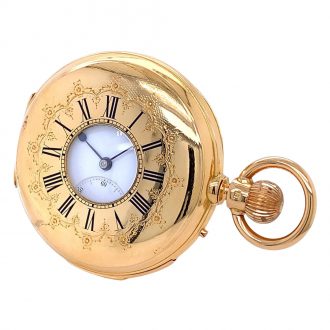
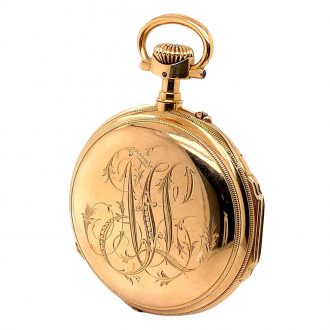
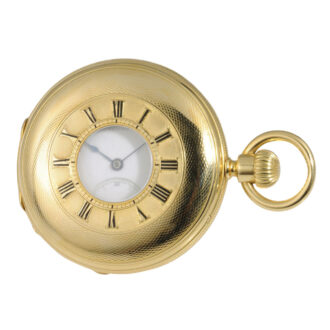
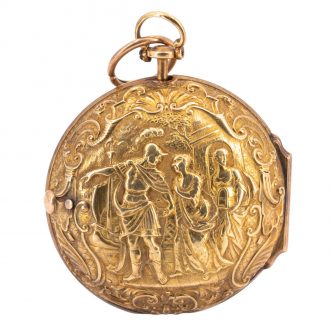
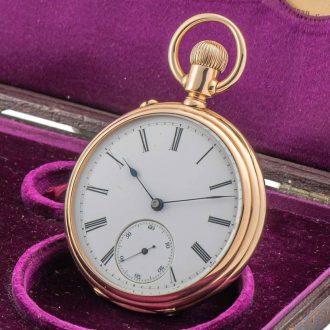
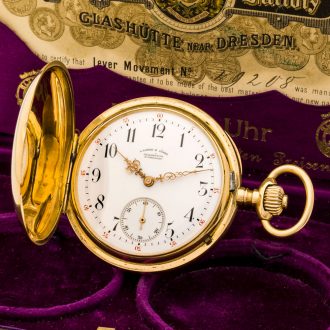
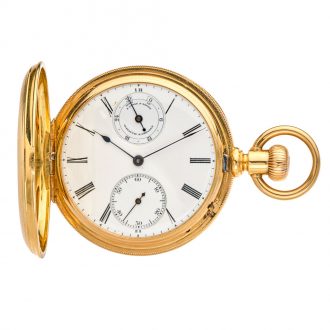
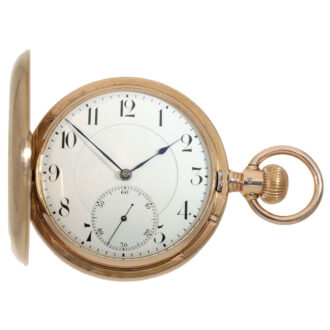
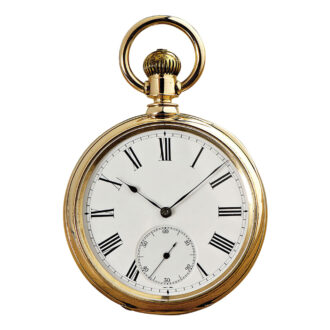
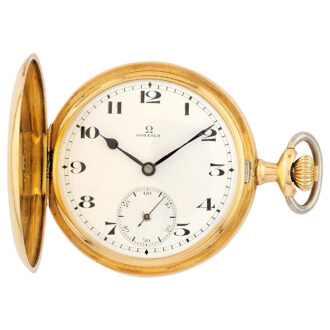
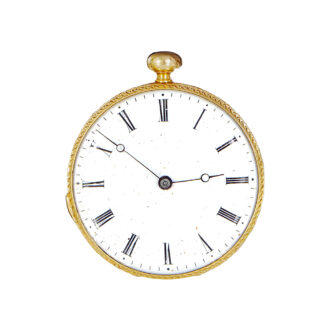
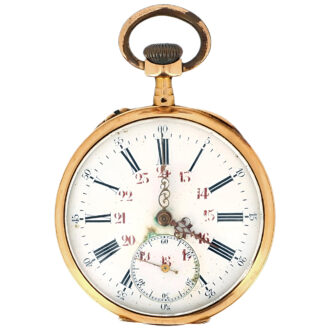
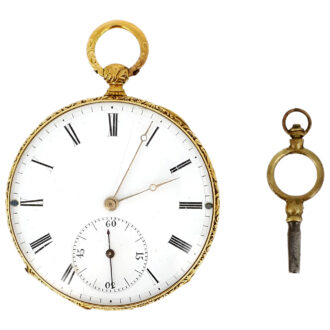
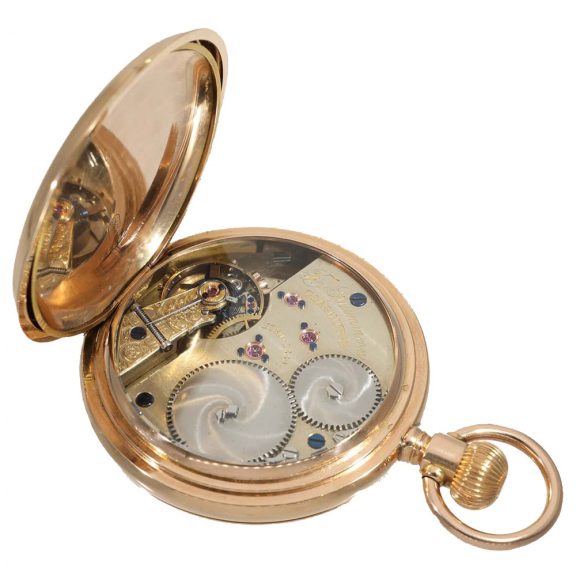
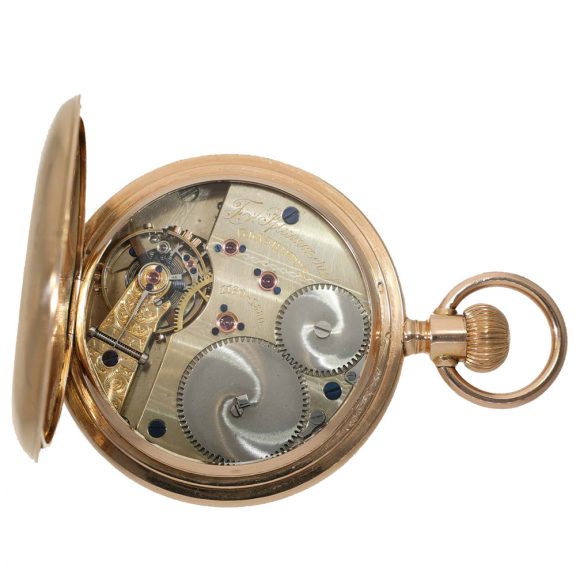
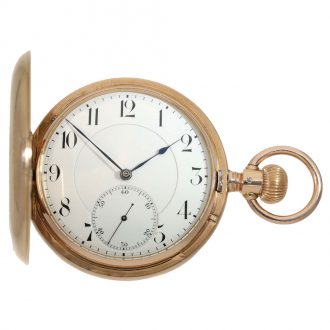
German 18K gold hunting cased quality 1A pocket watch Circa 1880
- Kenmerk
- HC1783
- Diameter
- 54 mm
- Estimate
- € 8.000 - 16.000
- Price sold
- € 12.400
Gold early Glashütte watchmaking school pocket chronometer
–
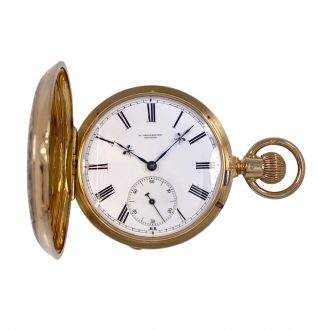
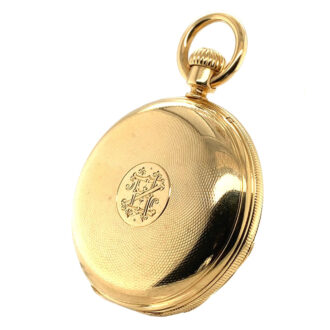
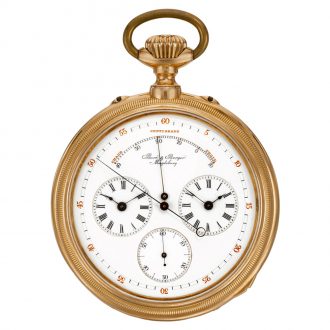
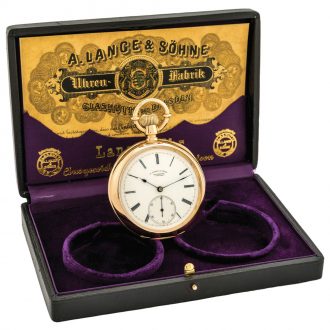
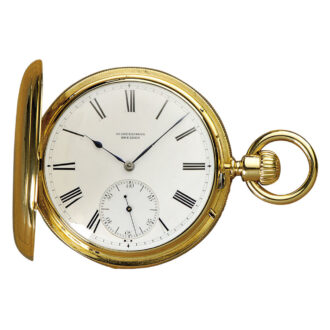
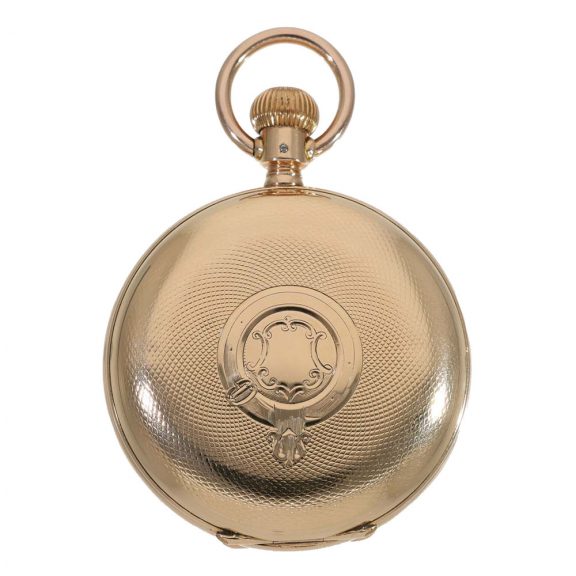
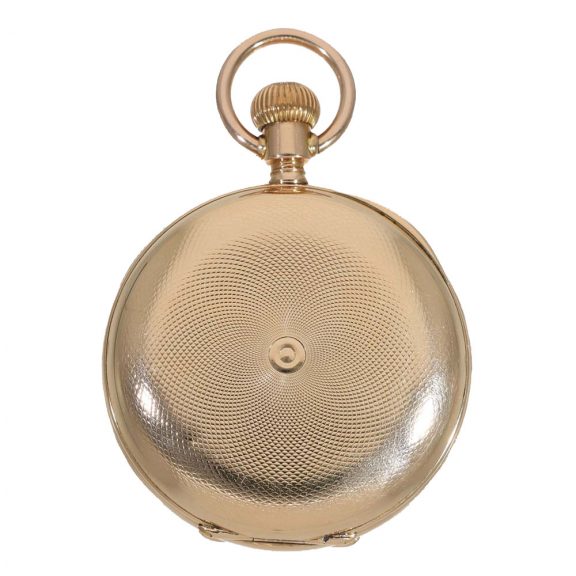
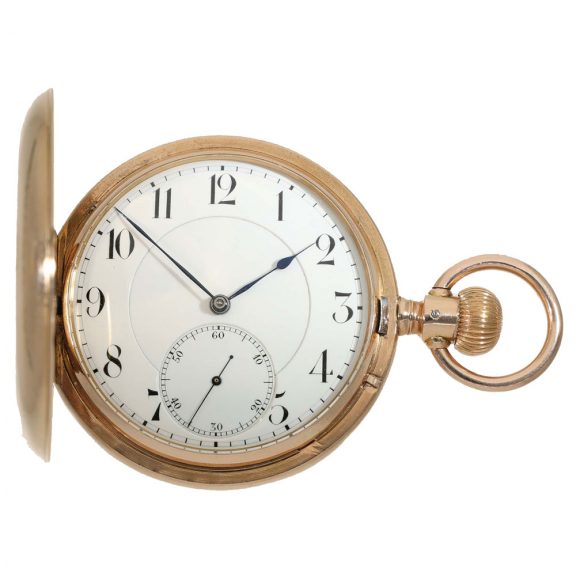
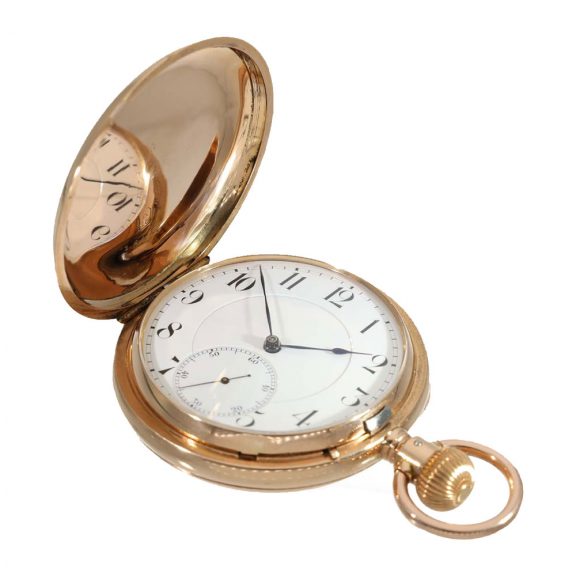
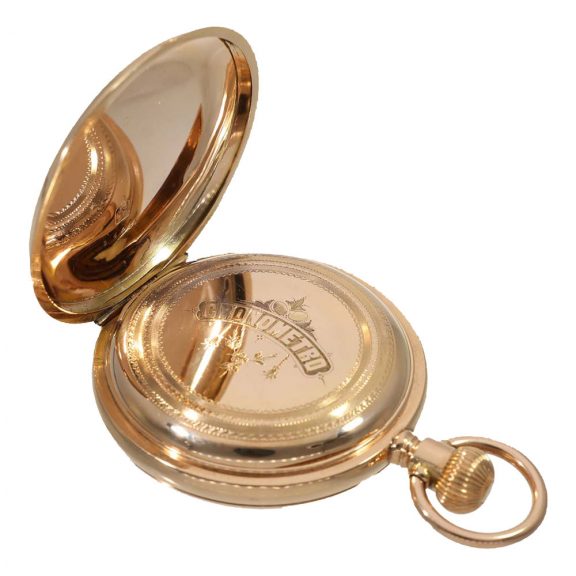
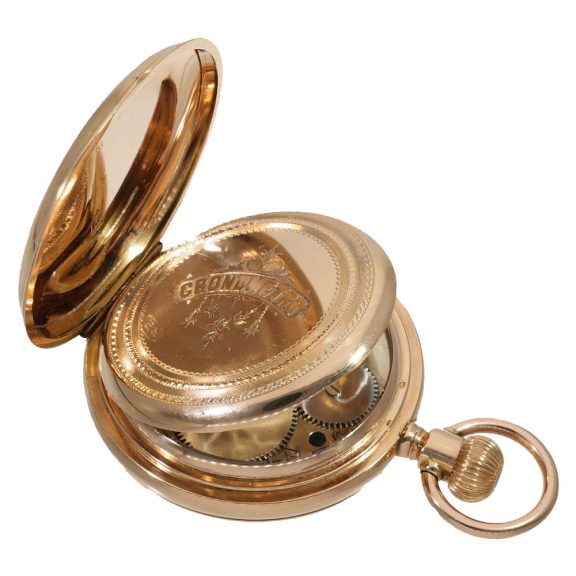
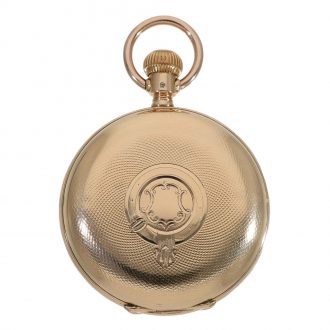
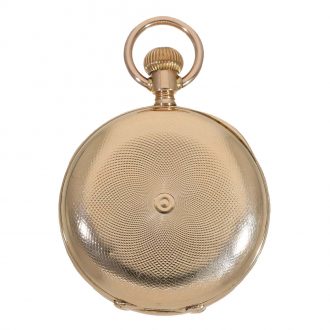
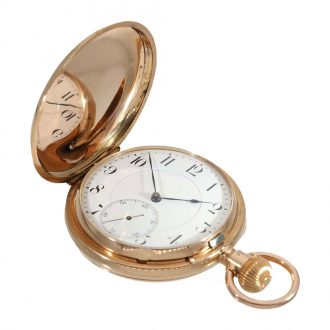
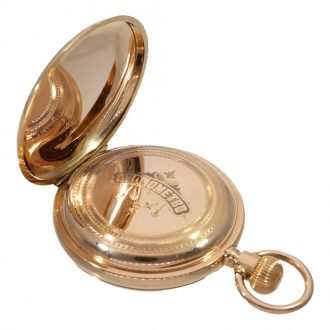
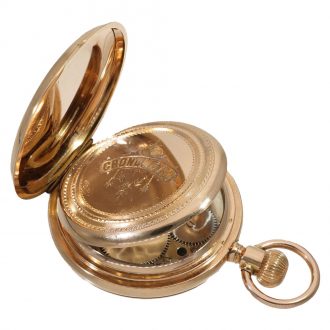
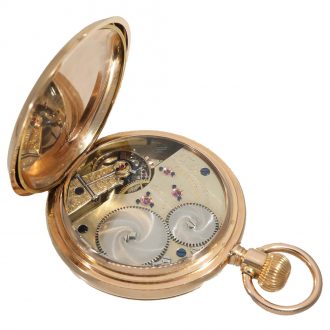
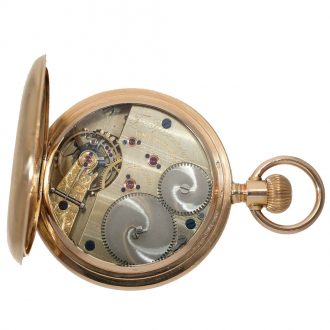
One of the earliest pocket chronometers from the Glashütte watchmaking school in Germany, made by Ferdinand von Pflummern, circa 1880. The full hunter case of this watch was crafted from 18 carat gold, has a cuvette engraved Chronometro, is engine turned on both sides and has a vacant cartouche on the back lid. The white enamel dial features Arabic hour numerals, an outer minute track, a subsidiary seconds dial at 6 o’clock and blued steel spade hands. The glazed quality 1A movement is numbered, fitted with a lever escapement, a Grossmann rocker, Grossmann fusee and screwed gold chatons.
The movement is signed
–
Diameter: 53.5 mm
–
Weight: 110 g
–
Signed: F. v. Pflummern Glashütte
–
Only about 15 pocket chronometers were made at the Glashütte watchmaking school. This example from 1880 is one of the earliest surviving pocket chronometers. After testing, it was probably intended for sale to South America, hence the Spanish name ‘Chronometro’.
–
Glashütte Watchmaking School
The Glashütte Watchmaking School was founded in 1878 by Moritz Grossmann to codify watchmaking procedures, train skilled craftsmen and sustain the burgeoning local watch industry in Glashütte, Germany.
–
Foundation and early history
Establishment: The Deutsche Uhrmacherschule Glashütte (German School of Watchmaking in Glashütte) was established in 1878 at the initiative of prominent local watchmaker Moritz Grossmann, who also served as the first chairman of its board of trustees.
Purpose: The school’s mission was to ensure a continuous supply of highly qualified staff for the town’s growing watchmaking industry, which had been initiated by Ferdinand Adolph Lange in 1845. This was crucial for establishing Glashütte as a hub of expertise and a world renowned synonym for high quality watches.
Curriculum & reputation: The institution codified procedures, tools and measurements, and quickly gained an international reputation, attracting students from around the world. Graduates proudly wore the title “Graduate of the German Watchmaking School Glashütte”.
Key figures: Ludwig Strasser, famous for precision pendulum clocks, became the school’s director in 1885 and held the position for 32 years, playing a key role in shaping the institution. Alfred Helwig, an esteemed watchmaker who invented the flying tourbillon in 1920, was a student and later a technical instructor at the school for 41 years, training over 800 apprentices.
–
20th Century and rebirth
Mid century Turmoil: The school and the Glashütte watch industry faced significant challenges during World War I, the subsequent depression and World War II, during which the town was heavily bombed. After the war, the remaining watch companies were merged into a single state owned enterprise in 1951, the VEB Glashütter Uhrenbetriebe (GUB), under the East German communist regime.
Post reunification: Following German reunification in 1990 and the return to a market economy, the GUB was privatized. The company was eventually renamed Glashütte Original in 1994, which sought to revive the traditional craftsmanship and in-house manufacturing that defined the town’s watchmaking heritage.
–
Modern era
Alfred Helwig School of Watchmaking: To preserve the expertise and ensure future talent, Glashütte Original founded its own modern watchmaking school in 2002, named the Alfred Helwig School of Watchmaking in honor of the famous master.
Location and affiliation: Since 2008, the school has been housed in the same historic building that the original German School of Watchmaking occupied, which also hosts the German Watch Museum Glashütte. The school is affiliated with the Swatch Group (which acquired Glashütte Original in 2000) and offers WOSTEP certification, continuing to train new generations of watch and toolmakers.
Signed: F. v. Pflummern Glashütte
Share this page: