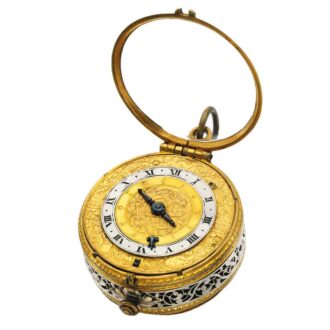
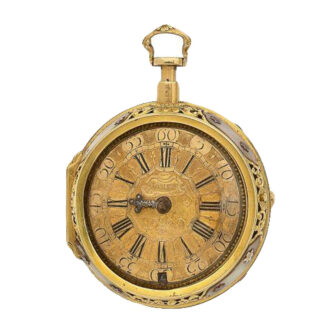
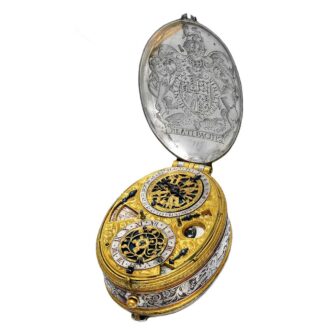
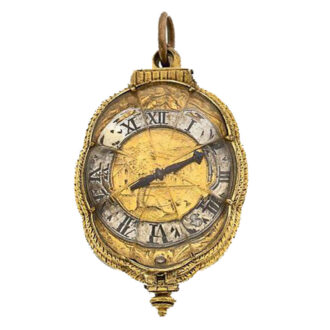
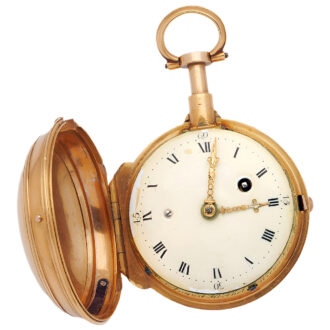
German experimental pocket watch with center Circa 1785
- Kenmerk
- HC0721
- Diameter
- 54 mm
- Estimate
- € 3.250 - 6.000
- Price sold
- € 4.200
Extremely rare silver open faced pocket watch
–
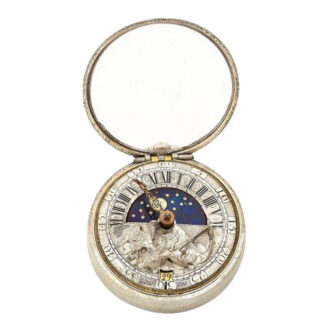
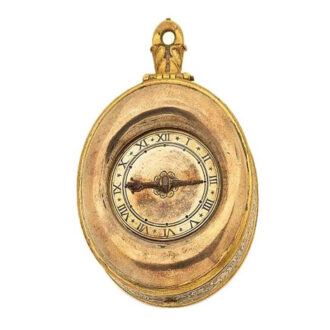
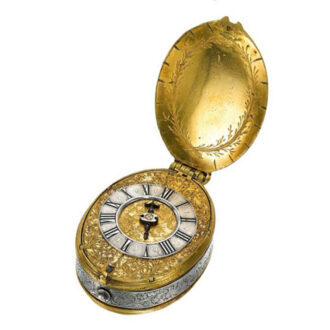
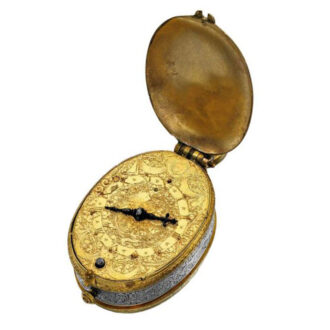
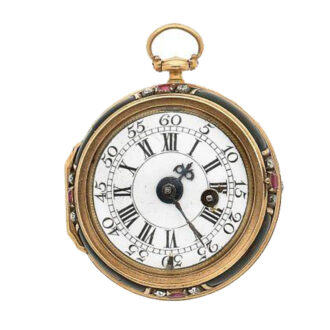
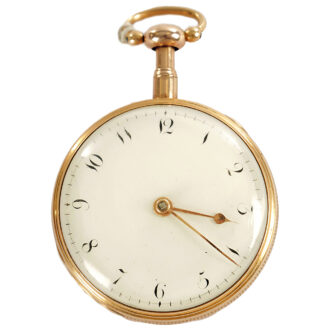
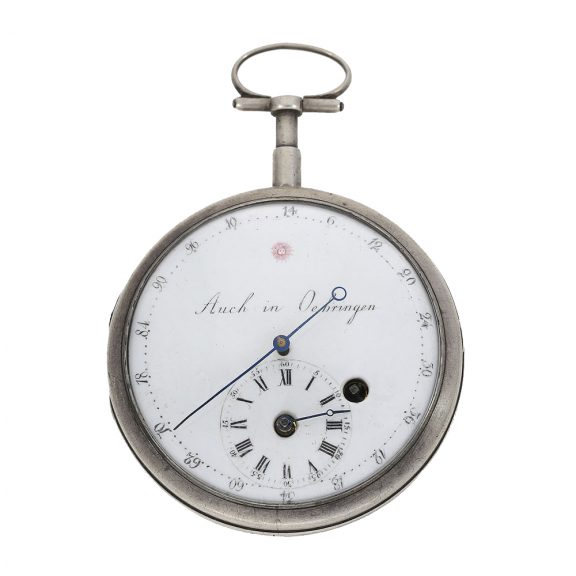
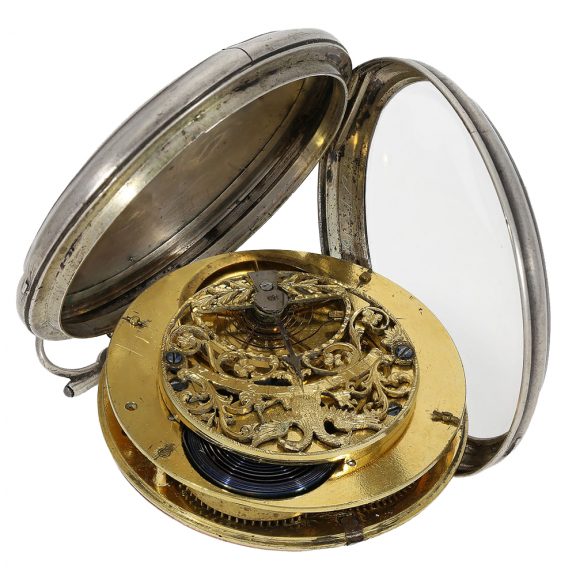
An extremely rare, experimental pocket watch with center seconds, made by the Hahn student Jakob Auch in Oehringen, Bade-Würtemberg, Germany, circa 1785. The open faced plain case of this experimental watch is crafted from silver and has an, extremely unusual enamel dial with decentral time indication at six o’clock with Arabic minute numerals, Roman hour numerals and a steel hour hand, the outer ring center seconds has an extremely rare scale and a steel hand. The mmovement has a highly interesting cylinder escapement with an especially large balance and movement construction in the manner of Philipp Matthäus Hahn in Echterdingen.
Dial signed.
–
Diameter: 54 mm
–
Weight: 89 g
–
Signed: Auch in Oehringen
–
The dial of this watch was professionally restored but the minute hand is missing and the movement starts ticking but needs service (cleaning).
–
Jakob Auch
Jakob Auch was born in Echterdingen on February 22, 1765 and died in Weimar on March 20, 1842. He lived in Echterdingen until 1787 and later in Vaihingen and Seeberg before moving to Weimar in 1798 to become engineer to the court. Auch was one of the most able pupils of Philipp Matthäus Hahn and created many pocket watches in the style of his famous master. He probably took his son Louis (Ludwig) into his business before 1800. One of the pocket watch is signed “J. Auch und Sohn, Weimar” (J. Auch and Son, Weimar).
–
Philipp Matthäus Hahn
Philipp Matthäus Hahn was born on November 25th, 1739 in Scharnhausen and he died on May 2nd, 1790 in Echterdingen. He was a German avid protestant clergyman, astronomer, inventor and minister of the parishes Onstmettingen, Kornwestheim and Echterdingen, but also one of the most eminent precision mechanics and watch and clockmakers of the 18th century. Hahn produced a large number of high quality pocket watches, most of them with calendar and moon phase indications. He made calendar movements of exceptional mechanical quality and attractive design. He also made hall clocks as well as astronomical bracket clocks. In about 1763 he devised a precision sundial or helio chronometer that incorporated the correction for the equation of time. Today his large observatory clock is one of the highlights of the clock museum in Furtwangen. Hahn was the first maker in Germany to use the cylinder escapement in his pocket watches. He further was very interested in the production of calculators and scales, in 1774 he designed one of the earliest mechanical calculators and laid the foundation for Württemberg’s industry of weighing machines, which still enjoys an international reputation today. His sons continued his work and signed their watches and clocks with the signature Hahn Hofmechanikus Stuttgart. Along with his sons Christoph Matthäus, Johann Georg, Christian Gottfried and Immanuel, Hahn’s brothers Georg David Polykarp and Egidius Stephanius Gottfried also worked temporarily in his workshop. The most notable makers in Hahn’s group were Jacob Auch, Georg Matthäus Burger, Georg Joseph Sandra, Philipp Gottfried Schaudt, Johann Gottfried Ewald Sechting, Mauritius Steiner and Christoph Friedrich Strubel.
Signed: Auch in Oehringen
Share this page: