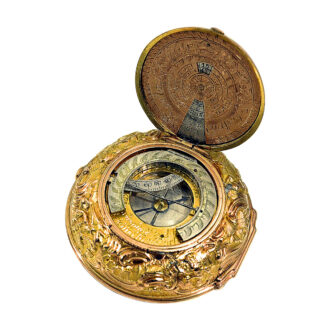
Austrian important repoussé verge pocket watch Circa 1750
- Kenmerk
- AD0076
- Diameter
- 50 mm
- Estimate
- € 70.000 - 130.000
- Price sold
- € 74.400
Two-tone gold astronomical verge repoussé watch
–
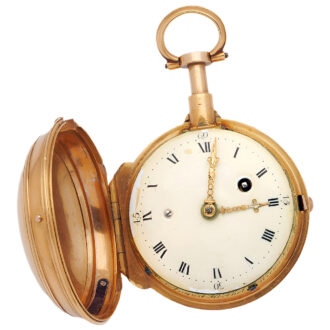
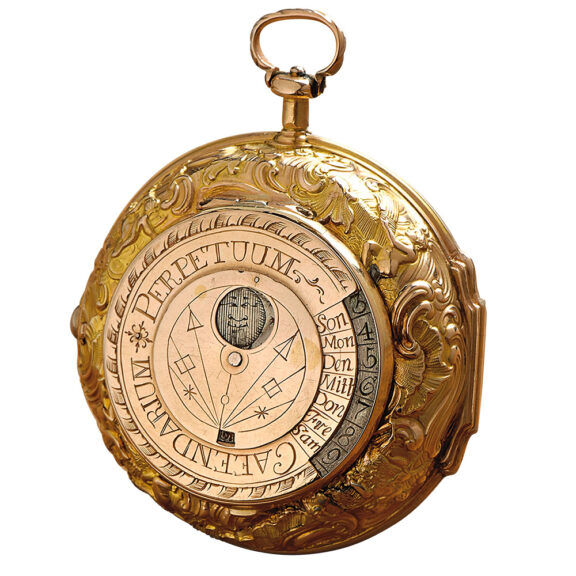
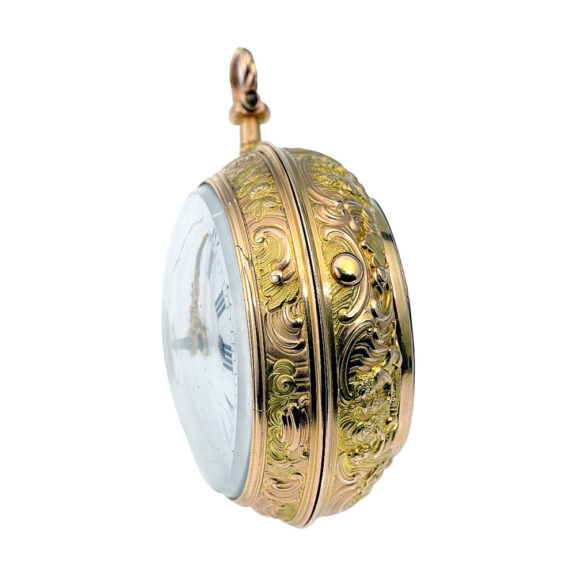
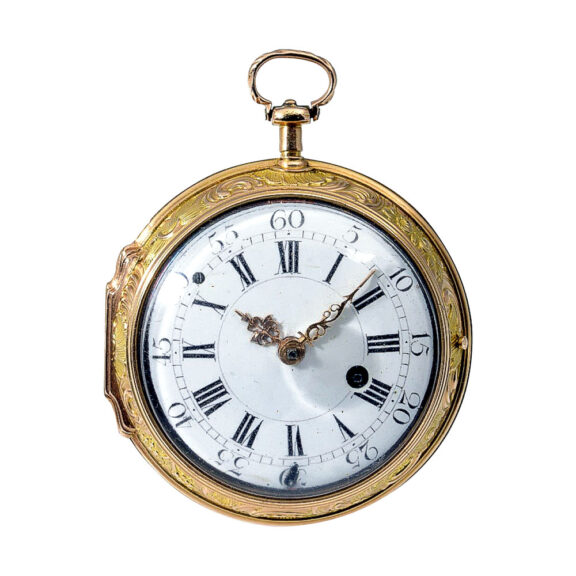
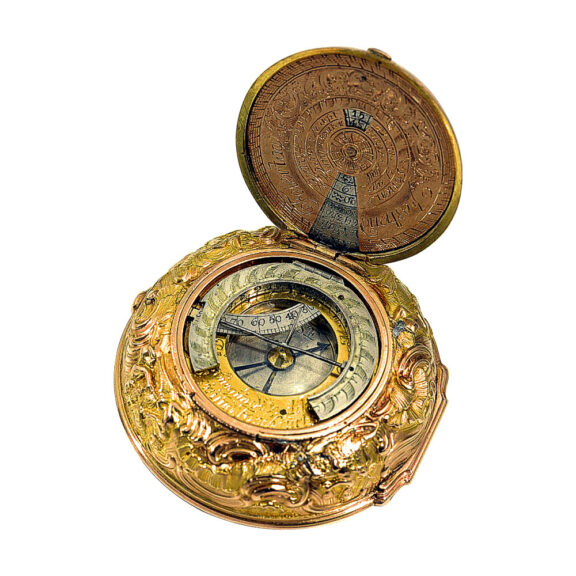
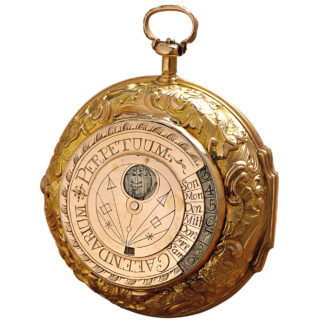
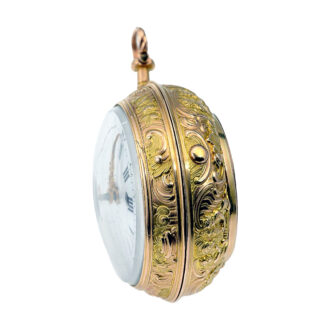
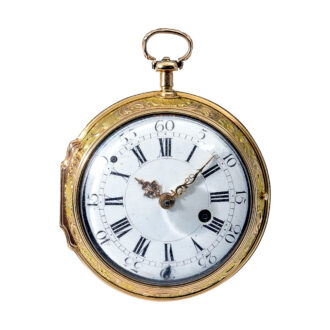
An important Austrian two-tone gold astronomical verge repoussé pocket watch with manual perpetual calendar, temporal scales Calendarium Perpetuum and detachable universal equinoctial sundial, circa 1750. Full plate movement, chain/fusee, three arm brass balance, fine florally engraved and pierced balance bridge. White enamel dial. Repoussé case from the Baroque period, hinged gold lid to the back with a fitted, revolving disc inscribed Calendarium Perpetuum, the gold disc with planetary aspect scale has a window for the moon phases and moon age as well as a curved cut out segment for the date in combination with the days of the week, the interior has a rotating gold disk engraved with foliage on a hatched ground and adjusted to indicate the following information apertures on an engraved silvered disk: month with number of days, Fest und Feiertag (relevant festival and saints days), Sonenlauff (sun’s position in the zodiac), Leng Tag Leng Nacht (length of day/night), Gang Auff Gang Unter (time of sunrise/sunset), these are displayed in two apertures tapering in the middle that reveal the relevant data. Hinged case lid has a container with a detachable miniature equinoctial sundial (diameter 29 mm) with engraved city names to the back, applied hour ring with Arabic numerals and a compass behind glass.
–
Diameter: 50 mm
–
Weight: 109 g
–
Signed: Joseph Antoni Beringer Salzburg
–
A sundial to a pocket watch was occasionally added in both France and Germany, particularly in the late 16th and early 17th centuries. However, these were of simple form, engraved within the back or front cover with a fixed gnomon and usually without a compass for correct orientation.
–
Only one other example of a true universal equinoctial sundial contained within a watch is known to exist, a silver cased watch signed Nicolaus Delle, Augsburg, also dating from circa 1750 (sold at Antiquorum, Geneva, 2 April 2000, lot 376 for the sum of SFR 55.000). The Delle dial is affixed to the removable cuvette of the watch movement and not free standing.
–
According to Jürgen Abeler’s records, Joseph Anton Beringer was watchmaker to the court and lived and worked in Salzburg in the early 18th century. In 1742 he married the daughter of maker to the court Franz Jakob Niedermayer and became a master in 1743. This timepiece is described in Jürgen Abeler’s index of watch- and clockmakers and was part of the famous Greppin collection, which was auctioned in 1975 by Koller in Zurich over several days.
Signed: Joseph Antoni Beringer Salzburg
Share this page: