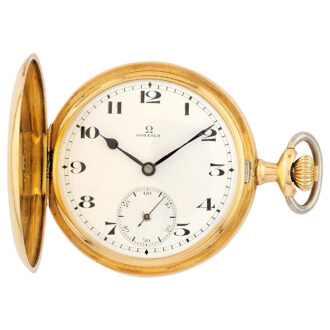
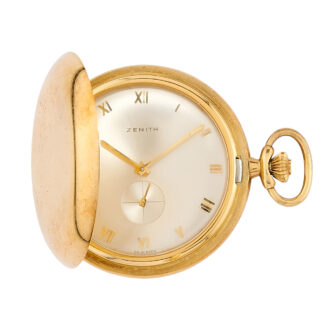
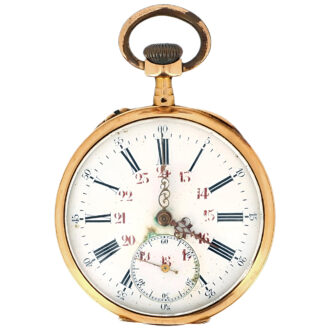
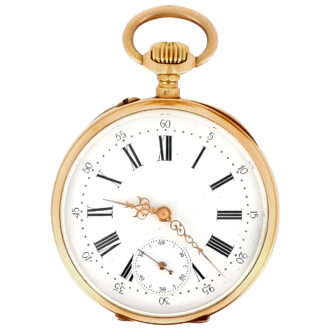
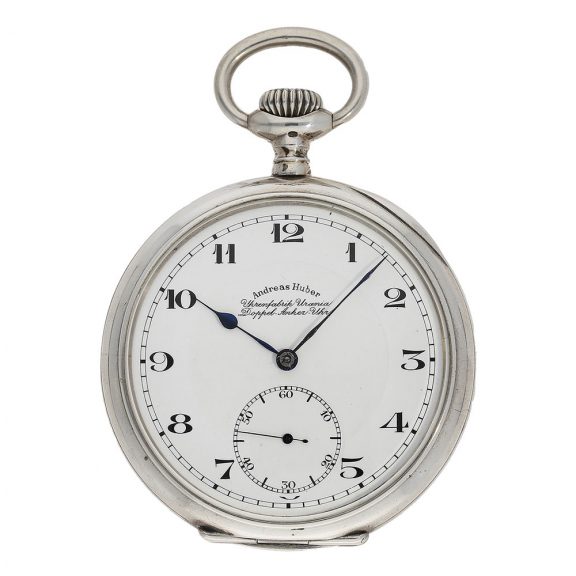
German Urania clock factory double anchor clock Circa 1915
- Kenmerk
- HC0528
- Diameter
- 52 mm
- Estimate
- € 3.500 - 7.000
- Price sold
- € 4.455
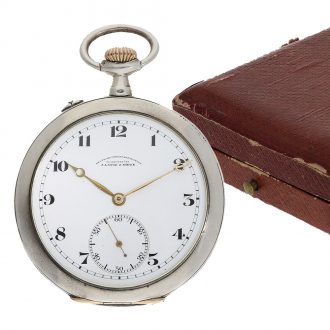
Absolute rarity in original signed box
–
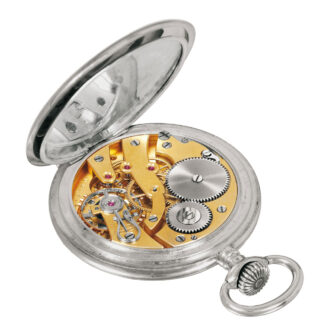
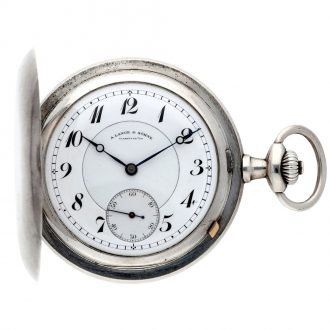
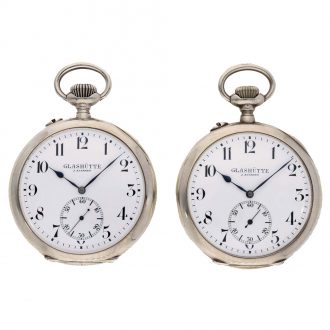
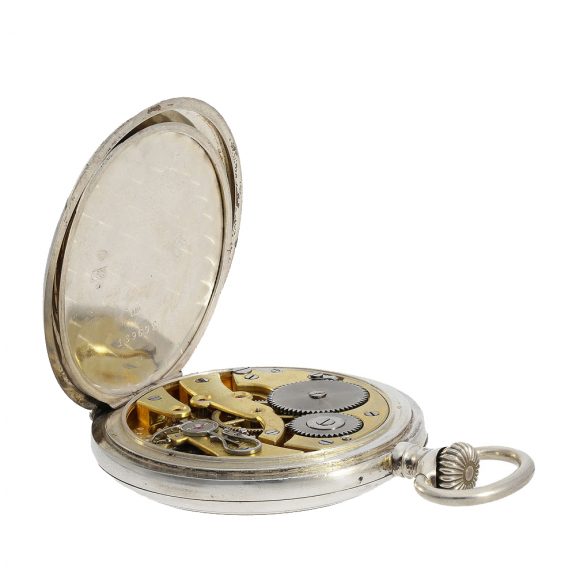
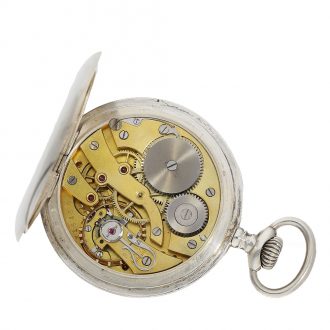
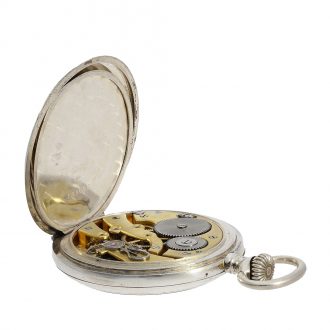
A remarkable timepiece, the “double anchor clock” crafted by Andreas Huber in the renowned Urania “Hof Uhrenfabrik” (official watch factory of the court), based in München, Germany, circa 1915, this particular clock is one of only five known to exist. What sets it apart even further is the presence of its original box.
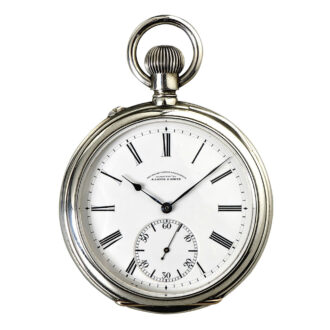
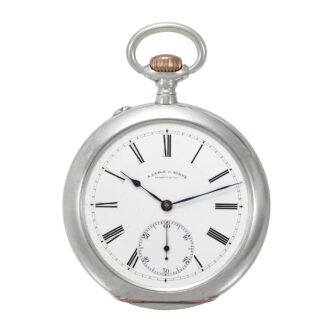
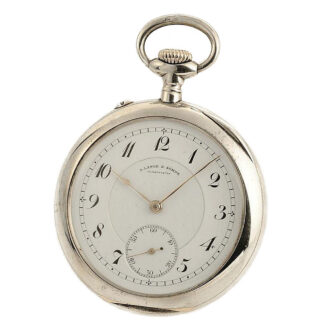
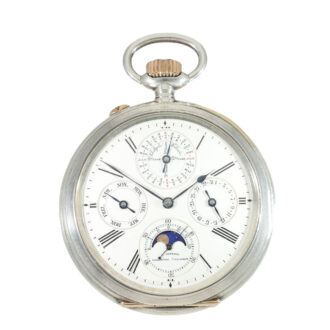
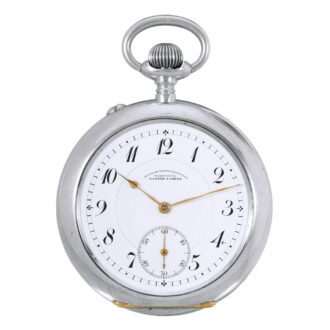
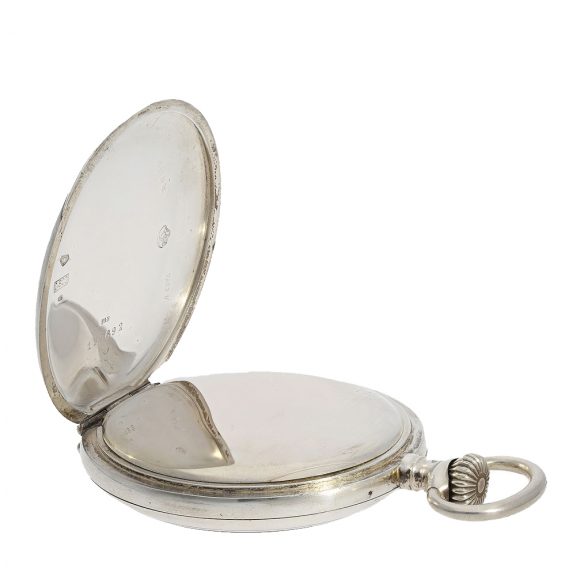
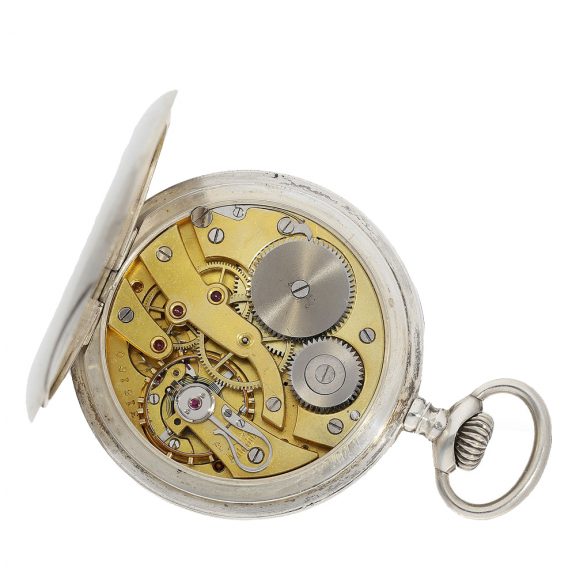
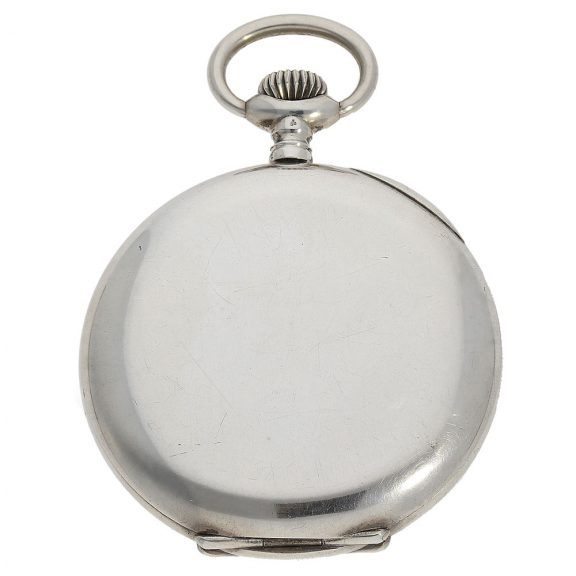
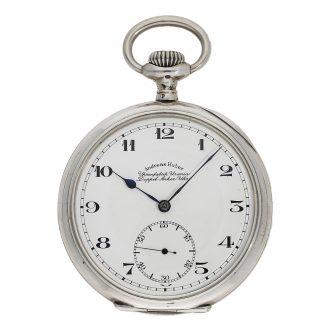
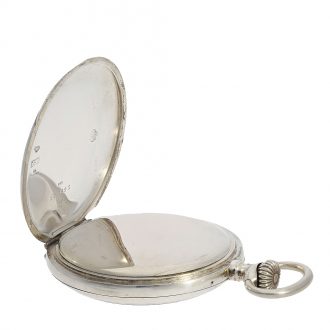
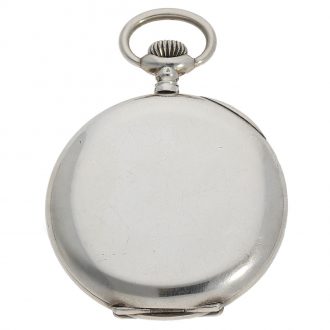
Encased in a simple yet elegant open faced silver case, this double anchor clock bears the serial number 139692. Its white enamel dial features Arabic numerals encircling the outer ring, indicating the hours with precision. At the 6 o’clock position, a subsidiary dial showcases the seconds, while blued steel hands gracefully sweep across the face, marking the passage of time. The movement incorporates a precision “double anchor” escapement. This ingenious mechanism, patented by Louis Wille under # 68208, ensures unparalleled accuracy and reliability. The movement also boasts a fine adjustment feature, allowing for precise calibration. Engraved with the works number 315150, this exceptional movement exemplifies the craftsmanship and attention to detail characteristic of the Urania “Hof Uhrenfabrik”.
Both the dial and the original box bear the signature of the master horologist.
–
Diameter: 52 mm
–
Weight: 88 g
–
Signed: Andreas Huber, Uhrenfabrik Urania, Doppel-Anker-Uhr
–
Andreas Huber
Andreas Huber was a Munich watch shop and a watch manufacturer, named after the founder and after his grandson of the same name. On October 13, 1856, Andreas Huber founded, after he had just received a legacy of 3,000 Florins, with this money a watch shop in Munich in the Roeckl house on Karlsplatz (Stachus) number four. The day before, he had married his childhood sweetheart, Xaviera, who in the following years became an indispensable employee of his company. Because she skillfully builds new business relationships with the major clientele of nobility and upper classes. The Bavarian royal family is aware of the company Huber. King Ludwig II ordered precious ceremonial watches in heavy French bronze watch cases. 1912 the title “Hofuhrenfabrik” (official watch factory of the court) was given to the company by the Bavarian prince regent, and so till today, they may be called “Ehem. Königlich Bayerischer Hofuhrmacher” (Former Royal Bavarian Court Clockmaker).
In the vernacular of Munich, the company is always referred to as “Uhren Huber”. In the second generation, the company was passed to Joseph Huber, who introduced the first pocket alarm clock in Germany and also has many great business plans, even abroad, for it is ‘Gründerzeit’ (years of rapid industrial expansion in Germany around 1900) and everywhere the fever of success is rampant. Joseph Huber devised a new sales and sales system to sell watches in the army and to officers. After a short time, Huber watches belong to the most popular in these customer groups.
Generation transfer
Between 1913 and 1920 Huber stores were opened in Berlin, Düsseldorf and Nuremberg. Joseph Huber dreams of further major expansion plans, but when he passes the company to his son Andreas Huber II in 1920, he must soberly realize that it is entirely indebted. The young chief is of a much different calibre than his father rather sensitive, art minded and culturally interested. He establishes contact with artists, writers and musicians. He also restores the company and brings it back on track. Huber watches are also sold under its own brand Urania. 1921 season of year watches for trams and buses are developed and produced by Huber. Huber introduces in Berlin the first radio time announcement of Germany. He specializes in stopwatches and measuring instruments for car racing. In addition, complicated measuring instruments for international expeditions are made. 1936 Huber receives the order to carry out the timekeeping at the Olympic Winter Games in Garmisch-Partenkirchen.
Restart after World War II
In the year of the war 1944, all Huber’s work departments and businesses are destroyed. But, again in the centre of Munich, in the year 1946 three shops were opened. The new head office in the Residenzstraße was put into operation in 1950.
When Andrew II died in 1966, Martin Huber, at the age of only 25 years and with the support of his mother, took the lead of the company in the fourth generation. He leads the firm to the threshold of the millennium. He has always remained faithful following the tradition to always having at least one separate “Huber Watch” on sale. Martin Huber also makes himself a reputation as a watch author with standard works on Patek Philippe and A. Lange & Söhne.
Present state
Today there are three branches, all of which are in the shopping areas of the city centre of Munich. In September 2002 the company was sold to the Swiss watchmaker Bucherer.
The son of the first wife of Martin Huber from their previous marriage, Ashley Pace, continues the watch enthusiasm of the family in the fifth generation. After having worked as managing director at Andreas Huber, he opened the luxury watch store Ashleys, also in Munich City, between Hofbräuhaus and Maximilianstraße.
–
The provenance of this watch: Mondani Collection, auctioned in Geneva in 2006 for 6.490 Swiss francs.
Literature: Christoph Prignitz: “Double anchor, a pocket watch with rare technology”. Accordingly, only five specimens are known to exist with the watch presented here. The subject of the patent was a shock absorber for the oscillating system, which cannot be found in any other lever escapement.
Signed: Andreas Huber, Uhrenfabrik Urania, Doppel-Anker-Uhr
Share this page: