Magnificent English diamond set duplex watch Circa 1800
- Kenmerk
- SA0340
- Diameter
- 58, 97 mm
- Estimate
- € 100.000 - 200.000
- Price sold
- € 235.000
Magnificent 8-day gold, enamel, split-pearl and diamond-set duplex watch
–
William Anthony 8-day watch in gold, enamel, pearls and diamonds, made for the Chinese market, circa 1800
–
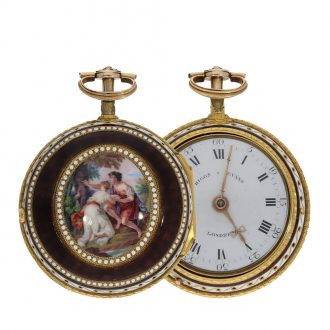
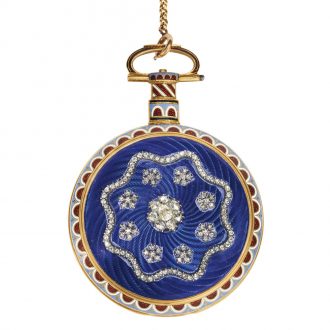
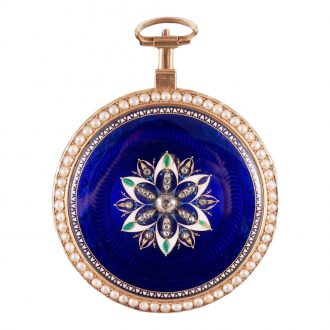
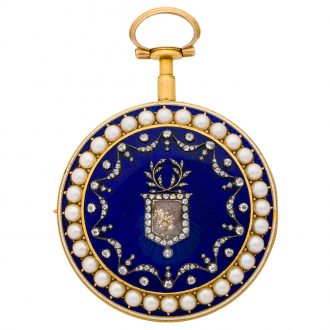
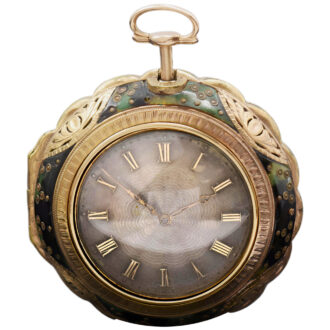
This is a magnificent and rare English watch that runs for eight days on a single winding. It is made of gold, decorated with enamel and set with split pearls and diamonds.
–
Case
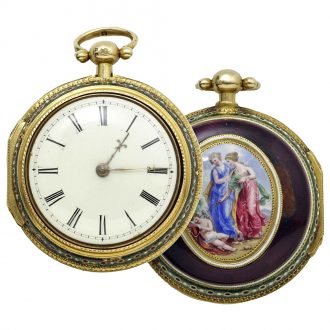
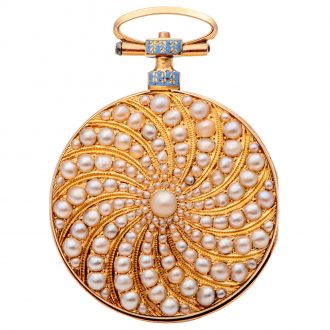
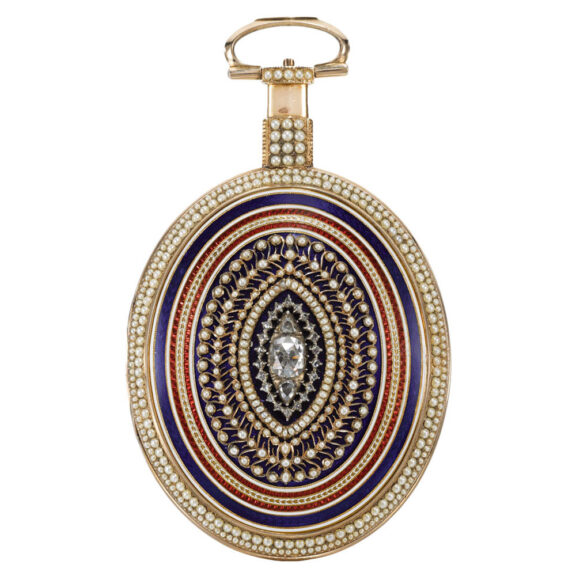
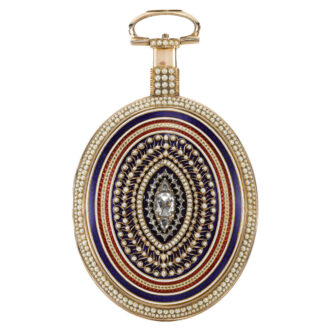
The oval case has three diamonds at the centre of the back, inside a border of diamonds. Around them are three rows of pearls separated by fine gold wirework. The outer bands are translucent blue and red enamel over engine-turning, alternating with bands of opaque white enamel decorated with gold. Each bezel is set with two rows of split pearls, and the pendant is also decorated with split pearls. A push-button in the pendant opens the back.
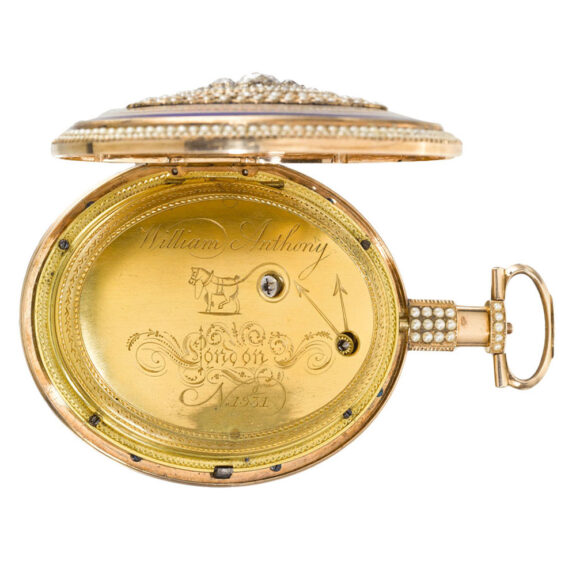
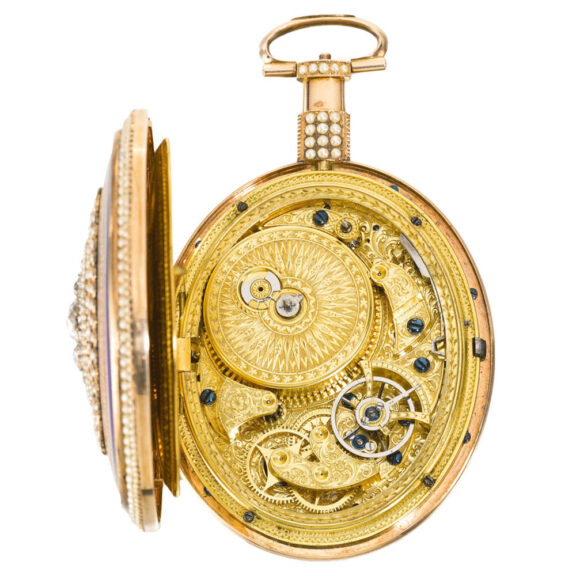
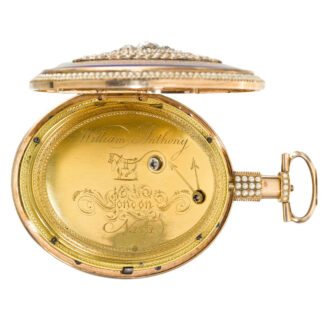
Inside is a gilt-metal dust cover signed “William Anthony, London.” It has two openings, each with an engraved picture next to it:
- A horse pulling a rope, which shows the direction for winding
- A pair of watch hands, next to the off-centre square used to set the hands
Dial:
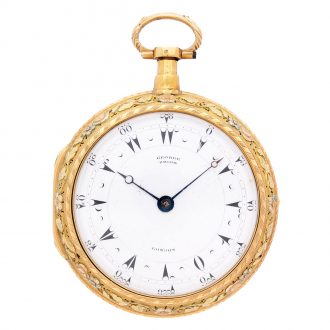
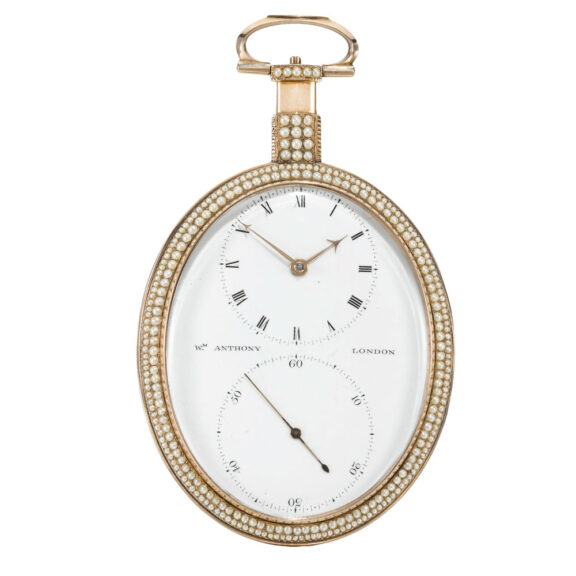
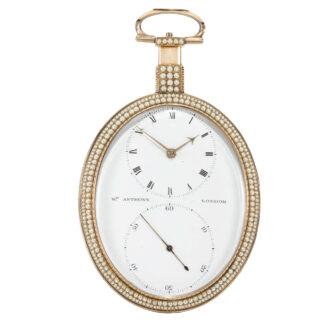
- Oval white enamel dial, signed “Wm Anthony, London”
- Two small dials of the same size: one above for hours and minutes, with Roman numerals and gold arrow hands, one below for seconds, with Arabic numerals and a counterbalanced hand
Movement:
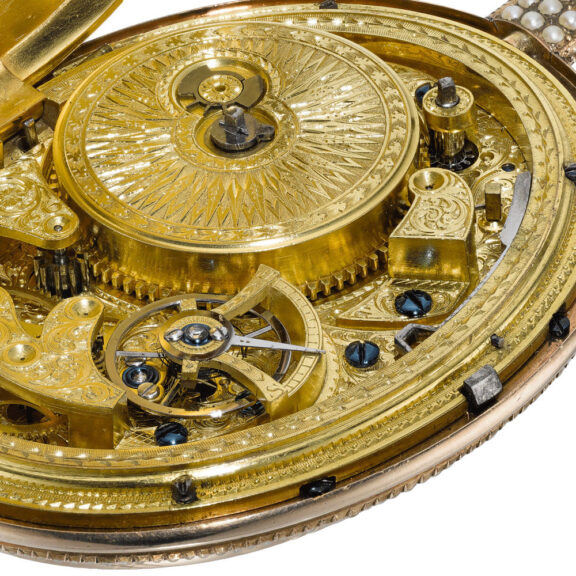
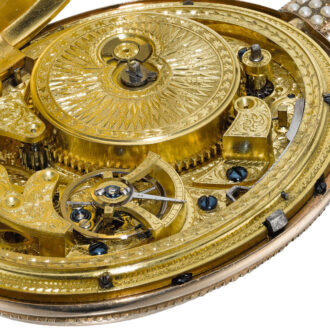
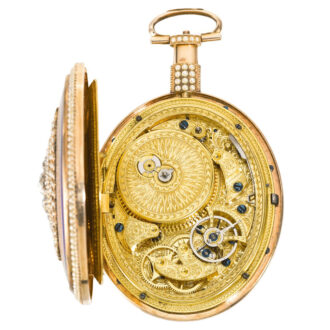
- Oval gilt movement, richly engraved
- Duplex escapement
- Polished steel balance with five arms
- Diamond endstone
- Large, richly engraved hanging barrel
- Train of five wheels, which gives the watch its long running time
Diameter including pendant and bow: 97 mm
–
Width: 58 mm
–
Signed: William Anthony London
–
William Anthony’s oval watches
William Anthony specialised in watches for the Chinese market. He is especially famous for his magnificent, elaborate oval watches. The rarest of them have hands that lengthen and shorten to follow the oval shape of the dial.
–
On this watch, the rich but carefully ordered decoration of the case is balanced by the beautiful clarity of the white enamel dial. The dial is divided into two equal parts: hours and minutes above, seconds below.
–
The movement
The eight-day movement is finely engraved on almost every surface. It has a large, prominent hanging barrel and a duplex escapement. Although its design shows influences from the Continent, the style of the gilding and the quality of the engraving suggest that the work was done in England. Tellingly, there is no engraving under the English diamond settings of the six-arm steel balance and the duplex escape wheel. The settings were fitted first, and the engraver then worked around them.
–
A small group
This watch belongs to a small group of fewer than ten similar watches by Anthony, which seem to have been made in pairs. R. A. Marryat is the recorded owner of this watch, as shown in the 1965 edition of Watches by Clutton and Daniels.
–
Several related watches are known:
- No. 1932, the next number after this watch, was sold at Sotheby’s London. Its description suggests it closely resembles this watch.
- A matching pair of oval watches by Anthony belonged to King Farouk of Egypt and was sold at the Farouk sale at Sotheby’s in March 1954.
- Nos. 1705 and 1706 seem to be a pair. Both have hands that lengthen and shorten along the long and short axes of the dial. No. 1705 was sold at Sotheby’s London and no. 1706 at Sotheby’s New York. They are almost identical, except that 1705 has a ruby at the centre of the back and 1706 a diamond.
- Three oval watches from the Sandberg Collection were sold at Antiquorum: a matching pair, nos. 1913 and 1914, and no. 1935, which shares design features with this watch.
William Anthony 1765–1844
Anthony is recorded as working in Red Lion Street and St John’s Square in London. In 1815 he played an active part in founding the Watch and Clockmakers’ Benevolent Association.
–
After that, his business seems to have declined. One reason was his expensive purchase of royal and other wardrobes from the time of Charles I, which he exhibited at the Somerset Gallery but which drew few visitors. Another was a failed lawsuit against Grimaldi and Johnson. When he died, he was found to hold a valuable lease on the Doughty Estate. For some reason, he had not collected rent on it for the previous 20 years, and by then the leases had almost run out.
Signed: William Anthony London
Share this page: