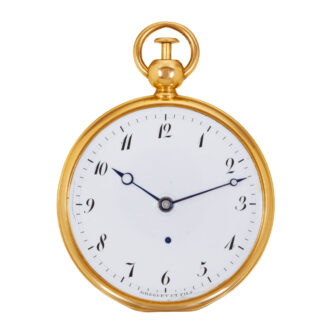
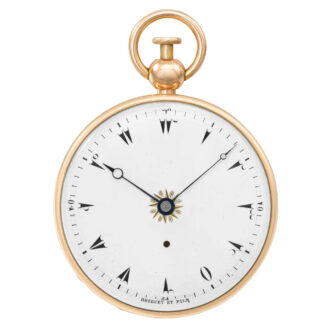
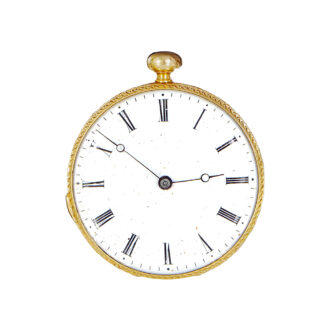
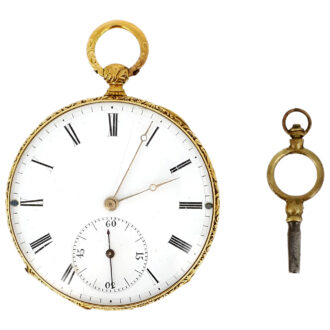
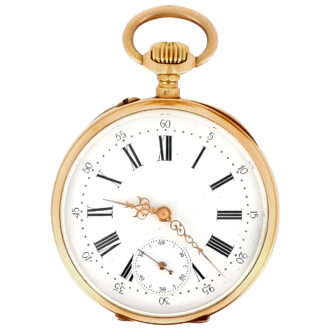
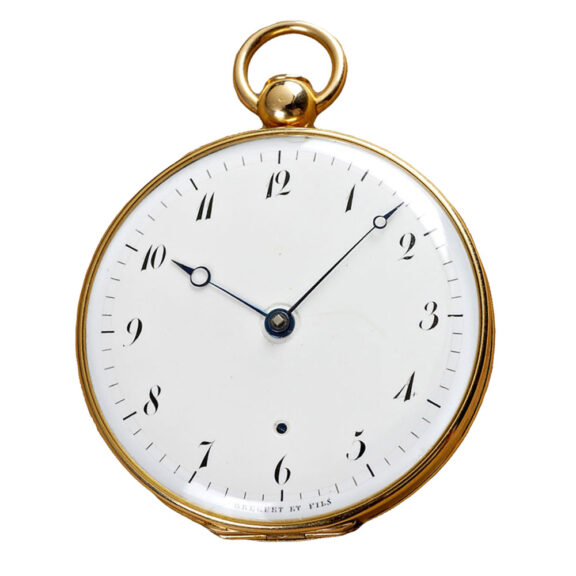
French gold quarter repeating duplex watch Circa 1813

- Kenmerk
- TD0153
- Diameter
- 52 mm
- Estimate
- € 45.000 - 75.000
- Price sold
- € 56.250
Gentleman’s open faced pocket watch
–
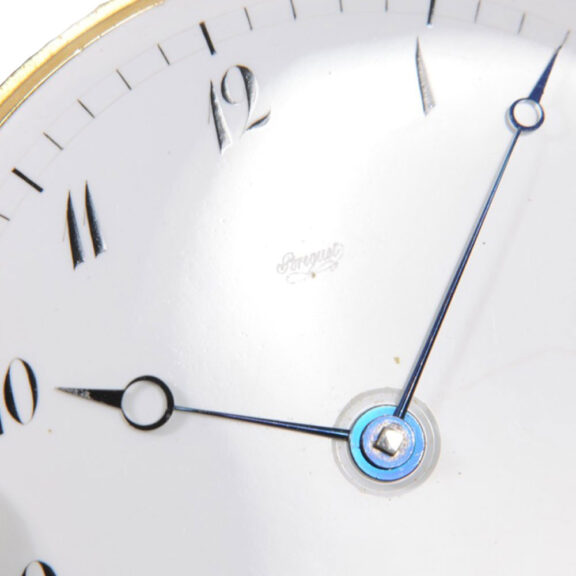
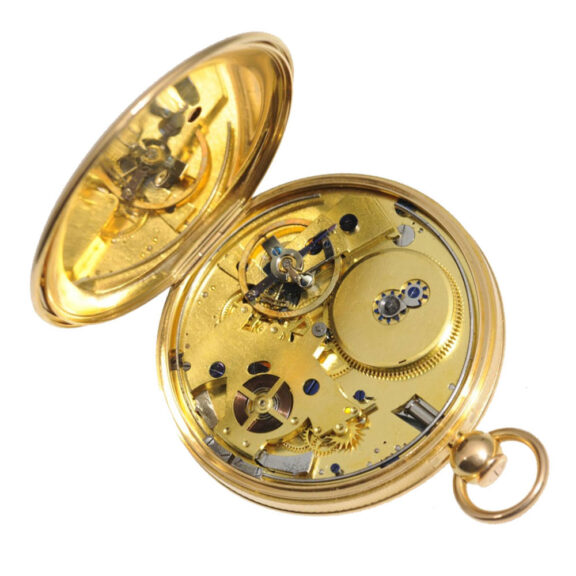
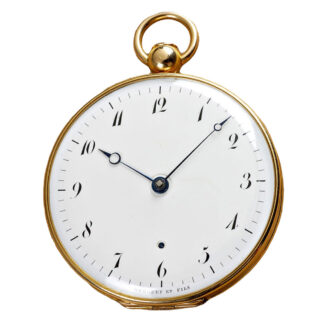
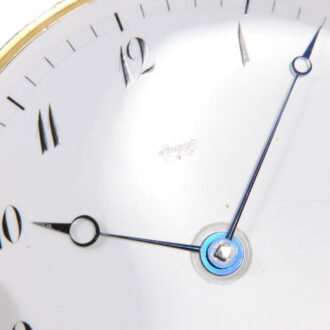
A gentleman’s important quarter repeating pocket watch with double wheel duplex escapement and secret signature, circa 1813.
Sold at 06/08/1813 for 1500 francs to Caroline Bonaparte, Reign of Naples with Breguet.
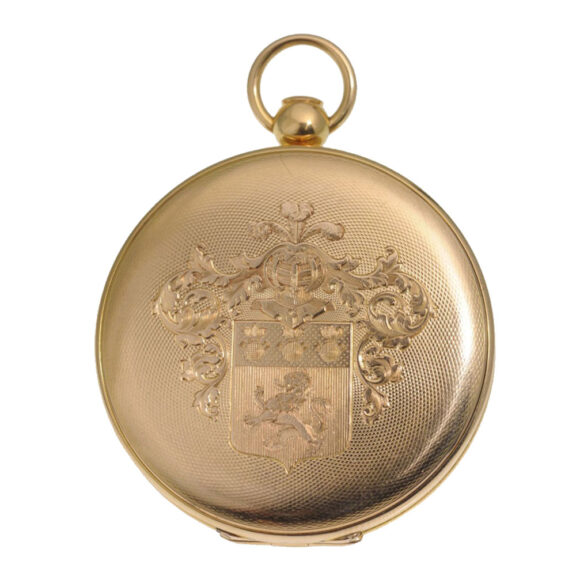
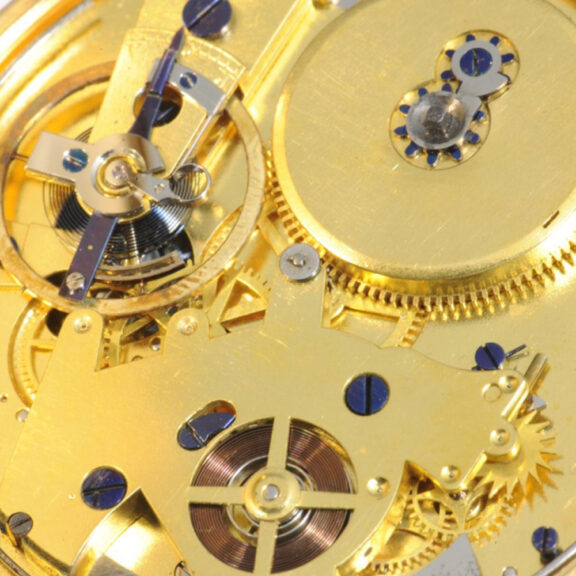
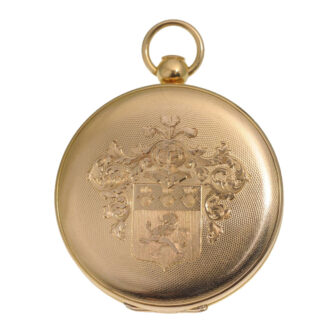
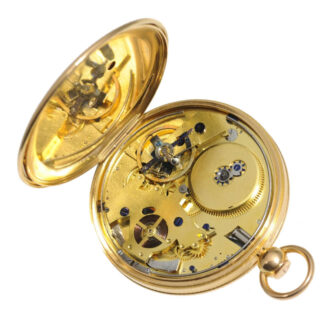
An 18 carat gold case by Tavanier, engraved coat of arms, enamel dial, secret signature, bridge movement, two hammers / two gongs,
three-arm brass balance with shock protection-“parachute”, temperature compensated balance spring, going barrel, open barrel for striking train.
–
Diameter: 52 mm
–
Weight: 105 g
–
Signed: Breguet Paris
–
George Daniels “The Art of Breguet” on the Duplex Escapement: Another frictional rest escapement used by Breguet was the duplex. Because it works better in thick watches it found more favour in England than in France, the country of its origin. It was rarely used by Breguet and only a few examples are known to the author.
Lit.: George Daniels, “The Art of Breguet”, New York 1986.
Caroline Bonaparte (* March 25, 1782 in Ajaccio, Corsica; † May 18, 1839 in Florence), or rather Maria Annunziata Carolina Buonaparte,
was Queen Consort of Naples and youngest sister of Napoléon Bonaparte. In 1793 she moved to France with her family,
where she fell in love with General Joachim Murat and married him in 1800. Caroline was as ambitious and power-hungry as her brother and persuaded him to make her – through her husband – Grand Duchess of Berg and Cleves in 1806 and Queen of Naples in 1808. She was particularly good at creating strong bonds with important statesmen and among her friends were Junot, Talleyrand and Fouché. The birth of Napoleon II destroyed her ambitions to see her oldest son Napoléon Achille Murat succeed her brother to the throne. She allied herself with Napoleon’s enemy Clemens von Metternich, who tried in vain to save Murat’s throne after the Hundred Days. When Murat attempted to regain control of Naples and Sicily by fomenting an insurrection in Calabria, he was executed by firing squad on October 13, 1815 in Pizzo, by order of King Ferdinand IV. His widow fled to Austria (where she purchased Schloss Frohsdorf in 1817) and later lived at the Villa Campo Marzo near Trieste and in Florence, where she called herself “Countess of Lipona” (Lipona being an anagram of Napoli).
In 1830 Caroline married General Francesco Macdonald (1777–1837), who had been Murat’s Minister of War in 1814/15. She died on May 18, 1839 in Florence and was laid to rest in the Ognissanti Church.
Signed: Breguet Paris
Share this page: