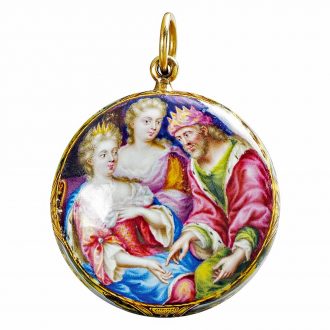
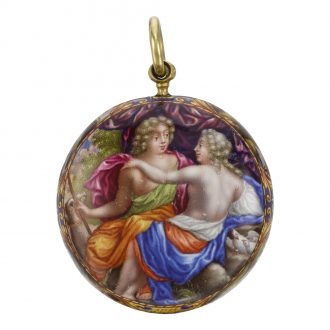
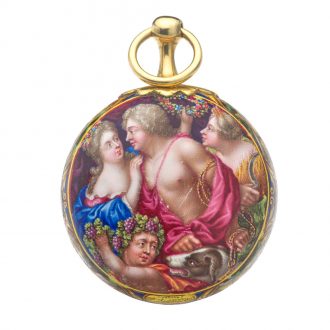
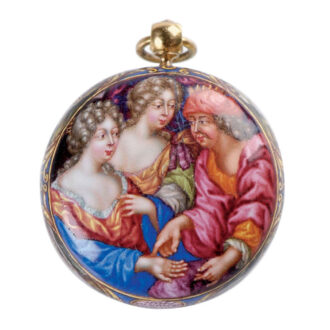
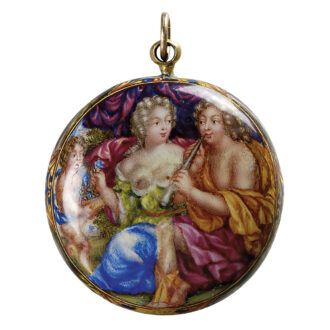
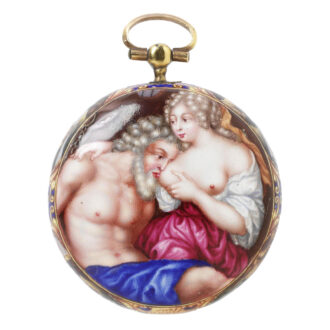
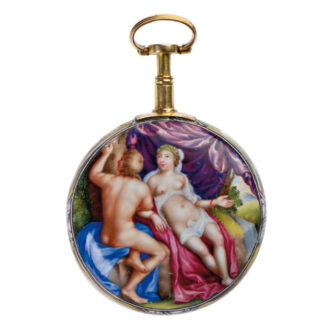
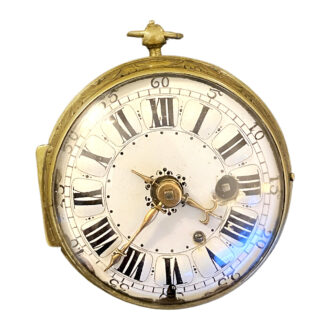
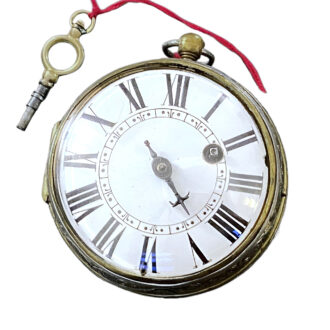
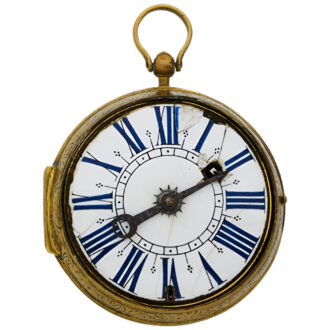
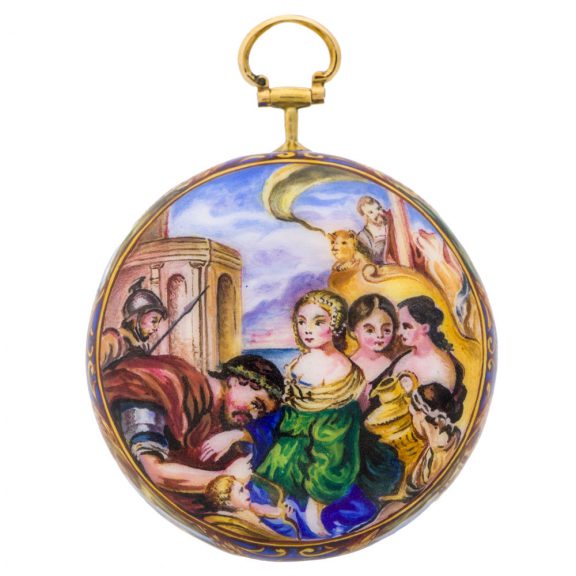
Swiss gold watch with enamel scene of Cleopatra Circa 1680
- Kenmerk
- TA4833
- Diameter
- 47 mm
- Estimate
- € 10.000 - 20.000
- Price sold
- € 6.400
Gold open faced verge
–
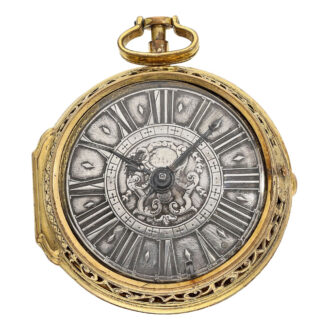
A fine Swiss, gold and painted on enamel pocket watch, circa 1680. A polished, solid case with curved in edges, the back painted scene (the meeting of Cleopatra and Anthony), the interior decorated with a rural landscape, the band with four cartouches depicting countryside landscapes, loose ring pendant. White enamel dial with radial Roman numerals, outer minute track with five minute Arabic numerals and blued steel hands, gilt brass, full plate movement, conical pillars, fusee and chain, verge escapement, three arm brass balance, pierced and engraved foliate continental clock, polished steel endplate garnet endstone, silver regulation dial Movement signed.
–
Diameter: 47 mm
–
Signed: Otto Schroeder Swiss made
–
Neumarkt previously sold the present lot on September 20, 1968. The painting (approx. 1650) of Sebastien Bourdon (1616-1671) has been completely lost today. It is due to its similar style that this paiting was attributed (see Thuillier, Jacques, Sebastien Bourdon, catalogue critique et chronologique de l’oeuvre complet, Paris, 2000, p.210 No 71 and p. 226-227, No. 81) The subject depicts the meeting of Cleopatra VII, queen of Egypt and Anthony, roman general and politician in Tarse, capital of meridonial Anatolia (today Turkey). It is a historical fact that after many issues, the couple is led to suicide due to the lack of flexibility of the emperor at the time, Octavia. The theme of Anthony and Cleopatra appears in French theater around 1552, under the reign of Henri II. Etienne Jodelle (1532-1573) created the play to show the royals, depicting the trapped Cleopatra as a lesson in morals. This first French tragedy was designed to warn people of the dangers of love and passion. The author is instantly credited for humanism in theater and is admitted, the following year, to the circle of Pleiade, a group of seven poets gathered around Pierre de Ronsard (1524-1585). Similar pieces can be found in New York.
Signed: Otto Schroeder Swiss made
Share this page: