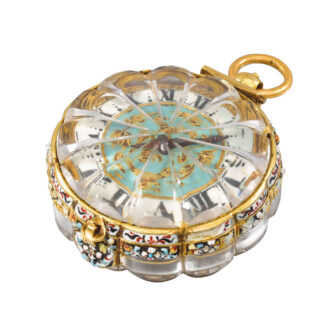
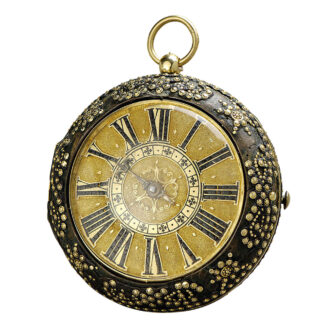
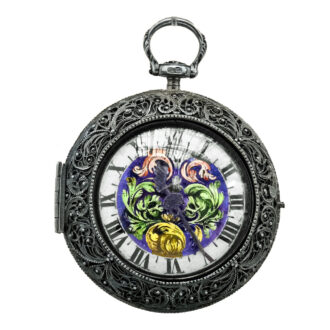
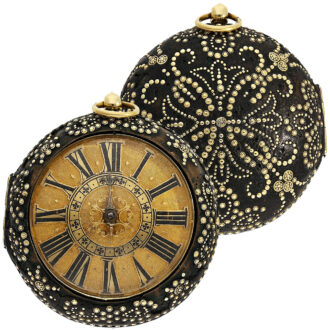
Important French/Swiss gold and enamel verge watch Circa 1660
- Kenmerk
- DB1071
- Diameter
- 33 mm
- Estimate
- € 150.000 - 250.000
- Price sold
- € 218.750
Enamelled gold ladies’ pocket watch
–
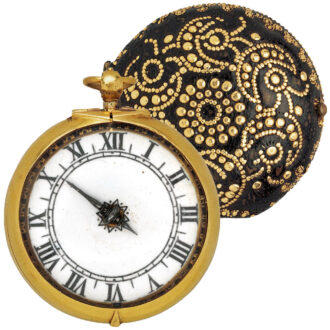
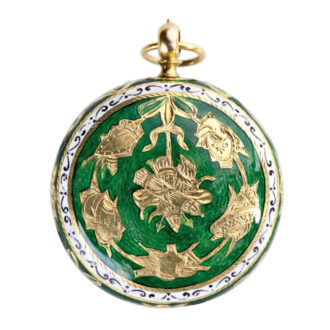
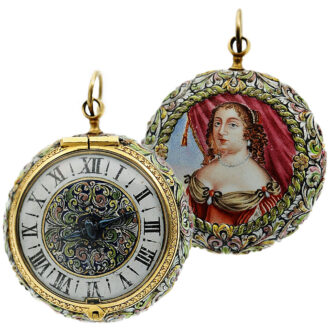
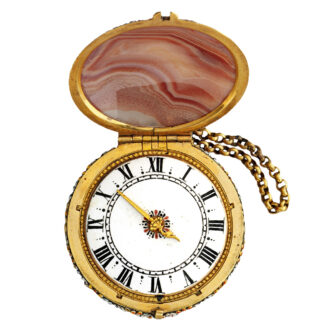
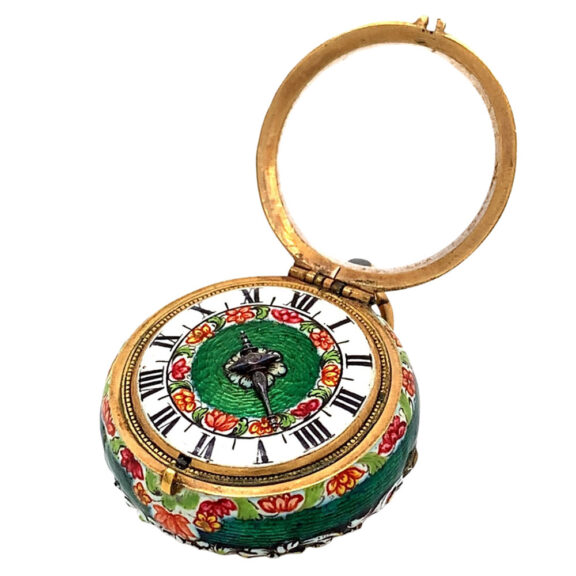
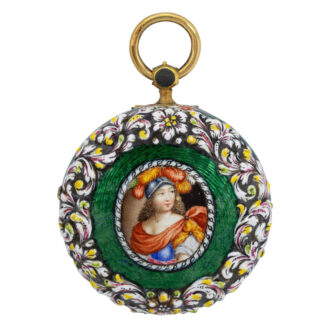
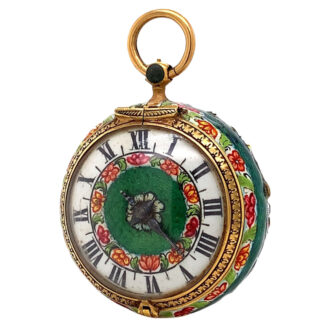
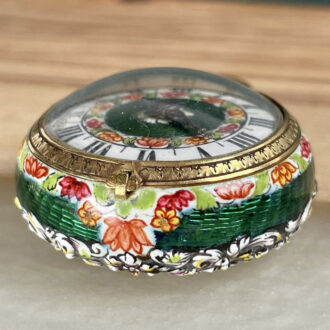
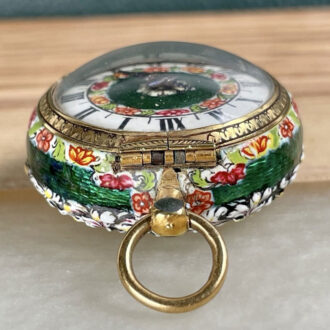
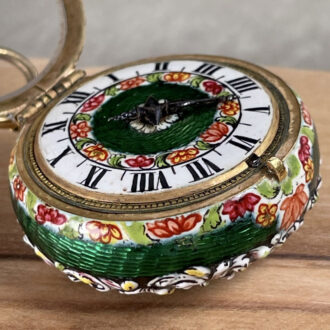
An important, museum-quality small French/Swiss 20k gold and enamel open-face pocket watch by Isaac Gradelle, circa 1660.
–
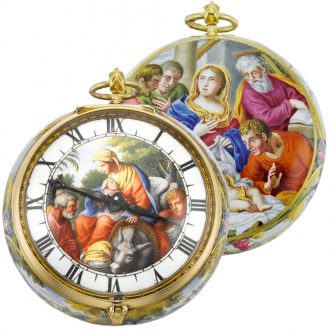
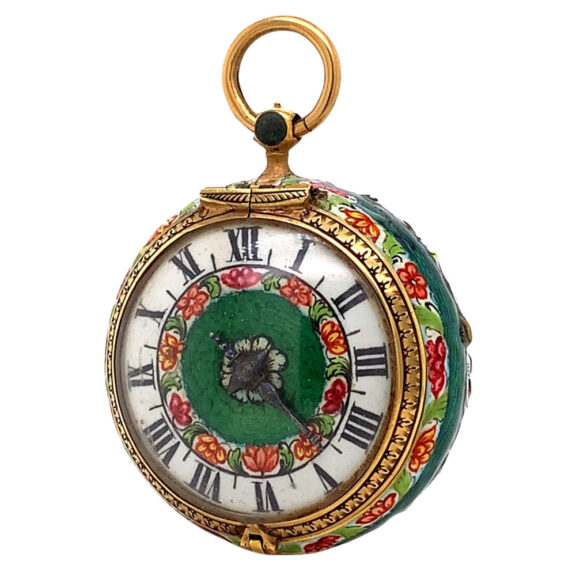
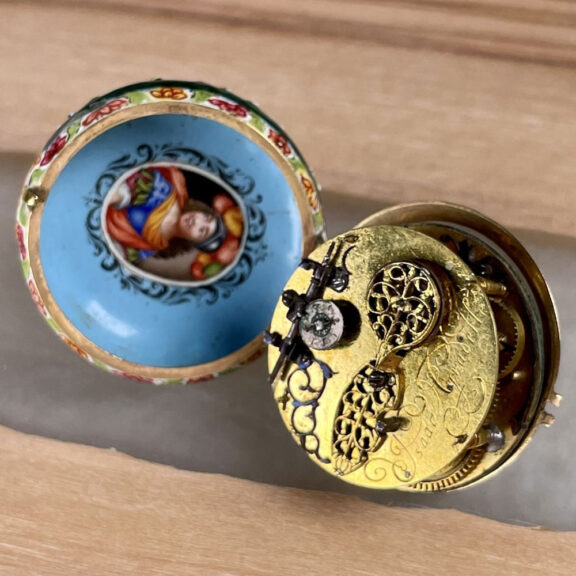
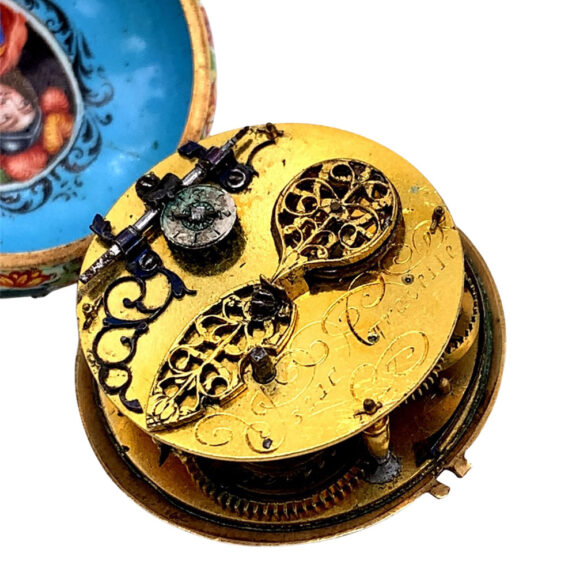
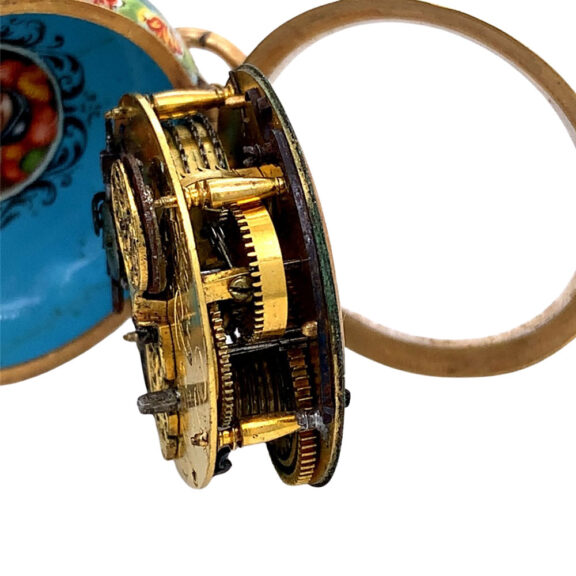
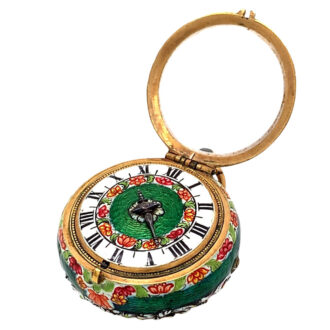
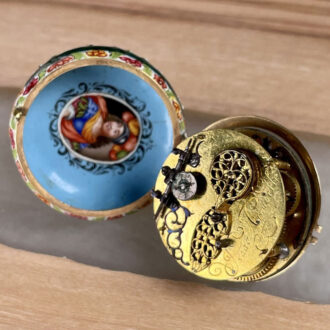
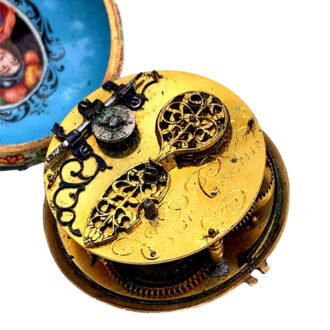
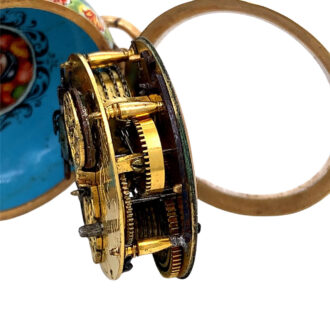
The gilt full-plate movement has a fusee with an early chain, worm-and-wheel mainspring set-up and a verge escapement. The steel balance has no hairspring. There is a pierced balance cock and a blued locking mechanism on top.
–
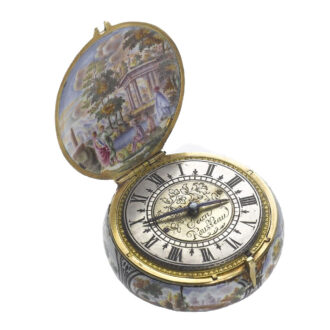
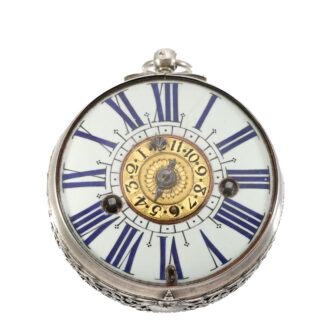
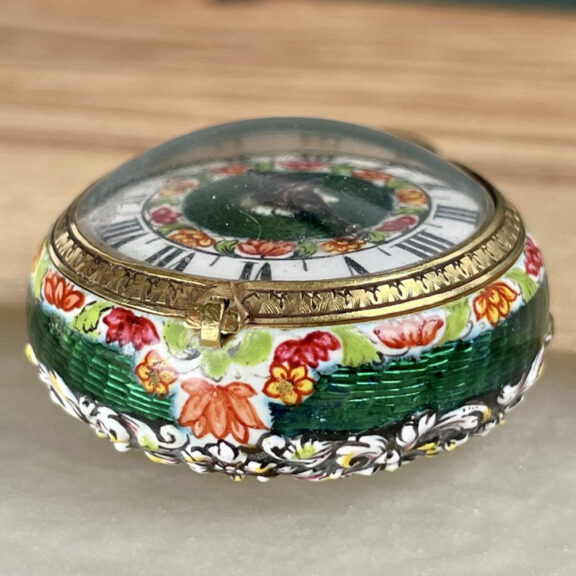
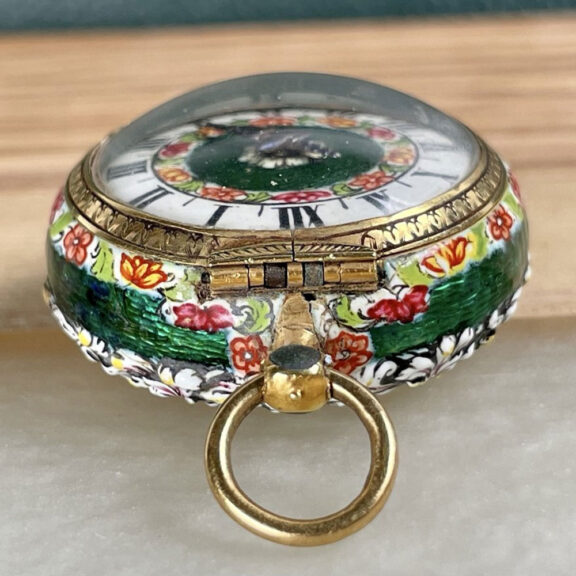
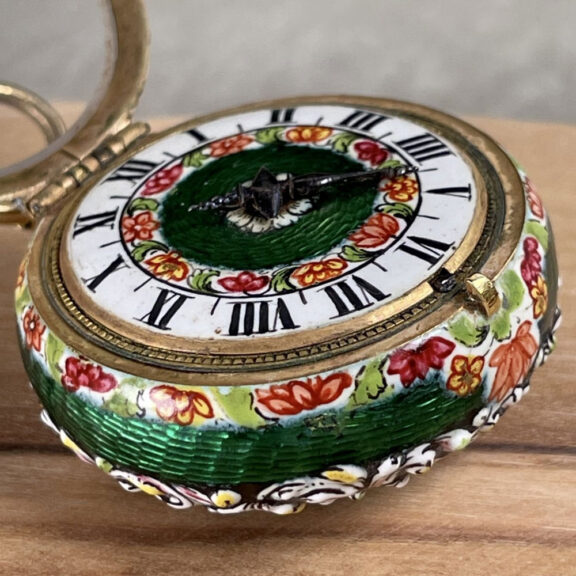
The white enamel dial has Roman hour numerals and half-hour markers. A wreath of flowers and leaves in polychrome enamel surrounds a centre of chased gold under translucent green enamel. The dial has a single blued steel hand.
–
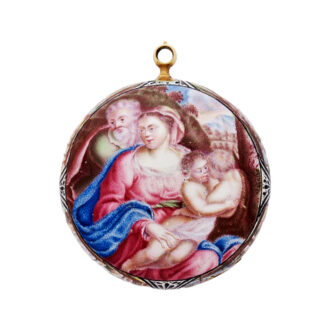
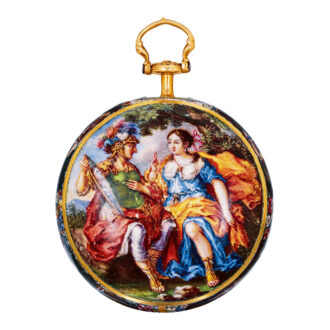
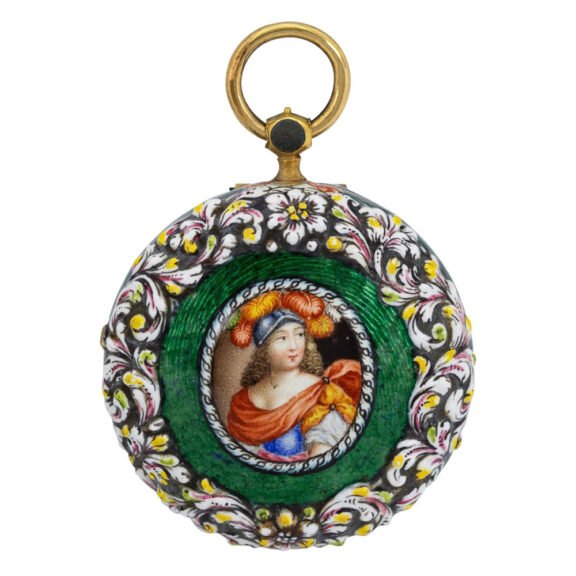
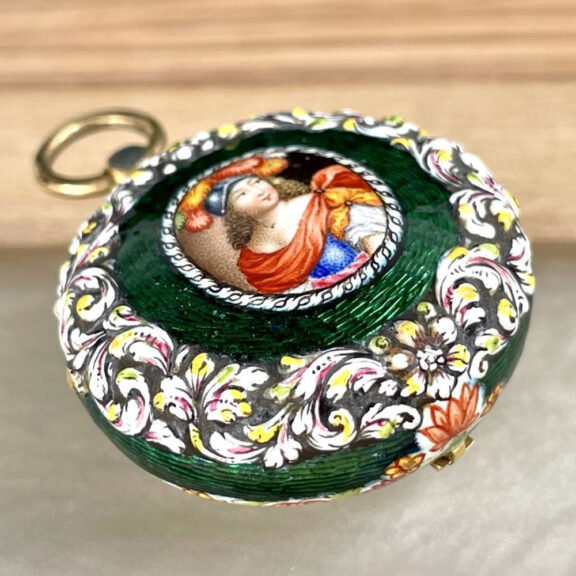
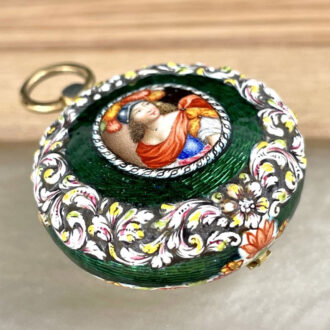
On the case back, a border of raised flowers and tendrils in pastel colours surrounds the central oval cartouche. Between the border and the cartouche is translucent green enamel over a chased ground. The cartouche holds a polychrome enamel portrait of Minerva in a magnificent feathered headdress. It is painted in the dotted technique and framed by a cord border.
–
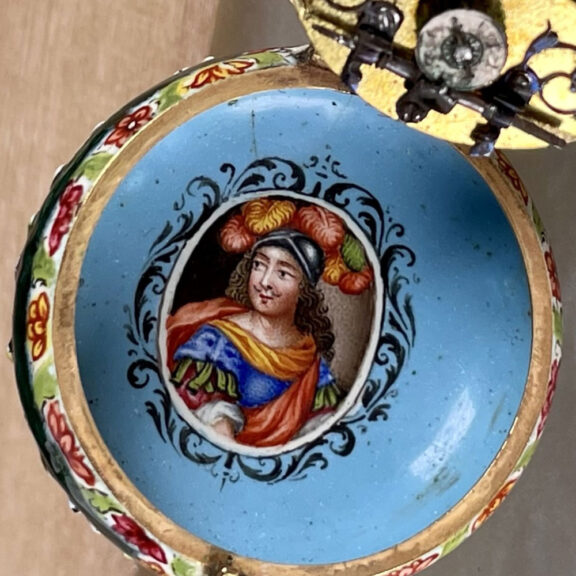
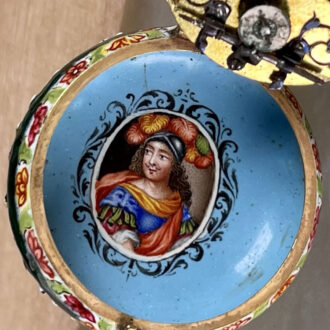
The inside of the back has a polychrome enamel portrait of Apollo, god of music, prophecy, healing, archery and light. He also wears a feathered headdress and is shown against a light blue background. This is a well-known image, traditionally seen as Louis XIV, who appeared as the Sun King in the Ballet royal de la Nuit in 1653.
–
The delicate gold front bezel is engraved with stylised leaves. The enamel work is attributed to Pierre Huaud I.
–
Diameter: 33 mm
–
Weight: 27 g
–
Signed: Isaac Gradelle
–
A few watch cases with enamel work similar to that of the present piece made by Pierre Huaud I (1612-1680) are known, but his sons Pierre Huaud II (1647-1698) and Jean-Pierre (1655-1723) can also be attributed.
–
In the collection of Dr E. Gschwind in the Museum Haus zum Kirschgarten in Basel is a watch with a very similar case and dial featuring a later seal, which is attributed to Pierre Huaud I. The technology and colours used are remarkably similar to those of this timepiece.
–
Currently only one watch case signed “P. Huaud pinxit à Genève” is known, and can be clearly attributed to the father. It is also in the collection of Dr E. Gschwind in the Museum Haus zum Kirschgarten in Basel.
–
Another almost identically watch, with a movement by Denis Bordier (1629-1708), was auctioned at Sotheby’s in Geneva, November 11th, 2019. The enamel painting was attributed to Pierre Huaud II.
–
An almost identically watch with a movement by Jean-Baptiste Duboule is in the collection of the Patek Philippe Museum. It is attributed to Pierre Huaud II’s brother, Jean-Pierre, and also shows a Minerva on the back and a figure with a feathered helmet on the inside.
–
However, there are a number of characteristic features that characterize the work of Pierre Huaud I:
a) small flowers as main or secondary ornaments
b) a turquoise enamel ground
c) translucent green or blue enamel on a guilloché ground
d ) sometimes the use of landscape painting or an enamelled ground in high relief
e) opaque or translucent champlevé enamel within an engraved field
–
In addition, Pierre I regularly used a vibrant orange hue and preferred to depict some of his subjects in a black and white frame.
–
A clear assignment to the individual Huauds is only possible using the name of the watchmaker and his data.
–
Isaac Gradelle was a French watchmaker. He is mentioned by G.H. Baillie and Brian Loomes as a watchmaker in the first half of the 17th century.
–
A square pendant watch with a gilded silver case, identical tulip decoration and an identical movement, signed Isaac Gradelle, was made around 1640/1650 and is now in the Kellenberger Museum in Winterthur. The timepiece is on permanent loan from the Oscar Schwank Collection and is depicted.
–
Due to the dates and the similarities with other Gradelle pieces the enamel painting on this watch can therefore clearly be attributed to Pierre Huaud I.
–
Pierre Huaud I (1612-1680) was born in Chatellerault, France, as the son of goldsmith Jean Huaud. In 1630, he fled to Geneva at the age of 18, indicating that he probably began his apprenticeship with his father or another French goldsmith, some sources suggest that this may have been in Blois and that he had to complete his apprenticeship with Laurent Legere in order to obtain the master’s degree in Geneva.
–
He began his apprenticeship with Legere in 1630, became a journeyman in 1634 and a master in 1636. In 1643, he married Françoise Mussard. Among the couple’s children were three sons who later practiced the profession of enameller: Pierre II (1647-1698), Jean-Pierre (1655-1725) and Ami (1657-1724). In 1671, Pierre I and his three sons received citizenship in Geneva.
Signed: Isaac Gradelle
Share this page: