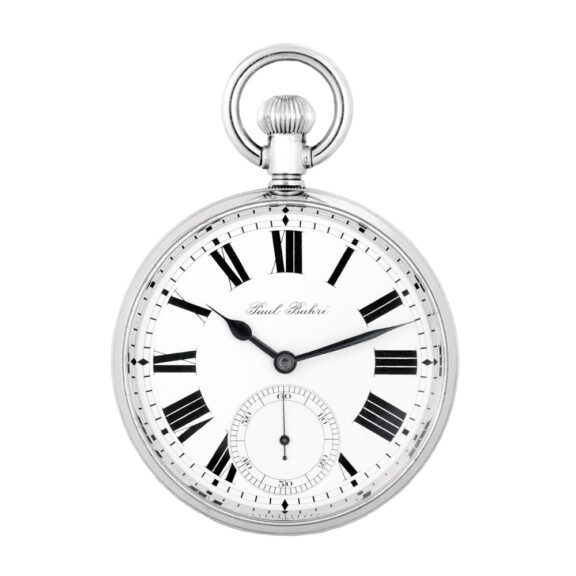
Swiss nickel-cased keyless lever chronometer Circa 1940
- Kenmerk
- TA2488
- Diameter
- 65 mm
- Estimate
- € 2.750 - 6.000
- Price sold
- € 2.900
Nickel lever watch in original fitted box
–
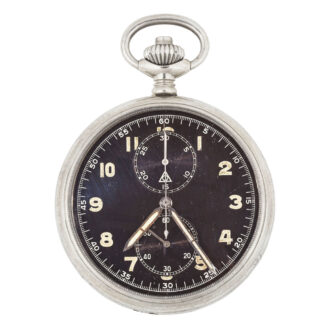
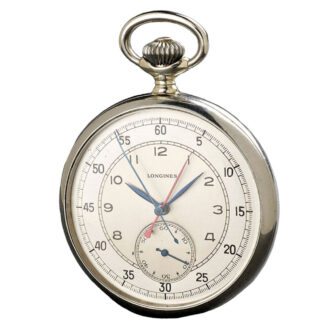
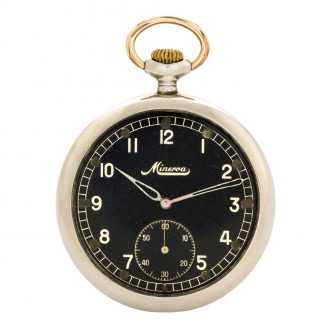
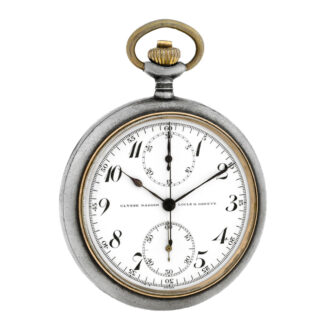
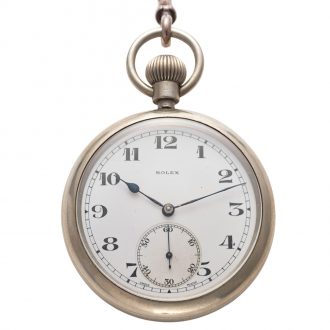
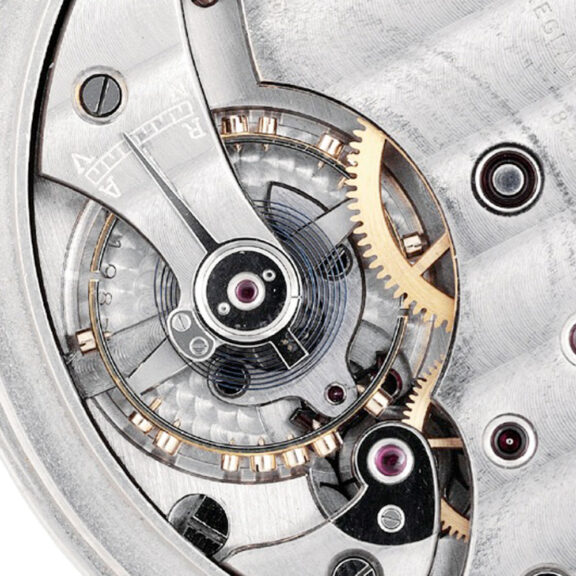
A very fine and large Swiss, nickel-cased, keyless lever chronometer with Guillaume balance, circa 1940. Accompanied by the original fitted box and Observatoire de Neuchatel Bulletin de Marche dated June 1, 1943. Chronomètre de Bord Prize Class Lever Chronometer by Paul Buhré S.A., Le Locle, Swiss, the movement by Henri Barbezat-Bole SA.
–
A polished case, screw down bezel and back. Snap-on cuvette engraved with the Bulletin Observatoire details. White enamel dial with radial Roman numerals, outer minute track, subsidiary seconds. Blued steel spade hands. A rhodium-plated movement, Geneva striping decoration, 18 jewels, straight-line lever escapement, Anibal-brass Guillaume balance regulated in 9 positions, blued steel Breguet balance spring with a terminal curve, index regulator. Dial and cuvette signed, case and movement numbered.
–
Diameter: 65 mm
–
Signed: Paul Buhré Le Locle
–
The original Bulletin de Marche included with this watch lists the entrant as Paul Buhré and H. Barbezat-Bole S.A. of Le Locle. The company of Henri Barbezat-Bole took over Paul Buhré in 1930 and from this date the name of the company was Paul Buhré & Henri Barbezat-Bole SA.
–
Pavel (Paul) Buhre The firm was established by Carl Buhre in 1815 in St. Petersburg. His son Paul entered the business and by 1874 the company had acquired a large watch manufactory in Le Locle, Switzerland. In 1899 the company was given the Imperial warrant to supply the Czar and his family with watches for themselves and for presentation. Between 1887 and 1917 the office of the Emperor bought around 15,000 watches and the name of Pavel Buhre became synonymous with the watches of Czarist Russia. Anton Chekhov mentions Buhre’s name several times in his literature.
–
The Buhre company dominated the supply of watches to Russia and at one time held over 50% of the market in ordinary watches. The complicated watches for rich customers were specially ordered in Switzerland. The company won medals at National and International exhibitions, including a silver medal in Paris in 1889 and gold in Paris in 1900. Czar Nicholas II wore a gold watch by Pavel Buhre and this, along with a silver marine watch, were found amongst his possessions after his execution in 1917. The revolution effectively ended the business of Pavel Buhre although the seized watches and parts continued to be used by the Soviets, including Stalin and Khrushchev.
Signed: Paul Buhré Le Locle
Share this page: