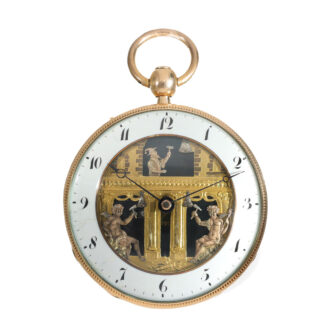
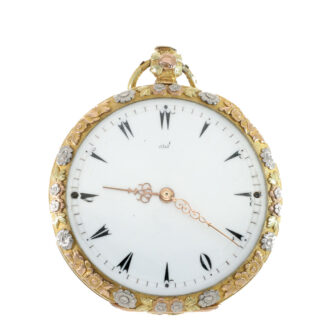
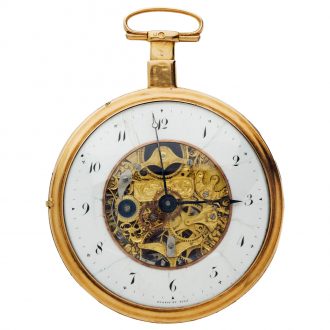
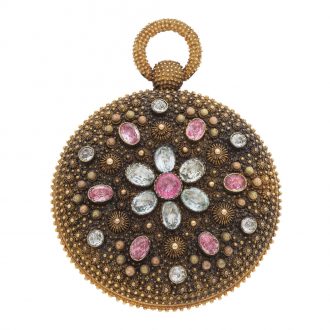
Exceptional Swiss gold, enamel and pearl-set watch Circa 1820
- Kenmerk
- SB0090
- Diameter
- 59 mm
- Estimate
- € 60.000 - 100.000
- Price sold
- -
Duplex watch made for the Chinese market
–
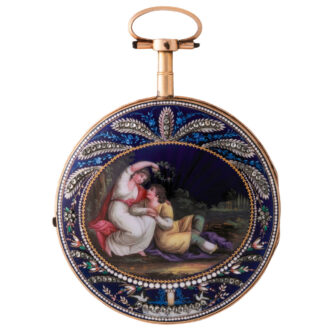
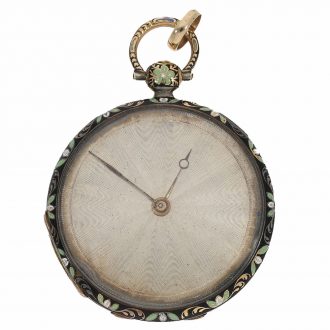
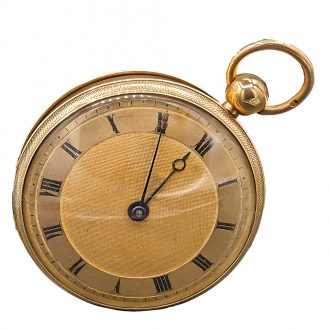
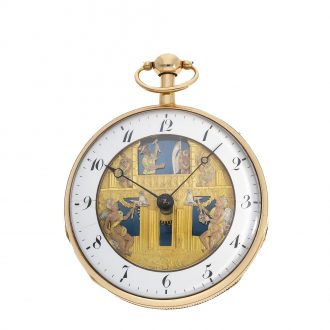
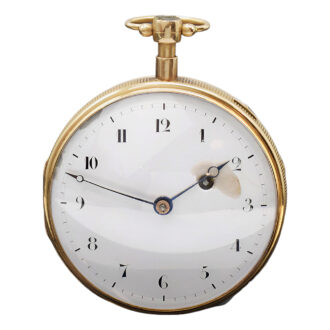
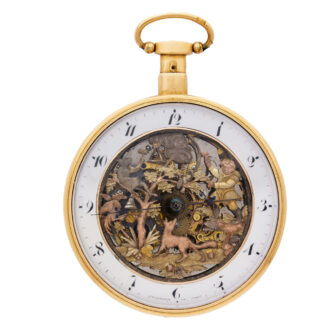
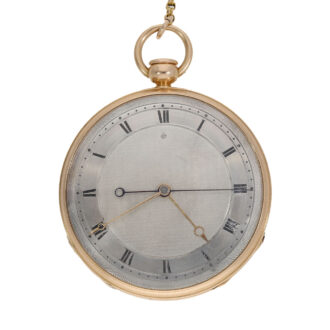
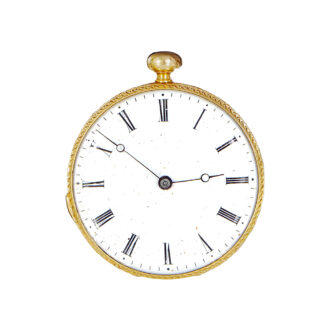
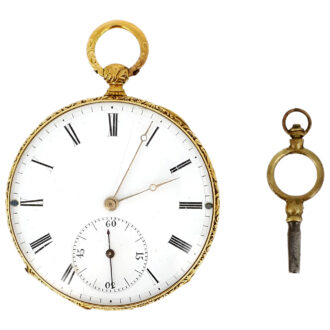
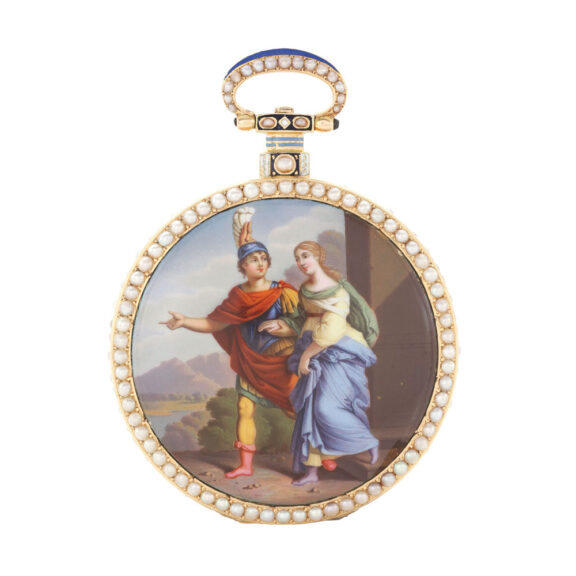
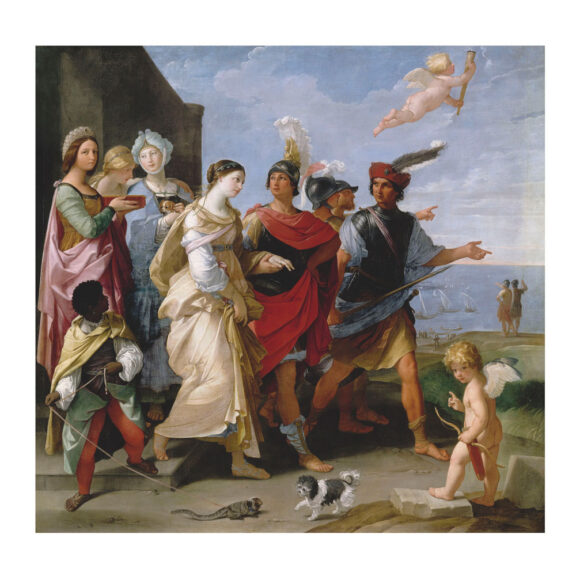
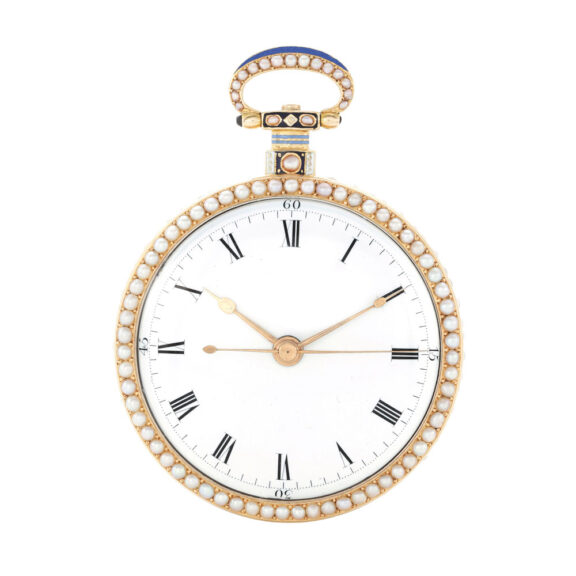
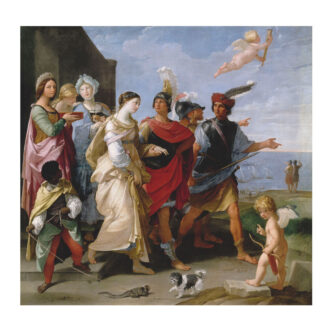
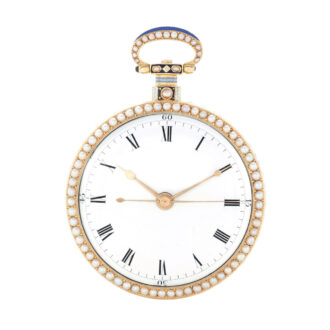
An exceptional Swiss 18 carat gold, enamel and pearl-set open faced centre seconds duplex pocket watch with enamel scene attributed to Jean-Louis Richter made for the Chinese market, circa 1820. Retailed by William Ilbery, London. Finely foliate chased and engraved gilt movement, ruby duplex escapement, diamond endstone, Ilbery’s over-banking prevention device. Gold cuvette with engraved decoration. White enamel dial with Roman numerals and gold spoon hands. An Empire case, the back with a polychrome enamel scene depicting the Abduction of Helen after Guido Reni (1575 – 1642), both the bezels and the bow set with pearls, blue enamel to the also pearl-set band. Movement signed, case stamped B for Bovet.
–
–
An exceptional Swiss 18 carat gold, enamel and pearl-set open faced centre seconds duplex pocket watch with enamel scene attributed to Jean-Louis Richter made for the Chinese market, circa 1820. Retailed by William Ilbery, London. Finely foliate chased and engraved gilt movement, ruby duplex escapement, diamond endstone, Ilbery’s over-banking prevention device. Gold cuvette with engraved decoration. White enamel dial with Roman numerals and gold spoon hands. An Empire case, the back with a polychrome enamel scene depicting the Abduction of Helen after Guido Reni (1575 – 1642), both the bezels and the bow set with pearls, blue enamel to the also pearl-set band. Movement signed, case stamped B for Bovet.
–
Diameter: 59 mm
–
Signed: Ilbery London
–
William Ilbery, circa 1760-1839, was active in London from 1780 in Goswell Street, he moved to Duncan Terrace towards the end of the 18th century. After James Cox in London and Jaquet-Droz in Switzerland, he also specialized in producing luxury watches for the Chinese market. His early production was very much in the English style, featuring a full plate movement and an English-type single-wheel duplex escapement. However, for his highest-quality watches, he incorporated a spring detent escapement. Later, the watch movements he produced were much inspired by the Lépine calibre with a free-standing barrel, as were Jaquet-Droz’s Swiss production signed in London and that of William Anthony, who worked in London. The cases of his watches were sumptuously decorated by the best Genevan enamellers, such as Jean-Francois-Victor Dupont, who usually signed his work, and Jean-Louis Richter, who signed rarely. He organized the production in Switzerland, mainly in Fleurier, of profusely engraved movements for the Asian market. He was followed in this by makers such as Bovet and Juvet who also worked in Fleurier (Val de Travers). Ilbery can therefore be considered one of the most representative makers of ‘Chinese’ watches. He seems to have maintained close contacts with the continental trade since a watch signed ‘Ilbery Paris’ is known while Ilbery & Son are recorded in London and Fleurier, as well as in Canton.
–
Jean-Louis Richter (1766-1841) was a painter active in Geneva’s ‘Fabrique’ from the 1780s to the 1830s. His work often unsigned is clearly recognizable. He was the son of Jean Jost Richter who died in 1792, an engraver and ‘bourgeois’ of Frankfort on the Main, who became an inhabitant of Geneva on February 7, 1766. In 1778, at the age of 12, Richter began a six-year apprenticeship with the Roux brothers, who specialized in the decoration of watches and jewellery. In January 1793, ‘Rifter’ (sic) is listed among the citizens of Geneva who are to elect the new National Assembly, he is described as a painter. In 1820, Richter was elected to the Conseil of the city of Geneva and in 1830, he was elected again. In addition to his painting on enamel, Richter also practised another genre, imported from Berlin and Brunswick: a painting on objects made of cardboard and sheet iron. In 1826, Richter is recorded in the “Almanach des adresses du canton de Genève” as working “en l’Isle, No. 243”. Around 1815 he became associated with Aimé-Julien Troll (1781-1852). In 1828 they are listed as executing paintings on enamel and in oils, landscapes, portraits, flowers and all types of jewellery, Quai de l’Isle, 243. The association between Troll and Richter had been dissolved by 1840. Jean-Louis Richter died in Geneva on July 21, 1841, at the age of nearly 75. Dr Hans Boeckh has shown that the work of Richter may be divided into three periods: in the earliest of them, the English influence is predominant, with subjects coming from the engravings of artists such as William Hamilton (1751-1801) and Peltro William Tomkins (1760-1840), although the influence of other artists can be perceived as well, contemporaries such as Johann Ludwig Aberli (1723-1786), Francesco Bartolozzi (1727-1815), Angelica Kauffmann (1741-1807) or painters from earlier times such as Guido Reni (1575-1642) and Eustache Lesueur (1616-1655). Richter’s second period was dominated by Italian landscapes, real or imaginary, in the style of Claude-Joseph Vernet (1714-1789). In his third period, Richter favoured Swiss landscapes, often after the work of Pierre-Louis de la Rive.
–
This watch is a collaboration of three of the most important artists who are known for the highest quality watches made for the Chinese market. The attribution to Bovet is based on the ‘B’ stamped inside the case. This particular mark, which is found in two forms, is seen only in Bovet and Geneva watches sold by London retailers such as Ilbery or Just. A watch in the Bovet museum bears the same mark. In the Musée de L’Horlogerie et de l’emaillerie, there also exists a Bovet watch with the mirror image of this same scene (inv.M910) which Dr Hans Boeckh attributed to Richter in terms of the enamel. In the Patek Philippe museum there is an Ilbery watch with the preceding serial number 6212. It is identical in terms of form of case, dial and movement, the museum dates it between 1812-1820.
–
Signed: Ilbery London
–
William Ilbery, circa 1760-1839, was active in London from 1780 in Goswell Street, he moved to Duncan Terrace towards the end of the 18th century. After James Cox in London and Jaquet-Droz in Switzerland, he also specialized in producing luxury watches for the Chinese market. His early production was very much in the English style, featuring a full plate movement and an English-type single-wheel duplex escapement. However, for his highest-quality watches, he incorporated a spring detent escapement. Later, the watch movements he produced were much inspired by the Lépine calibre with a free-standing barrel, as were Jaquet-Droz’s Swiss production signed in London and that of William Anthony, who worked in London. The cases of his watches were sumptuously decorated by the best Genevan enamellers, such as Jean-Francois-Victor Dupont, who usually signed his work, and Jean-Louis Richter, who signed rarely. He organized the production in Switzerland, mainly in Fleurier, of profusely engraved movements for the Asian market. He was followed in this by makers such as Bovet and Juvet who also worked in Fleurier (Val de Travers). Ilbery can therefore be considered one of the most representative makers of ‘Chinese’ watches. He seems to have maintained close contacts with the continental trade since a watch signed ‘Ilbery Paris’ is known while Ilbery & Son are recorded in London and Fleurier, as well as in Canton.
–
Jean-Louis Richter (1766-1841) was a painter active in Geneva’s ‘Fabrique’ from the 1780s to the 1830s. His work often unsigned is clearly recognizable. He was the son of Jean Jost Richter who died in 1792, an engraver and ‘bourgeois’ of Frankfort on the Main, who became an inhabitant of Geneva on February 7, 1766. In 1778, at the age of 12, Richter began a six-year apprenticeship with the Roux brothers, who specialized in the decoration of watches and jewellery. In January 1793, ‘Rifter’ (sic) is listed among the citizens of Geneva who are to elect the new National Assembly, he is described as a painter. In 1820, Richter was elected to the Conseil of the city of Geneva and in 1830, he was elected again. In addition to his painting on enamel, Richter also practised another genre, imported from Berlin and Brunswick: a painting on objects made of cardboard and sheet iron. In 1826, Richter is recorded in the “Almanach des adresses du canton de Genève” as working “en l’Isle, No. 243”. Around 1815 he became associated with Aimé-Julien Troll (1781-1852). In 1828 they are listed as executing paintings on enamel and in oils, landscapes, portraits, flowers and all types of jewellery, Quai de l’Isle, 243. The association between Troll and Richter had been dissolved by 1840. Jean-Louis Richter died in Geneva on July 21, 1841, at the age of nearly 75. Dr Hans Boeckh has shown that the work of Richter may be divided into three periods: in the earliest of them, the English influence is predominant, with subjects coming from the engravings of artists such as William Hamilton (1751-1801) and Peltro William Tomkins (1760-1840), although the influence of other artists can be perceived as well, contemporaries such as Johann Ludwig Aberli (1723-1786), Francesco Bartolozzi (1727-1815), Angelica Kauffmann (1741-1807) or painters from earlier times such as Guido Reni (1575-1642) and Eustache Lesueur (1616-1655). Richter’s second period was dominated by Italian landscapes, real or imaginary, in the style of Claude-Joseph Vernet (1714-1789). In his third period, Richter favoured Swiss landscapes, often after the work of Pierre-Louis de la Rive.
–
This watch is a collaboration of three of the most important artists who are known for the highest quality watches made for the Chinese market. The attribution to Bovet is based on the ‘B’ stamped inside the case. This particular mark, which is found in two forms, is seen only in Bovet and Geneva watches sold by London retailers such as Ilbery or Just. A watch in the Bovet museum bears the same mark. In the Musée de L’Horlogerie et de l’emaillerie, there also exists a Bovet watch with the mirror image of this same scene (inv.M910) which Dr Hans Boeckh attributed to Richter in terms of the enamel. In the Patek Philippe museum there is an Ilbery watch with the preceding serial number 6212. It is identical in terms of form of case, dial and movement, the museum dates it between 1812-1820.
Signed: Ilbery London
Share this page: