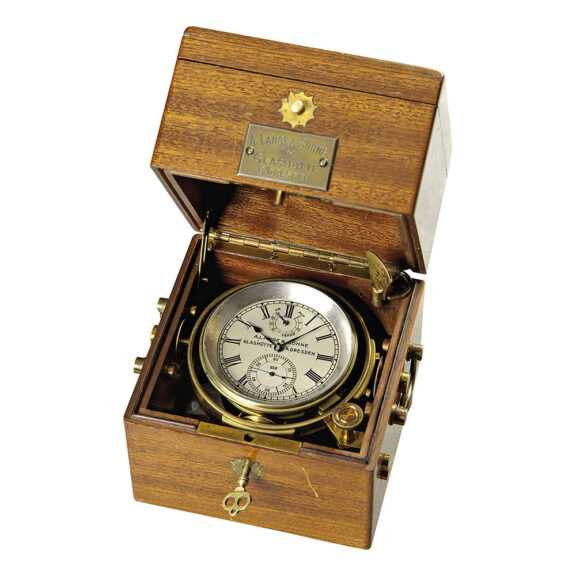
Small German 54h power reserve torpedo boat chronometer Circa 1913
- Kenmerk
- DB0014
- Diameter
- -
- Estimate
- € 12.500 - 20.000
- Price sold
- € 18.400
Chronometer in mahogany box by A. Lange & Söhne
–
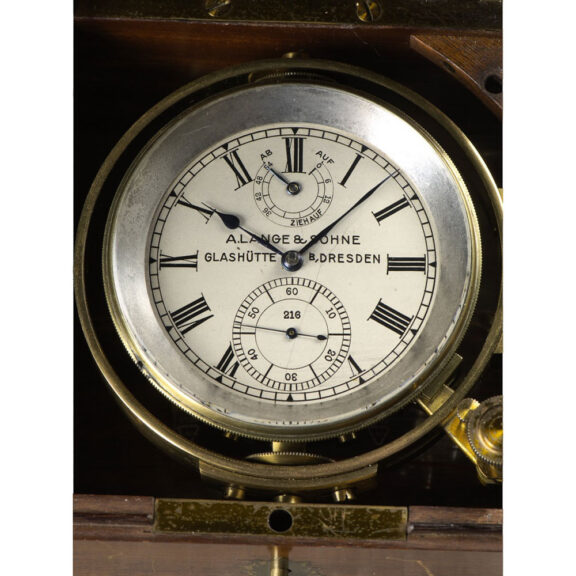
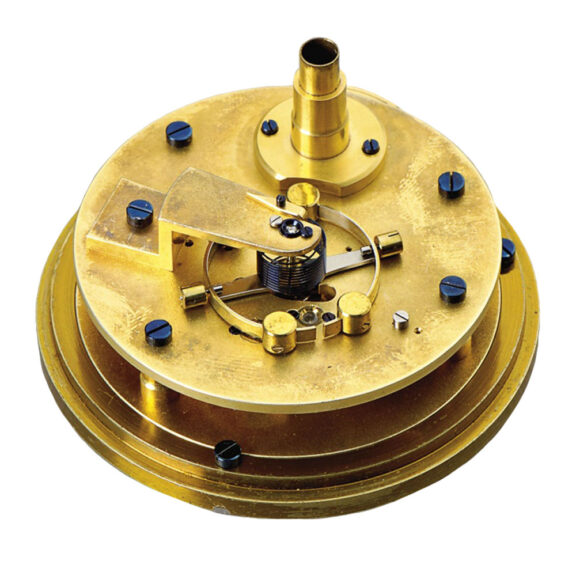
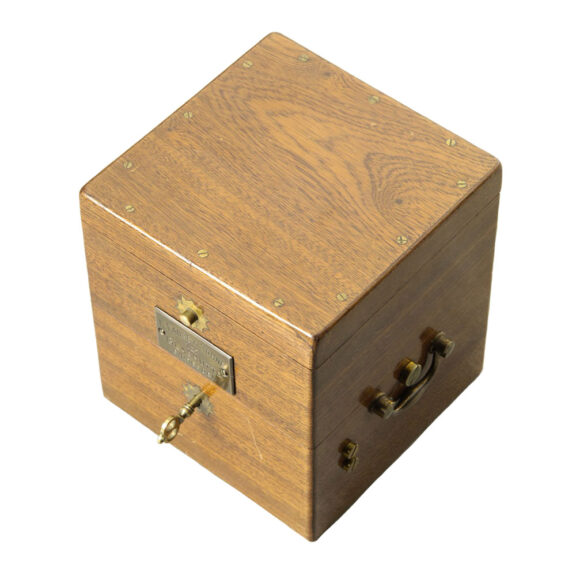
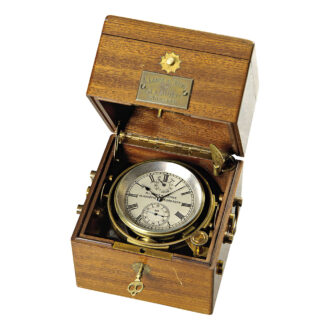
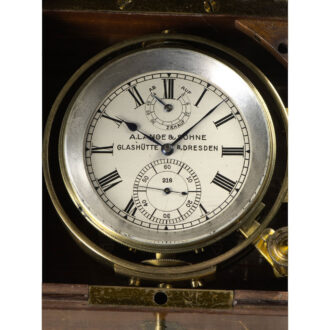
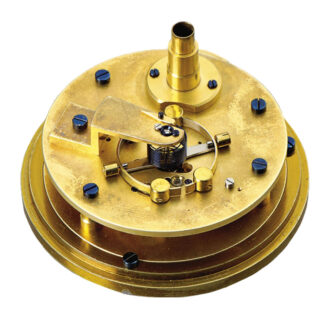
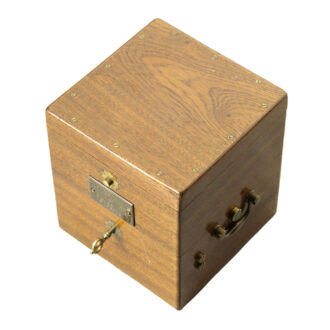
A rare and small German torpedo boat chronometer with 54-hour power reserve, circa 1913. Sold on November 30, 1914, to the hydrographic department of the k.u.k. Kriegsmarine in Pola for the sum of 560 Marks. Frosted gilt-brass movement, 56 mm, going barrel, spring detent escapement according to Thomas Earnshaw, nickel-steel Guillaume balance, two screws and four weights. Silvered dial with Roman hours and outer minute divisions, 54h power reserve indication at 12 o’clock, subsidiary seconds at 6. Fitted in a mahogany box. Dial signed, case No. 216 and movement No. 127. Comes with an Extract from the archives.
–
Dimensions: 130 x 145 x 130 mm
–
Signed: A. Lange & Söhne Glashütte B/Dresden
–
Chronometer No. 127 was sold to the Hamburg-American Line on August 13, 1913, for 800 mark. It is yet unclear why its mahogany case today holds the numbered movement and case of chronometer No. 216, sold to a completely different part of the world – to Pula, which is today part of the Republic of Croatia. At the time Pula was an important naval and commercial harbour of the Austro-Hungarian Navy with dry and floating docs, laboratories and depots as well as the Hydrographic Office, which created surveys based on their collected hydrographic data. An almost illegible French customs document that comes with the timepiece does not provide any further information on this mystery either.
–
This small-size chronometer is part of a series of torpedo boat chronometers Lange & Söhne produced from 1911 on at the behest of the Imperial Naval Office in Berlin. No more than 65 of them had been produced by 1933. In R. Meis: A. Lange & Söhne, 1997, Reinhard Meis quotes a brochure dating from 1920, which states: “The small size marine chronometer has the same advantages as our large size marine chronometers but is fitted with a simple barrel without fusee”. Lange & Söhne only produced torpedo boat chronometers again near the end of World War II, those, however, were based on the category B pocket watch calibre 48.
–
Ferdinand Adolph Lange was the founder of A. Lange & Söhne. He was born in 1815 as the son of Johann Samuel Lange. Early in life, his parents separated and he was adopted by a foster family. Luckily this family offered him a chance at proper education and in 1829, he joined the Technical University of Dresden. Lange’s master was Christian Friedrich Gutkaes, the maker of the famous five-minute clock in the Dresden Opera House and the court watchmaker later on. Lange finished his apprenticeship with honours and went on to work with Gutkaes as his assistant for more than two years. In 1837, Lange decided he wanted to learn the watchmaking craft from the best of the time and this decision took him to Paris, Switzerland and England. He spent four years with the master watchmaker Winnerl, a student of Breguet, in Paris. Lange returned to Dresden in 1841 and took over his now father-in-law Gutkaes’ business in 1842. He had the ambition to bring prosperity to the once rich, now unfortunate Erzgebirge region, Glashütte, he wanted to build a watchmaking industry and create jobs. He received funding from the high council of Saxony and on December 7th, 1845, Ferdinand Adolph Lange founded A. Lange & Cie. He started with fifteen young men who were obliged to work with him for at least five years and following Lange encouraged his apprentices to found their own specialized firms in Switzerland. He set up a watchmaking cluster in the region along with his colleagues Julius Assmann, Adolf Schneider and Moritz Grossmann. At the time, there was a specialist for every part, producing individual pieces of the highest quality. Ferdinand Adolph developed numerous mechanisms, from the remontoir to dead-seconds and repeaters and he introduced the metric system to watchmaking. Eventually, it took Glashütte watchmaking 20 years to develop. After two successful decades and as the mayor of Glashütte Ferdinand Adolph Lange retired in 1868. He enjoyed his spacious house built adjacent to the factory, which today serves as the headquarters of the modern A. Lange & Söhne. He gave the reigns of his legacy to his sons Richard and Emil Lange, subsequently, the company’s name was changed from A. Lange & Cie to A. Lange & Söhne. Under their management A. Lange & Söhne expanded tremendously. Ferdinand Adolph Lange died in 1875.
Signed: A. Lange & Söhne Glashütte B/Dresden
Share this page: