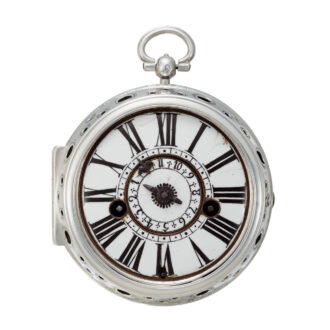
Swiss gold chronometer with detent escapement Circa 1985
- Kenmerk
- SB0634
- Diameter
- 56 mm
- Estimate
- € 100.000 - 200.000
- Price sold
- € 313.100
Gold minute repeating chronometer by Patek Philippe
–
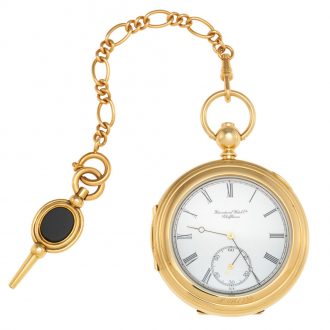
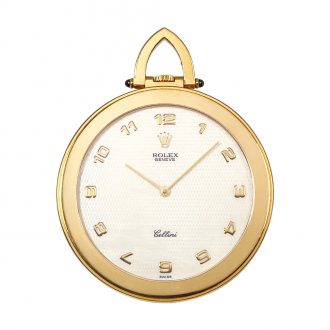
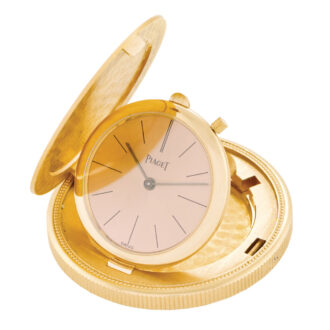
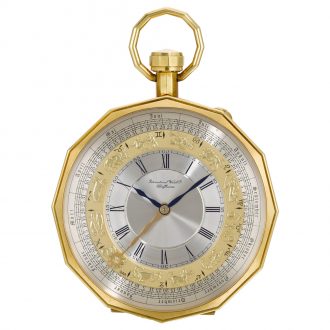
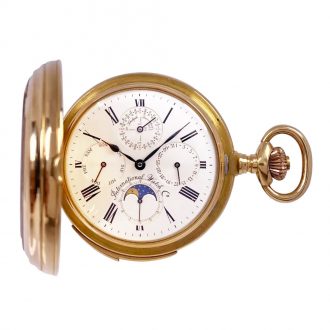
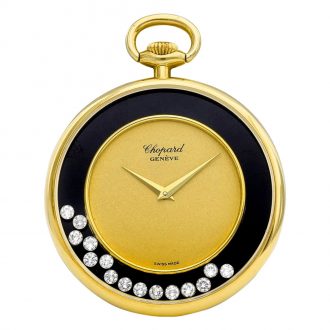
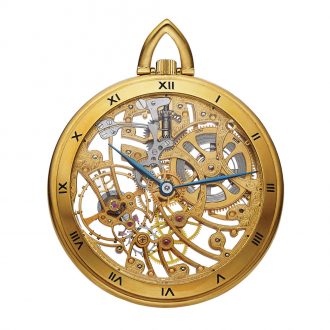
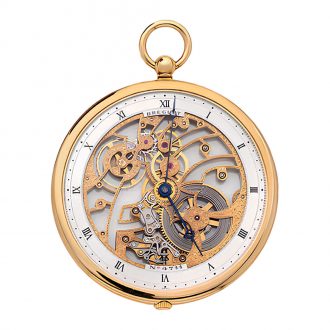
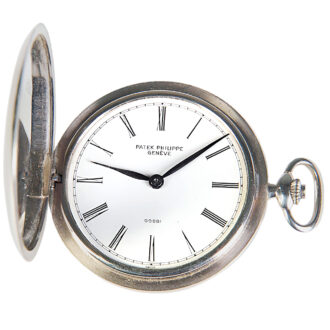
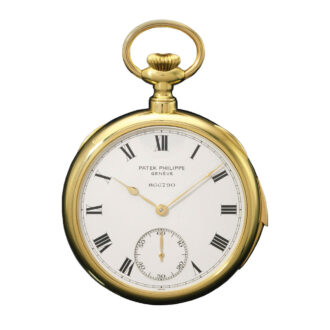
This is an exceptionally fine and rare Swiss pocket chronometer from around 1985, in 18-carat gold with an open face. It is a minute repeater with a detent escapement and is wound by the crown.
–
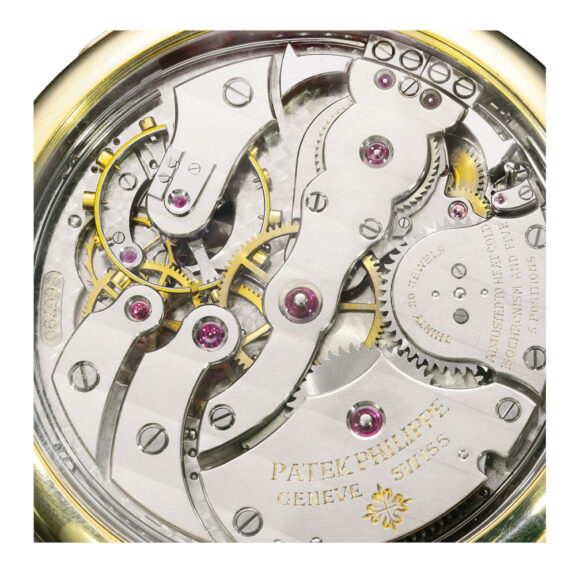
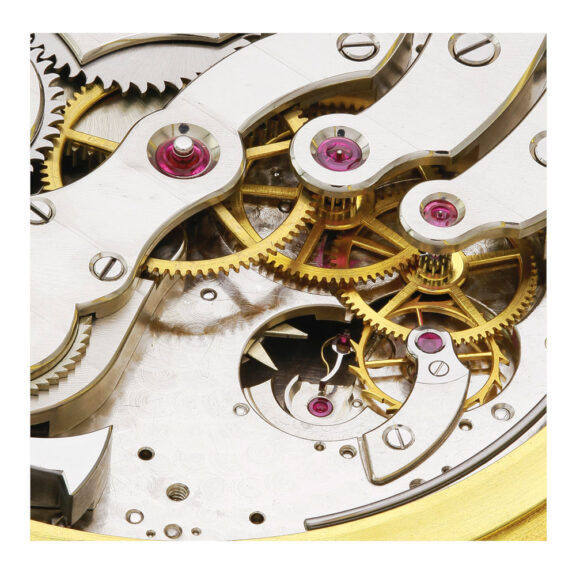
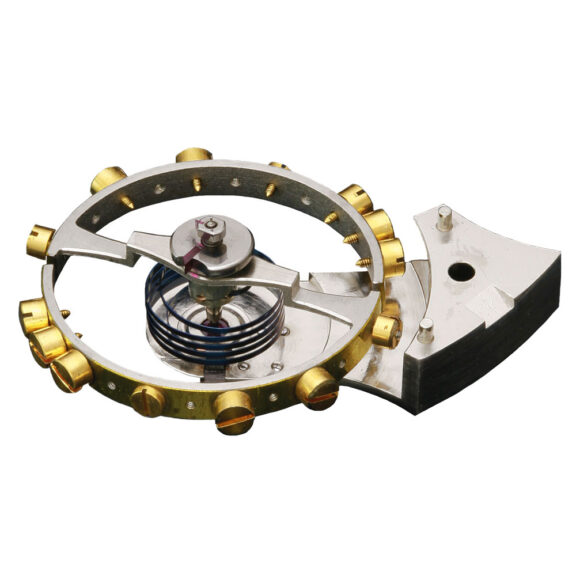
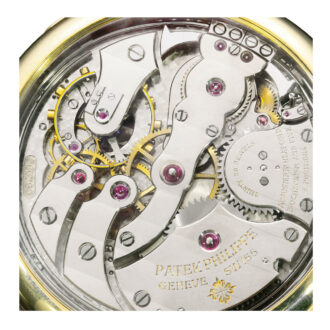
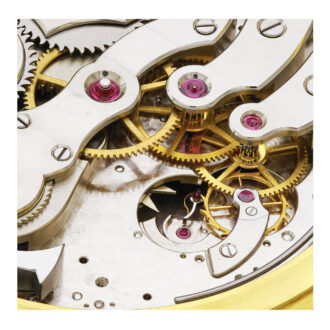
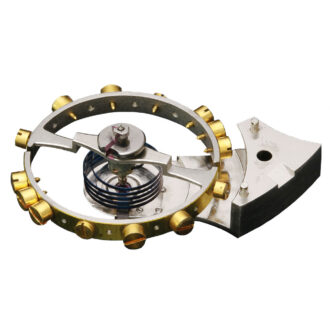
The hand-wound movement is made of nickel and has 30 jewels. It uses a detent chronometer escapement and a two-metal balance that corrects for temperature. The blued steel balance spring is a helix and runs free-sprung, without a regulator. The watch chimes the minutes on two steel gongs.
–
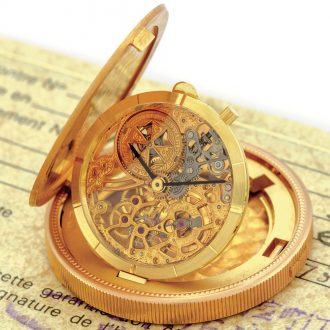
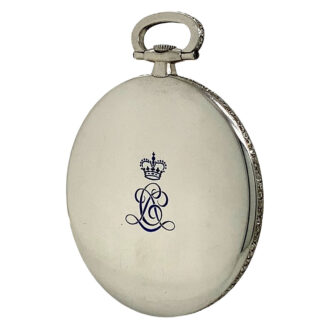
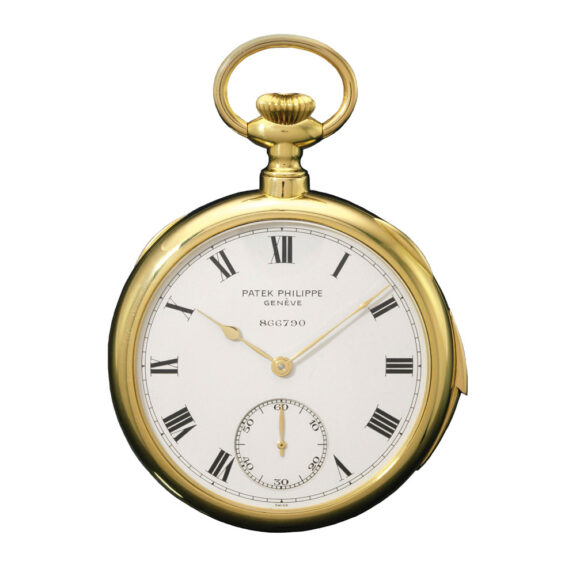
The silvered dial has Roman numerals, a minute track around the edge, a small seconds dial and gold spade-shaped hands. The case is polished, with a hinged sapphire crystal back that shows the movement and a slide on the side to start the chiming. The case, dial and movement are all signed.
–
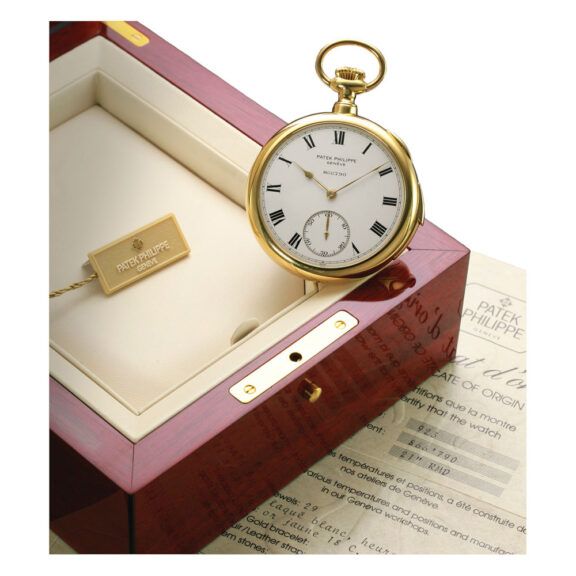
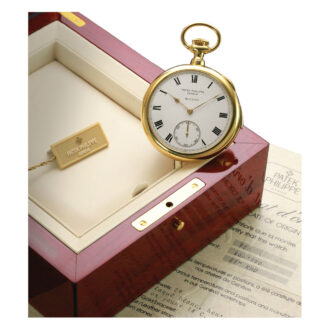
The watch comes with its Certificate of Origin, an Extract from the Archives confirming its sale on 3 April 1989, a presentation case and a hang tag.
–
Diameter: 56 mm
–
Signed: Patek Philippe Genève Swiss
–
The watch
This superb pocket chronometer was purchased from the famous Milanese retailer, Orologeria Luigi Verga in 1989, during the 150th anniversary of Patek Philippe. The watch is in immaculate condition having spent almost a quarter of a century in a safe with its original accessories: Certificate of Origin, presentation case and swing tag. Our research shows that this magnificent watch’s original retail price for the Italian market, in 1989, was 400.000.000 ITL (today approximately 200.000 euros).
–
Reference 923
An exceedingly rare reference, the 923 was displayed at the Basel fair in 1986 and only two examples were made each one being different in size with a specific dial for each example, the present watch being the largest one of the two examples known of reference 923.
–
The detent escapement at Patek Philippe
During the final 20 years of the twentieth century Patek Philippe started to case and complete a small number of movements with detent escapements (numbers 866’xxx). This extremely limited production appears to have consisted of no more than 2 movements every 3 years. At the present time only 31
–
Patek Philippe movements with detent escapement are known and according to research:
–
Signed: Patek Philippe Genève Swiss
–
The watch
This superb pocket chronometer was purchased from the famous Milanese retailer, Orologeria Luigi Verga in 1989, during the 150th anniversary of Patek Philippe. The watch is in immaculate condition having spent almost a quarter of a century in a safe with its original accessories: Certificate of Origin, presentation case and swing tag. Our research shows that this magnificent watch’s original retail price for the Italian market, in 1989, was 400.000.000 ITL (today approximately 200.000 euros).
–
Reference 923
An exceedingly rare reference, the 923 was displayed at the Basel fair in 1986 and only two examples were made each one being different in size with a specific dial for each example, the present watch being the largest one of the two examples known of reference 923.
–
The detent escapement at Patek Philippe
During the final 20 years of the twentieth century Patek Philippe started to case and complete a small number of movements with detent escapements (numbers 866’xxx). This extremely limited production appears to have consisted of no more than 2 movements every 3 years. At the present time only 31
–
Patek Philippe movements with detent escapement are known and according to research:
• Between 7 and 8 movements have never been cased
• 5 Movements are known to incorporate quarter repetition
• 1 Movement with minute repeater (present watch) plus between 9 and 12 movements
• 5 Movements are known to incorporate quarter repetition
• 1 Movement with minute repeater (present watch) plus between 9 and 12 movements
with starting number 866’xxx
• 3 Deck marine chronometers
• 2 Detent escapement movements with Tourbillon
• 3 Deck marine chronometers
• 2 Detent escapement movements with Tourbillon
–
The complexity and skill required to produce the detent escapement has resulted in historically low production numbers. It is interesting to note that, by comparison, 93 tourbillon movements are known to have been cased as pocket watches by Patek Philippe, three times the number of detent movements known.
–
The chronometer: It is to Pierre Le Roy, son of the famous French watchmaker Julien Le Roy, that we owe thanks for the three fundamental principles that led to the development of the modern chronometer timepieces:
–
1. The free escapement
2. The self-regulating balance
3. The isochronous hairspring
2. The self-regulating balance
3. The isochronous hairspring
–
Pierre Le Roy described his free escapement in his writings of 1748, published in the History of the Academy of Sciences, and put it into practice in 1763. Comparing the two versions shows how much the design changed. The changes reflect the huge effort Le Roy put in over those years to combine a free escapement with two other goals: making the balance swing at an even rate, and correcting for changes in temperature.
–
In his Précis des recherches of 1768, Le Roy mentioned a work he had first announced in 1750: an essay on the physics and dynamics of springs, which was never published. The manuscript shows that by then his research into friction, the elasticity of springs and the way metals expand with heat had already led him to design an early equalizing device and a mechanism to correct for the effect of temperature on watches.
–
Le Roy presented many papers on watches and clocks to the Academy, but his work on marine timekeepers is so important that he can truly be called a genius. In 1748 he designed a detent escapement. The drawing, published by Gallon in Machines et inventions approuvées par l’Académie Royale des Sciences, does not fully explain how it worked. It does, however, show the first attempt at an escapement that left the balance completely free to swing, except at the brief moments of unlocking and impulse.
–
Once his escapement gave the balance this freedom and regularity, Le Roy discovered that any balance spring of sufficient length has a particular length at which all its swings, large or small, take the same time. This is called isochronism. Changing the length of the spring to correct for temperature would upset this, so the correction had to be made on the balance itself. He therefore designed a round, split balance made of two metals. Because the metals expand at different rates, the sections of the rim bend inward or outward as the temperature changes, and this cancels out its effects.
–
Building on Le Roy’s ideas, John Arnold and then Thomas Earnshaw made the first truly practical marine chronometers in England, which were used on British Navy ships. In France, Louis Berthoud and his pupil Henri Motel, said to be his nephew, used the same principles to build chronometers for the French Navy. The pivoted detent escapement later became widespread in Swiss watchmaking.
–
The retailer: Orologeria Luigi Verga
Luigi Verga opened his first shop in 1947, close to Milan’s Duomo in Via Mazzini. Recognised as one of the world’s most prestigious retailers of fine watches, Luigi Verga remains a family business. Luigi Verga’s son, Valerio, began working for his father when he was just fifteen years of age and Valerio’s own children, Umberto and Valeria, have followed in their father’s footsteps, both joining the family firm.
Signed: Patek Philippe Genève Swiss
Share this page: