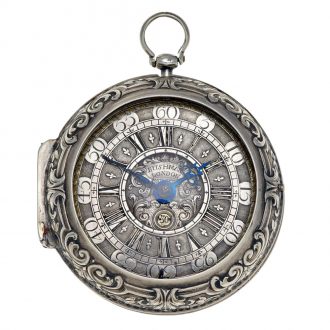
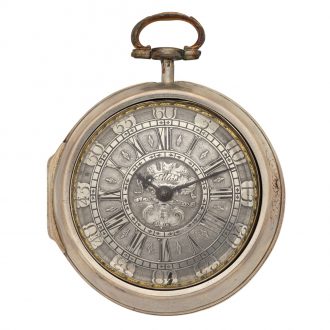
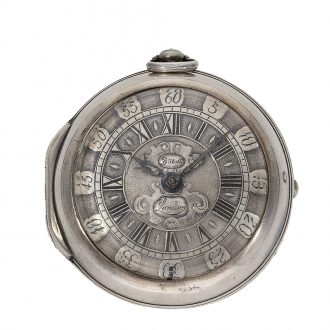
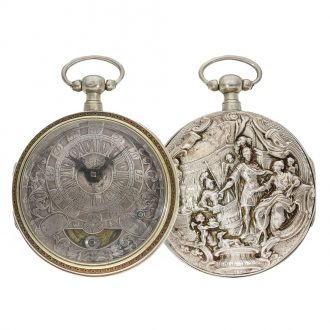
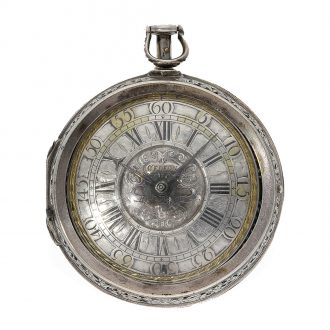
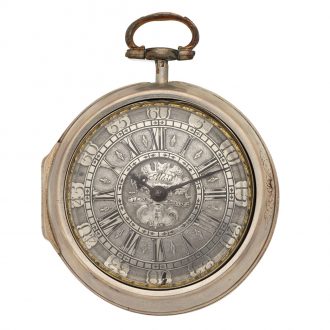
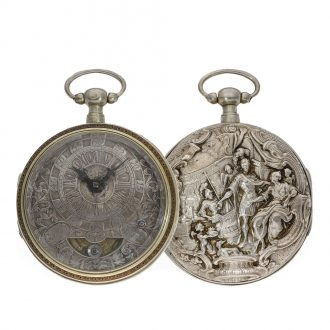
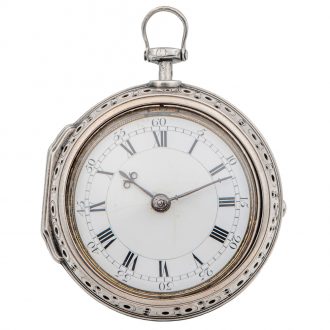
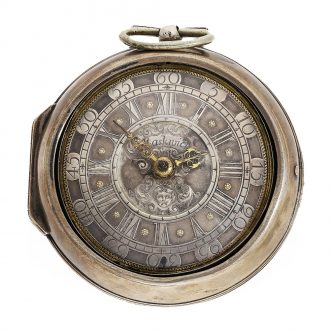
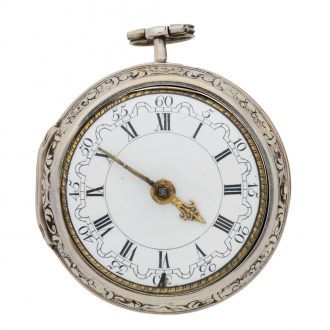
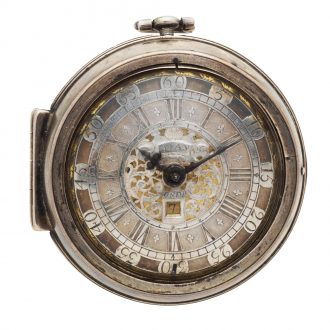
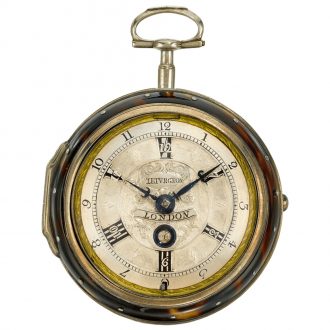
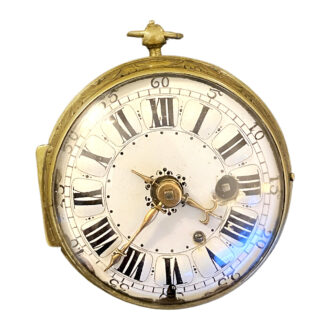
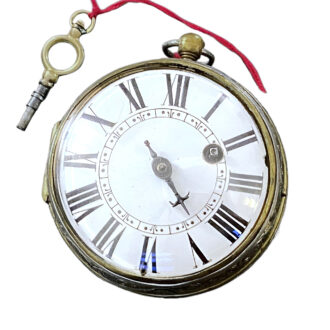
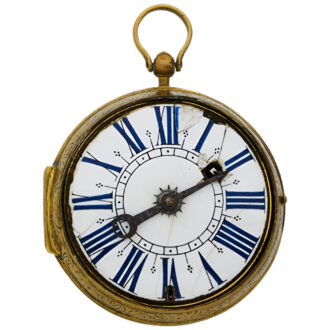
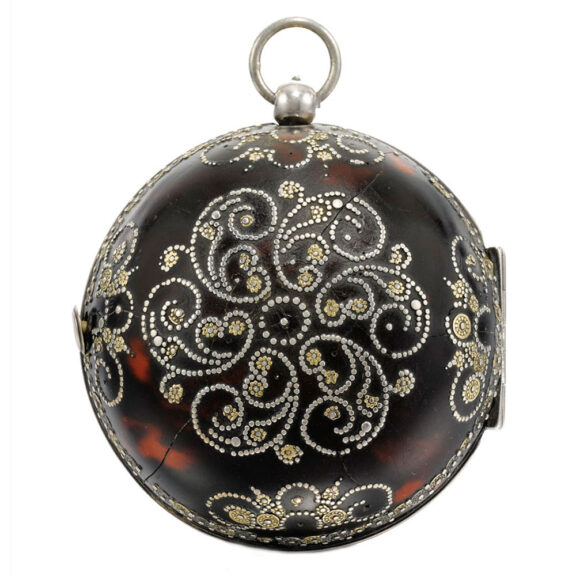
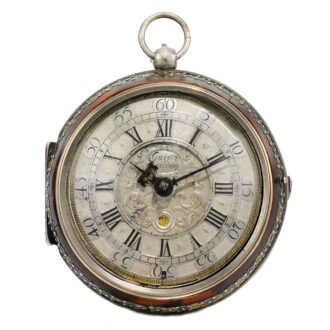
Verge tortoiseshell, date and mock pendulum Circa 1700
- Kenmerk
- SA0412
- Diameter
- 57 mm
- Estimate
- € 6.500 - 12.000
- Price sold
- -
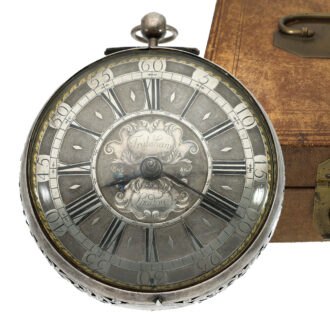
Tortoiseshell verge watch with date and mock pendulum
–
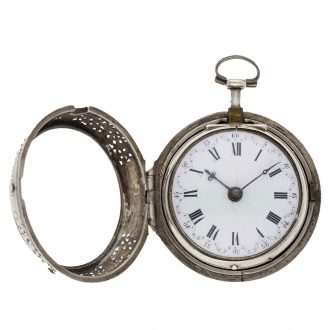
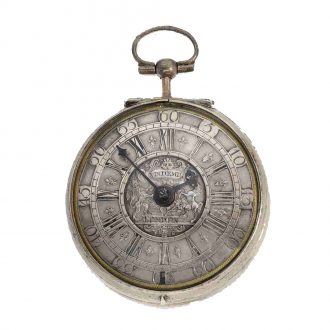
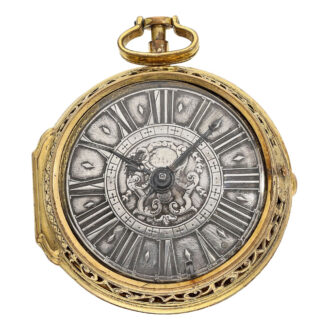
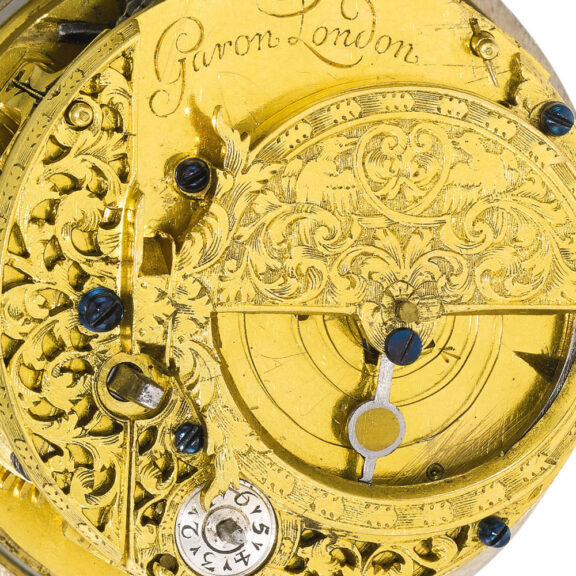
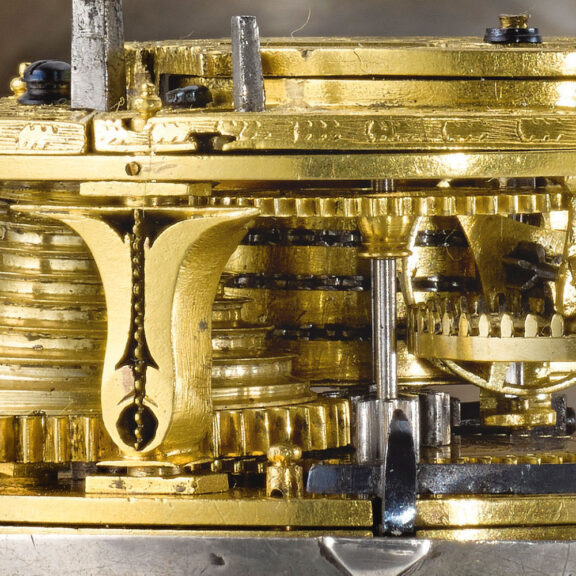
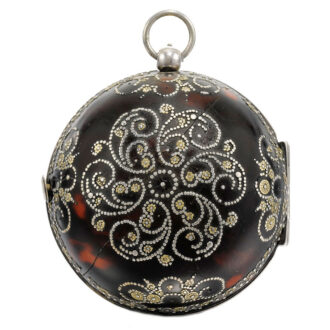
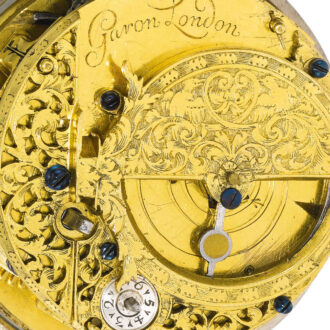
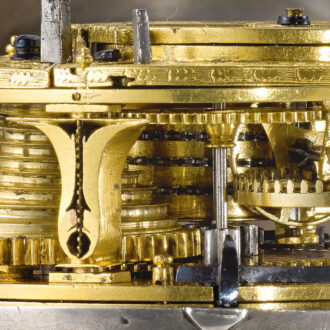
An English fine and rare silver and tortoiseshell pair cased verge watch with date, the balance with mock pendulum, circa 1700, gilded full plate movement, verge escapement, large balance cock decoratively engraved with foliage and birds and with semi-circular aperture revealing the balance in the form of a mock pendulum with spring, pierced and engraved foot, fusee and chain, tulip pillars, signed Garon, London.
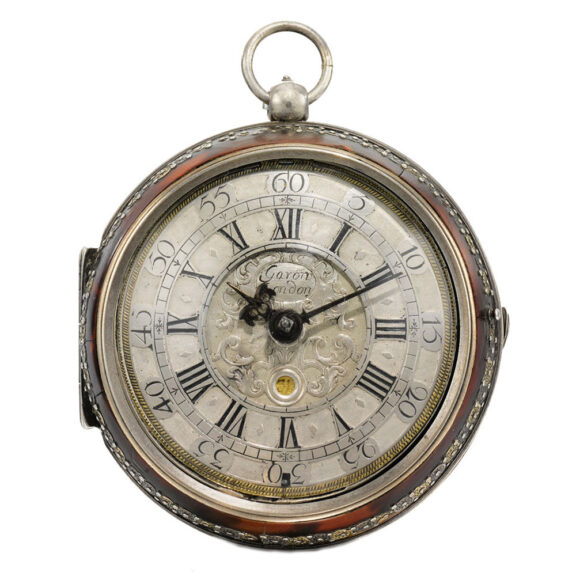
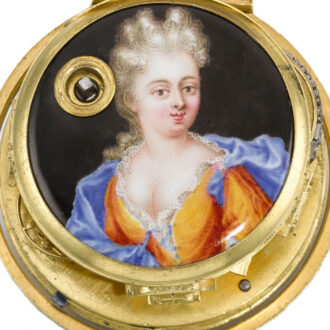
Silver champlevé dial, Roman numerals with half hour divisions between and to the ring beneath, outer Arabic minute ring, date aperture with gilded ring above 6 o’clock, blued steel tulip and poker hands, outer gilded ring, cartouche to the centre signed Garon, London with scrolling foliage beneath.
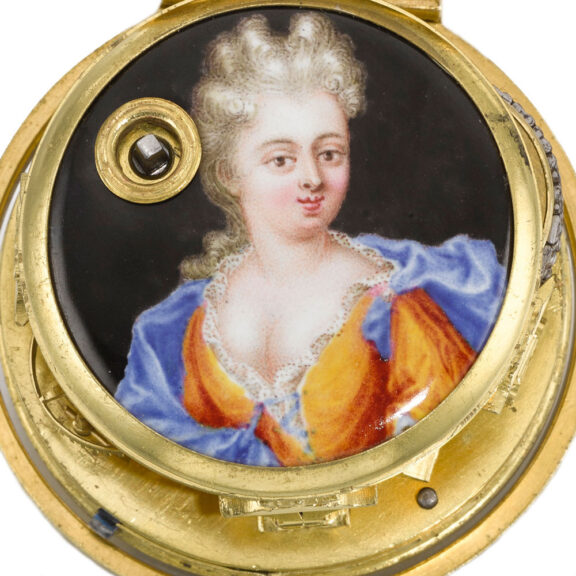
Plain silver inner case, the back with shuttered winding aperture, ring bow and pendant, tortoiseshell outer case with foliate scrolling silver piqué work with gilt flower heads, the bezels set with piqué roundels.
–
Diameter: 57 mm
–
Signed: Garon London
–
Although by the time this watch was made the balance spring had been widely adopted, the revolutionary improvement in timekeeping that it heralded must still have been a source of wonder in the early 1700s. Within this watch, Peter Garon has used his balance cock to produce an aperture through which the action of the balance and spring can be more fully admired by the addition of a ‘mock’ pendulum. Stylistically, the balance and cock table had become larger during the 1690s which perfectly lent itself to this special ‘pendulum’ arrangement. Not only must this attractive visual arrangement have been of use to the salesman of 1700, but so too must it have brought pleasure to the owner whenever he opened up his watch.
Peter Garon was born circa 1673 to Hugenot parentage and apprenticed to Richard Baker until 1694. Brian Loomes in his book, The Early Clockmakers of Great Britain, notes that Garon was initially refused freedom of the Clockmakers’ Company as he was deemed an ‘alien’, but was later granted freedom of the City by the Lord Mayor and finally made a Freeman of the Clockmakers’ Company in August 1694. Garon appears to have worked at St. Bartholomew’s Lane End and later at St. Giles Cripplegate [op. cit. pp. 243-244]. F.J . Britten notes that Garon was declared bankrupt in the London Gazette of 1706 but he continued to work and his son, also called Peter, was apprenticed to him in 1713. Garon’s career finally ended in insolvency in 1723.
Signed: Garon London
Share this page: