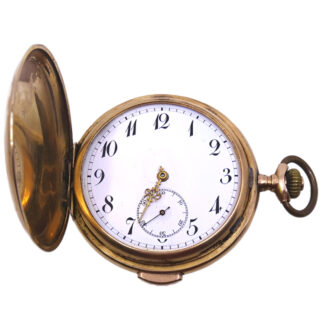
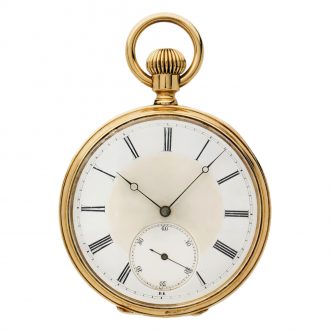
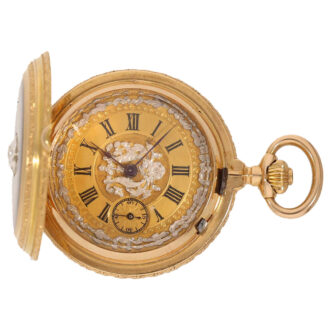
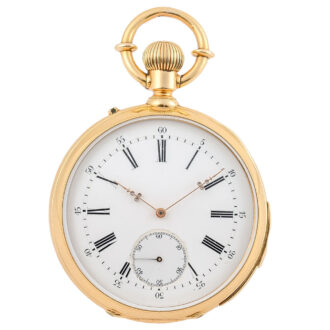
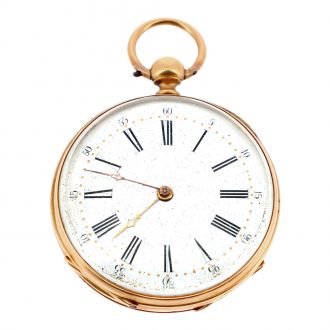
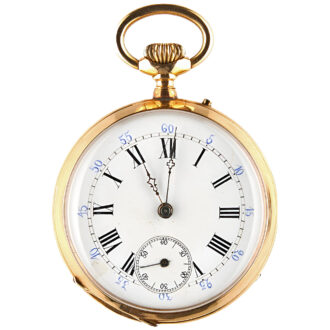
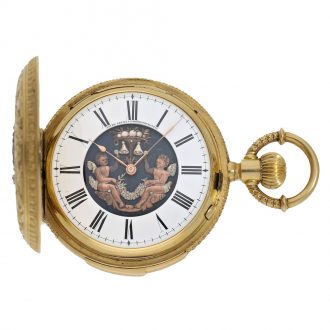
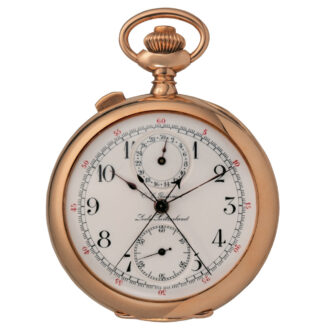
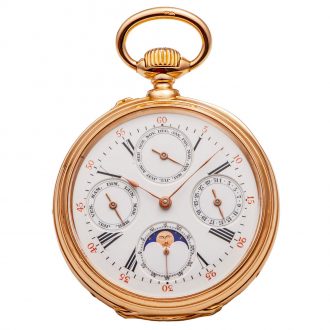
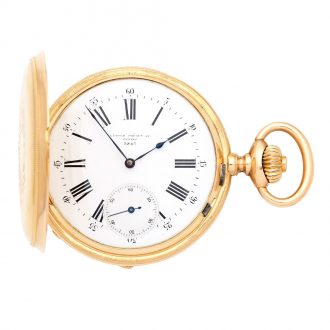
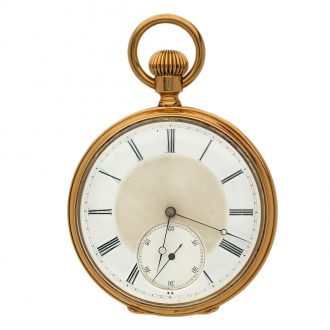
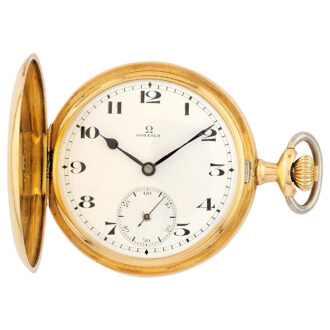
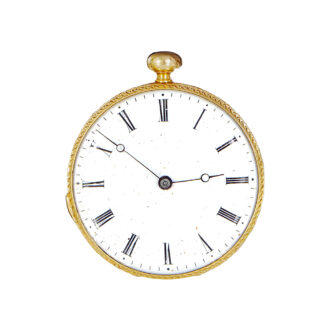
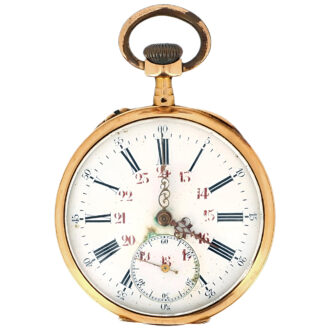
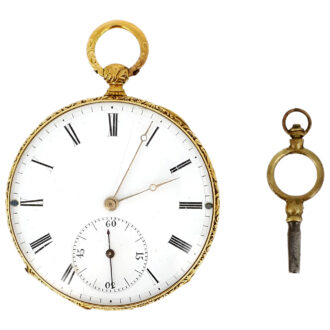
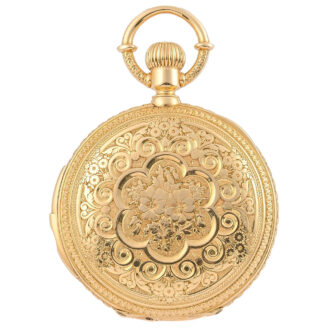
Swiss 18 carat gold floral engraved minute repeater Circa 1880
- Kenmerk
- TA5348
- Diameter
- 53 mm
- Estimate
- € 6.500 - 11.000
- Price sold
- € 4.700
Gold hunting cased keyless lever watch
–
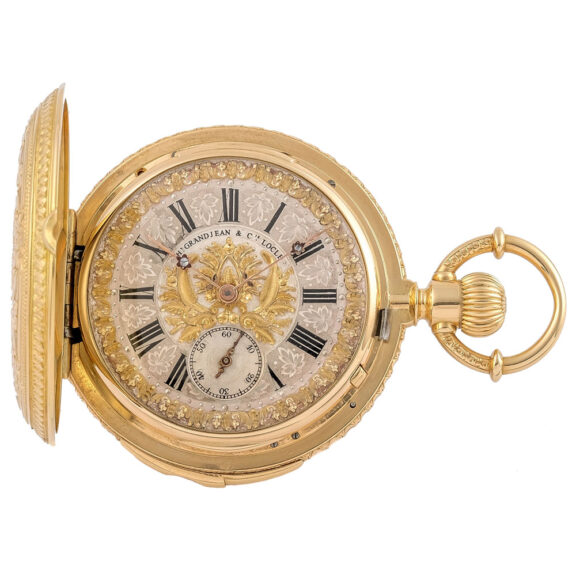
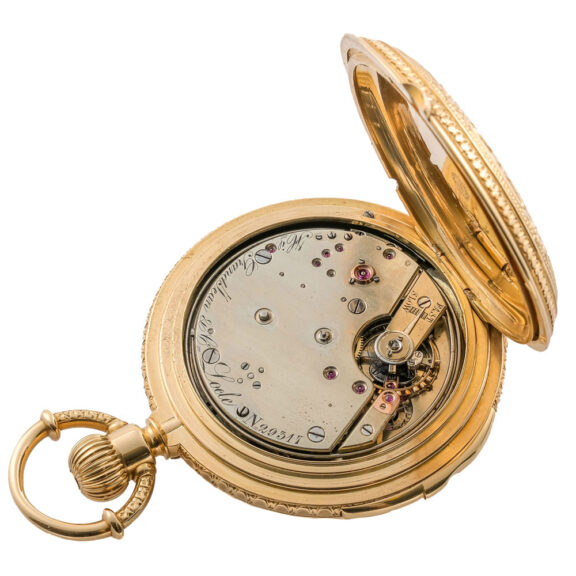
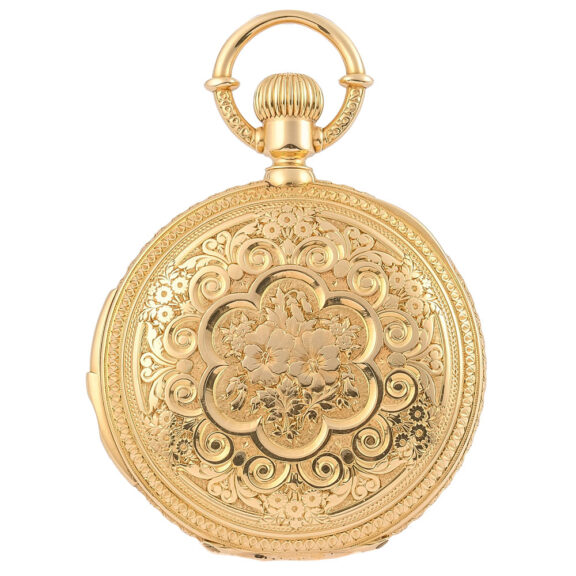
A Swiss 18 carat yellow gold hunting cased minute repeating keyless pocket watch made by Henri GrandJean & Co in Le Locle, circa 1880. Made for the Spanish or South American market. Minute repeating by two hammers on two steel gongs, activated by a slide located on the case band at 6 o’clock. Cover and case back chiselled and fine cut engraved with stylized foliage and geometric patterns, the front with an escutcheon and a further chiselled band. The case is made by L.G. in the Neuchâtel Mountains.
–
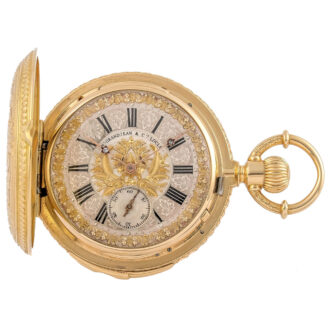
Silver satin dial with radial Roman hour numerals, the center and rim with varicoloured gold scrolled floral decoration and frieze, subsidiary seconds at 6 o’clock and gilded metal, stone set flower hands. A nickel plated ¾ plate movement with going barrel, straight line lever escapement, cut bimetallic compensated balance with gold poising screws and blued steel hairspring with terminal curve, polished steel index regulator and repeater work on the main plate, under the dial. Signature on the dial, case, cuvette and movement.
–
Diameter: 53 mm
–
Weight: 145 g
–
Signed: Henri GrandJean & Co. Le Locle
–
Henri Grandjean, Swiss chronometer maker, active in Le Locle and London. From 1824 until 1830, he was assigned the task of organising the South American branches of his father’s company; in 1830, his brother Henri-Gustave Grandjean emigrated to Peru and was from then on in charge of these businesses. Henri Grandjean trained as a watchmaker in his hometown. Around 1830, his factory, Henri Grandjean & Cie., began to build marine chronometers that were modelled on the English chronometers. His business partner was, at the time, Edouard Thévenaz. Together with Louis-Jean Richard and Ulysse Nardin, he was the originator of the Swiss marine chronometer production.
–
Along with Constant Girard (1825- 1903; later Girard-Perregaux), Henry Grandjean was also one of the first to enter the South American Market. In 1831, Grandjean married Elise Montandon, the daughter of Isaac-Pierre Montandon. He was granted permission to open watchmaking schools and founded the observatory at Neuchâtel. Later, Grandjean went into politics and became a representative and prefect of the city of Le Locle. In La Chaux de Fonds, he worked for the establishment of the Quartier-Neuf, which was finally built in 1855; his intention was to eliminate real estate speculation and to create low-priced housing for working-class families.
–
In 1851, at the first Universal Exposition in London, Grandjean received a First-Class medal. His list of medals continues until 1868, the year in which the company won an award for its marine chronometers. In the meantime, they also received at least eight different awards, not including those from the Observatory of Neuchâtel. In 1873, the company received in Vienna a Diploma of Honour (Gold Medal) and the Merit Medal.
–
Henry Grandjean died in 1879, but it appears that the company continued for the next twenty years until 1899, the year in which Rossel & Fils registered their name as successors, who were also most likely running the company during these 20 years. On January 9, 1908, Rossel & Fils transferred the title to Charles-Ferdinand Perret. A street in Le Locle was named after him, ‘the rue Henri Grandjean. The watch with a tourbillon carriage was the ultimate in precision timekeeping. During the 1920s and 1930s, James Casar Pellaton was the most esteemed maker of tourbillon carriages, which he supplied to the most prestigious companies, including Patek Philippe, Vacheron Constantin, Girard-Perregaux, and Ulysse Nardin.
Signed: Henri GrandJean & Co. Le Locle
Share this page: