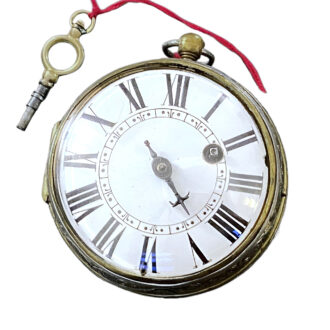
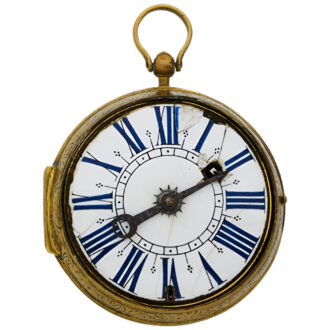
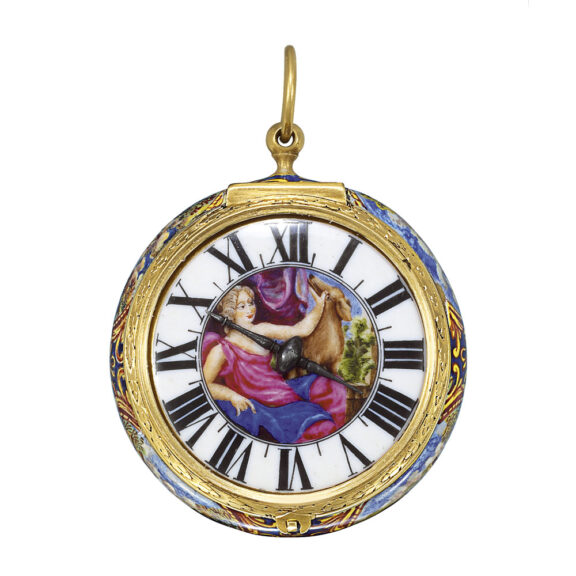
English 20 Carat gold single handed pendant watch Circa 1680
- Kenmerk
- TA2063
- Diameter
- 39 mm
- Estimate
- € 15.000 - 35.000
- Price sold
- € 10.800
Gold open faced verge pocket watch
–
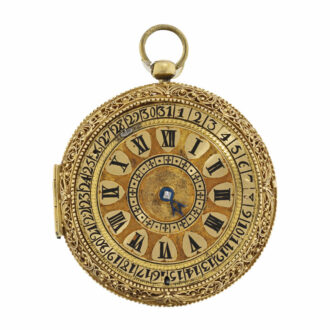
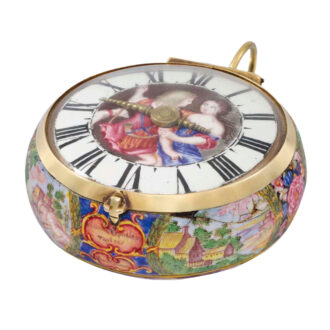
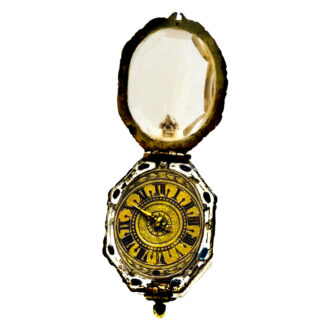
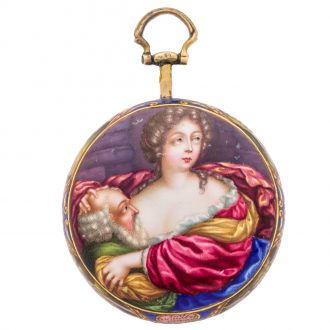
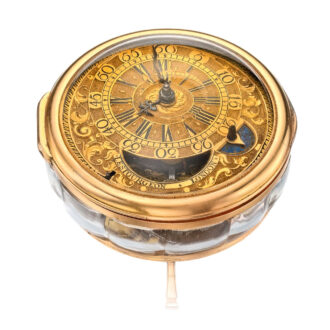
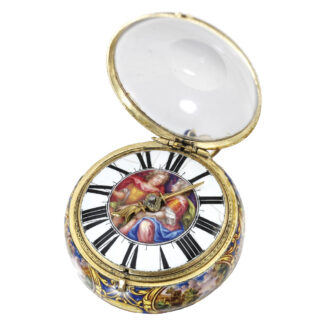
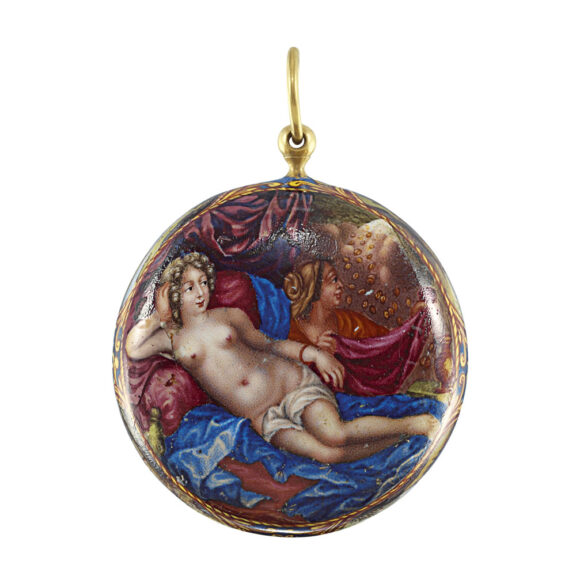
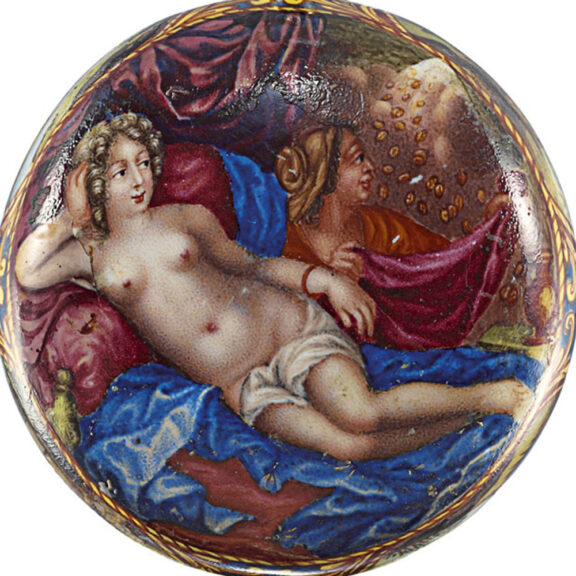
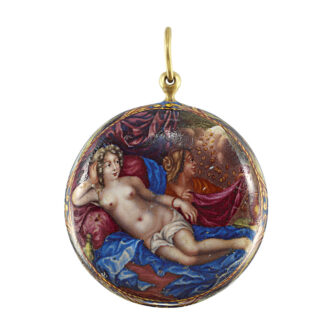
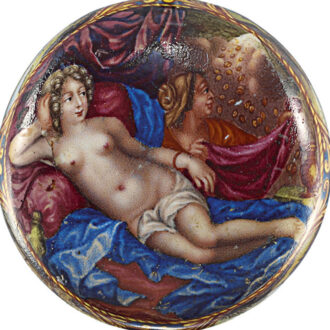
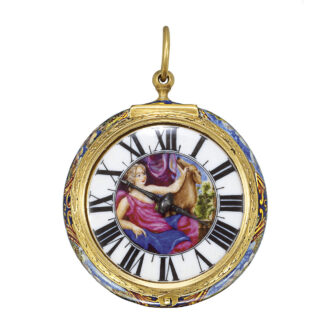
A fine English 20K gold and enamel single hand pre balance spring pendant watch, circa 1680. Danaë and the golden rain by James Wightman. The case with a curved edge, a polychrome enamel scene on the back with a nude reclining Danaë in the foreground and a servant in the background catching gold in a cloak as golden rain falls from the sky, the inside painted with lakeside ruins and a passing traveller, four vignettes on the band with rural landscapes, the bezel with engraved stylized leaves, loose ring pendant, the enamel attributed to Pierre II Huaud.
–
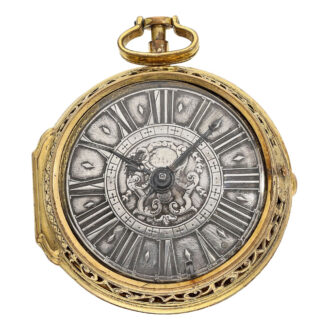
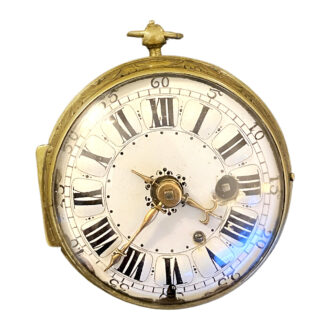
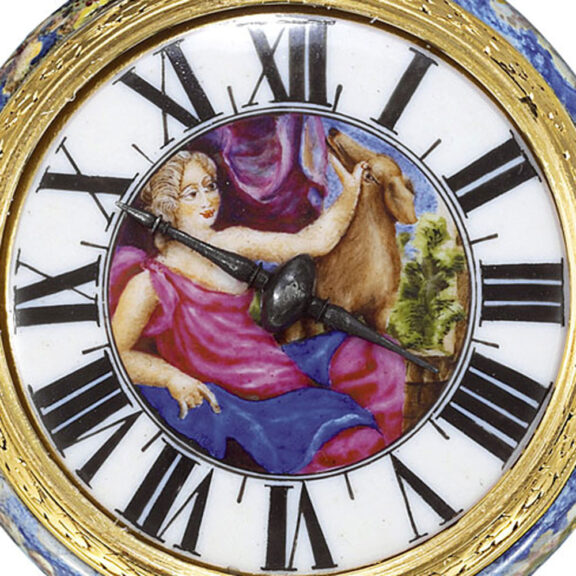
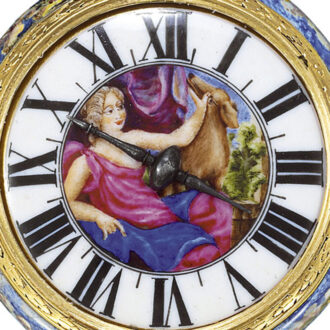
Enamel on gold dial, radial Roman hour chapter on white enamel annular ring, the centre painted on enamel depicting Diana and her dog and steel poker hand. A gilded hinged full plate movement, fusee and cat gut, short three wheel train, circular steel foliot, irregular pierced and engraved cock secured by a screw, ratchet wheel mainspring set up with pierced and engraved gilt brass elaborate click. Movement signed.
–
Diameter: 39 mm
–
Signed: James Wightman London
–
The case is restored by the manufacturer and the dial is re-gilt.
–
James Wightman. At the end of the 17th century, there were two known watchmakers named Wightman, John and William. John was apprenticed to Jonathan Jones in 1688 and free in 1696. William was apprenticed to the famous Joseph Windmills from 1686 to 1694. It is conceivable that James was the father of one or both of them.
–
Danaë and Jupiter. When Acrisius, king of Argos, learned from an oracle that his grandson would dethrone him, he had his only daughter Danaë imprisoned in a tower. Jupiter transformed himself into a shower of gold and impregnated Danaë, who gave birth to Perseus. Acrisius locked the mother and child in a chest which he cast into the sea. Danaë and Perseus are often considered to be the Greek counterpart of the immaculate conception.
–
Les Frères Huaut (or Huaud). The cases painted on enamel by ‘Les deux Frères Huaut’ were among the finest examples of their kind from the Geneva School and were not only highly valued when originally made, but remained as art treasures in the centuries that followed. Pierre I was the founder of the Huaud dynasty. He was born in 1612 in Geneva as the son of a French goldsmith Jean Huaud. He settled in Geneva in 1630 and three of his 11 children became famous enamellists like their father: Pierre II (1647-1698), Jean-Pierre (1655-1723) and Ami (1657-1724). The brothers were most likely trained by their father and worked with him. Pierre II started his own business around 1680. Jean-Pierre and Ami became partners in 1682 and were appointed painters to the Prussian court in 1686 when they moved to Berlin and started working for Elector Frederick William of Brandenburg (1620-1688). Among their most well-known works are Diana and Actaeon, The Judgement of Paris, The Holy Family, St. John the Baptist, The Nativity and The Adoration of the Shepherds.
Signed: James Wightman London
Share this page: