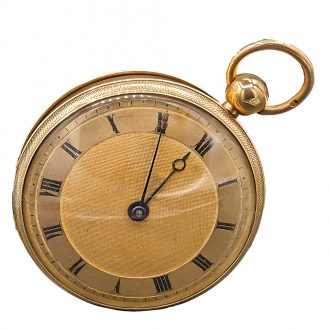
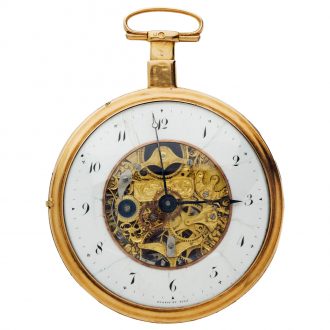
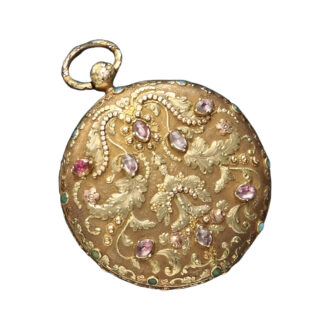
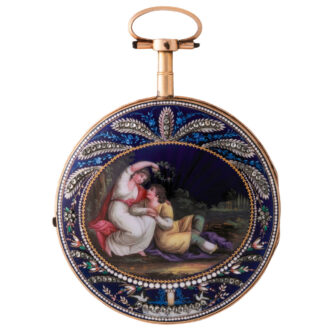
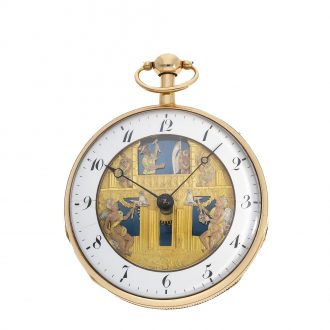
Swiss gold quarter repeating automaton watch Circa 1820
- Kenmerk
- TA4872
- Diameter
- 55 mm
- Estimate
- € 40.000 - 100.000
- Price sold
- € 81.400
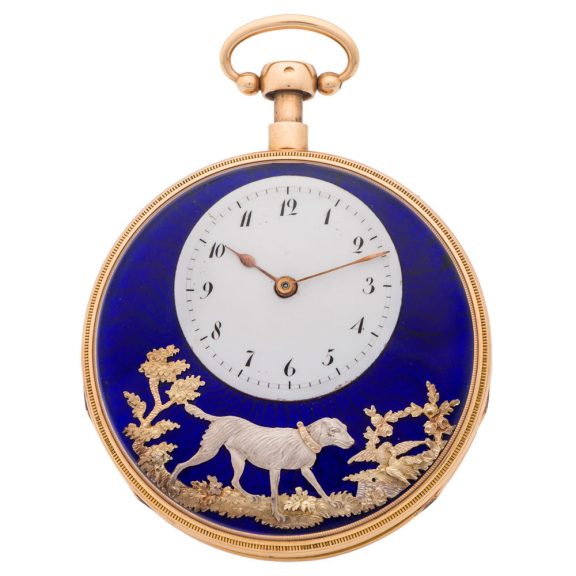
Gold cylinder watch with a moving dog
–
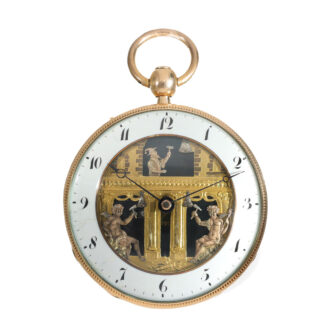
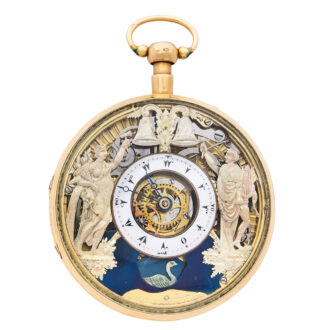
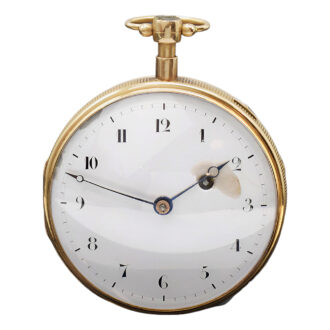
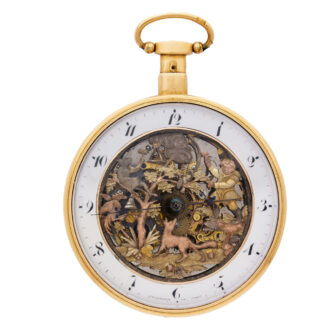
A Swiss 18 carat gold quarter repeating automaton watch so called the barking dog, circa 1820. An Empire case, polished back, reeded band, gold glazed hinged cuvette. White enamel dial, eccentric, set at the top of a dark blue translucent guilloché enamel plate, radial Roman numerals, outer minute track and Arabic quarter hour numerals and gold spade hands. Lower part with applied varicoloured gold and silver automaton scene of a dog barking at two billing doves in a floral arbour, the dog moves its head with each movement of the bellows, the whole on applied gold grass. Gilt brass, half plate movement, free standing barrel, cylinder escapement, steel escape wheel, plain three arm brass balance, flat balance spring. The repeating barking mechanism with a round bellows and whistle is activated by depressing the pendant. Punched on the movement with the maker’s trademark
–
Diameter: 55 mm
–
Signed: J.D. Piguet & P. Meylan Geneva
–
This watch repeats the hours and quarters with the sound of a barking dog; the rarest form of repeating. There are only approximately 20 Barking dog watches known. There is a controversy as to whether the company employed only one series of consecutive numbers or used separate series for certain types of watches. Although the numbers of Piguet & Meylan watches go up to the 7000s, the barking dogs numbers are lower than 300. It is possible that the company started its production with barking dog models, then proceeded to other ones, but continued the production of the barking dog watches with the first series numbers. The present lot was previously sold by Neumarkt on June 1, 1972.
–
Piguet & Meylan. Isaac Daniel Piguet and Philippe Samuel Meylan were in partnership from 1811 to 1828, and just before 182,8, their premises were 45, rue Rousseau in Geneva. Isaac Daniel Piguet was born in 1775 in Le Chenit in the Vallée de Joux. Isaac Daniel Piguet was the son of Pierre Moïse Piguet and Elisabeth Nicole. He married Jeanne Françoise Capt around 1795, and around 1800, settled in Geneva with his family. Isaac Daniel Piguet went into business with Henry Daniel Capt, his brother-in-law, on February 10, 1802. The association between Piguet & Meylan came to an end in 1828. Piguet and his son David Auguste established a new company, Piguet père & fils, located no 69 rue Jean-Jacques Rousseau. Isaac Daniel Piguet died in Geneva on January 20, 1841, at the age of 66. Philippe Samuel Meylan was born February 15, 1772, in Bas-du-Chenit, and died in 1845.
–
At 20 years old, he came to Geneva, where he worked for the Godemar Frères as a quality Master worker. Afterwards, he went back to Brassus, where he founded a little factory in 1811. He then returned to Geneva, where he definitively settled. He met another watchmaker from his own village, Isaac Piguet, with whom he entered into partnership, founding the Piguet & Meylan firm, which would last from 1811 to 1828. It specialised in minute cadratures, musical watches, skeleton or automaton watches, mechanical animals and figures, he is also credited with the invention of the bagnolet calibre. Isaac Daniel Piguet was Born in 1775 in Le Chenit in the Vallée de Joux. Isaac Daniel Piguet was the son of Pierre Moïse Piguet and Elisabeth Nicole. He married Jeanne Françoise Capt around 1795, and around 1800, settled in Geneva with his family. Isaac Daniel Piguet went into business with Henry Daniel Capt, his brother-in-law, on February 10, 1802.
–
The association between Piguet & Meylan came to an end in 1828. Piguet and his son David Auguste established a new company, Piguet père & fils, located at No. 69 rue Jean-Jacques Rousseau. He died in Geneva on January 20, 1841. Philippe Samuel Meylan was born February 15, 1772, in Bas-du-Chenit, died in 1845. At 20 years old, he came to Geneva where he worked for the Godemar Frères as a quality Master worker. Afterwards, he went back to Brassus, where he founded a little factory in 1811. He then returned to Geneva, where he definitively settled. He met another watchmaker from his own village, Isaac Piguet, with whom he entered into partnership, founding the Piguet & Meylan firm, which would last from 1811 to 1828. It specialised in minute cadratures, musical watches, skeleton or automaton watches, mechanical animals and figures, he is also credited with the invention of the bagnolet calibre.
Signed: J.D. Piguet & P. Meylan Geneva
Share this page: