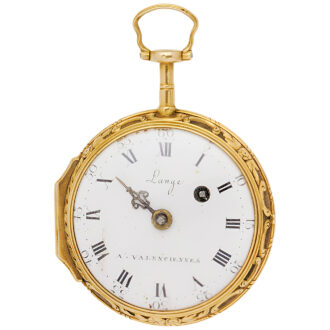
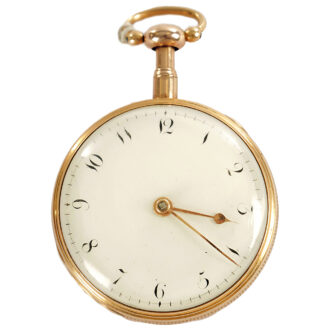
Swiss/English coach watch for the Chinese market Circa 1790
- Kenmerk
- AD9675
- Diameter
- 118 mm
- Estimate
- € 150.000 - 250.000
- Price sold
- € 230.550
Gilt metal, gold and enamel coach watch
–
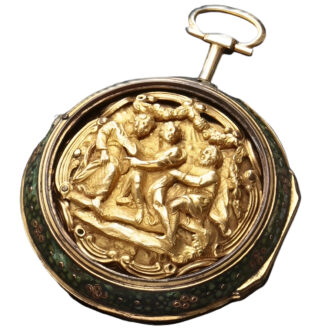
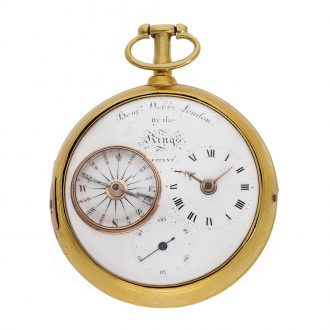
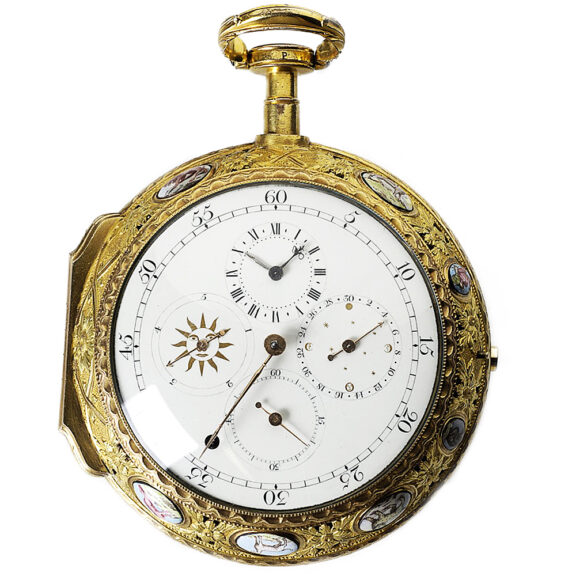
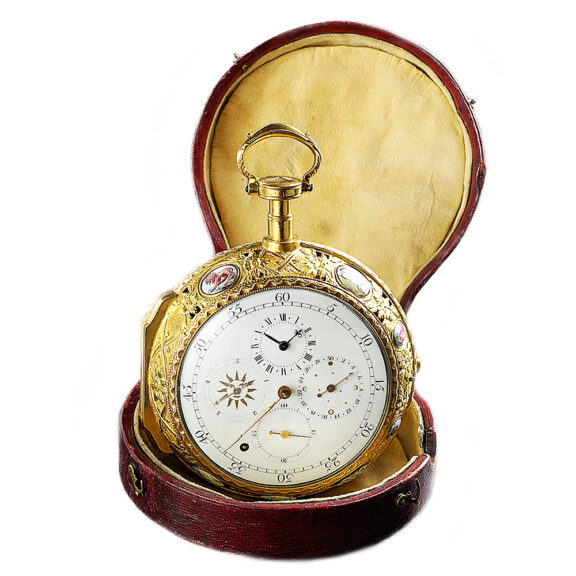
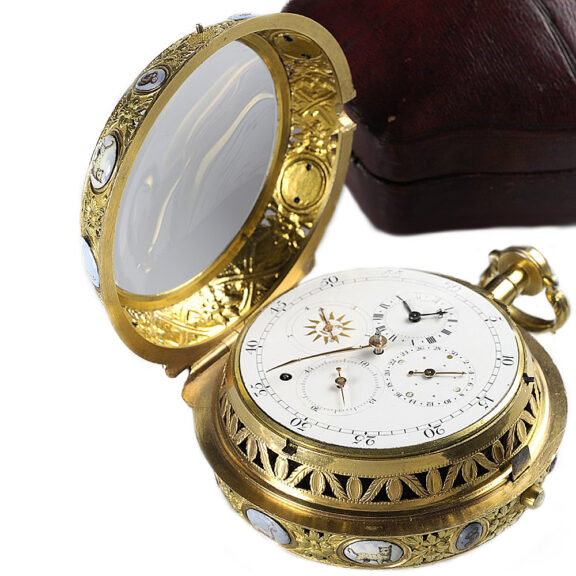
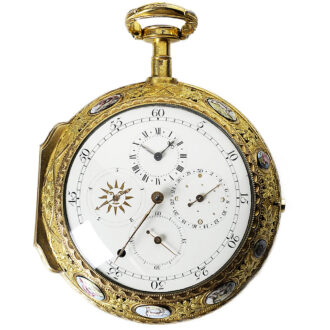
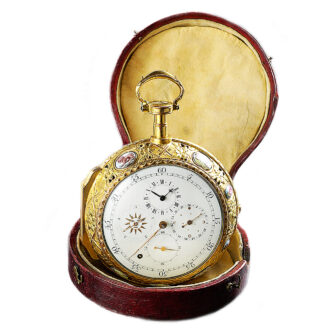
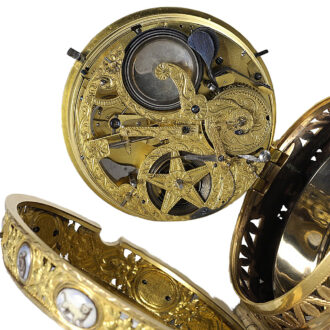
A rare and historically interesting Swiss/English gilt metal, gold and enamel open faced coach watch with astronomical regulator dial, quarter striking, music and alarm made for the Chinese Market, The Lion and the Lioness, circa 1790.
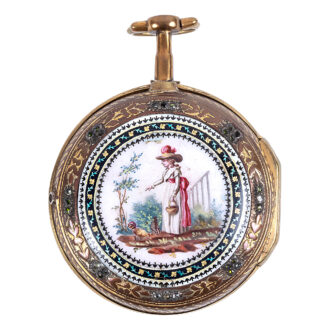
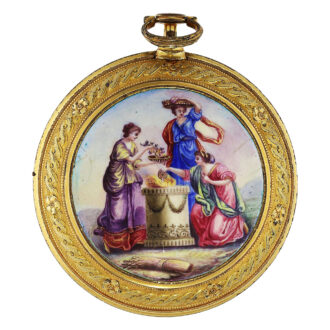
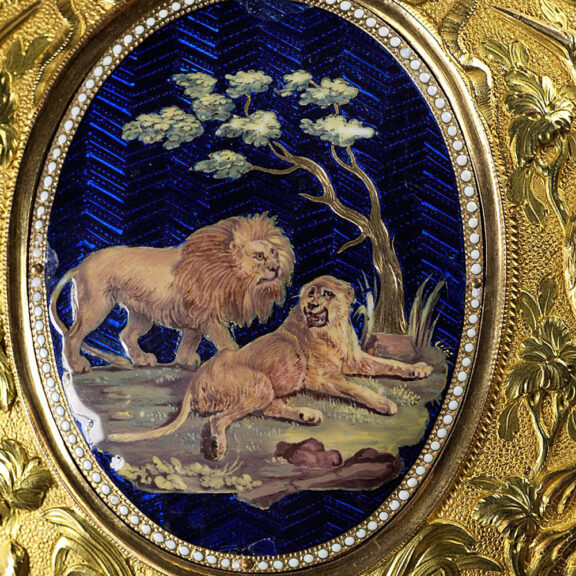
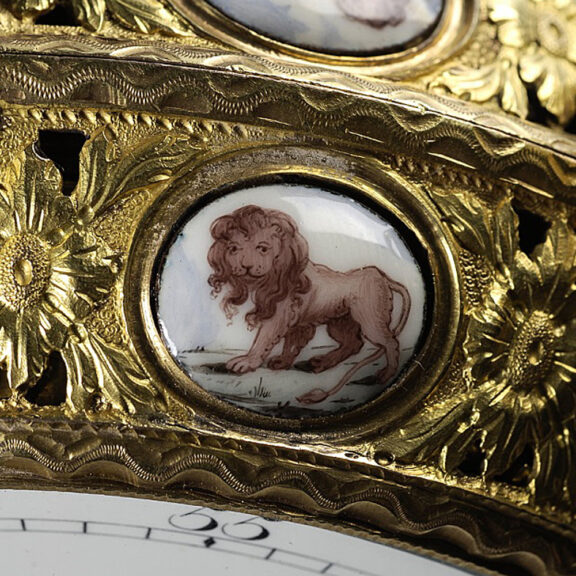
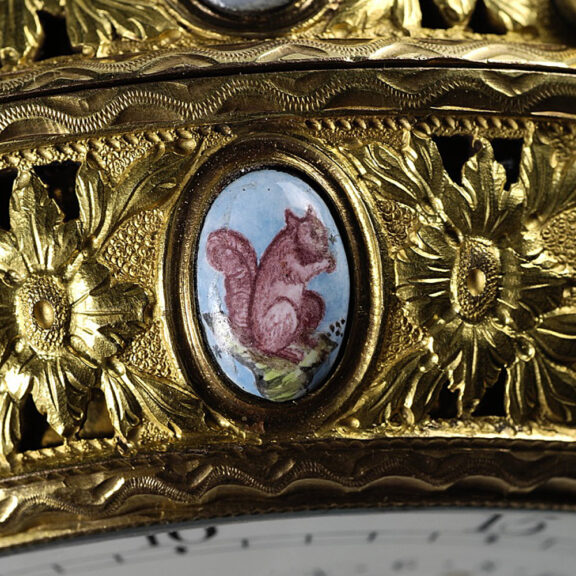
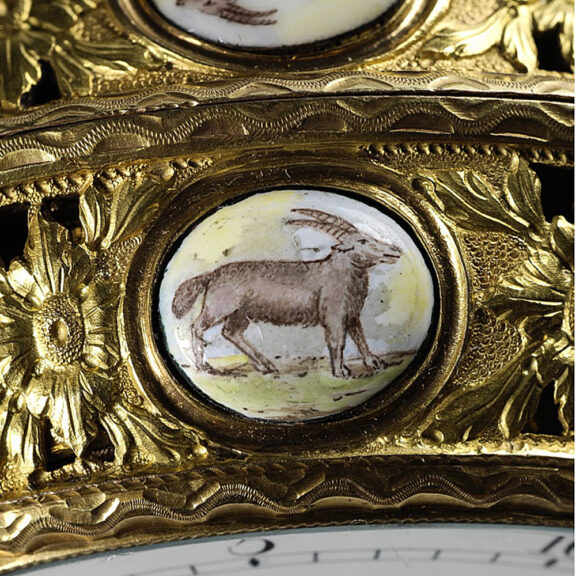
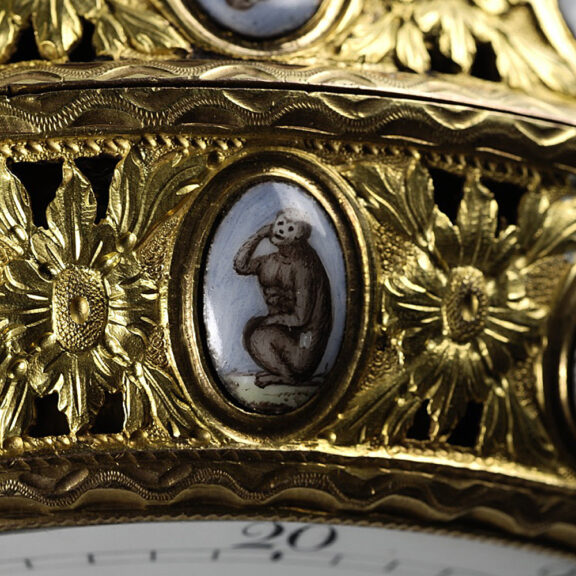
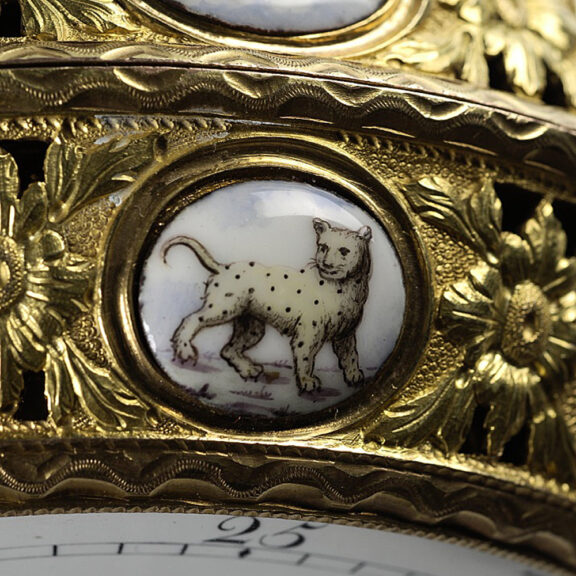
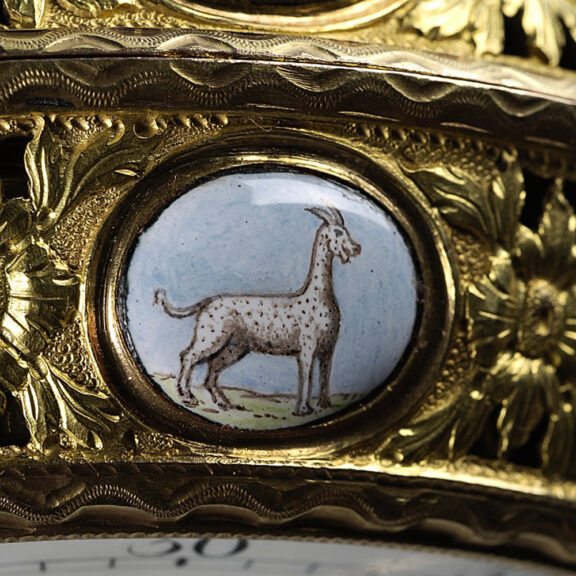
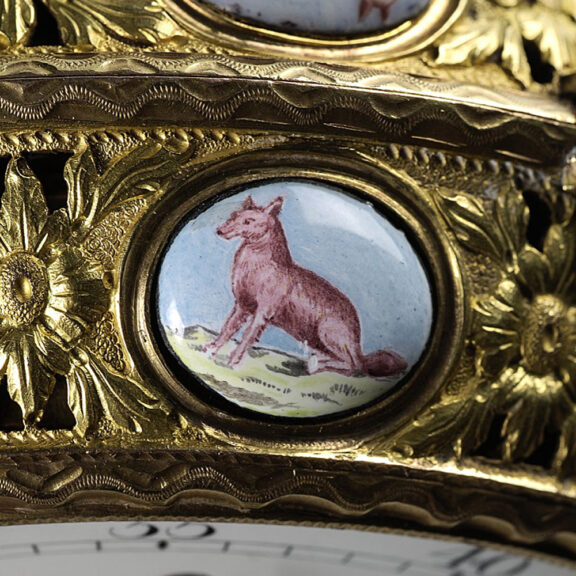
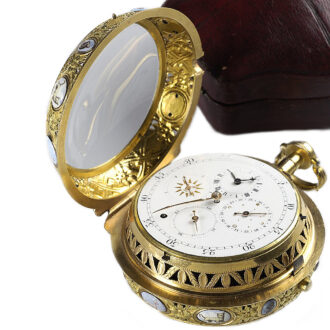
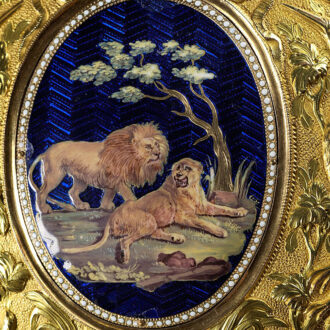
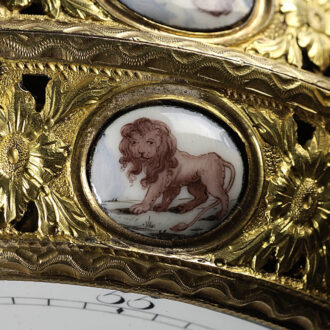
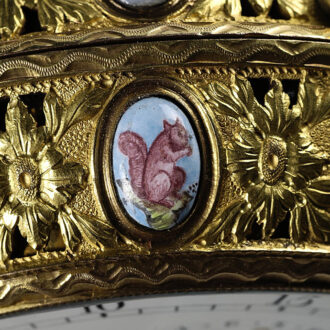
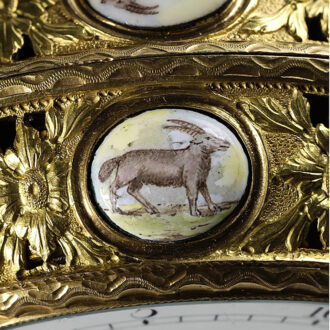
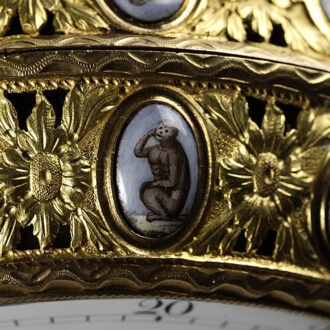
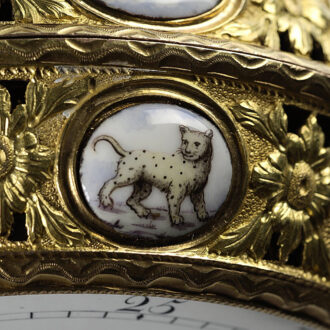
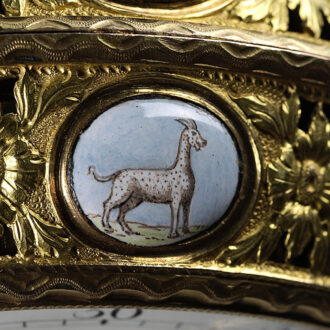
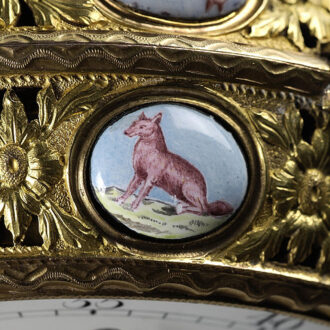
The case has a brass frame with punched and chased copper plates, partly gold-plated in red, green and yellow; the back is decorated with an oval gold enamel medallion (62 x 48 mm) painted with a lion and a lioness after the mezzotint by George Stubbs (1776), it is surrounded by green gilded tropical leaf tendrils and flanked by two upright cranes, a phoenix above the enamel plaque holds a ribbon garland, underneath a small copper enamel plate on which an opossum is depicted, seven further oval medallions, each painted with corresponding stylized animals, are located on the two openwork floral gold-plated bezels. These clockwise show a great kudu, squirrel, monkey, leopard, giraffe, fox and lion, all directly taken over from Thomas Boreman‘s work A description of Three Hundred Animals (1774 ). The enamel is possibly by Jean Abraham Lissignol.
–
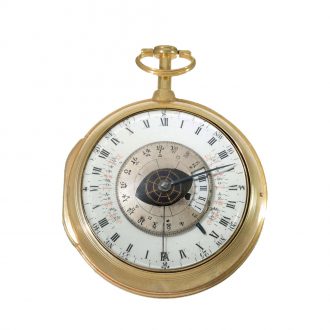
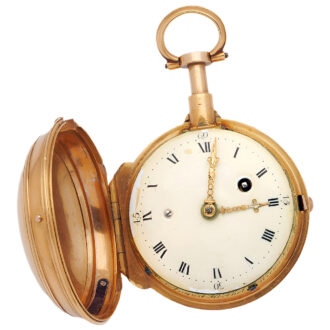
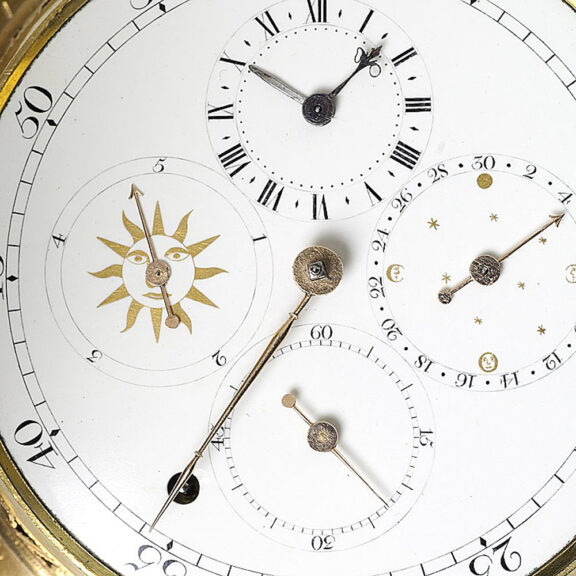
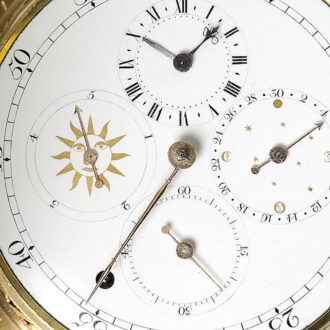
White enamel dial with outer Arabic five minute numerals, in the centre four subsidiary dials, at 12 o’clock Roman hour indication, at 3 o’clock a lunar calendar with gold plated moon phase quarters and decorative stars, the small seconds at 6 o’clock and the flashing 1/5 second at 9 o’clock with a central gilded sun face, blued steel hour hand, the hands for the subsidiary dials are made of polished gold, steel alarm clock hand.
–
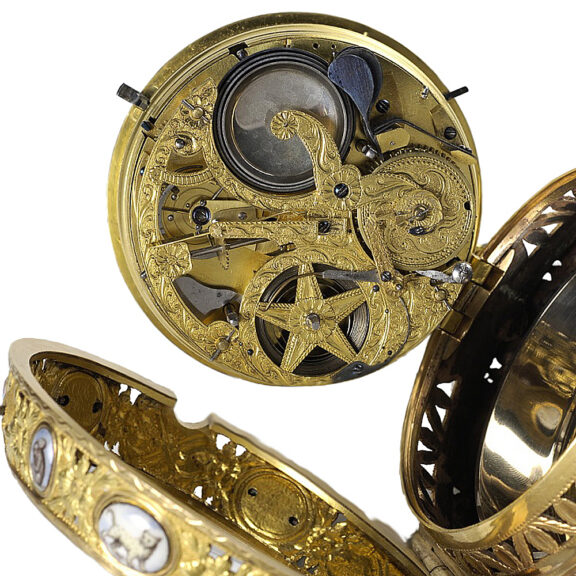
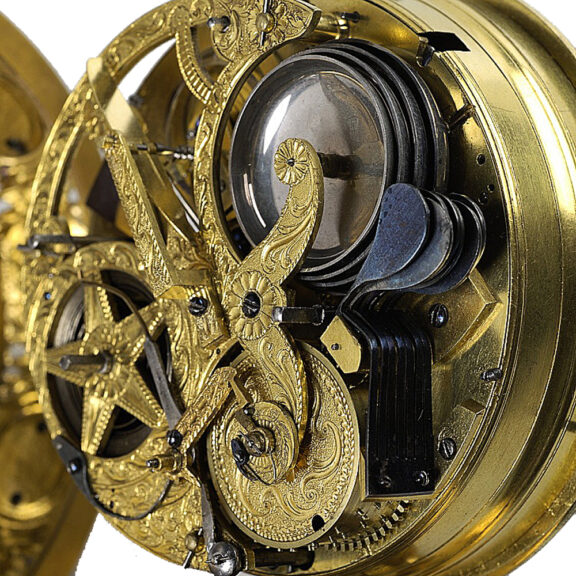
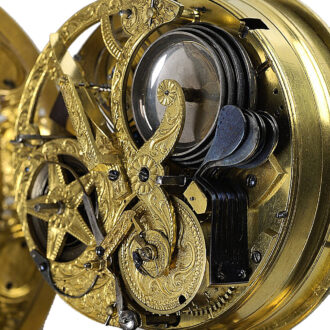
Three tiered movement attributed to Jaquet-Droz & Leschot, gilt-brass plates and bridges, fusee with chain for the going train, jewelled cylinder escapement, plain balance, going barrel for the alarm, going arbours for the quarter striking on a large bell in the back of the case, music with pin drum playing the tune on the hour or at will with seven hammers on four bells, the skeletonized backplate is elaborately pierced and engraved with foliage against a matted ground, gilt dust ring secured by dog screws. The largest bell in the musical train signed Drury London. A number of the parts of the movement are scratched with a capital B. Numbering in this way usually indicates it is one of a pair or small series of virtually identical movements. Comes with the original fitted chamois lined red leather presentation box and keys.
–
Diameter: 118 mm
–
Weight: 1.250 g
–
Signed: Drury London
–
Drury, London. The clock is very likely to be dated between 1785 and 1790. Because of this, it can be assumed that it is James Drury, the son of John Drury, who died in 1771. James Drury himself died in 1811. Both came from a famous family of watchmakers and later bell-makers in the first half of the 18th century. Their name appears on many European bells, especially those of Daniel de St. Leu, a Geneva watchmaker whose movements are undoubtedly Swiss.
–
George Stubbs, August 25, 1724 – July 10, 1806, was an English artist and is mainly well-known for his paintings of horses. In addition, Stubbs made many paintings of exotic animals largely unknown to the English population, such as kangaroos, leopards, rhinos, and especially lions, of which there are several examples. Sources for this painting were animals housed in popular London zoos and private enclosures.
In the 1760s, Stubbs tried enamel painting on copper and larger porcelain plates by Josiah Wedgewood. A version of the motif depicted on this watch case, enamelled by Stubbs and dated 1770, is in the Yale Institute for British Art. The oval enamel medallion is painted on a gold plate and attached to the metal case with small pins. The blue enamel lies on a guilloché ground, whereby the polychrome scene is slightly raised and varnished on a white background. The trunk of the tree is not painted but engraved. The subject was taken directly from an engraving of an unknown painting by George Stubbs. It bears the title “The Lion and Lioness”, with engraved inscription G. Stubbs pinxt GT Stubbs fecit 1776. Here it is mentioned in the text that the lions are shown at night, which is interesting considering the dark blue guilloché enamel background. The engraving could have been sent to Geneva for reproduction, although Lennox-Boyd reports that several dealers in mainland Europe had English prints for sale. The technique used can be seen on a series of clocks destined for the Chinese market.
Three specimens with oval enamel medallions (all with medallions similar in size to Stubbs’) have appeared on the market recently, all signed by Kenebel and with themes from the work of the English artist William Hamilton (1751-1801). Two, titled “Abend”, are identical and have consecutive work numbers. This would mean that this is a matching pair as the watches by William Anthony and James Cox, and not about the mirror image representations of the same topic. The third clock shows a different scene version but was made using the same technique.
The Kenebel clocks are variously dated around 1800, which seems late considering Hamilton’s death in 1801; the most likely source is not the print by A. Conte, which was used in the Antiquorum catalogue of the Sandberg collection, but the engraving by Bartollozi, who worked in England until 1799, dated 1790. Therefore, a date between 1780 and 1790 is more likely. Antiquorum and Christie’s attribute the enamel work to Jean Abraham Lissignol (1749-1819, enamelist and miniaturist), but there is no definitive evidence. The same enamel technique seems to have been used on the extraordinary “Tempel” clock with a bird, exhibited in the “A La Vieille Russie gallery” in 1968 and signed by Monin. A not-dissimilar temple clock in the Farouk collection, signed Staplin, also has very similar enamel work. These pieces certainly came from the workshops of Jaquet-Droz & Leschot.
–
Thomas Boreman. Little is known about his life, but he was certainly one of the earliest English children’s book publishers. His book “Three Hundred Animals” was first published around 1730. Boreman’s earliest work included his “Gigantic Histories” from 1740, miniature books with illustrations and a list of subscribers with names of both children and parents. This two-volume work was followed by “Curiosities in the Tower of London”, with images of animals in the Tower Zoo. The seven miniature medallions with the stylized animals on the bezels and another below the large enamel plaque by Stubbs are enamelled on copper and taken directly from the book by Thomas Boreman (several editions). It seems likely that this enamel work was made in England.
–
Jean Abraham Lissignol was a Swiss painter, revolutionary and one of the finest enamellers of his time. He was born in Geneva on May 7th, 1749 and died in Plainpalais on June 28th, 1819. He was the pupil of Jean-Marc Roux and later became his partner. Specialized in snuff boxes and watch cases, he worked for Jaquet-Droz & Leschot, the Rochat Brothers and John Rich.
Signed: Drury London
Share this page: