French important gold and enamel verge watch Circa 1730
- Kenmerk
- TD0291
- Diameter
- 45 mm
- Estimate
- € 20.000 - 35.000
- Price sold
- -
Gold and enamel open faced verge watch
–
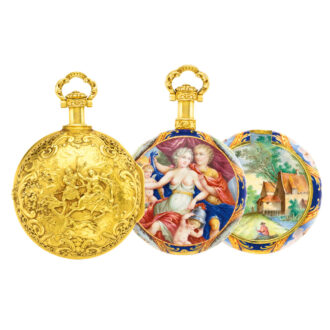
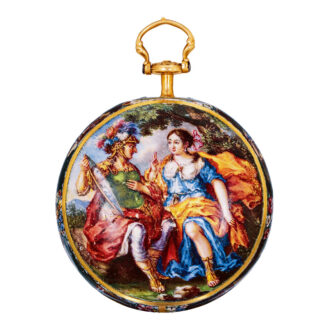
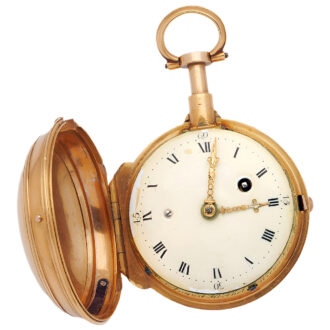
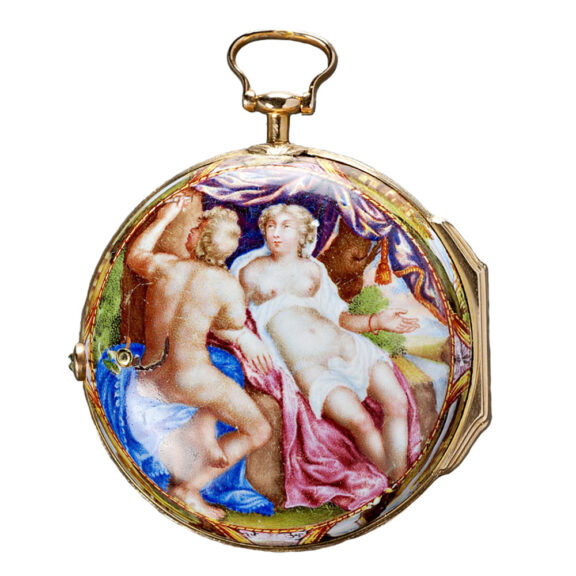
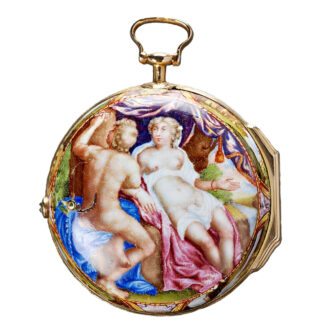
An early and very important French gold and enamel open faced verge pocket watch, Angelica and Medoro, circa 1730.
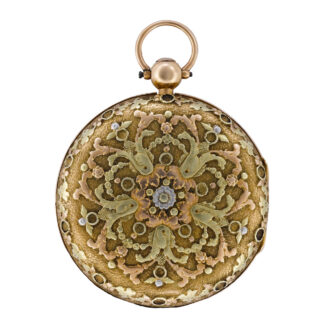
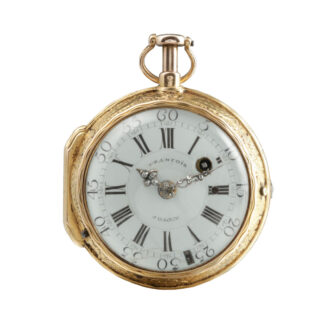
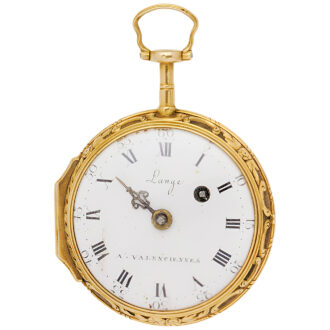
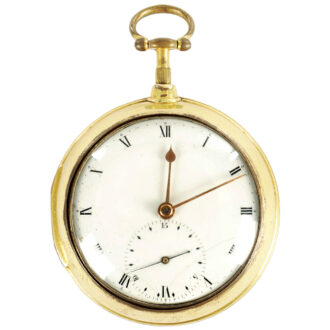
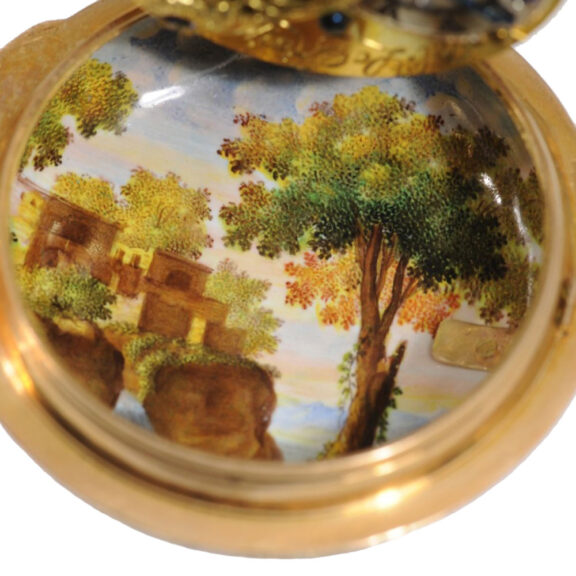
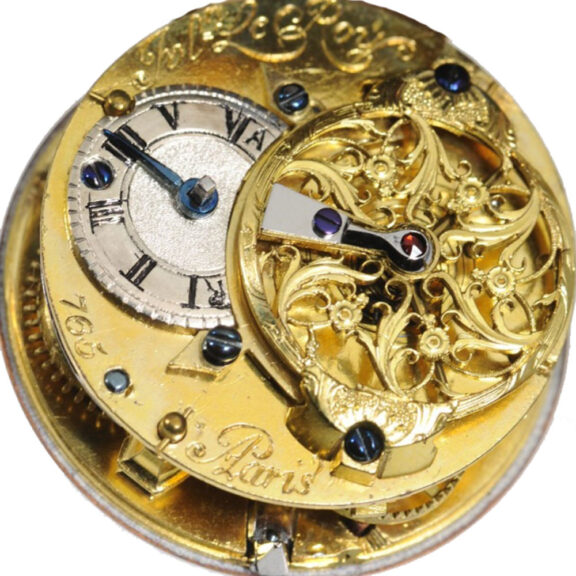
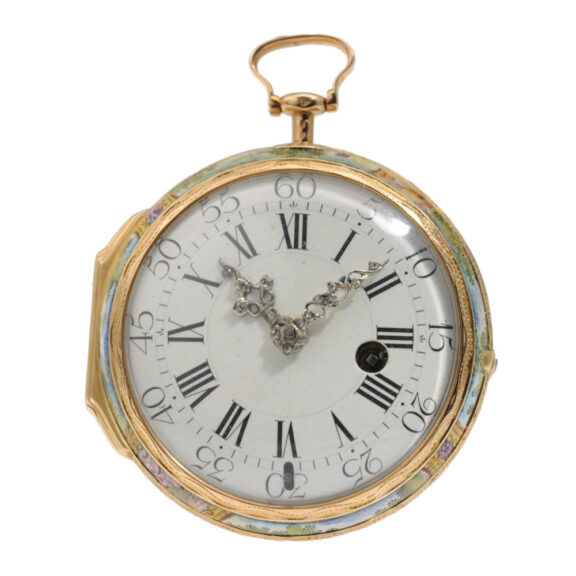
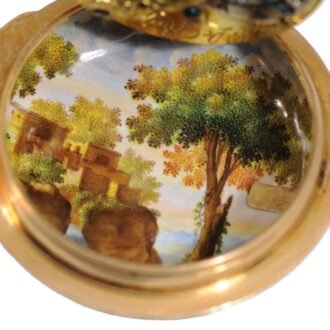
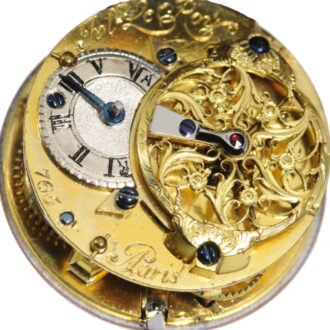
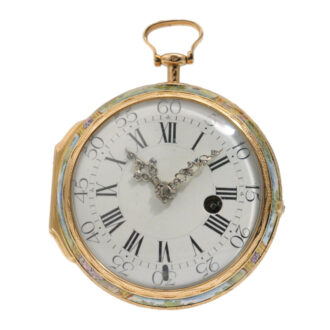
A polychrome enamel painting on the case back showing Angelica and Medor carving their initials in a tree, the band with cartouches depicting idealized landscapes separated by yellow volutes with flowers and a signature badge on a pink-coloured ground, and on the inside, another enamel scene with a hiker standing before a large waterfall and a magnificent building in an idealized landscape, the enamelling is signed Huaud le puisné fecit, a large diamond with a greenish shade opens the case. White enamel dial with Roman hours and Arabic five-minute numerals. Full plate movement, chain and fusee, three-arm brass balance. Verge movement.
–
Diameter: 45 mm
–
Weight: 74 g
–
Signed: Julien Le Roy à Paris
–
Julien Le Roy is one of the clockmakers who contributed most to the progress and the reputation of French watch- and clockmaking. Born in Tours on August 6, 1686, and died in 1759 in Paris. He came to Paris in 1699. In 1713 he achieved his master’s degree, and in the following years, he became a jury member of the Paris Guild of Watchmakers. Later, Le Roy became director of the Société des Arts de Genève and, in 1739, Court Watchmaker (French Horloger Ordinaire du Roi) under Louis XV; he had his private quarters in the Louvre. He improved almost all branches of clockmaking, and many important inventions in the realm of time measurement are owed to him. In 1717, Julien Le Roy presented an equation clock to the Royal Academy of Sciences, which showed the true time, the place of the sun and its decline. His most important discoveries concerned watch mechanisms. The adjustable ‘potence’ for the verge escape wheel considerably improved the escapement’s functioning, and the steel end-piece (coqueret), which allowed oil to be retained in the balance pivots to diminish frictional force, was quickly adopted by other watchmakers. He was the inventor of dumb repeating watches, too; in 1740, he created a new arrangement that enlarged the area allotted to the repeating work. This invention, called ‘à bâte levée’, was also adopted by his fellow clockmakers. In 1755 he invented a small anchor escapement used as a regulator for the repeating train. He contributed to the Encyclopédie by writing several articles on clockmaking together with his son Jean-Baptiste, the Academician. Le Roy ran his workshop in the Rue de Harlay in Paris until his death. Examples of his timepieces can be found in various important museums worldwide, such as the Louvre and the Victoria and Albert Museum.
–
Angelica and Medoro was a popular theme for Romantic painters, composers and writers from the 16th until the 19th century. They are two characters from the 16th-century Italian epic Orlando Furioso by Ludovico Ariosto.
–
In the ‘Musée d’Horlogerie du Locle collection, there is a similar Blois enamel pocket watch with a movement by Cabrier, London, circa 1670. The enamel is signed ‘Huot le puisné fecit’.
–
Les Frères Huaut (or Huaud). The cases painted on enamel by ‘Les deux Frères Huaut’ were among the finest examples of their kind from the Geneva School and were not only highly valued when originally made but remained as art treasures in the centuries that followed. Pierre I was the founder of the Huaud dynasty. He was born in 1612 in Geneva as the son of a French goldsmith Jean Huaud. He settled in Geneva in 1630, and three of his 11 children became famous enamellists like their father: Pierre II (1647-1698), Jean-Pierre (1655-1723) and Ami (1657-1724). The brothers were most likely trained by their father and worked with him. Pierre II started his own business around 1680. Jean-Pierre and Ami became partners in 1682 and were appointed painters to the Prussian court in 1686 when they moved to Berlin and started working for Elector Frederick William of Brandenburg (1620-1688). Among their most well-known works are Diana and Actaeon, The Judgement of Paris, The Holy Family, St. John the Baptist, The Nativity and The Adoration of the Shepherds.
Signed: Julien Le Roy à Paris
Share this page: