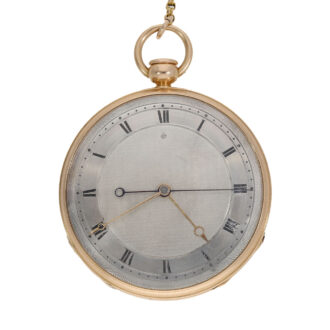
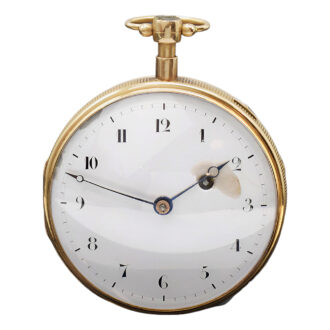
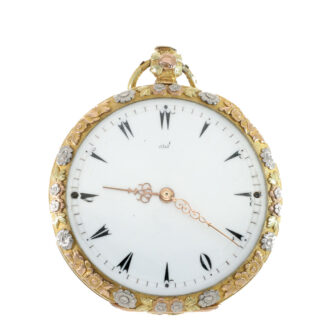
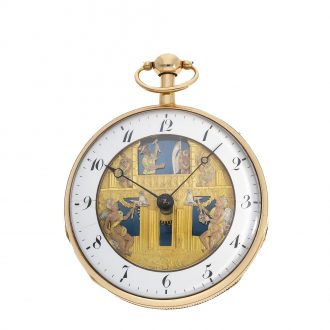
Swiss fine and rare musical snuff box with watch Circa 1820
- Kenmerk
- SA2125
- Diameter
- -
- Estimate
- € 50.000 - 100.000
- Price sold
- € 97.450
Gold and enamel butterfly form musical snuff box with watch
–
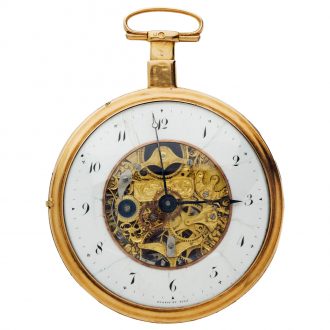
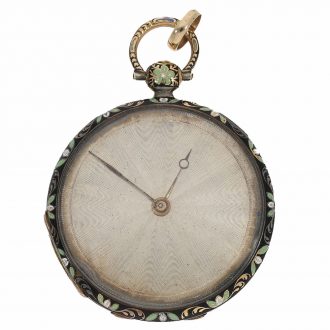
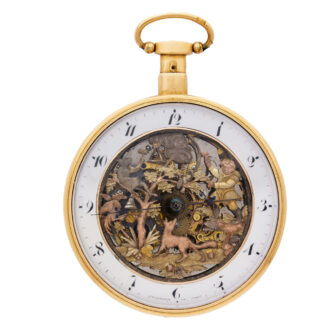
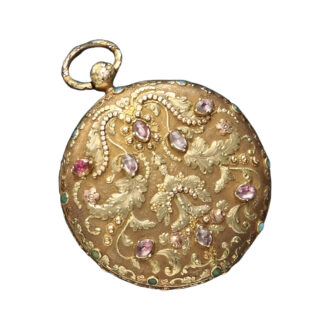
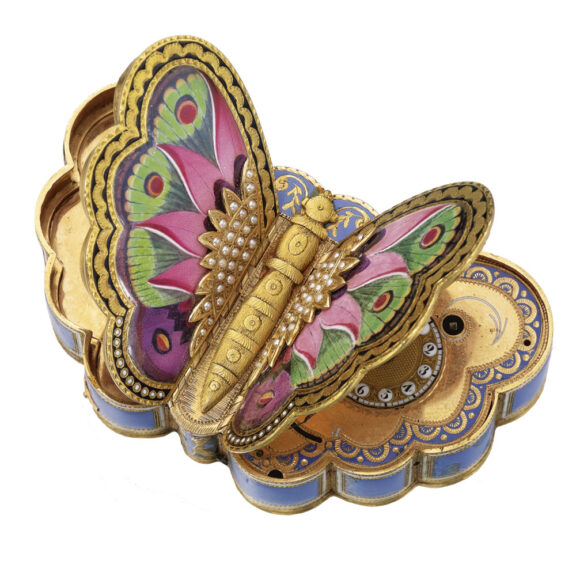
A Swiss fine and rare gold and enamel pearl-set butterfly-form musical snuff box with watch, made for the Chinese market, case probably by georges reymond, circa 1820, the music stamped PM playing on sur plateau movement, the music work conforming to the box shape, playing on demand by means of a lever fitted into a side panel, the box formed as a butterfly, its hinged wings vibrantly polychrome enameled with restoration throughout to simulate the wings in tones of sea green, plum and lavender, with powder blue champlevé enamel to simulate the antennae, the wings with possibly later gold pearl-set appliqué flanking the realistically engraved thorax, one wing concealing the watch and the other a snuff compartment.The watch with gold engine-turned dial with Arabic numerals enameled on white cartouches, with regulator below 6 o’clock, the edges decorated with black champlevéenamel scallop motif, the sides and base decorated with opaque powder blue enamel with restoration and loss, the sides spaced by champlevé enamel foliate motif, the base further framed within a border of champlevé enamel leafage heightened by turquoise, black and white enamel, box stamp GR Width 72 mm
–
Signed: Piguet & Meylan
–
The firm Piguet & Meylan was formed by Isaac-Daniel Piguet and Philippe Samuel Meylan in 1811. Piguet was born at Le Chenet in 1775. He settled in Geneva and became Burgher in 1812, one year after he had gone into partnership with Philippe Samuel Meylan to undertake the ‘manufacture of watches, jewellery and mechanisms of all kinds.’ Piguet specialized in complex watches with carillons and clock watches. Meylan was born in le Brassus in 1772 and is credited with adapting ‘tongues of sonorous metal for the combs of musical movement suitable for watches and other small objects. He is responsible for the famous magician automaton boxes and barking dog automaton watches.’Piguet & Meylan are particularly known for their watches made for the Chinese Market. As such, decoration was very important to the creation of all their pieces, and they employed some of the best enamel painters to decorate their watches. Examples of their works can be seen in many of the world’s foremost collections, including the Patek Philippe Museum, Geneva, the Metropolitan Museum of Art, New York, and the Musée d’Horlogerie, Locle.Enamel with restoration and loss
–
A Swiss fine and rare gold and enamel pearl-set butterfly-form musical snuff box with watch, made for the Chinese market, case probably by georges reymond, circa 1820, the music stamped PM playing on sur plateau movement, the music work conforming to the box shape, playing on demand by means of a lever fitted into a side panel, the box formed as a butterfly, its hinged wings vibrantly polychrome enameled with restoration throughout to simulate the wings in tones of sea green, plum and lavender, with powder blue champlevé enamel to simulate the antennae, the wings with possibly later gold pearl-set appliqué flanking the realistically engraved thorax, one wing concealing the watch and the other a snuff compartment.The watch with gold engine-turned dial with Arabic numerals enameled on white cartouches, with regulator below 6 o’clock, the edges decorated with black champlevéenamel scallop motif, the sides and base decorated with opaque powder blue enamel with restoration and loss, the sides spaced by champlevé enamel foliate motif, the base further framed within a border of champlevé enamel leafage heightened by turquoise, black and white enamel, box stamp GR Width 72 mm
–
Signed: Piguet & Meylan
–
The firm Piguet & Meylan was formed by Isaac-Daniel Piguet and Philippe Samuel Meylan in 1811. Piguet was born at Le Chenet in 1775. He settled in Geneva and became Burgher in 1812, one year after he had gone into partnership with Philippe Samuel Meylan to undertake the ‘manufacture of watches, jewellery and mechanisms of all kinds.’ Piguet specialized in complex watches with carillons and clock watches. Meylan was born in le Brassus in 1772 and is credited with adapting ‘tongues of sonorous metal for the combs of musical movement suitable for watches and other small objects. He is responsible for the famous magician automaton boxes and barking dog automaton watches.’Piguet & Meylan are particularly known for their watches made for the Chinese Market. As such, decoration was very important to the creation of all their pieces, and they employed some of the best enamel painters to decorate their watches. Examples of their works can be seen in many of the world’s foremost collections, including the Patek Philippe Museum, Geneva, the Metropolitan Museum of Art, New York, and the Musée d’Horlogerie, Locle.Enamel with restoration and loss
Signed: Piguet & Meylan
Share this page: