Swiss gold and enamel single handed verge watch Circa 1660-1670
- Kenmerk
- AD9222
- Diameter
- 33 mm
- Estimate
- € 120.000 - 250.000
- Price sold
- € 136.950
Gold and enamel verge pocket watch
–
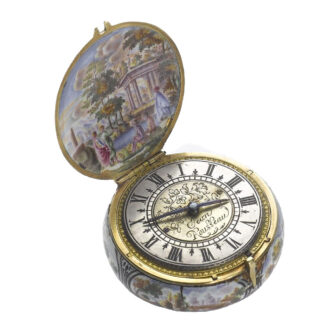
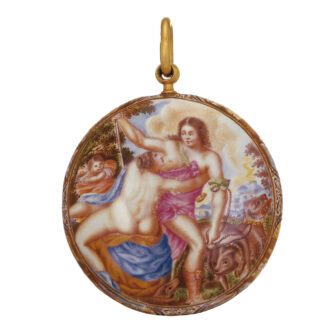
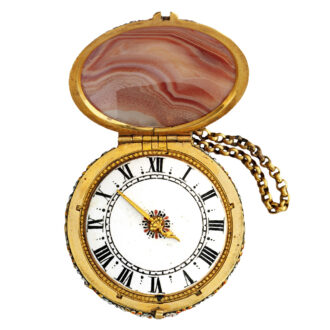
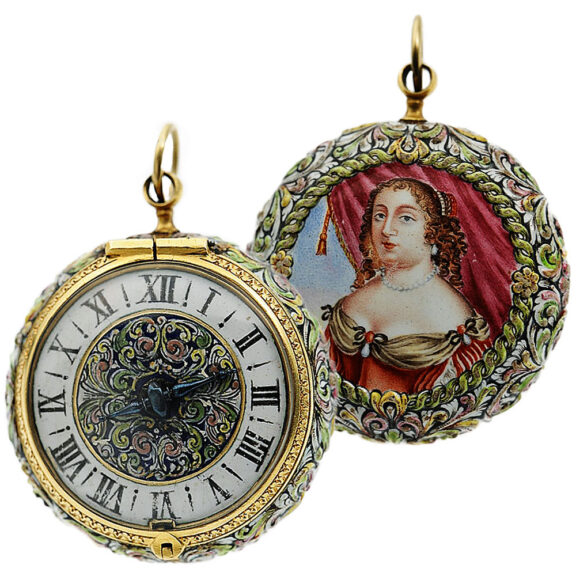
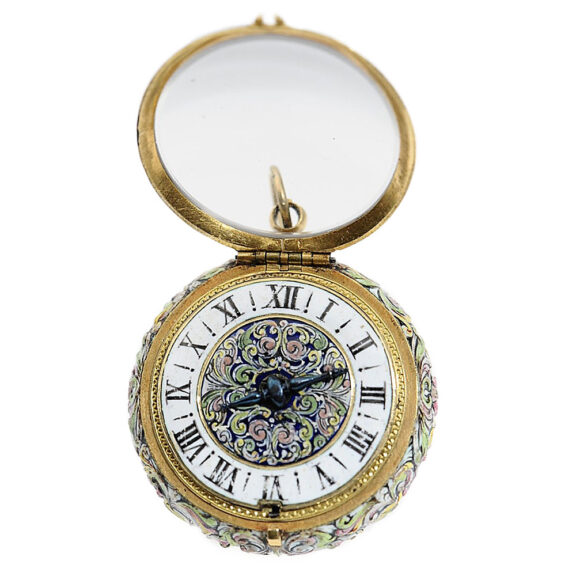
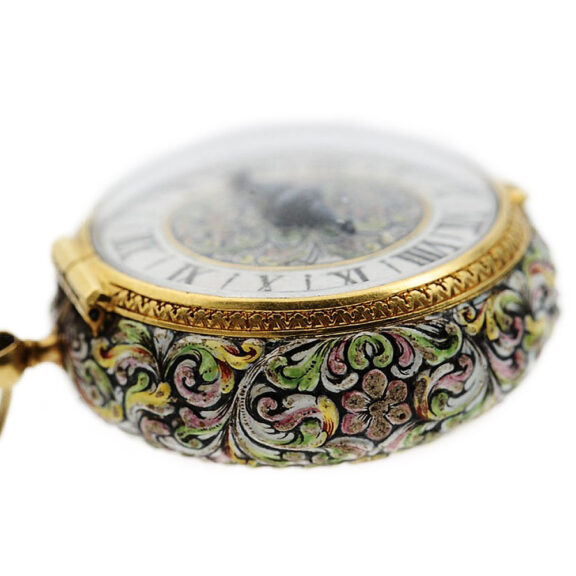
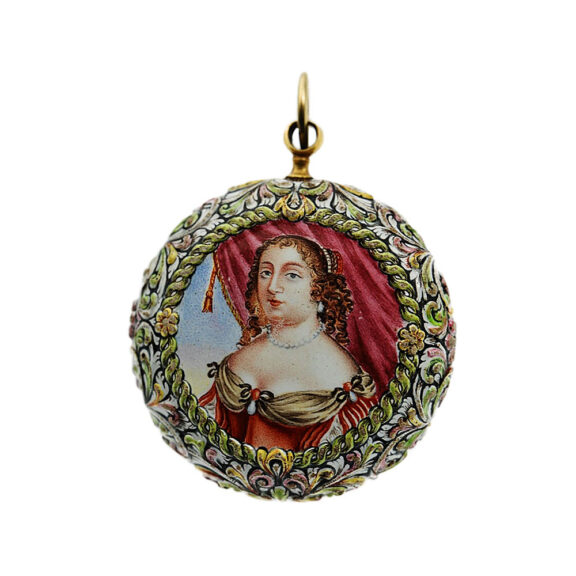
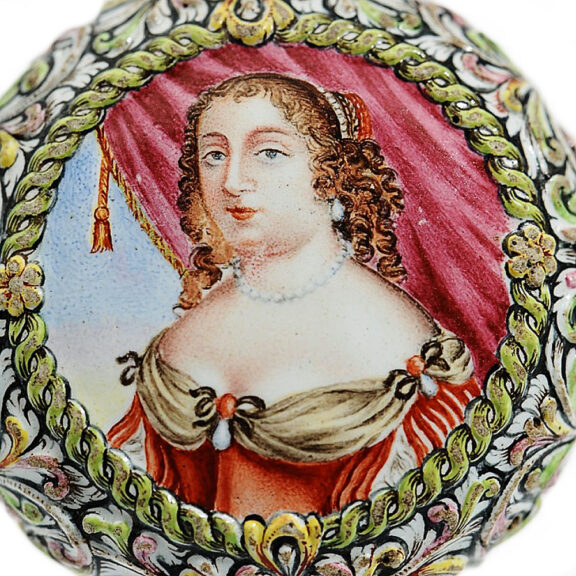
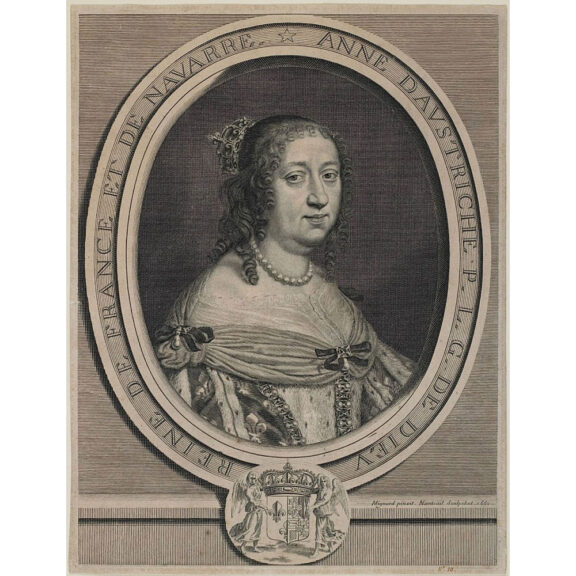
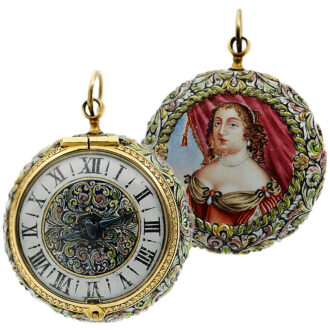
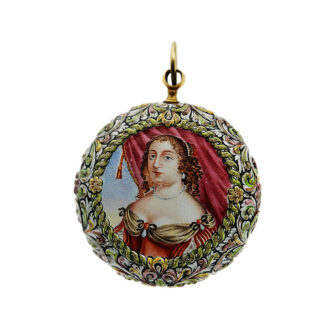
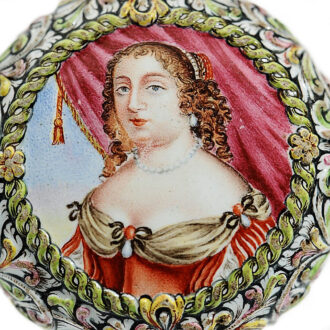
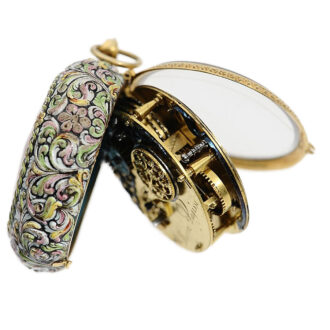
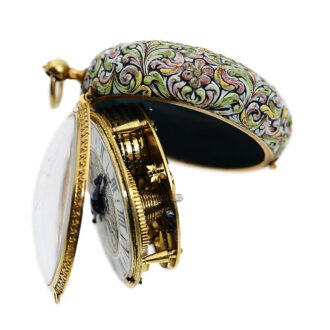
An important Swiss gold and enamel open faced verge pocket watch with a portrait of Anne d’Autriche, Reine de France after Pierre Mignard, circa 1660-1670.
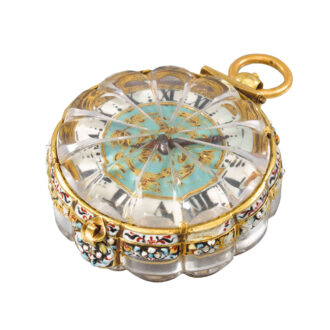
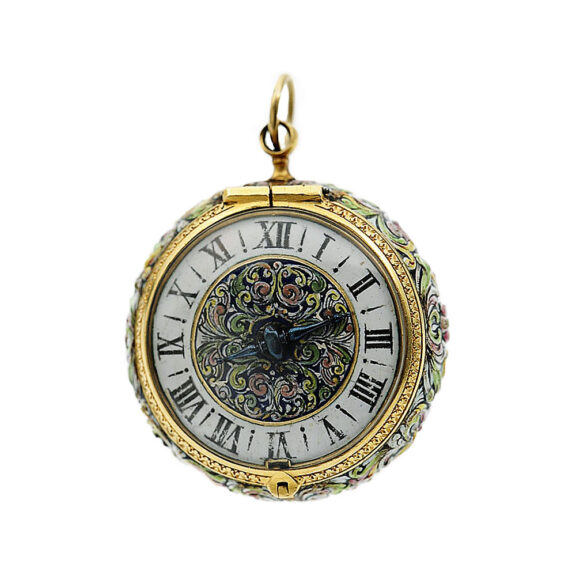
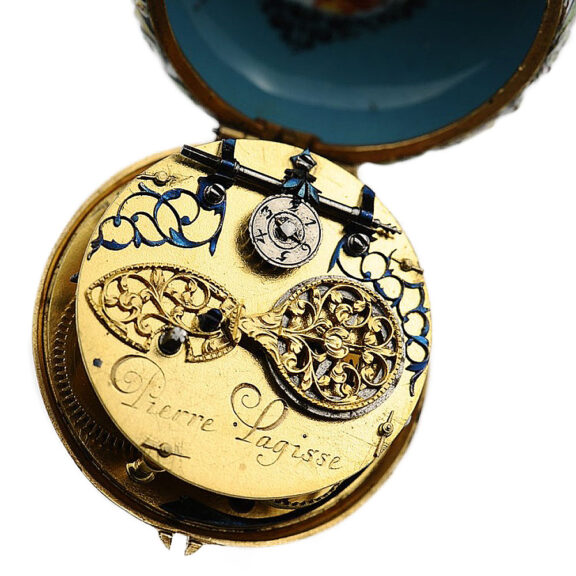
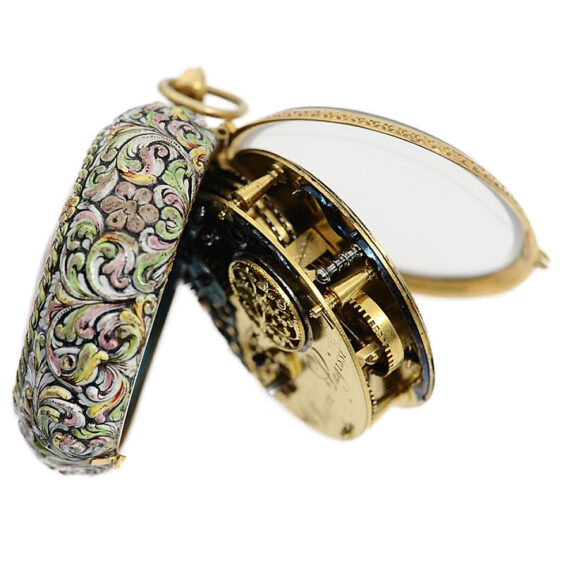
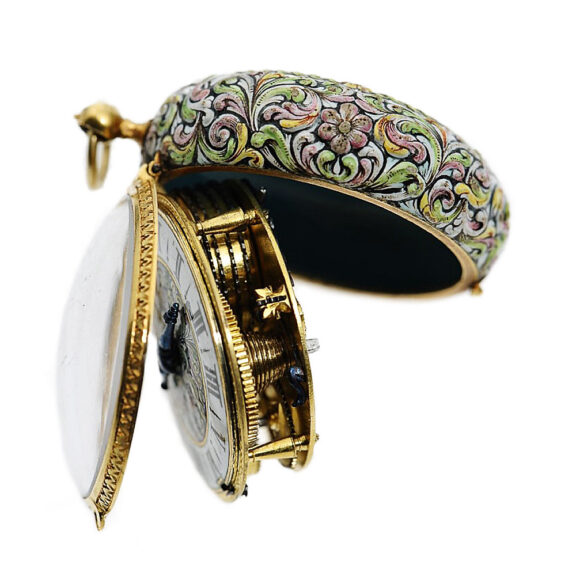
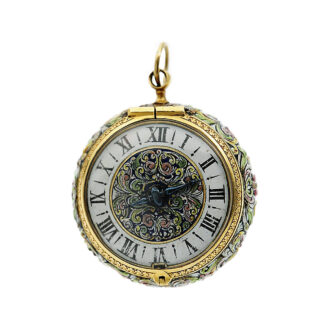
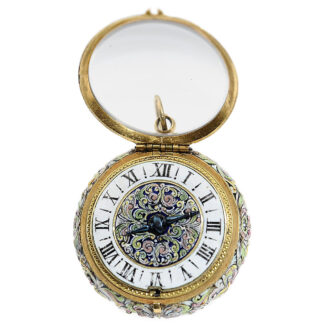
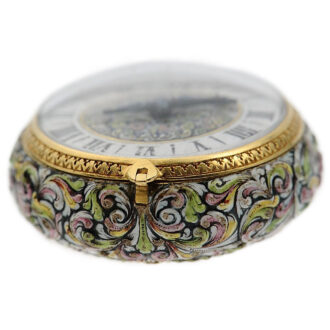
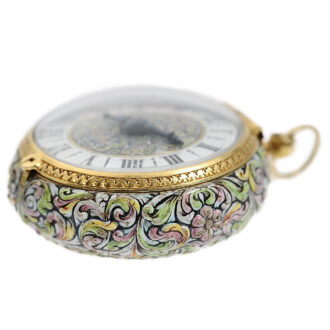
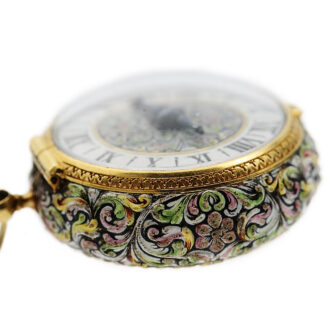
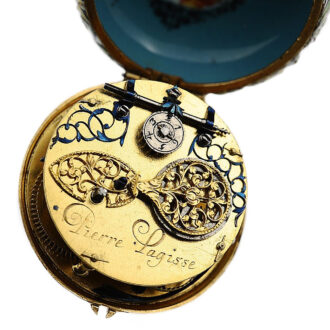
Signed full plate movement with gilt plates, fusee with early chain, verge escapement, plain steel balance without spring, oval pattern balance cock pierced and engraved with foliage within a pellet border, worm and wheel set up with pierced blued steel brackets and engraved silver setting disc.
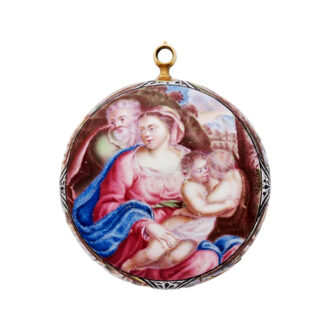
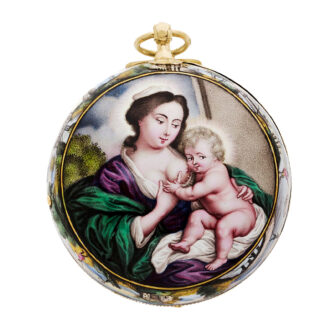
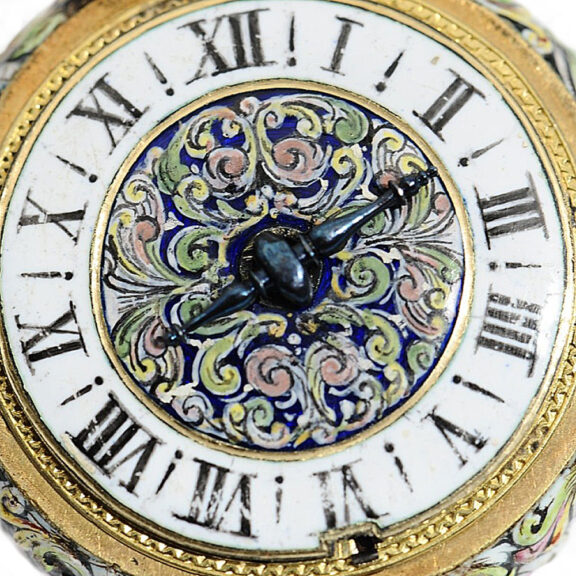
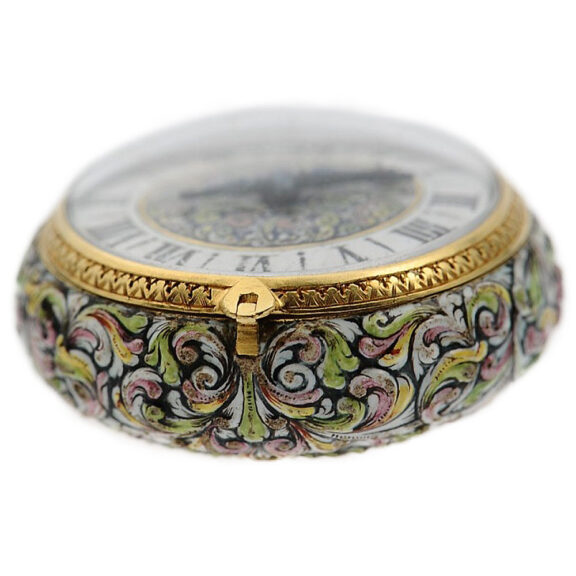
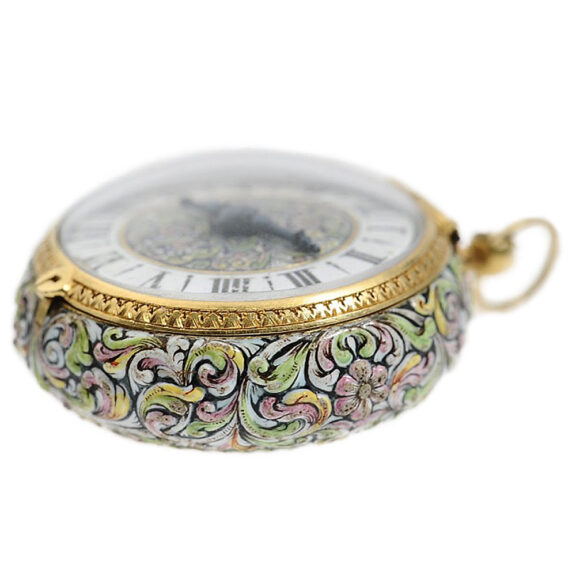
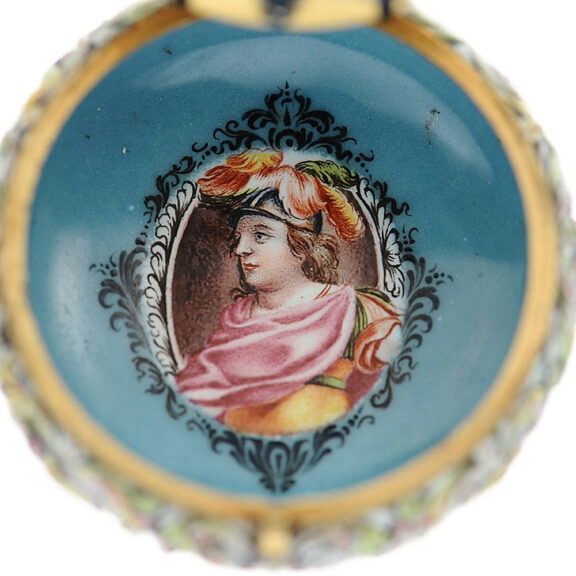
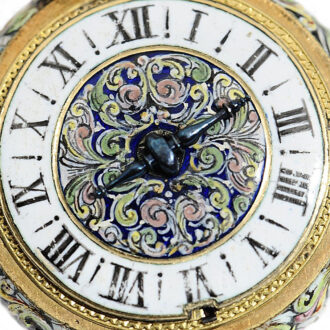
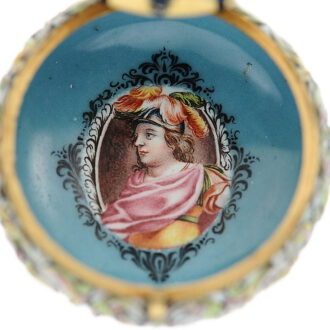
High relief case with a design of flowers and foliage painted in pastel shades, a similar rope twist frame surrounding the polychrome enamel portrait of Anne d’Autriche, on the inside another enamel portrait of a gentleman in classical dress, possibly alluding to Louis XIV in theatrical costume, on a turquoise ground and centred within an en grisaille frame. The dial has a white enamel chapter ring with black Roman hours, the centre with floral scrolls matching the design of the case and a single blued steel hand with turned button ends.
–
Diameter: 33 mm
–
Signed: Pierre Lagisse
–
Pierre Didier Lagisse, also called Didier, was a Swiss watchmaker. The Lagisses in Geneva were famous as a watchmaking family in the 17th and 18th centuries. Pierre Didier Lagisse was born Julian on December 15, 1625, in Geneva as the son of Antoine Lagisse (1581-1628/1629) and Renée Carnaglio. Pierre Didier was the brother of Marc Lagisse. He married Anne Catherine de Sève (1643-1711) on December 13, 1668. Seven children were born from this marriage, but none had a job listed. Pierre Didier, who first worked in Geneva and later settled in Isfahan, was appointed watchmaker and advisor to the Shah. This position helped him to a considerable fortune during his professional career. Lagisse worked with the enameller Pierre Huaud I.
––
Pierre Huaud I (Le Pere), Geneva, 1612-1680. Born in Chatellerault, France, son of French goldsmith Jean Huaud, a refugee in Geneva in 1630 at 18, indicating that he may well have begun training under his father or another French goldsmith. Some sources suggest that this may have been in Blois and that his subsequent full apprenticeship under Legère was required to be received as Master in Geneva. Apprenticed to Laurent Legère in the same year, a companion in 1634 and Master in 1636. Married in 1643 to Françoise Mussard, and amongst their children, three sons who became enamellers – Pierre II (1647-1698), Jean-Pierre (1655-1725) and Ami (1657-1724). In 1671, Pierre I and his three sons were made ‘bourgeois’ of Geneva.
–
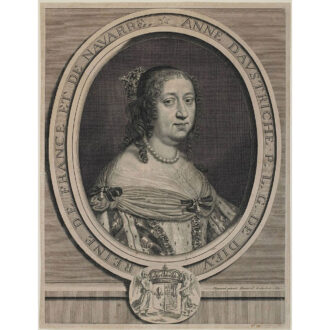
On the gold and enamel spindle pocket watch shown here, the portrait certainly represents Anna of Austria, the wife of King Louis XIII, after a portrait by Pierre Mignard I. There are other portraits of Queen Anna in similar clothes and postures by Mignard and from his circle, which were later reproduced as engravings. It is unlikely that the enameller had access to any of the original paintings; he was certainly working from one of these engravings. Several artists made these works, but it can be assumed that it was based on an engraving by Robert Nanteuil (dated 1660) or Antoine Masson (dated 1665). Both artists worked in Paris. The salient feature of both stitches is the large pearl ornaments that adorn the dress on the shoulders and chest. The Nanteuil engraving is obviously a mirror image, not uncommon as the plate was engraved as an exact copy of the original. Masson’s original, on the other hand, was engraved in a mirror image to provide the same view as the original painting. The engraving by Masson has other pearl decorations on the front of the dress, which, however, have not been adopted in the portrait on the watch. It is also quite possible that different versions or variants of the printing plate were made. In any case, it was up to the enameller himself which style elements he wanted to use for his work. Inside the clock, the classic portrait of the gentleman is executed a little more extravagantly than is usually the style of Huaud’s clocks. This may be due to the special artistry of Pierre Huaud I. However, it is also conceivable that the artist refers to Anna’s husband, Ludwig XIII or her son, Louis XIV, both of whom were passionate about dance and theatre. The sumptuous feathered headgear is not dissimilar to the familiar engravings depicting kings in theatrical costumes.
–
A grisaille (en grisaille), or grey painting, is a painting in which one does not apply natural colours but restricts oneself to depicting things in all possible shades of the same colour, usually grey or brown.
Signed: Pierre Lagisse
Share this page: