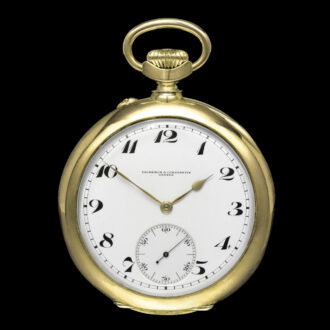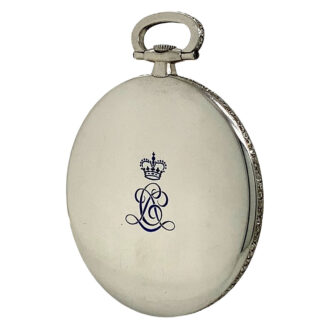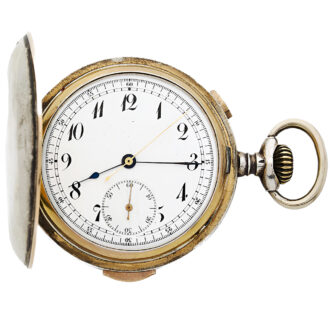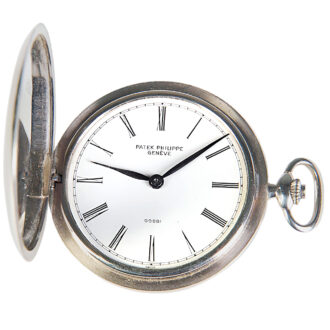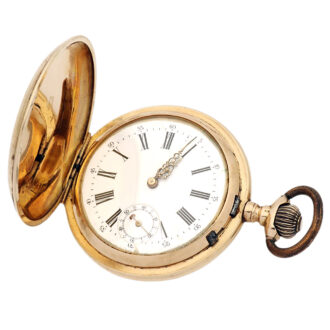
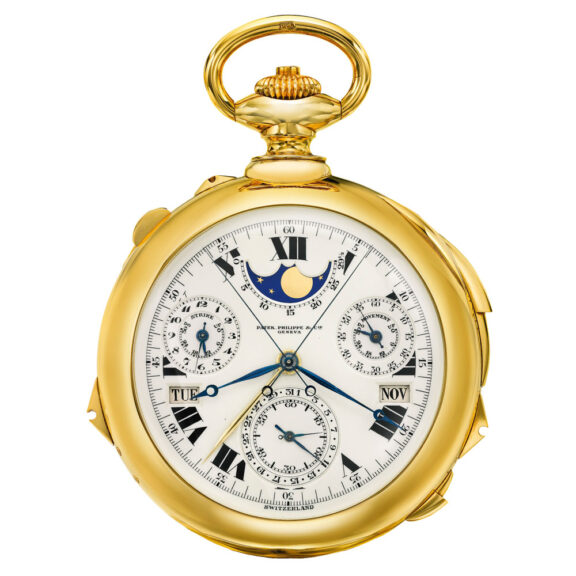
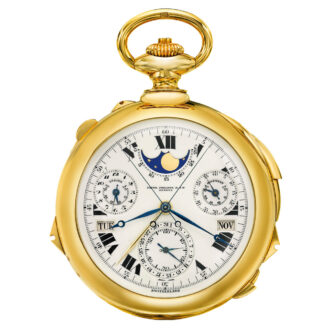
Swiss unique 18 carat gold Supercomplication Circa 1932
- Kenmerk
- SA0578
- Diameter
- 74 mm
- Estimate
- € 12.500.000 - 25.000.000
- Price sold
- € 19.000.000
–
–
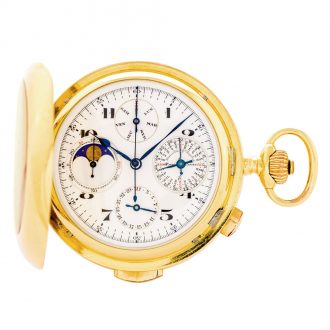
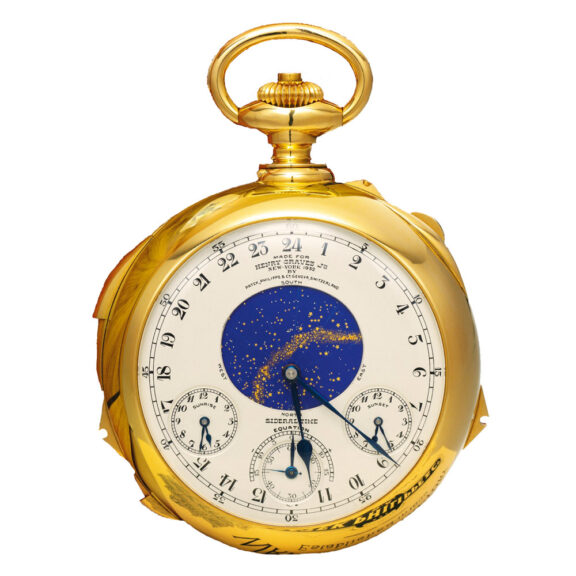
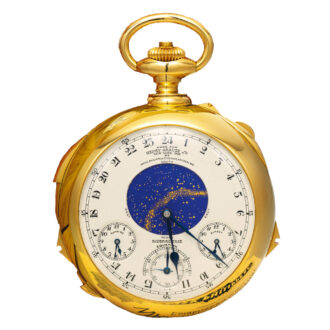
An 18 carat gold double dialed and double open faced minute repeating clockwatch with Westminster chimes, grande and petite sonnerie, a split seconds chronograph, 60 minute counter, 12 hour register, perpetual calendar accurate to the year 2100, moon phases, equation of time, dual power reserve for the striking and going trains, mean time and sidereal time, a central alarm, indications for time of sunrise/sunset and a celestial chart for the night time sky of New York City at 40 degrees 41.0 minutes North latitude.
–
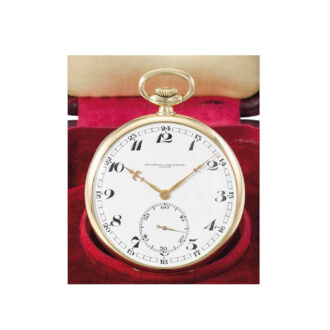
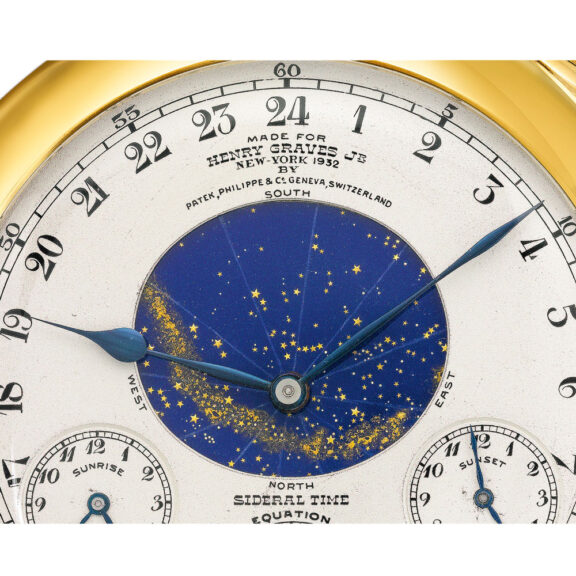
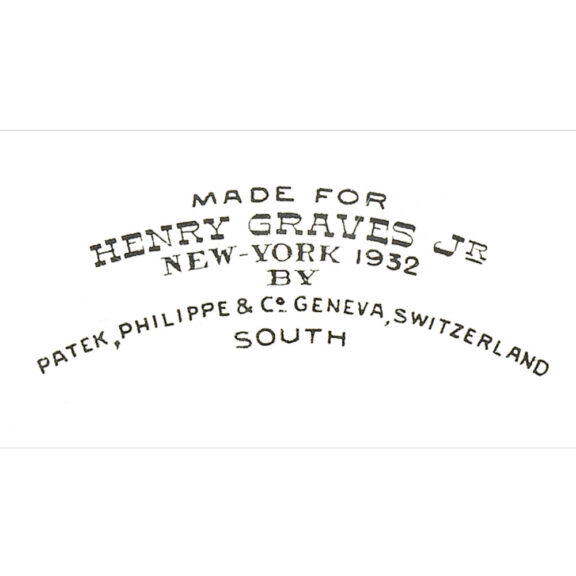
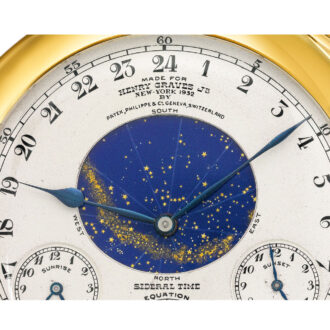
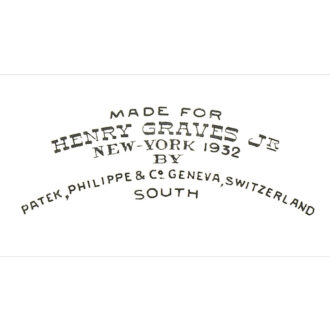
This watch is accompanied by the Certificate of Origin, an Extract from the Archives and the original fitted tulipwood presentation box inlaid with ebony and centred by a mother of pearl panel signed Made For Henry Graves Jr New-York 1932 By Patek, Philippe & Co Geneva Switzerland South.
–
Diameter: 74 mm
–
Thickness: 36 mm
–
Weight: 536 g
Signed: Patek, Philippe & Cie Geneva Switzerland
–
The Henry Graves Jr. Supercomplication
–
In 2014 Patek Philippe celebrated 175 years as one of the world’s great watchmakers. Over that time the firm has made many extraordinary watches that changed how we think about timepieces. None is more important than the Henry Graves Jr. Supercomplication. With 24 complications, it was the most complicated watch in the world for 56 years. It lost that title only in 1989, when Patek Philippe unveiled the Calibre 89 for its 150th anniversary. Even today it is the most complicated watch ever made without the help of computer.
–
A movement built for one watch
Work on the Supercomplication began in 1925 and was finished in 1932. Complicated movements were usually built by adding complications to a simpler base calibre. This calibre was different: every complication was designed specifically for this one watch.
–
The project brought together some of the finest craftsmen of the time, each a specialist in his own field. They had to make every complication work perfectly with all the others, and make the case and dial beautiful as well. This was no experiment for its own sake. It was a private commission, and it had to satisfy a demanding client. The result was the most complicated watch in the world and also one of the most beautiful.
–
Henry Graves Jr. (1868–1953)
Henry Graves Jr. was born into a well-known banking family in Orange, New Jersey. His father, Henry Graves Sr., was a partner in the New York bank Maxwell & Graves on Liberty Street. Henry joined his father in the business and moved to New York City. In 1896 he married Florence Isabel Preston of Irvington-on-Hudson, and they had four children.
–
The family was wealthy. Summers were spent in Irvington and at Saranac, New York, where they owned Eagle Island. There Graves enjoyed boating, notably on the Eagle, a 50-foot speedboat. Winters were spent near Charleston, South Carolina, where he was a member of the Yeamans Hall Club. The rest of the year the family lived in Manhattan, first at 420 Park Avenue and from 1931 at 834 Fifth Avenue. Graves lived there until his death.
–
Collector of art
Graves was a passionate art collector. On 3 April 1936 the American Art Association Anderson Galleries in New York held the sale Masterpieces of Engraving and Etching: The Collection of Henry Graves Jr. The auction house later became part of Sotheby’s. The catalogue said no comparable collection of prints had ever been sold in America. The star lot was Albrecht Dürer’s Adam and Eve, which sold for $10,000, a remarkable price in the middle of the Great Depression.
–
Graves is best remembered for his Patek Philippe watches. The family jeweller, Tiffany & Co., introduced him to the firm. He was impressed by Patek Philippe’s successes in the timing competitions at the Geneva Observatory, and he began buying its watches in the 1910s. Over time he became one of the company’s most famous clients.
–
He either commissioned watches directly or had his family coat of arms added to watches he bought. The arms show an eagle rising from a ducal coronet, with the motto Esse Quam Videri (“To be, rather than to seem”). Most of his watches carry the arms on the case. On the Supercomplication they appear on the watch box. Many of his pocket watches are also inscribed “Made for Henry Graves Jr New York”.
–
The race for the most complicated watch
In the early 20th century, two American collectors competed to own the finest and most complicated watch in the world. Both chose Patek Philippe as their main watchmaker. One was Henry Graves Jr., a New York banker and sportsman. The other was James Ward Packard, an automobile manufacturer from Warren, Ohio.
–
Packard took the lead. In January 1916 he received a Patek Philippe pocket watch with 16 complications. In April 1927 a second followed, with ten complications including a celestial chart. Yet neither was the most complicated watch ever made.
–
Graves, a born competitor, could not resist the challenge. In strict secrecy he went back to Patek Philippe with a bold request: “the most complicated watch ever made”. It had to surpass Packard’s sky-chart watch No. 198.023, the Leroy No. 1 and Breguet’s famous “Marie Antoinette”.
–
Patek Philippe’s watchmakers took up the challenge. Without computers, they had to work out the astronomy, mathematics and precision mechanics in detail by hand. By the standards of the day the work went quickly: research, development and construction took “only” seven years, from 1925 to 1932.
–
On 19 January 1933 Graves took delivery of his Supercomplication. He paid $15,000 for it. The watch weighs about 535 grams and has 920 parts:
- 430 screws
- 110 wheels
- 120 levers and other mechanical parts
- 70 jewels
–
Provenance
The Supercomplication stayed in Graves’s collection until his death in 1953. His daughter Gwendolen inherited it, together with a large part of the collection. In 1960 she gave it to her son, Reginald H. “Pete” Fullerton Jr., the last member of the family to own it. In 1969 he sold it to Seth G. Atwood, founder of the Time Museum.
–
The case
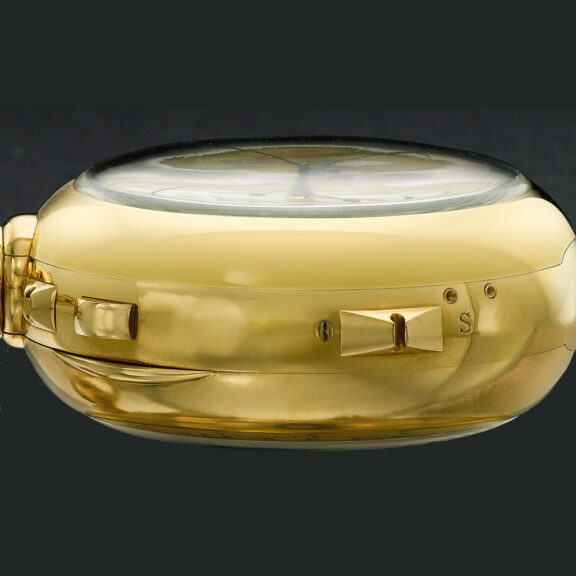
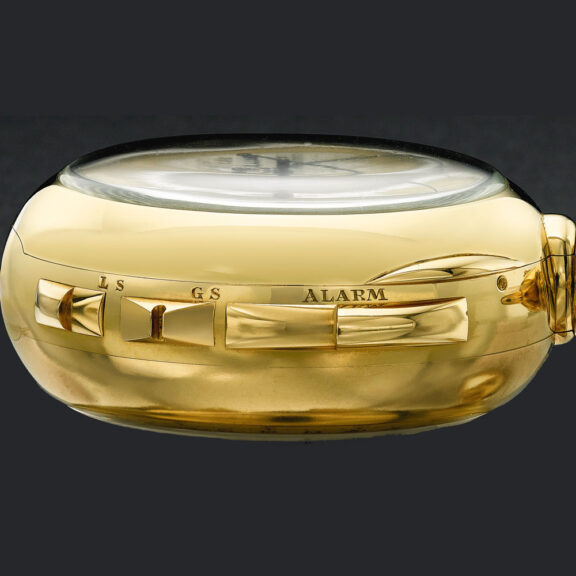
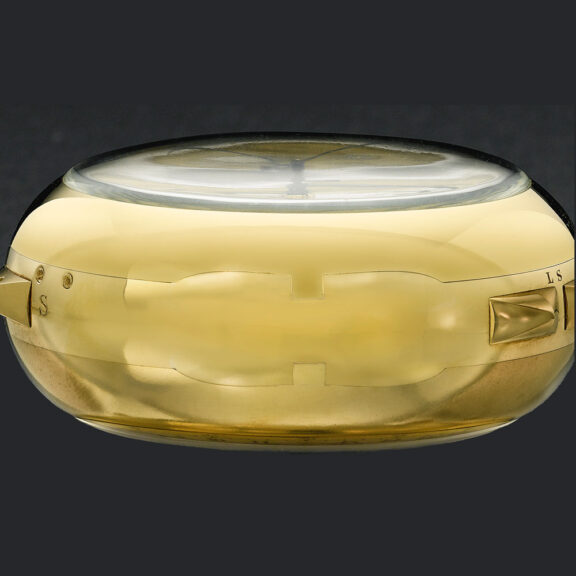
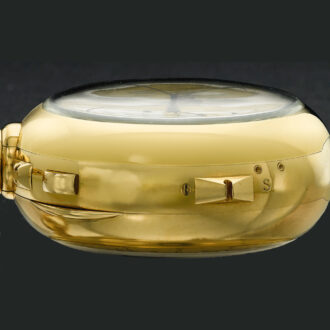
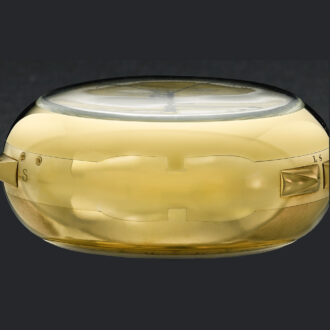
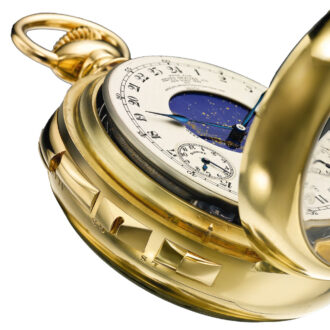
The case was made by Luc Rochat of L’Abbaye in the Vallée de Joux. It is a double open-faced case of classic bassine shape:
diameter 73.2 mm
- thickness 35 mm including the crystals
- total weight of the watch 535 g (1 lb 3 oz), of which the case alone weighs 250 g
Both bezels are unusually thick to make room for the deep dials and their hands. Each has a concealed hinge, a hallmark of the highest-quality cases.
–
Despite its size, the watch is beautifully proportioned. The watchmakers, dial makers and case maker worked closely together to use every cubic millimetre of space. Almost five years passed from the design of the case to final delivery. Hundreds of adjustments were made in that time to make every slide and pusher work precisely and smoothly.
–
The dials
–
The sidereal time dial
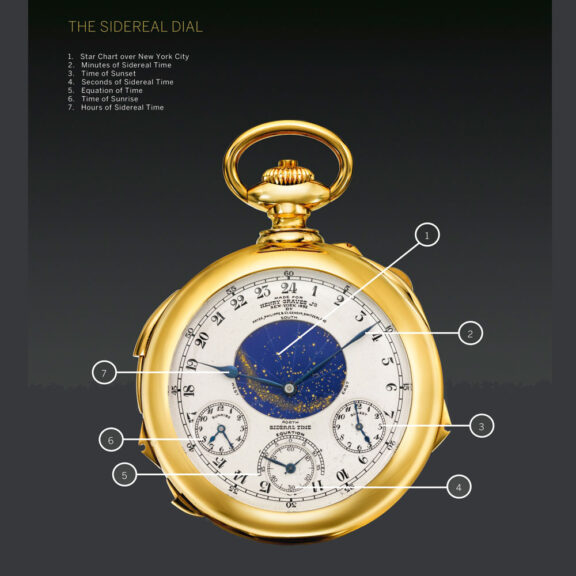
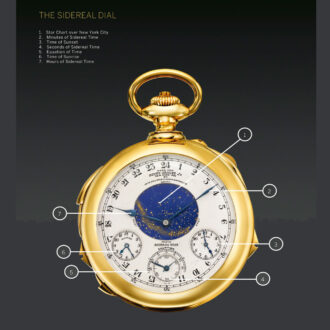
–Stern Frères S.A. made the sidereal time dial between 1929 and 1932. The base is a gold plate with a silvered finish. Three small dials, for sunrise, sunset and sidereal seconds, were sunk into it by circular engraving, and the plate was then engraved and enamelled.
–
The sky chart is a gold disc covered in blue champlevé enamel. Stern Frères’ archives show that Patek Philippe supplied the gold and paid 110 francs for the dial. They also still hold a copy of the original drawings, which were sent to Graves for approval. These are preserved in the Stern Frères special design book.
–
Details
- gold dial plate with silvered finish, engraved and enamelled, with a large personal inscription
- black enamel Arabic numerals and an outer minute track
- a large opening for the sky chart, surrounded by the cardinal points
- the sky chart is blue champlevé enamel over gold paillon stars, showing about 450 stars and the Milky Way. It shows the night sky exactly as seen from Graves’s Fifth Avenue apartment overlooking Central Park
- three sunken small dials: sunrise and sunset in New York, and seconds combined with the equation of time
- the equation of time sector, above the small seconds dial
- pear-shaped blued steel hands
–
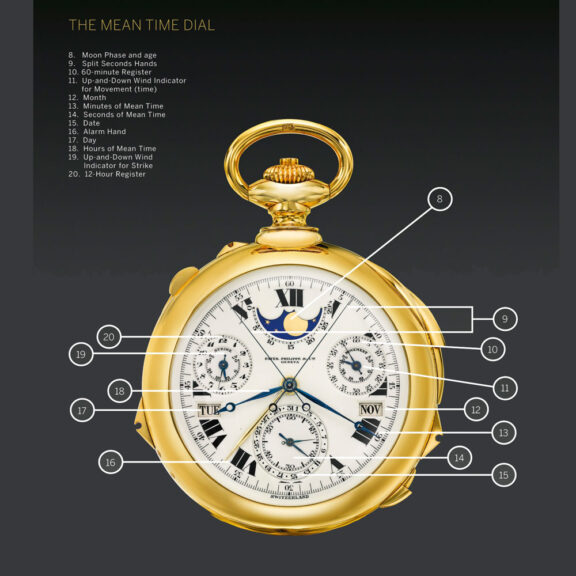
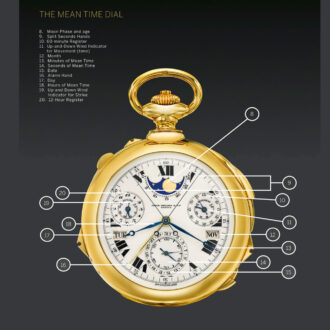
The mean time dial
Stern Frères also made the white enamel mean time dial, in 1929–1930. Its calm appearance hides how hard it was to make. The dial carries seven layers of hands, all of which must pass smoothly over one another:
- two split-seconds hands
- the hour and minute hands
- the alarm hand
- double hands in each power reserve dial
To fit them all, the small dials are double sunk. Each is made from two separate enamel sections with their own markings. This adds depth to the dial while keeping the gap between crystal and dial as small as possible, so the watch stays as slim as possible.
–
Details
- white enamel dial with radial black Roman numerals (chiffres romains regardants, Geneva style)
- outer track for minutes and chronograph seconds in fifths of a second
- double-sunk small dials for the 60-minute and 12-hour registers, combined with power reserves for the going and striking trains
- a further double-sunk small dial for seconds and date
- apertures for day, month and moon phase
- Breguet hour and minute hands, feuille hands on the small dials, a gold alarm hand and blued steel for all other hands
–
The movement
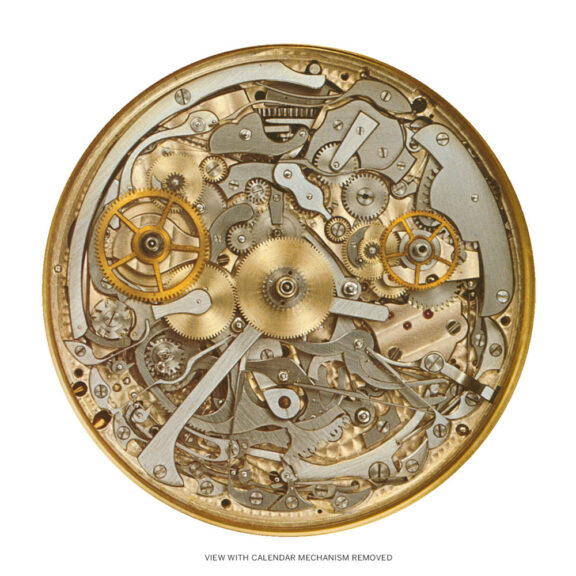
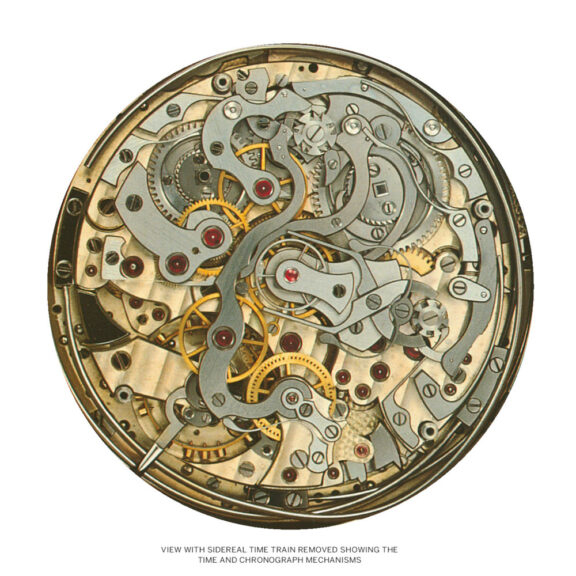
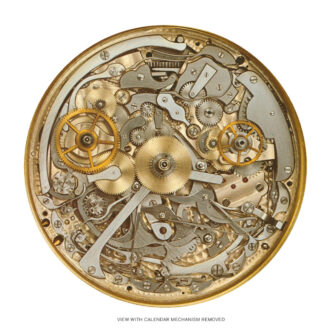
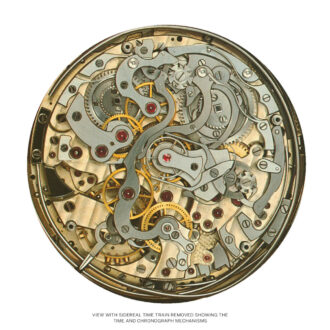
The movement is built in three tiers. The central tier is double-sided, and each side carries an additional tier.
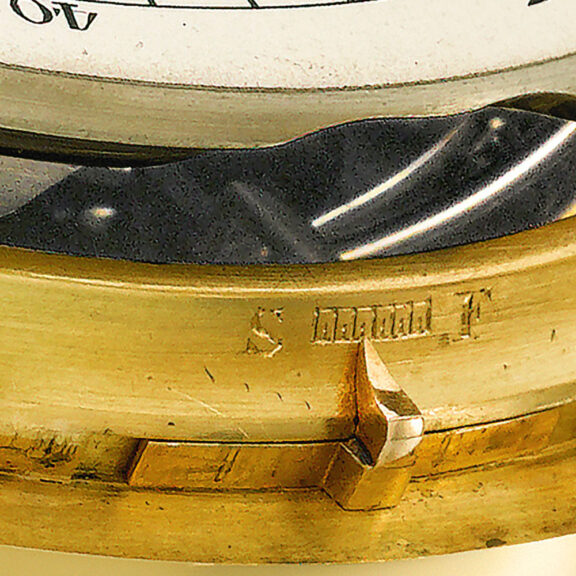
- 25’’’ damascened, two-train movement with multi-layered plates and 70 jewels, signed and numbered on the movement band
- lever escapement on the main plate; the first three wheels are 14K gold
- bimetallic compensation balance with gold regulating screws, adjusted to heat, cold, isochronism and five positions
- a unique regulator, made so it can be adjusted while hidden under the bezel
- striking mechanism with two barrels: Westminster carillon, grande and petite sonnerie, four hammers on four gongs
- power reserve indicators for the going and striking trains
- both chronograph mechanisms visible on the back of the central tier
–
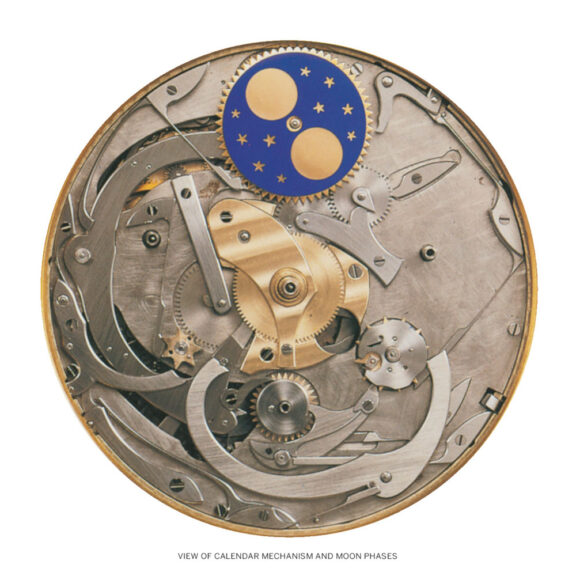
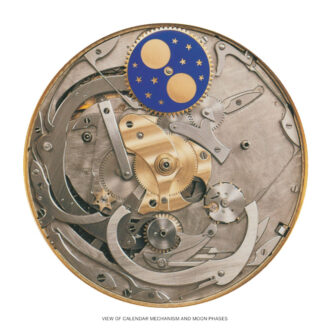
Under the mean time dial: the alarm, the springs and levers of the triple setting system for time and alarm, the calendar and the moon phase.
–
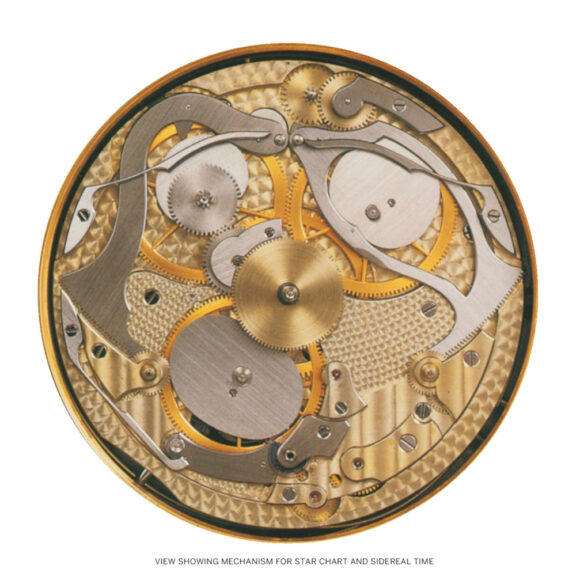
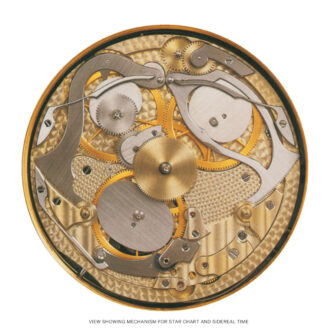
Under the sidereal time dial: the sidereal time train, the sky chart mechanism, and the cams for the equation of time, sunrise and sunset.
–
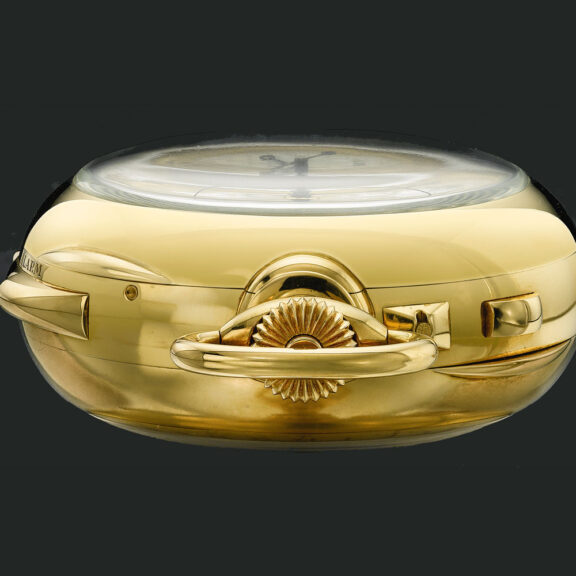
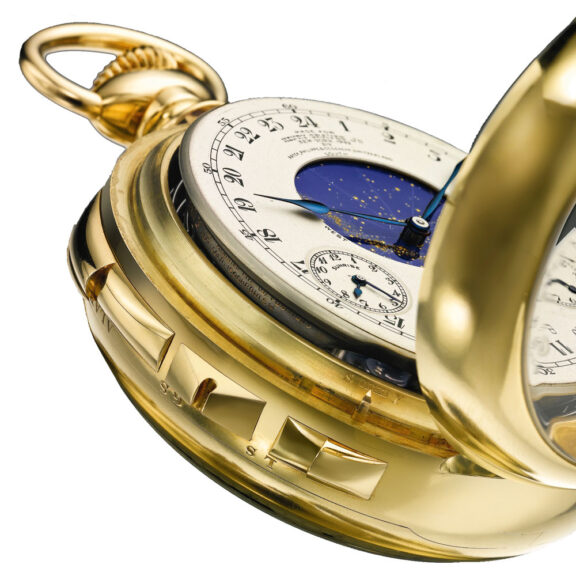
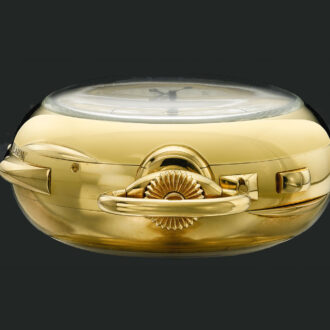
Thirteen functions on the case
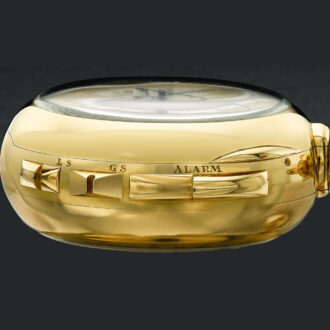
Facing the mean time side and going clockwise from the crown, the case has 13 controls:
- crown, turned one way to wind the going train and the other way to wind the chime
- crown pulled out: first position sets mean time, second position sets sidereal time
- coaxial pusher in the crown to start, stop and reset the chronograph
- moon phase corrector
- alarm winding slide
- slide to select petite or grande sonnerie
- minute repeater slide
- month corrector
- day-of-the-week corrector
- date corrector
- strike/silent slide
- split-seconds pusher
- pusher to engage hand-setting when the crown is pulled out
The main complications explained
–
Perpetual calendar and moon phase
The calendar always shows the correct day, date and month, whatever the length of the month, and adjusts automatically for leap years. Day and month appear in rectangular windows, an unusual layout. The moon phase aperture shows the phase and age of the moon.
–
A solar year lasts about 365 days, 5 hours and 49 minutes. The Gregorian calendar of 1582 corrects for this by adding a leap day every four years. It then leaves out three of those leap days every 400 years: century years are leap years only if divisible by 400. For that reason 2000 was a leap year but 2100 will not be. The calendar of the Supercomplication will therefore need its first manual correction in 2100.
–
Chiming: grande sonnerie, petite sonnerie and minute repeater
- Grande sonnerie: strikes the hour and the Westminster quarters at every quarter.
- Petite sonnerie: strikes only the quarters.
- Minute repeater: on demand, strikes the hours, quarters and minutes.
- Alarm: sounded by a fifth hammer on a fifth gong, separate from the carillon.
–
The Westminster chime is famous from the clock tower in London known as “Big Ben”. It was first used at Great St Mary’s Church in Cambridge in 1793. The melody is said to be based on Handel’s aria “I know that my Redeemer liveth” from the Messiah.Split-seconds chronograph with 60-minute and 12-hour registers
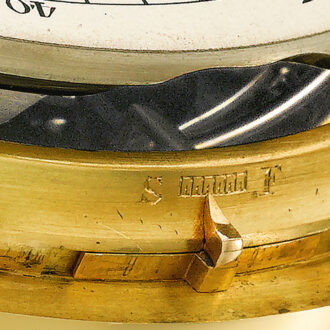
The chronograph can time two events at once. The pusher in the crown starts, stops and resets it. While it runs, the split pusher in the case band (between 10 and 11 o’clock on the mean time side) stops one of the two seconds hands while the other runs on. Elapsed minutes are shown on the right-hand register and hours on the left.
–
The construction is classic, but the registers are not. A 60-minute register is much harder to build than the usual 30-minute one, and a 12-hour register is rarely seen on a Patek Philippe.
Sidereal time, sunrise and sunset, equation of time
A sidereal day is the time the Earth needs to turn once relative to a fixed star: about 23 hours, 56 minutes and 4.1 seconds. The Supercomplication shows full sidereal time in hours, minutes and seconds. This is the most accurate way to display it, and also the most complicated. The sidereal train has three main wheels and makes one revolution per sidereal day. It needs a gear ratio of exactly 1.0027379092, driven by a 62-tooth wheel on the arbor of the fourth wheel. The dial uses the French spelling sidéral.
–
The equation of time shows the difference between solar time, as a sundial shows it, and mean time. Because the Earth’s orbit is elliptical, the difference varies through the year from about +14 to −16 minutes. The two agree around 15 April, 15 June, 1 September and 25 December. The watch shows this on a sector scale marked ±17 minutes, driven by an arbor that comes up through the movement from the calendar.
–
The small dials for sunrise and sunset are calibrated for New York City.
–
The star chart
Behind the oval aperture, the star chart turns anti-clockwise. It shows the night sky over New York, including the Milky Way and the magnitudes of the stars. It is linked to the sidereal train and can be set with the crown.
Signed: Patek Philippe and Co Geneva
Share this page: