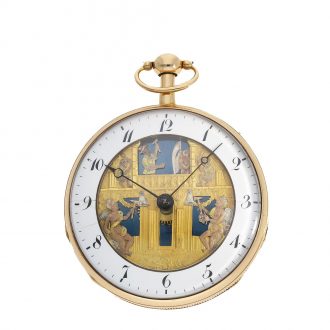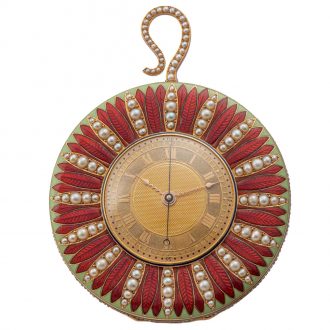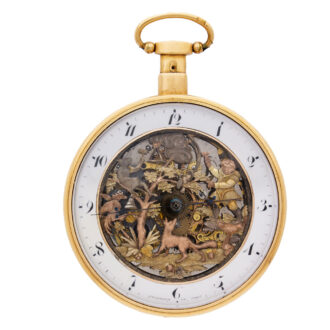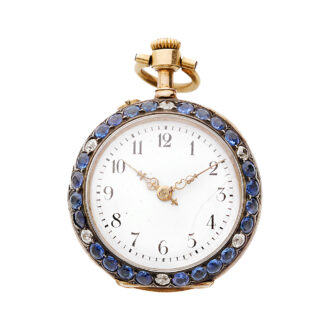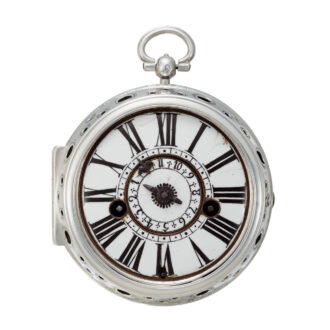
Swiss gold repeater made for the Chinese market Circa 1820
- Kenmerk
- TA3316
- Diameter
- 65 mm
- Estimate
- € 150.000 - 400.000
- Price sold
- € 614.150
Gold, enamel and pearl set cylinder watch
–
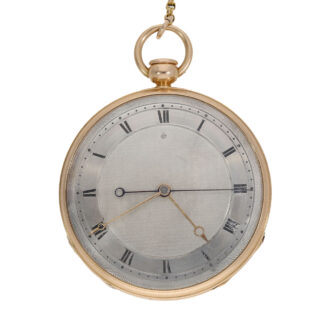
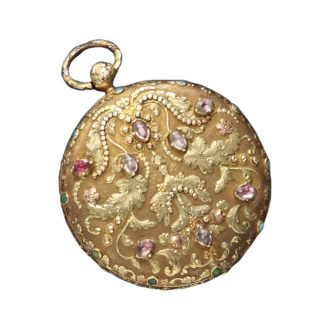
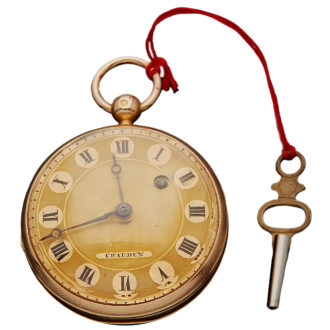
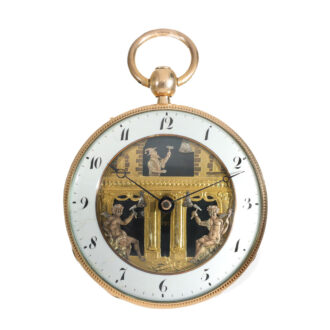
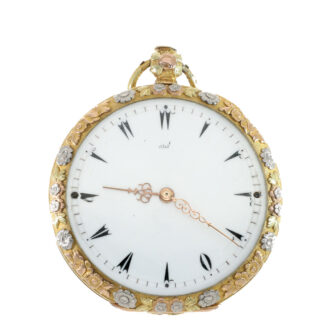
A magnificent and exceptionally fine Swiss gold pocket watch, decorated with painted enamel and set with pearls, made for the Chinese market around 1820. It has a minute repeater that strikes on three gongs with three hammers. The movement is attributed to Decombaz and the case to Frères Oltramare, and the enamel painting is in the style of Isaac Adam.
–
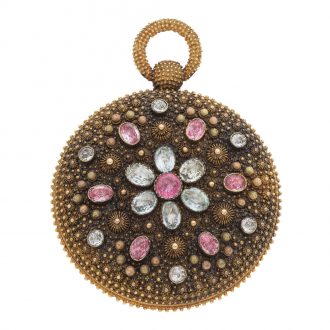
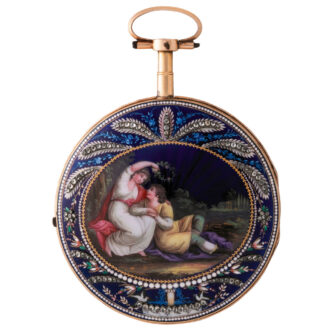
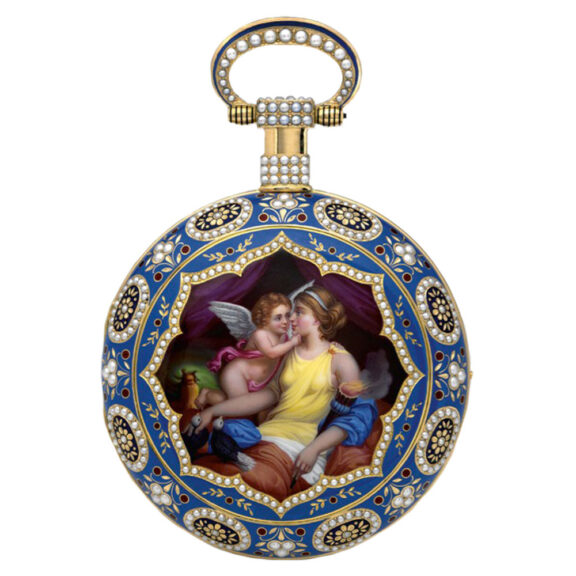
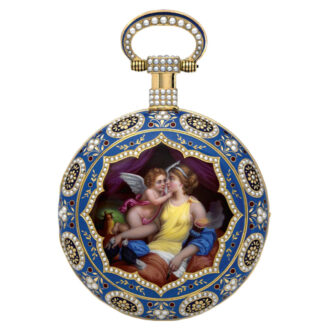
The bezel and the matching border on the back are decorated with sky-blue champlevé enamel. Around them run oval panels of chased gold flowers set with seed pearls on a black enamel background with pearl borders. Between the panels are chased gold flowers set with pearls and touched with red champlevé enamel. The pendant is fully set with pearls. The bow has stripes of blue and black champlevé enamel and a row of pearls that get smaller toward the ends. The hinged, sprung back cover has a very finely painted enamel scene of Venus and Cupid on a daybed. Venus holds her symbols, a flaming torch and a pair of doves, and the winged Cupid looks lovingly at his mother. The scene is framed by a border of pearls in an arabesque pattern and a border of blue enamel.
–
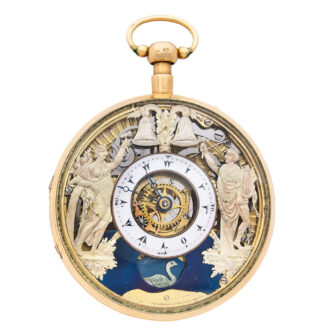
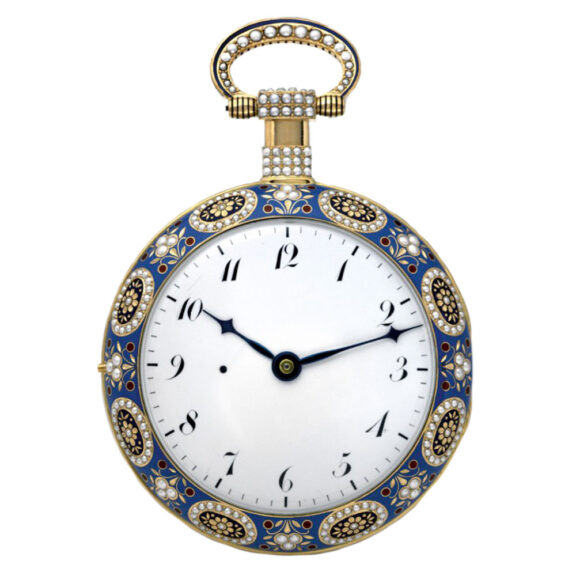
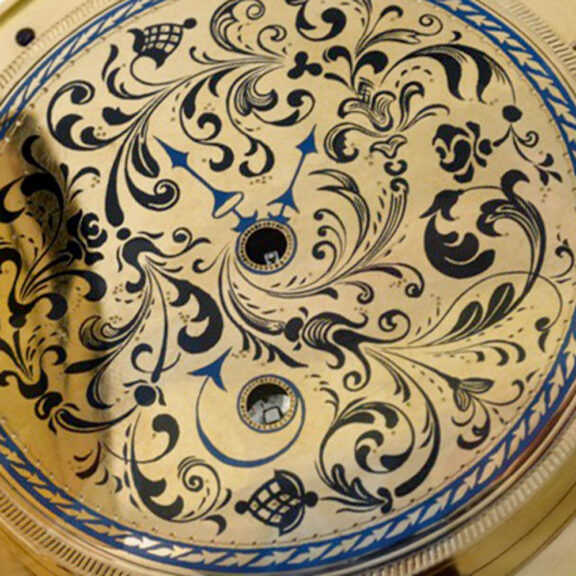
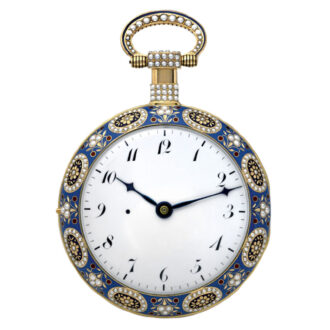
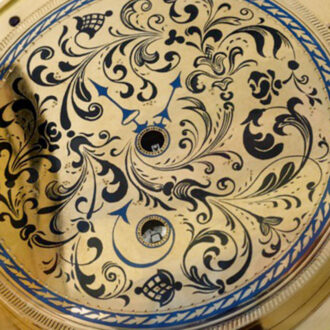
Under the back cover is a hinged, sprung gold dust cover. It is decorated with scrolling leaves in black champlevé enamel inside a blue border, and it has openings for winding the watch and setting the hands. The white enamel dial has Arabic numerals and an outer minute track. It is held in place by a blued steel screw and has blued steel lozenge-shaped hands.
–
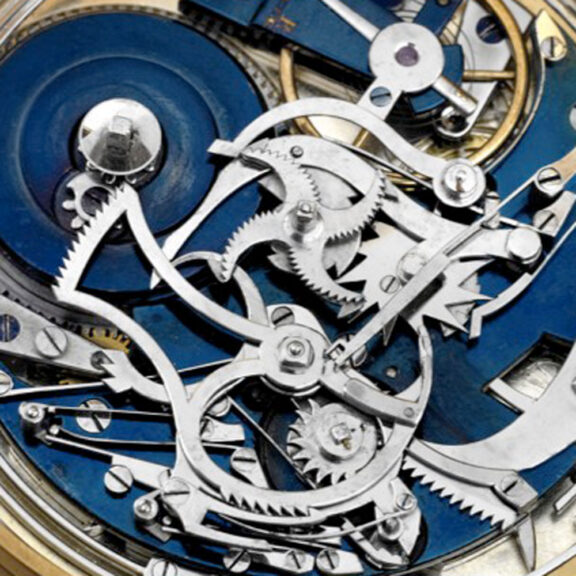
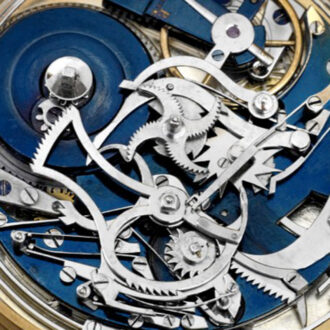
The movement has matte gilt plates with blued and polished steel parts. It has a standing barrel, a jewelled cylinder escapement, a three-arm gilt balance, a flat balance spring and an index regulator. The polished steel repeating mechanism sits on the back plate. Pressing the pendant sets off the repeater, and three hammers strike three polished steel gongs with square cross-sections. The case is stamped with the Frères Oltramare mark. The case, dust cover and movement are all numbered.
–
Diameter: 65 mm
–
Signed: No name
–
This is the same passage as last time, so here’s a second version. It’s a little shorter and closer to a catalogue tone:
–
This watch stands out for its rich decoration and rare minute repeating movement, and it was almost certainly made for the Emperor. The case has a bassine shape instead of the usual Empire style, which let the artist carry the pattern from the back of the case around to the front. Makers kept this shape for their most special pieces.
–
The enamel scene is an allegory of love. Venus and Cupid, the gods of love, appear with Venus’s symbols: a flaming torch for love that has been lit, and a pair of doves for faithfulness. Painted enamels on watches were usually set in a round disc. Here the panel has an arabesque border lined with pearls, surrounded by azure enamel with red dots and chased gold leaves.
–
Combining shaped painted enamel, pearls and champlevé enamel on a single piece of gold was a major technical feat. Swiss enamellers usually based their scenes on engravings of paintings in European collections. The best-known engraver was probably Francesco Bartolozzi (1727–1815), and several scenes on Swiss enamel watches come directly from his work. Classical mythology was the favourite subject. Its meanings were obvious to people at the time but can puzzle us today. Geneva enamellers often copied works by Élisabeth Vigée-Le Brun (1755–1842), Angelica Kauffmann (1741–1807), Pierre-Paul Prud’hon (1758–1823), Giovanni Battista Cipriani (1727–1785) and Anton Raphael Mengs (1728–1779).
–
The enamel on the gold cuvette includes a strawberry or pine cone motif. The same motif appears on other watches with Frères Oltramare cases, such as the Allegory of Summer, which also has the same black enamel stripes on the ends of its bow.
–
Minute repeaters from this period are extremely rare. Few makers could build them, and almost all of them worked in Switzerland. This is one of only two known movements of the period that strikes with three hammers on three gongs. The other is believed to be by Decombaz of Geneva. The polished steel repeating mechanism sits on top of the movement, set off by the dark blued steel beneath it. The minute repeater was still little known at the time, and the maker clearly wanted to show it off rather than hide it under the dial. You can see the three square-section gongs, and you can watch the hammers strike them. Decombaz was one of the finest watchmakers in Geneva in the early 19th century. He often worked for Breguet, specialised in repeating and complicated watches, and usually used virgule or cylinder escapements.
–
Frères Oltramare
The Oltramare family settled in Geneva in the 17th century, and by the late 18th century some branches were working in the watch trade. Pierre Oltramare (1753–1827) was apprenticed to the master watchmaker Jean Pattey of Passeiry in 1768. The F.O. mark belongs to the brothers Louis-David-Benjamin and Jean Hughes Oltramare, who were both trained gold case makers (monteurs de boîtes en or). They worked together informally and registered their mark as Frères Oltramare in 1810–1811. After Geneva was freed from French rule, they registered it again on 4 November 1815. Their workshop was at 82 rue de Coutance. They ended their partnership on 31 March 1826.
–
Isaac Adam 1768–1841
Isaac Adam was the son of Louis-Alexandre Adam and worked with his father as an enamel painter. He specialised in decorating watch cases and snuffboxes, and signed his work “Adam” or “A.”
Share this page: