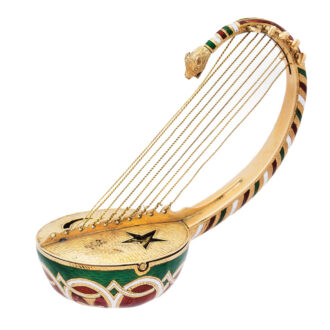
Swiss gold mandolin made for the Chinese market Circa 1820
- Kenmerk
- TA4886
- Diameter
- -
- Estimate
- € 1.000.000 - 2.000.000
- Price sold
- -
Gold quarter repeating musical automaton watch
–
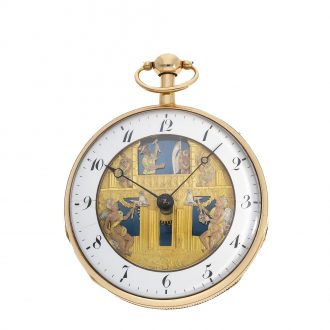
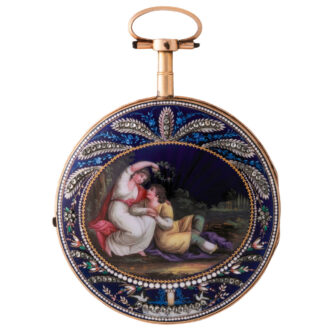
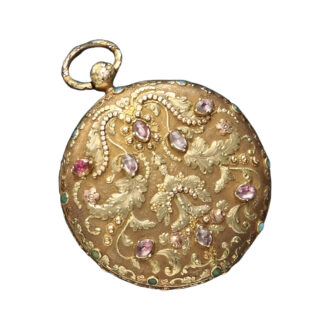
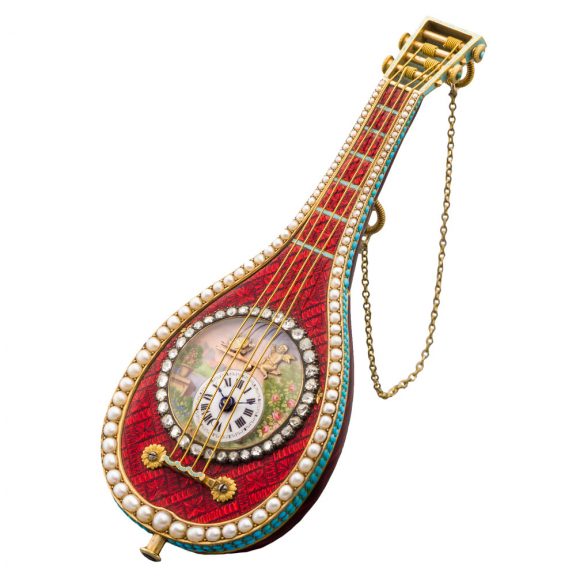
A magnificent and extremely rare 18 carat gold and enamel pearl set quarter repeating musical automaton watch, circa 1820. In the form of a Neapolitan mandolin, playing every hour or at will, made for the Chinese market. The mandolin is covered with translucent red scarlet enamel over flinqué, rose cut diamonds sound hole fitted with the watch dial and automaton scene (originally this bezel was probably pearl set). The back formed of six ribs in en suite red scarlet enamel over a geometrical pattern. The front of the neck is decorated with light blue enamel frets, gold knurled pegs, the front set with finely graduated split pearls on an applied gold frame. The edge is decorated with graduated half turquoise, gold twisted rope strings. A push button at the edge of the soundboard to activate the quarter repeating. Once the lid is opened, we discover a light blue gold and enamel hinging cuvette decorated with a champlevé column and foliages with translucent multicoloured flowers; on its side, the Music/Silence lever.
–
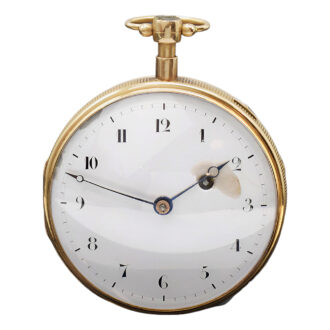
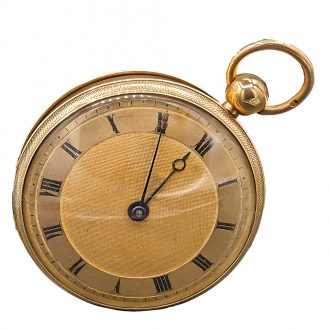
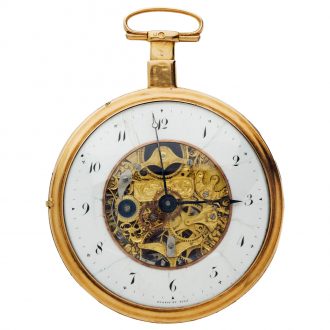
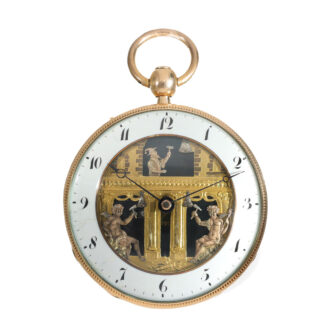
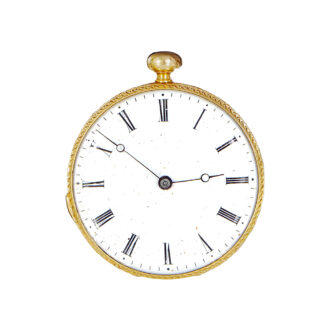
The gold plates surrounding the cuvette, with inside the movement, engraved with ribbon flowers enamelled in royal blue champlevé. Painted on enamel over a background with a park, roses in the foreground, a varicoloured gold Cupid and butterfly, symbol of fragility of Love, on an animated seesaw, over a radial Roman chapter set eccentrically at the lower part with outer minute and second rings. Blued steel spade hands, blued steel equilibrated central hand. Frosted gilt brass movement, two train, with free standing barrel for the going train, cylinder escapement, plain three arm balance, blued steel flat balance spring, polished steel endplate, index regulator, repeating on two gongs activated by depressing the pendant. Musical movement with 19 individual tuned blued steel vibrating blades acting on both sides of the pinned disc; the Music/silence lever at the edge of the cuvette, beneath the cover of the object. Movement punched “P M” inside a horizontal lozenge on the dial plate and was numbered in several places.
–
Dimensions: 127 x 50 mm
–
Signed: Piguet & Meylan Geneva
–
The second watch of this pair made for the Chinese market is kept in the Hans Wilsdorf Foundation Collection, Montres Rolex S.A., Geneva (Inv. No. 45). Alfred Chapuis (1880-1958) mentions in the book of this collection (1944, p. 116) that the music is a popular German song “Ach! du lieber Augustin…” and reproduces the score (p. 118). The magnificent watch of fantasy illustrated here is one of only four known, created circa 1820 by Piguet & Meylan of Geneva, two others are kept in private collections (Patek Philippe Museum and Hans Wilsdorf Foundation, Montres Rolex S.A.; both in Geneva). They are unusually large, and apart from the watch, they also feature automatons and play music. A fundamental difference between these four pieces and most fantasy watches is that these do not conceal the timepiece, but feature it as its most important function, just as a classic watch.
–
The rare size permits even more luxurious decorations, this piece having polychrome champlevé enamel and translucent enamel on guilloché, natural pearls, gold paillons, refined and delicate engraving, and such details, making this object extremely rare and desirable. The automaton, which represents two children on a seesaw, delicately beats time to the music. The placement and combination of the colours used for these exquisite enamels lead us to believe that this mandolin was specially made for the Chinese Emperor and his court, where most of Piguet & Meylan’s finest timepieces and objects were destined. The Neapolitan mandolin comes from the lute family, from which it inherited its characteristic gourd shape. Its history is quite long, its form, as we know it today, dating back to Florence around 1600. Its sweet notes and particular quality made it a huge success in Italy, and especially in the region around Naples. In England, since the sound was very similar to that of the virginal, the mandolin soon became the basis of all young women’s musical education. Many have unjustly labelled the mandolin an instrument of Italian folklore, when instead it has been featured as the solo instrument of choice of Vivaldi, in some of the works of Beethoven, Pergolesi, Verdi, Mahler, Stravinsky, and even in Mozart’s Don Giovanni opera.
–
This instrument was a perfect reflection of the time when Jean-Jacques Rousseau (originally of Geneva) in France and Sturm und Drang in Germany created a philosophical movement of romanticism as a reaction or denial of the classicism of the 16th century. In Geneva the goldsmiths and watchmakers were inspired by what the mandolin symbolised, and thanks to its gracious form, they miniaturised it, creating tiny masterpieces in precious metals, lavish with multicoloured enamels and oriental pearls, and such, transforming this instrument into jewels of fantasy, messengers of love, which discreetly adorned the breasts of their beloved. Watchmakers, such as Piguet & Capt, the Achards, the Esquivillons, the Bordiers, and Rémond, who were goldsmiths as well, were specialized in reproducing exotic shapes, such as musical instruments, fruits, flowers, good luck animals, flasks and objects of everyday life, into precious jewels destined to the most refined customers of Europe or foreign markets. The bulging shape of the mandolin lent it perfectly to hidden treasures, a vinaigrette, a concealed watch, or even a minute musical mechanism, whose pins strum the vibrating steel blades, imitating not only the shape of the mandolin but its sweet sound as well.
Signed: Piguet & Meylan Geneva
Share this page: