Swiss gold mandolin made for the Chinese market Circa 1820
- Kenmerk
- TA4886
- Diameter
- -
- Estimate
- € 1.000.000 - 2.000.000
- Price sold
- -
Gold quarter repeating musical automaton watch
–
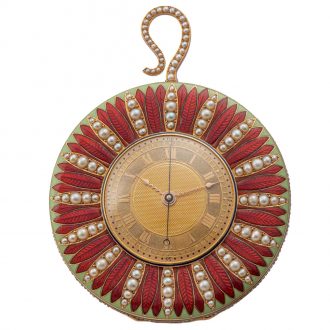
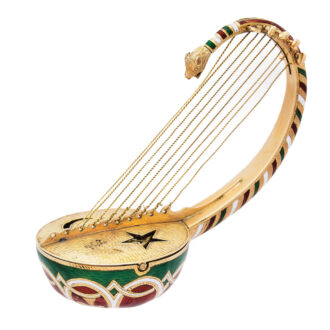
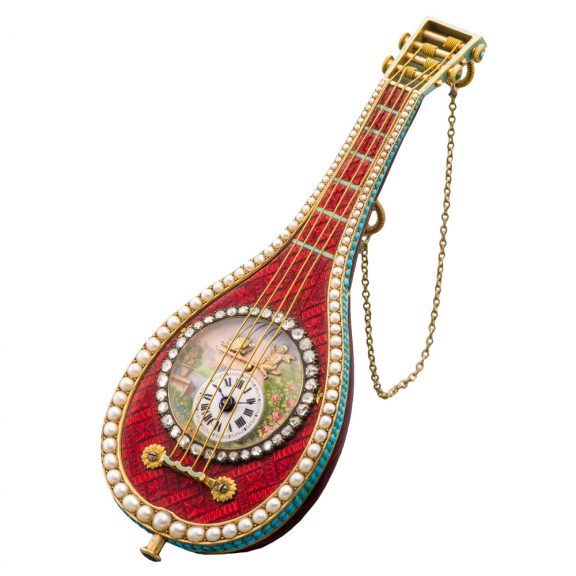
A magnificent and extremely rare 18-carat gold and enamel pearl-set quarter-repeating musical automaton watch, made by Piguet & Meylan, circa 1820. It is in the form of a Neapolitan mandolin and plays every hour or at will. It was made for the Chinese market.
–
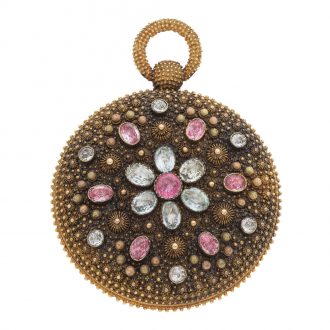
The mandolin watch is covered with translucent scarlet-red enamel over flinqué. The rose-cut diamond sound hole is fitted with the watch dial and an automaton scene (originally, this bezel was probably pearl-set). The back is formed of six ribs in matching scarlet-red enamel over a geometrical pattern. The front of the neck is decorated with light blue enamel frets and gold knurled pegs, and the front is set with finely graduated split pearls on an applied gold frame. The edge is decorated with graduated half-turquoise and gold twisted rope strings. A push button at the edge of the soundboard activates the quarter repeating.
–
Once the lid is opened, a light blue gold and enamel hinged cuvette is revealed, decorated with a champlevé column and foliage with translucent multicoloured flowers. On its side is the Music/Silence lever.
–
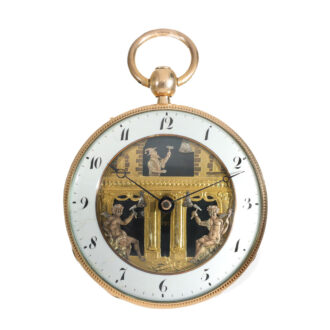
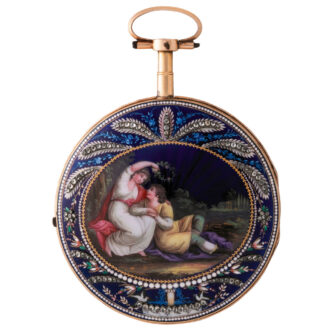
The gold plates surrounding the cuvette, with the movement inside, are engraved with ribbon flowers enamelled in royal blue champlevé. Painted on enamel over a background of a park, with roses in the foreground, is a varicoloured gold Cupid and butterfly a symbol of the fragility of Love on an animated seesaw. Below this is a radial Roman chapter set eccentrically at the lower part, with outer minute and second rings. The watch has blued steel spade hands and a blued steel equilibrated central hand.
–
The movement is frosted gilt brass and two-train, with a free-standing barrel for the going train, a cylinder escapement, a plain three-arm balance, a blued steel flat balance spring, a polished steel endplate, and an index regulator. It repeats on two gongs activated by depressing the pendant.
–
The musical movement has 19 individually tuned blued steel vibrating blades acting on both sides of the pinned disc. The Music/Silence lever is at the edge of the cuvette, beneath the cover of the object. The movement is punched “P M” inside a horizontal lozenge on the dial plate and was numbered in several places.
–
Dimensions: 127 x 50 mm
–
Signed: Piguet & Meylan Geneva
–
Piguet & Meylan made this magnificent fantasy watch in Geneva around 1820. Only four are known.
–
It was made for the Chinese market as one of a pair. Its twin is in the Hans Wilsdorf Foundation Collection of Rolex in Geneva. Alfred Chapuis (1880–1958) wrote about it in his 1944 book on that collection. He identified the tune as the popular song “Ach, du lieber Augustin”. A third example is in the Patek Philippe Museum in Geneva.
–
These watches are unusually large. Besides telling the time, they play music and have moving figures. They also differ from most fantasy watches: those usually hide the watch inside the object. In these four, the watch is not hidden but is the main feature, just as in a classic watch.
–
Because this watch is unusually large, there was room for even richer decoration. It combines polychrome champlevé enamel, translucent enamel over guilloché, natural pearls, gold paillons and fine, delicate engraving. Details like these make it extremely rare and desirable.
–
The automaton shows two children on a seesaw, gently beating time to the music. The choice and placement of the enamel colours suggest that the mandolin was made especially for the Chinese Emperor and his court. Most of Piguet & Meylan’s finest watches and objects were made for them.
–
The Neapolitan mandolin belongs to the lute family, from which it took its rounded, bowl-shaped back. Its sweet tone made it hugely popular in Italy, especially around Naples, and it soon became fashionable in England as well. The mandolin is often dismissed as a folk instrument, but that does it an injustice. Vivaldi wrote solo concertos for it, and it appears in works by Beethoven, Pergolesi, Verdi, Mahler and Stravinsky, and in Mozart’s opera Don Giovanni.
–
The mandolin was a perfect symbol of its time. In France, Geneva-born Jean-Jacques Rousseau, and in Germany, the Sturm und Drang movement, prepared the way for Romanticism, a reaction against the strict classicism of the 18th century.
–
In Geneva, goldsmiths and watchmakers were inspired by what the mandolin stood for and by its graceful shape. They made it in miniature, creating tiny masterpieces in gold, rich with multicoloured enamel and natural pearls. These fantasy jewels became messengers of love, worn discreetly on the breast of a loved one.
–
Some Geneva watchmakers were also goldsmiths and specialised in this kind of work. Among them were Piguet & Capt, Rémond, and the Achard, Esquivillon and Bordier families. They made precious jewels in unusual shapes, such as musical instruments, fruit, flowers, lucky animals, flasks and everyday objects. Their customers were the most refined buyers in Europe and beyond.
–
The mandolin, with its rounded body, was ideal for hiding small treasures. It could hold a vinaigrette (a tiny box for scented salts), a secret watch, or a miniature musical movement. In such a movement, small pins pluck steel blades to make music. So the jewel copied not only the shape of the mandolin, but also its sweet sound.
Signed: Piguet & Meylan Geneva
Share this page: