Swiss 18K gold musical watch with hidden erotic scene Circa 1810
- Kenmerk
- TA2393
- Diameter
- 58 mm
- Estimate
- € 70.000 - 120.000
- Price sold
- € 154.400
Gold quarter repeating cylinder watch
–
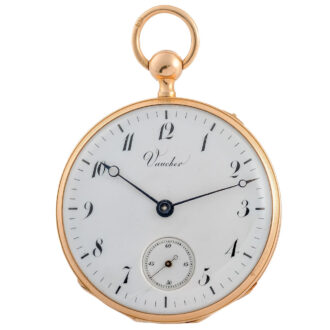
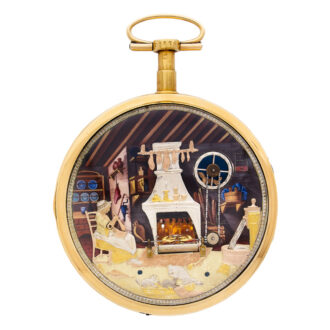
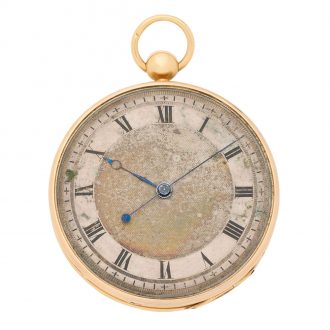
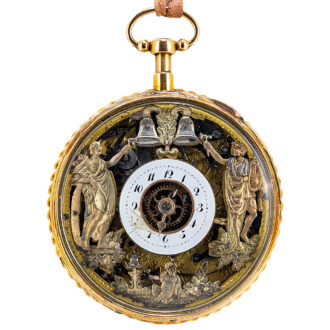
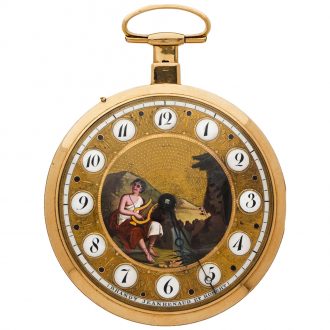
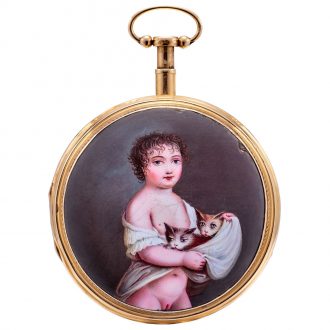
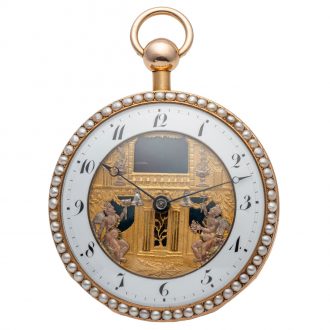
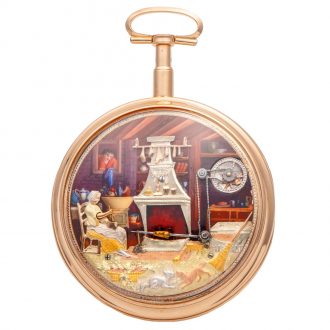
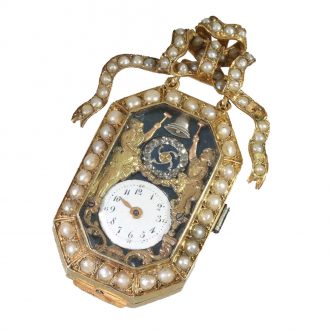
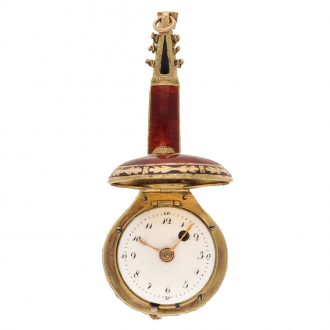
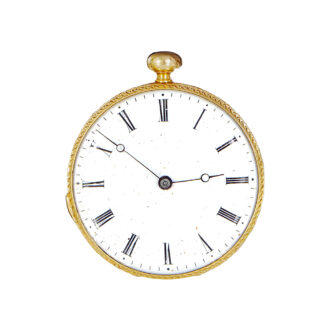
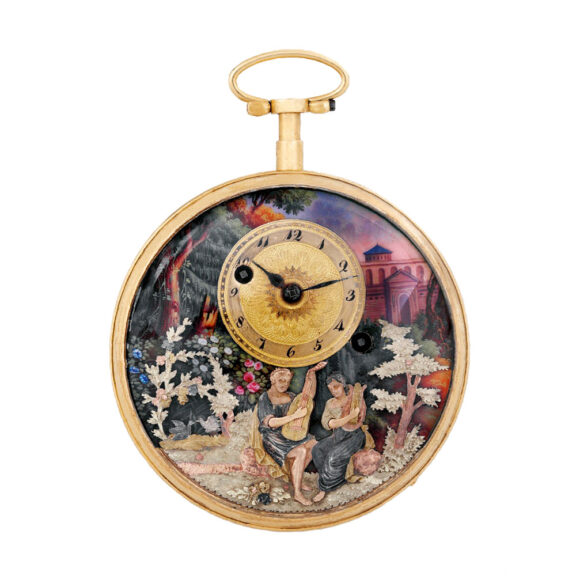
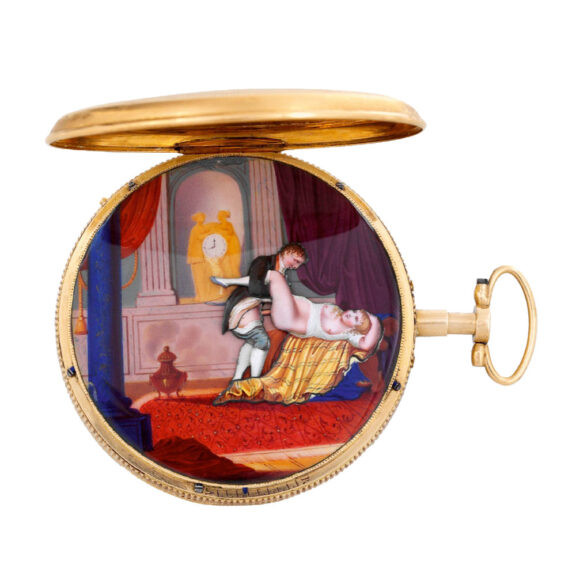
Extremely fine and equally rare Swiss 18K gold and enamel two-train quarter repeating musical watch, circa 1810. With two automatons, a scene with musicians and birds on the dial plate and a concealed erotic scene, both playing at will. Empire case, maker’s mark IG, reeded band, the back with wavy-line engine turning. A fixed gold and finely painted on enamel cuvette with an automaton scene of a gentleman and a lady in a sumptuous interior activated through a steel cam when the music plays. Small eccentric gold engine-turned and engraved dial, Breguet numerals on a plain reserve, outer minute dot divisions, the centre engraved with a rosette and steel spade hands.
–
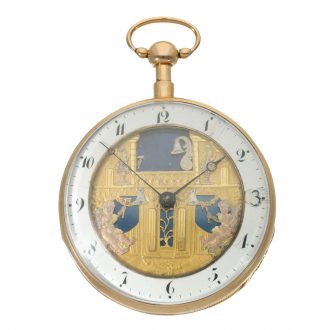
The dial with a polychrome enamel scene of a landscape with a classical building, the foreground applied with a varicoloured gold chased automaton scene of a seated gentleman playing the mandolin and a seated lady playing the lyre, to the side two birds in an arbour, one moving towards the other with the music. Gilt-brass, full plate, double train movement with cylindrical pillars, going barrel and cylinder escapement, plain gold three-arm balance, flat balance spring, small pierced and chased gilt-brass cock with polished steel end-piece, repeating on gongs activated by depressing the pendant, regulator arm protruding from under the cuvette with engraved scale at the edge. Musical train with a pinned barrel and six stacked steel blades.
–
Diameter: 58 mm
–
Signed: Henry Capt Genève
–
The case is slightly chipped.
–
This watch is undoubtedly the work of the exceptional Genevan watchmaker Henry Capt. It can be compared directly to other examples signed by him. This watch, with its concealed erotic automaton, is one of the very few known examples made by Henry Capt with two automaton scenes. The present watch is of higher specification than most; it has three animations on the dial instead of the usual two. The arm of each musician moves, and in a charming scene of two billing doves in an arbour, one dove appears when the music starts and disappears at the tune’s end. The enamel erotic scene is of very high quality depicting an aristocratic interior; of particular note is the pillar in the scene, which is very cleverly enamelled, with flecks of gold dust to accurately simulate lapis lazuli, again indicating the high status of the piece.
–
Henry-Daniel Capt was born in Le Chenit, Switzerland, in 1773; he married Henriette Piguet. He specialized in the production of complicated watches, musical watches and automaton watches. Among the first in Geneva to use the musical mechanism with pinned cylinder and tuned teeth comb, he was famous for his snuffboxes with music and automaton scenes. From Ventôse 16, An X (March 7, 1802) to 1811, he formed a partnership with Daniel Isaac Piguet, who was from the same village as he. Their signature was Piguet & Capt. In 1811, when Piguet broke off to join Meylan in a new partnership, Henry-Daniel Capt continued to work on his own until, in 1830, he went into partnership with Aubert and his son, Place Bel-Air. Their signature was Aubert & Capt. They were among the first Genevan makers to produce watches with chronographs.
–
In 1844 the workshop was at 108 rue Neuve in Geneva. Capt’s son then managed it, Henry Capt Jr. After a short time, it moved to 85 rue de la Fusterie and, in 1851, to 177 rue du Rhône. In 1880, the firm was bought by Gallopin, and its name became H. Capt Horloger, Maison Gallopin Successeurs, a trademark registered on November 1, 1880, under the No. 44. This signature was only used for watches retailed in their store, the watches supplied to other retailers being merely signed Henry Capt. Henri Capt, Isaac Piguet, and Philippe Meylan were the foremost makers of small musical automata in the late 18th and early 19th centuries. Most of his work is not signed, although he sometimes scratched his name on his movements.
Signed: Henry Capt Genève
Share this page: