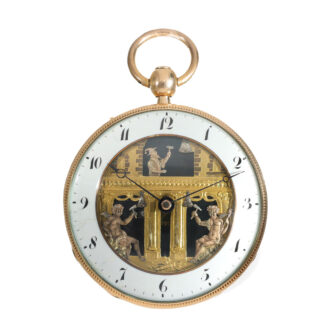
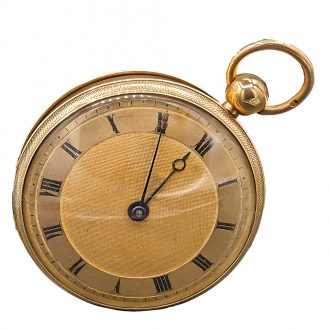
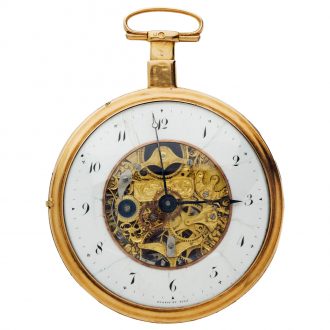
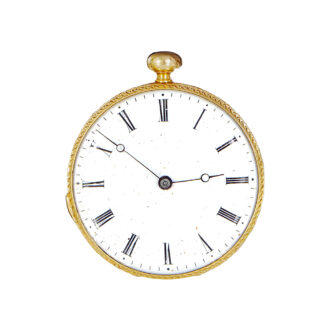
Swiss 18K gold repeater made for Chinese market Circa 1820
- Kenmerk
- TA1573
- Diameter
- 53 mm
- Estimate
- € 60.000 - 110.000
- Price sold
- € 102.000
Gold quarter repeating cylinder watch
–
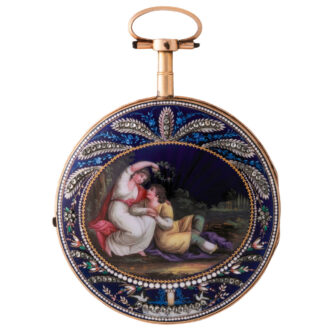
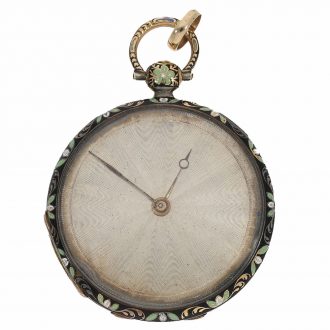
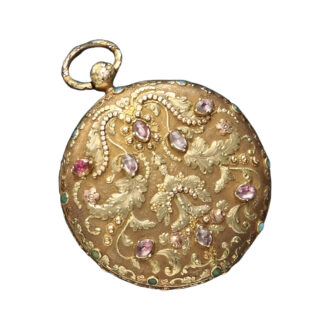
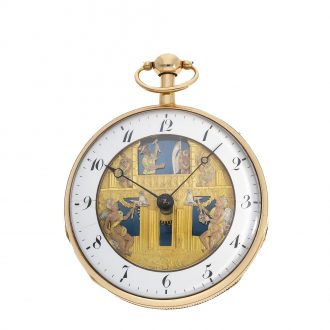
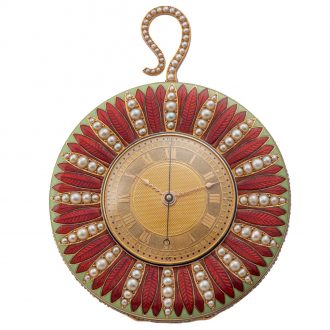
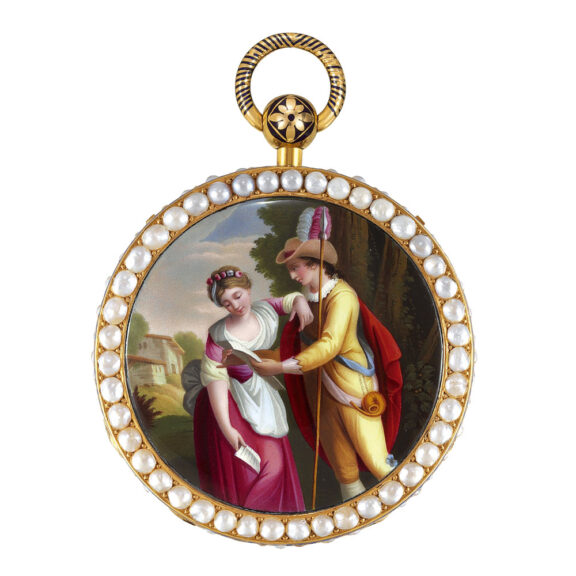
An extremely fine and very rare Swiss 18K gold, enamel and pearl-set quarter repeating cylinder pocket watch made for the Chinese market, circa 1820. Lavinia receiving the Letter from Palemon by Piguet & Meylan. An Empire case by Frères Oltramare, both bezels set with split pearls, the band, pendant and bow decorated with royal blue enamel, the band also set with split pearls, on the back cover a finely painted on enamel scene depicting Lavinia and Palemon in a wooded landscape. Hinged gold cuvette decorated with a pale blue champlevé enamel flower and leaf garland.
–
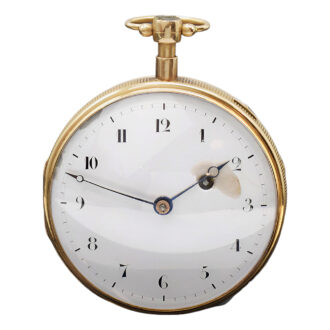
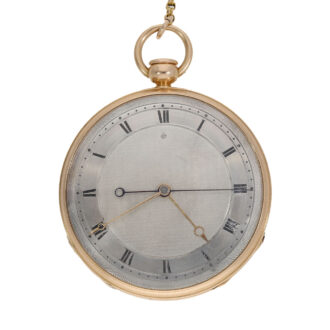
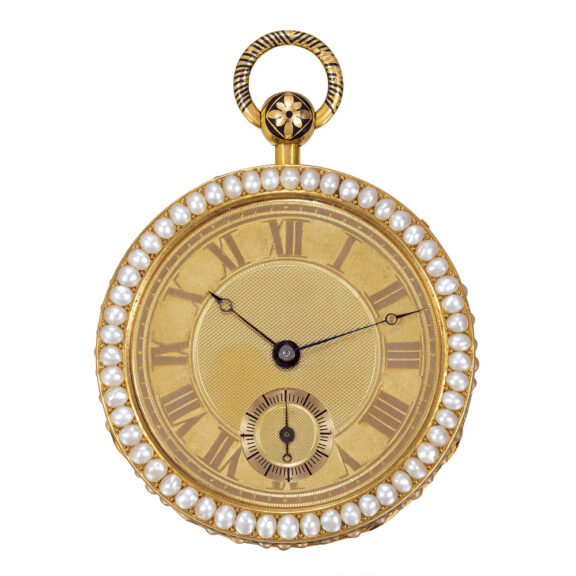
Gold dial, matted chapter ring with polished radial Roman hours, outer minute divisions, engine-turned centre, subsidiary seconds and blued steel Breguet hands. A frosted gilt movement, standing barrel, jewelled cylinder escapement, three-arm gold balance, blued steel flat balance spring, index regulator with bimetallic temperature compensation curb, repeating on gongs activated by depressing the pendant. Movement punched PM for Piguet & Meylan on the dial plate beneath the dial, case punched with FO for Frères Oltramare’s.
–
An extremely fine and very rare Swiss 18K gold, enamel and pearl-set quarter repeating cylinder pocket watch made for the Chinese market, circa 1820. Lavinia receiving the Letter from Palemon by Piguet & Meylan. An Empire case by Frères Oltramare, both bezels set with split pearls, the band, pendant and bow decorated with royal blue enamel, the band also set with split pearls, on the back cover a finely painted on enamel scene depicting Lavinia and Palemon in a wooded landscape. Hinged gold cuvette decorated with a pale blue champlevé enamel flower and leaf garland.
–
Gold dial, matted chapter ring with polished radial Roman hours, outer minute divisions, engine-turned centre, subsidiary seconds and blued steel Breguet hands. A frosted gilt movement, standing barrel, jewelled cylinder escapement, three-arm gold balance, blued steel flat balance spring, index regulator with bimetallic temperature compensation curb, repeating on gongs activated by depressing the pendant. Movement punched PM for Piguet & Meylan on the dial plate beneath the dial, case punched with FO for Frères Oltramare’s.
–
Diameter: 53 mm
–
Signed: Piguet & Meylan Genève
–
This painting illustrates the story from James Thomson‘s popular poem The Seasons dating from 1726-1730. The rural lovers Palemon and Lavinia appear in Thomson’s Autumn, they are adapted from the Biblical story of Ruth and Boaz. Palemon, a gentleman, professes his love for the country girl Lavinia, in a harvest-time setting. Thomson’s sentimental fantasy of rural romance was particularly attractive to a generation brought up on the ideals of sensibility. The poem that accompanies this scene is as follows: And are thou then Acastos’ dear remains. She whom my restless Gratitude has sought – So long in vain, O Heav’ns! the very frame The softened Image of my noble Friend.
–
Piguet & Meylan both originally from the village of Le Chenit in the Vallée de Joux, Isaac Daniel Piguet (1775-1841) and Philippe Samuel Meylan (1772- 1845) came to Geneva as young men and formed a partnership that lasted from 1811 to 1828. The company specialized in elaborate and beautifully decorated musical watches, including skeleton and automaton watches, and mechanical animals. The firm was established at 45, Rue Jean Jacques Rousseau in Geneva. After their association came to an end, both Piguet and Meylan continued for some time to work with their sons.
–
Isaac Daniel Piguet was born in 1775 in Le Chenit in the Vallée de Joux, he was the son of Pierre Moïse Piguet and Elisabeth Nicole. He married Jeanne Françoise Capt around 1795, and around 1800 settled in Geneva with his family. Isaac Daniel Piguet went into business with Henry Daniel Capt, his brother-in-law, on February 10, 1802. The association between Piguet & Meylan came to an end in 1828. Piguet and his son David Auguste established a new company, Piguet père & fils, located at No 69, Rue Jean-Jacques Rousseau. Isaac Daniel Piguet died in Geneva, on January 20, 1841, at the age of 66.
Diameter: 53 mm
–
Signed: Piguet & Meylan Genève
–
This painting illustrates the story from James Thomson‘s popular poem The Seasons dating from 1726-1730. The rural lovers Palemon and Lavinia appear in Thomson’s Autumn, they are adapted from the Biblical story of Ruth and Boaz. Palemon, a gentleman, professes his love for the country girl Lavinia, in a harvest-time setting. Thomson’s sentimental fantasy of rural romance was particularly attractive to a generation brought up on the ideals of sensibility. The poem that accompanies this scene is as follows: And are thou then Acastos’ dear remains. She whom my restless Gratitude has sought – So long in vain, O Heav’ns! the very frame The softened Image of my noble Friend.
–
Piguet & Meylan both originally from the village of Le Chenit in the Vallée de Joux, Isaac Daniel Piguet (1775-1841) and Philippe Samuel Meylan (1772- 1845) came to Geneva as young men and formed a partnership that lasted from 1811 to 1828. The company specialized in elaborate and beautifully decorated musical watches, including skeleton and automaton watches, and mechanical animals. The firm was established at 45, Rue Jean Jacques Rousseau in Geneva. After their association came to an end, both Piguet and Meylan continued for some time to work with their sons.
–
Isaac Daniel Piguet was born in 1775 in Le Chenit in the Vallée de Joux, he was the son of Pierre Moïse Piguet and Elisabeth Nicole. He married Jeanne Françoise Capt around 1795, and around 1800 settled in Geneva with his family. Isaac Daniel Piguet went into business with Henry Daniel Capt, his brother-in-law, on February 10, 1802. The association between Piguet & Meylan came to an end in 1828. Piguet and his son David Auguste established a new company, Piguet père & fils, located at No 69, Rue Jean-Jacques Rousseau. Isaac Daniel Piguet died in Geneva, on January 20, 1841, at the age of 66.
–
Philippe Samuel Meylan was born February 15, 1772, in Bas-du-Chenet, and died in Geneva in 1845. At 20 years of age, he came to Geneva where he was a master worker for the Godemar Frères. He met another watchmaker from his native region, Isaac Piguet, and they entered into a partnership, founding the Piguet & Meylan firm, which was to last from 1811 to 1828. It specialized in minute creatures, musical watches, skeleton and automaton watches. Meylan is also credited with the invention of the Bagnolet calibre. After Piguet & Meylan was dissolved, Philippe Samuel Meylan continued to work with his sons François and David Auguste.
Philippe Samuel Meylan was born February 15, 1772, in Bas-du-Chenet, and died in Geneva in 1845. At 20 years of age, he came to Geneva where he was a master worker for the Godemar Frères. He met another watchmaker from his native region, Isaac Piguet, and they entered into a partnership, founding the Piguet & Meylan firm, which was to last from 1811 to 1828. It specialized in minute creatures, musical watches, skeleton and automaton watches. Meylan is also credited with the invention of the Bagnolet calibre. After Piguet & Meylan was dissolved, Philippe Samuel Meylan continued to work with his sons François and David Auguste.
–
Frères Oltramare worked in Geneva between circa 1810-1826.
Frères Oltramare worked in Geneva between circa 1810-1826.
Signed: Piguet & Meylan Genève
Share this page: