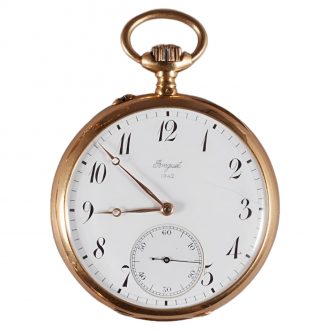
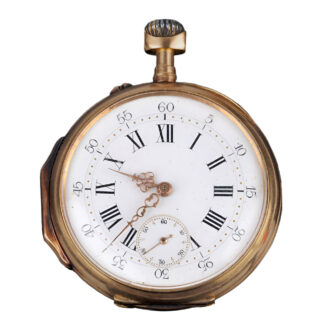
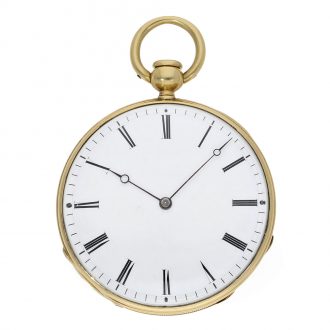
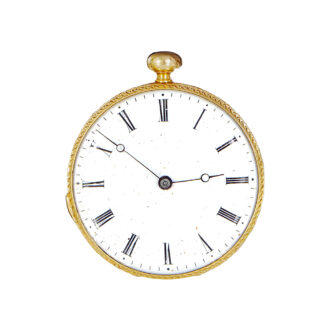
Swiss early gold stem winding cylinder watch Circa 1842
- Kenmerk
- SA3140
- Diameter
- 47 mm
- Estimate
- € 7.000 - 12.000
- Price sold
- € 54.500
Early gold stem winding watch
–
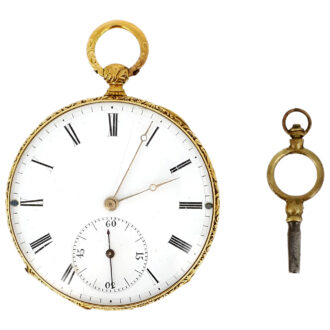
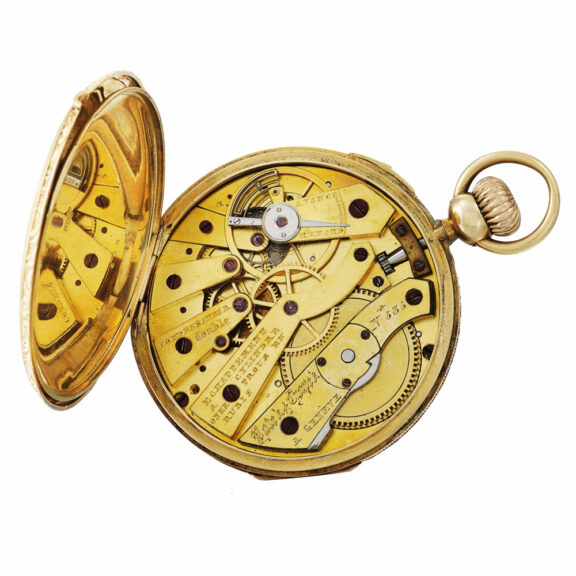
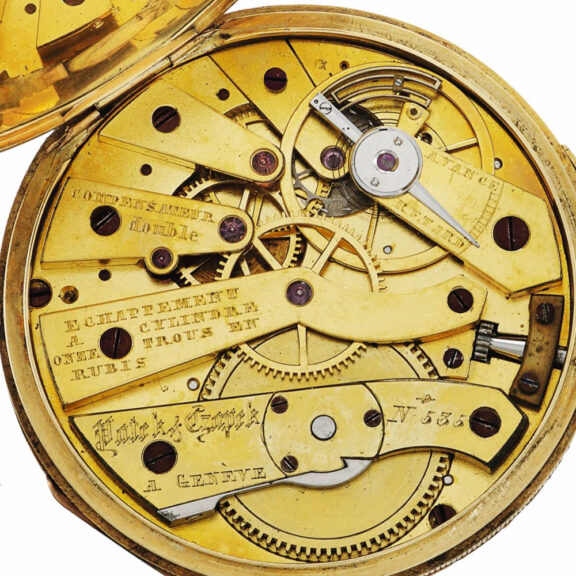
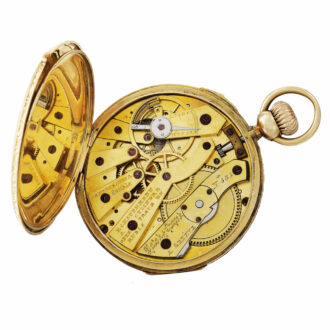
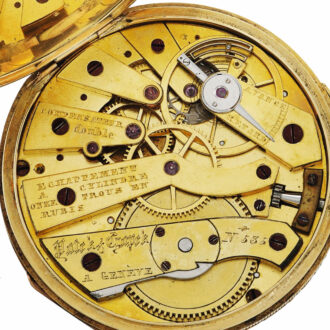
A very rare and early yellow gold open faced stem winding cylinder watch, made in 1842. Gilt cylinder movement, 11 jewels, stem winding mechanism.
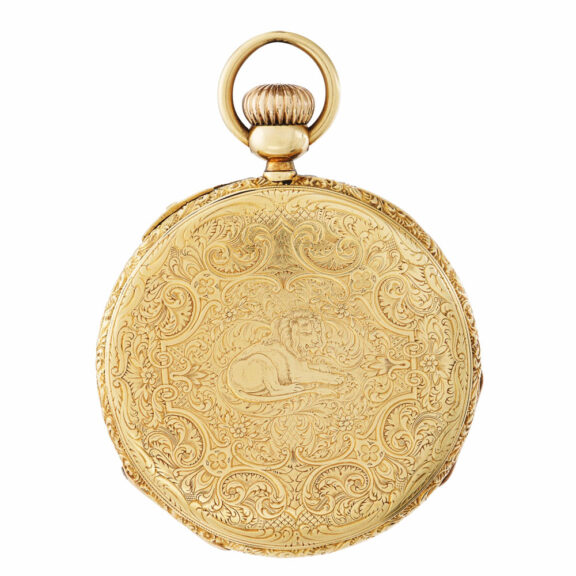
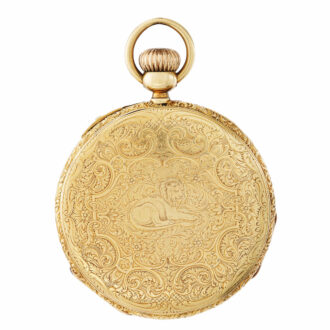
Silvered engraved dial, Roman numerals, outer minute track, subsidiary seconds, 18 Carat yellow gold case and cuvette, slide to the band to set hands, case engraved foliate design and central lion within a symmetrical cartouche, coin edged band, cuvette engraved, movement signed, case numbered.
–
Diameter 47.5 mm
–
Signed: Patek, Czapek & Cie.
–
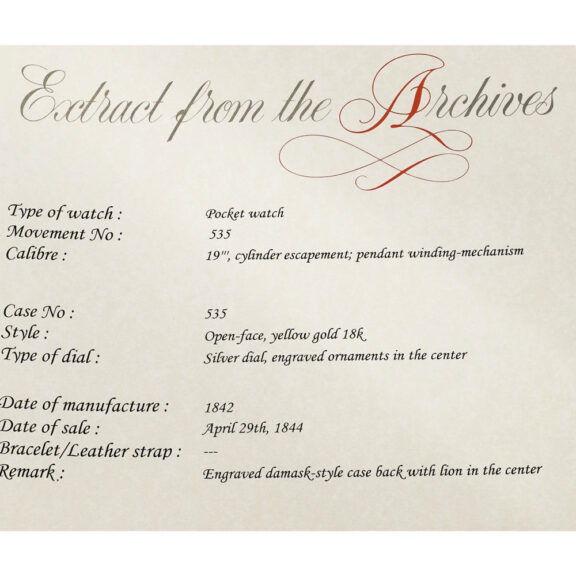
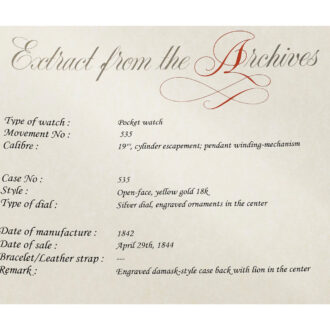
Accompanied by a Patek Philippe Extract from the Archives confirming the year of manufacture in 1842 and date of sale on April 29th, 1844, with pendent winding mechanism, engraved dial and engraved damask style case with lion in the center. In 1839 Frantisek Czapek and Count Anton de Patek launched a joint watchmaking business: Patek, Czapek & Cie. The partnership was short lived, dissolving in 1845. They were thought to produce as little as 200 watches per annum and this watch is one of only 42 pieces which employed the stem winding system, otherwise known as keyless watches. Of these, No. 535 is one of the earliest surviving and to the best of our knowledge has never before been offered at auction (the earliest number with a stem winding system is No. 171). For the collector who wants to acquire a piece of the early history of Patek Philippe, this proves to be a unique and rare horological treasure. Patek, Czapek & Cie. used stem winding systems made by Louis Audemars of Le Brassus from 1839 to 1845. Audemars was considered one of the pioneers of the keyless watch and sold unfinished movements to many firms in Geneva including Patek, Czapek & Cie. Though Jean Adrien Philippe is known as the inventor of the modern keyless stem winding mechanism for watches, he did not achieve success until the Paris exhibition in the summer of 1844. Philippe’s stem winding system did not get patented until 1845 through the French patent No. 1317. This watch with a diameter of 47.5 mm is atypical and for the period, considered oversized. Its size was likely a function of the stem winding system which required a thicker construction at the time. For a full description of Patek Philippe’s early watches under the auspices of Patek, Czapek & Cie, including the use of this early stem winding system, please see Huber, M. & Banbery A., Patek Philippe, Second Edition, 1993.
–
A very rare and early yellow gold open faced stem winding cylinder watch, made in 1842. Gilt cylinder movement, 11 jewels, stem winding mechanism.
Silvered engraved dial, Roman numerals, outer minute track, subsidiary seconds, 18 Carat yellow gold case and cuvette, slide to the band to set hands, case engraved foliate design and central lion within a symmetrical cartouche, coin edged band, cuvette engraved, movement signed, case numbered.
–
Diameter 47.5 mm
–
Signed: Patek, Czapek & Cie.
–
Accompanied by a Patek Philippe Extract from the Archives confirming the year of manufacture in 1842 and date of sale on April 29th, 1844, with pendent winding mechanism, engraved dial and engraved damask style case with lion in the center. In 1839 Frantisek Czapek and Count Anton de Patek launched a joint watchmaking business: Patek, Czapek & Cie. The partnership was short lived, dissolving in 1845. They were thought to produce as little as 200 watches per annum and this watch is one of only 42 pieces which employed the stem winding system, otherwise known as keyless watches. Of these, No. 535 is one of the earliest surviving and to the best of our knowledge has never before been offered at auction (the earliest number with a stem winding system is No. 171). For the collector who wants to acquire a piece of the early history of Patek Philippe, this proves to be a unique and rare horological treasure. Patek, Czapek & Cie. used stem winding systems made by Louis Audemars of Le Brassus from 1839 to 1845. Audemars was considered one of the pioneers of the keyless watch and sold unfinished movements to many firms in Geneva including Patek, Czapek & Cie. Though Jean Adrien Philippe is known as the inventor of the modern keyless stem winding mechanism for watches, he did not achieve success until the Paris exhibition in the summer of 1844. Philippe’s stem winding system did not get patented until 1845 through the French patent No. 1317. This watch with a diameter of 47.5 mm is atypical and for the period, considered oversized. Its size was likely a function of the stem winding system which required a thicker construction at the time. For a full description of Patek Philippe’s early watches under the auspices of Patek, Czapek & Cie, including the use of this early stem winding system, please see Huber, M. & Banbery A., Patek Philippe, Second Edition, 1993.
Signed: Patek, Czapek & Cie.
Share this page: