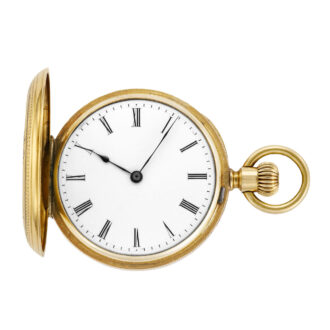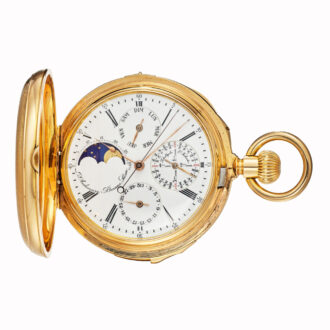
Magnificent diamond-set watch with seven complications Circa 1869
- Kenmerk
- TA2149
- Diameter
- 58 mm
- Estimate
- € 750.000 - 1.500.000
- Price sold
- € 826.300
Gold and diamond astronomic repeater
–
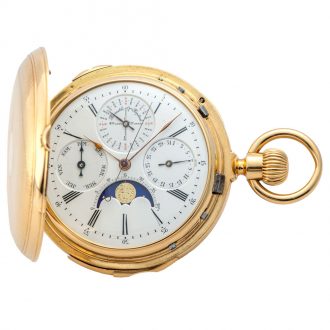
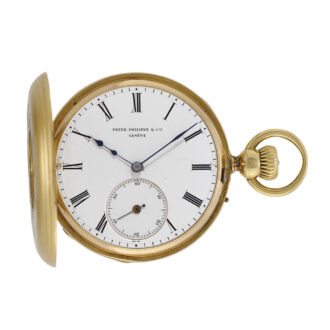
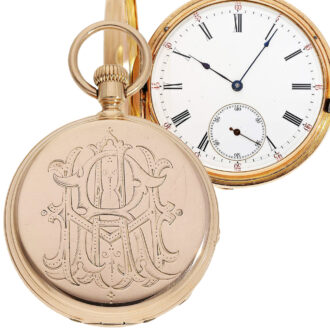
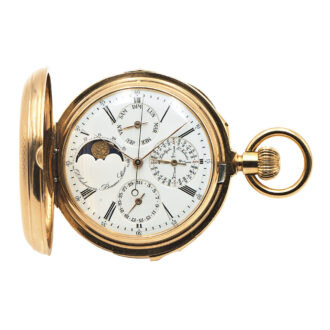
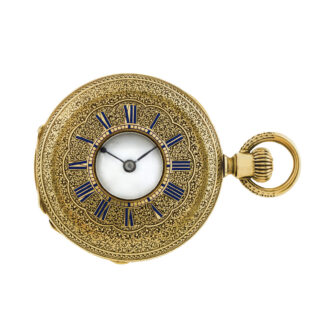
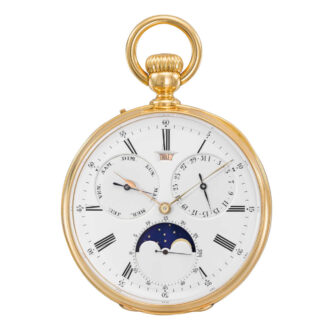
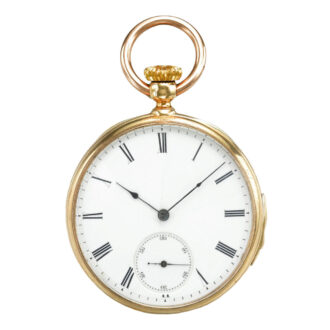
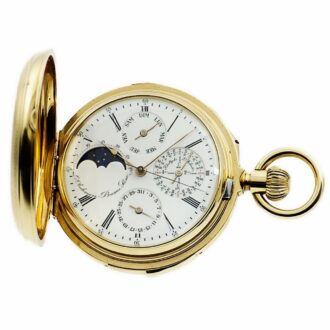
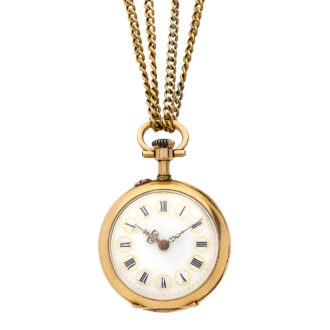
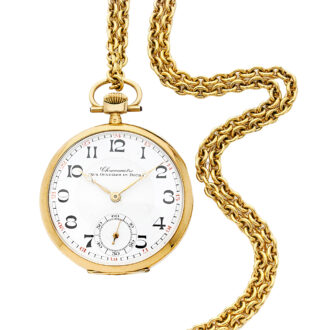
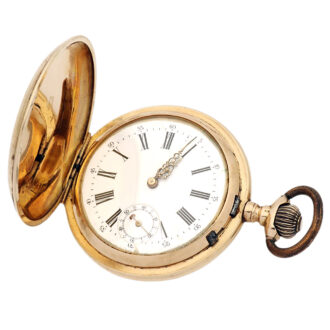
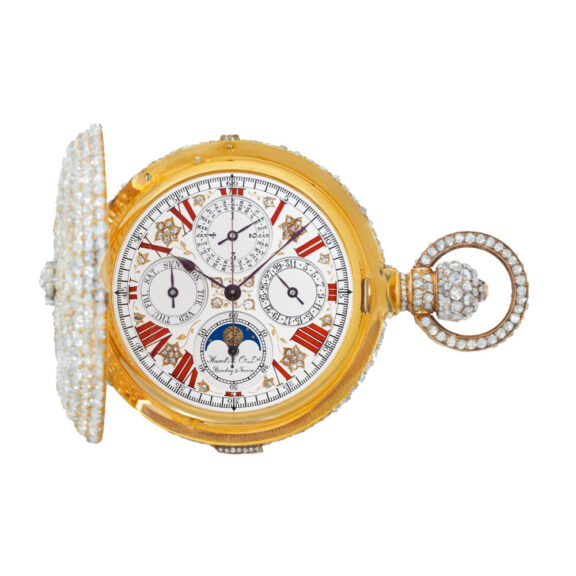
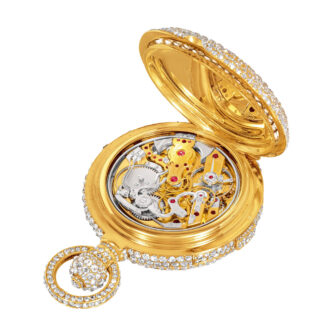
This exceptionally fine and important Swiss astronomical pocket watch was made around 1869 and Attributed to Henri Grandjean & Cie . The heavy 18K yellow gold hunting case is pavé-set with about 75 carats of diamonds. The watch has a minute repeater, a perpetual calendar with day, date, month, chronograph and moon phases.
–
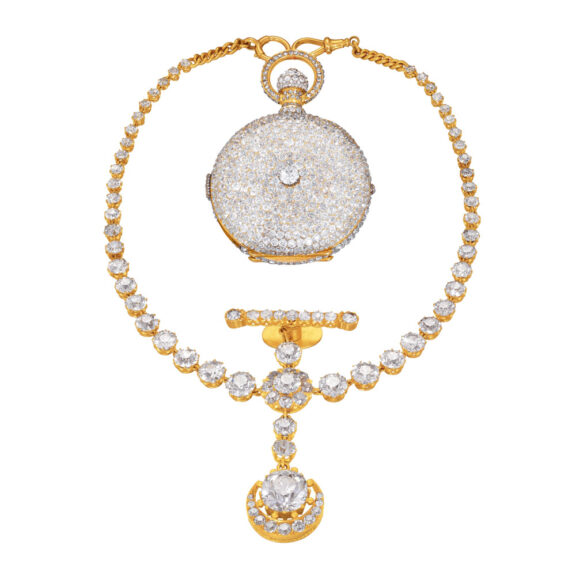
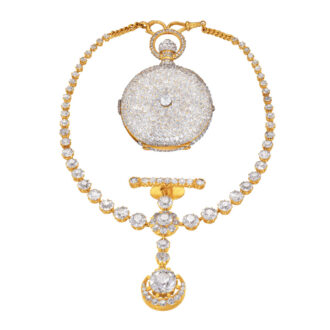
It comes with its magnificent original chain by Marcks & Co. Ltd., made of 20K yellow gold. The chain is set with 79 old European-cut and old mine-cut diamonds, about 80 carats in total, with the largest weighing about 14.50 carats.
–
This watch with seven complications is attributed to Henri Grandjean & Cie of Le Locle, Switzerland. It was made around 1900 for the jewellers Marcks & Co. Ltd. of Bombay and Poona, and sold to Mahbub Ali Khan, the sixth Nizam of Hyderabad (reigned 1869–1911).
–
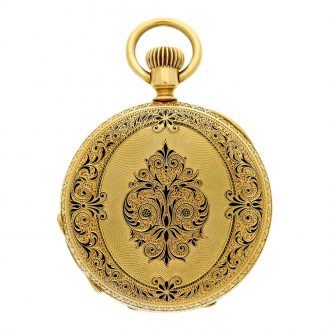
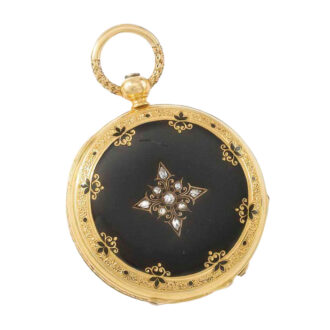
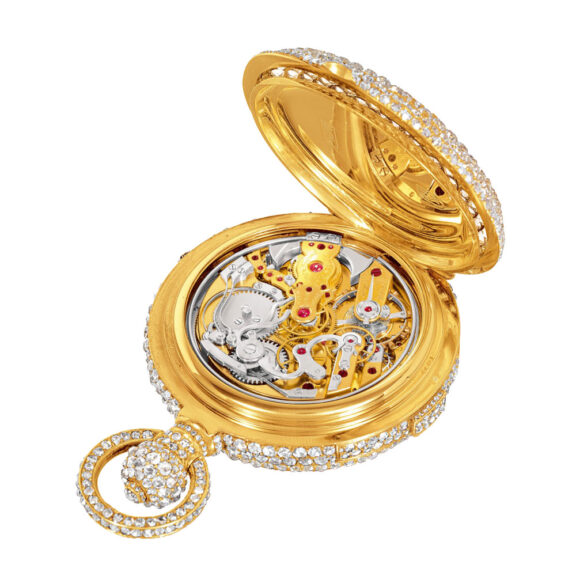
The band, pendant, bow, crown and covers are entirely set with about 1,150 old European-cut, old mine-cut and rose-cut diamonds, with a larger diamond at the centre of each cover. Inside is a hinged gold cuvette, with a gold-rimmed glass cover to view the movement. Together, the watch and its chain are set with 1,269 diamonds weighing about 155 carats.
–
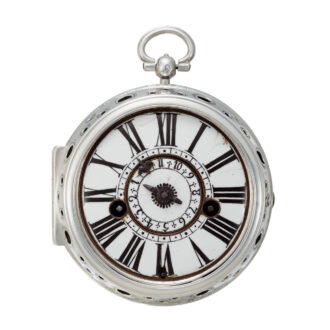
The dial is frosted silvered gold, with radial Roman numerals in red champlevé enamel, separated by small flowers set with 40 rose-cut diamonds. Around the edge is a minute track with a scale in fifths of a second and Arabic numerals every five minutes. Small dials show the seconds, date, day of the week, month and leap year, and an aperture shows the moon phase. The spade hands are black steel.
–
The frosted gilt movement has 36 jewels and a counterpoised straight-line lever escapement. The cut bimetallic compensation balance has gold screws for timing and temperature adjustment, a white metal Breguet balance spring and an index regulator. A slide in the band sets off the repeater on gongs, and a button in the band operates the chronograph. The dial, case, movement and chain are all signed by Marcks & Co.
–
Diameter: 58 mm
–
Signed: Attributed to Henri Grandjean & Cie Le Locle
–
This watch and chain are among the most exceptional pieces ever made for the Indian market. They once belonged to the famous jewel collection of the Nizam of Hyderabad, one of India’s richest and most flamboyant princely rulers.
–
An elderly salesman of Marcks & Co. later told a story that gives a fascinating glimpse of how the Nizam bought his watches. In a trembling voice, he recalled:
–“I was very young then, and had just started as an assistant salesman at Marcks & Co. in Bombay, which also had a branch in Poona. At the time it was the most important importer of Swiss watches, and it also ordered precious and complicated watches signed with its own name. One of our suppliers was Grandjean & Co. of Le Locle. The firm no longer exists, but in those days it had an excellent reputation for the quality of its complicated watches.”
–
Some had moon phases or a perpetual calendar. Others had automata that began to move when the watch was wound. Some struck the hours and quarters with the sound of Big Ben in London, and others repeated the minutes on demand. One even played God Save the Queen. They were truly splendid, and I could look at them and listen to them for hours. These watches were not made here; they came from very, very far away.
–
Then one day I was told that an important person was in town: Mahbub Ali Khan, the Nizam of Hyderabad (reigned 1869–1911).”
–
We knew he would visit the shop, because he loved watches. And indeed, he arrived in a horse-drawn carriage, dressed in Indian style, with a large cloak and a gold cane. His attendants bowed to the ground as he passed. We all lined up to greet him with the respect due to such a great and famous man.
–
He entered the shop majestically, slowly looking left and right, without a single glance at any of us. He seemed deaf to the manager’s words of praise. He walked straight to the showcase with the finest and most expensive pieces. After one brief look, he raised his cane and lightly touched the showcase with a diagonal stroke. He stood still for a few more seconds, taking it all in. Then, without a word, he walked slowly to the door, his eyes shining with joy.”
–
Still excited by the memory, the salesman went on:“It was like living one of the stories you hear as a child. I went over to Ramesh, my master, and asked what had happened. He looked at me for a moment, and then, after whispering a few words of thanks to Krishna, he told me that the Nizam had bought every watch in the showcase. They had to be packed as quickly as possible, because the Nizam was not used to waiting.”
“Yes,” the salesman said at last, “those were the good old days.”
–
The Nizams of Hyderabad
Hyderabad lies on the River Musi, about five miles east of Golconda. It was founded in 1591–92 by Muhammad Quli Qutb Shah, to house the growing population of Golconda, the capital of the Qutb Shahi rulers. Many new buildings soon rose along the river.
–
The Qutb Shahi dynasty founded the Kingdom of Golconda, one of five kingdoms that emerged when the Bahmani Kingdom broke up. They ruled the Deccan for about 170 years. All seven rulers were great builders and patrons of learning, and they helped Indo-Persian and Indo-Islamic literature and culture flourish in Hyderabad. Under their rule, Golconda became one of the world’s leading markets for diamonds, pearls, steel for weapons and printed fabrics.
–
Later, the seven Nizams of the Asif Jahi dynasty ruled the Deccan for nearly 224 years, until 1948. During their reign, Persian, Urdu, Telugu and Marathi all flourished side by side.
–
The highest offices of state were given to capable people, whatever their religion. Persian was the official language until 1893, and Urdu from then until 1948.
–
As the British and the French extended their power over India, the Nizam soon won their friendship without giving up his own authority. The British placed a Resident in Hyderabad, but the state continued to be ruled by the Nizam. The seventh Nizam was given the title “Faithful Ally of the British Government”.
–
The fabulous wealth of the Asaf Jahi dynasty
The jewel collection of the Nizams of Hyderabad is one of the finest in the world. Besides turban ornaments, gem-set and enamelled necklaces, earrings, armbands, bracelets and belts, it includes twenty-two unset emeralds and the legendary 184.50-carat Jacob Diamond. This magnificent South African stone is said to have been used by the last Nizam as a paperweight!
–
In 1950 Hyderabad became part of the Indian Union. Nizam Mir Osman Ali Khan then placed the most important pieces from the Hyderabad treasury in a jewellery trust, on condition that they could only be sold after his death. In 1972 the collection was first offered to the Indian government. What followed was a long drama of court cases, intrigue, conflicting decisions and enormous costs.
Signed: Marcks & Co. Ltd, Bombay & Poona
Share this page: