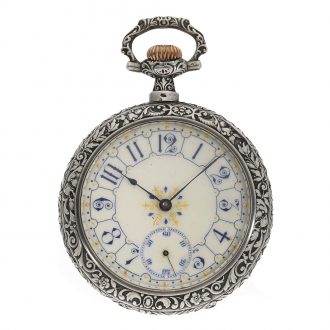
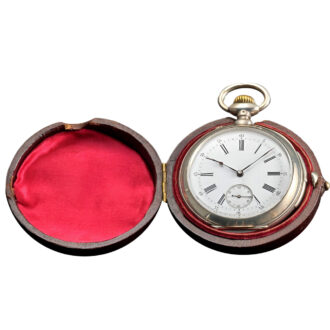
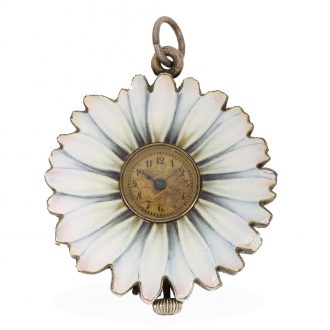
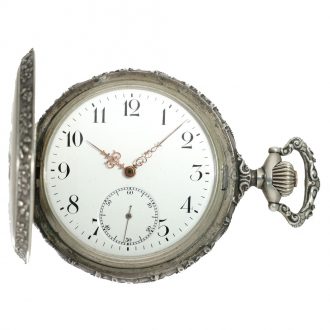
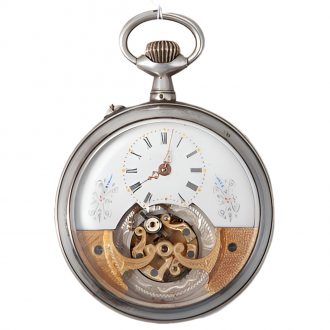
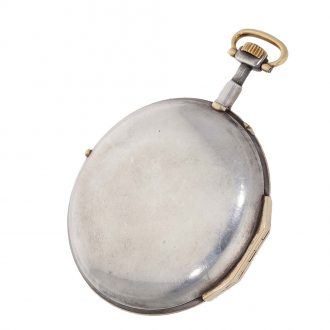
Swiss silver one of a kind watch with fine enamel painting Circa 1900
- Kenmerk
- HC1813
- Diameter
- 75 mm
- Estimate
- € 12.500 - 30.000
- Price sold
- € 14.900
Silver open faced lever watch
–
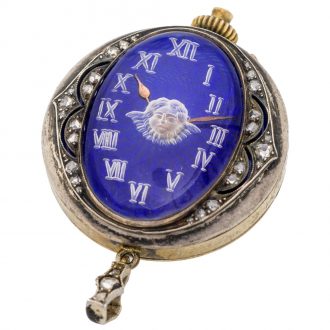
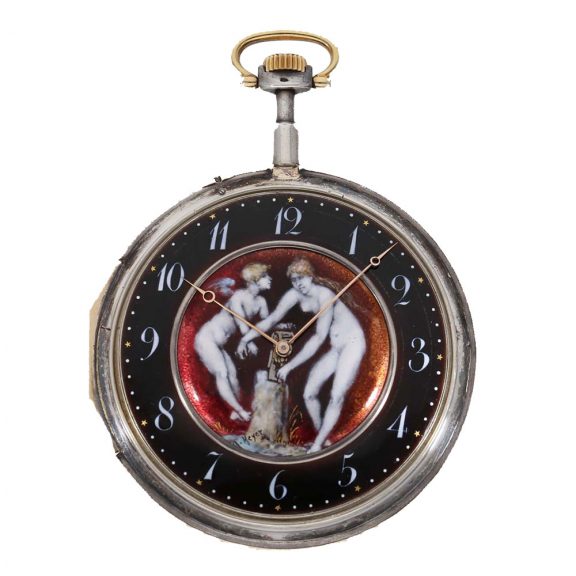
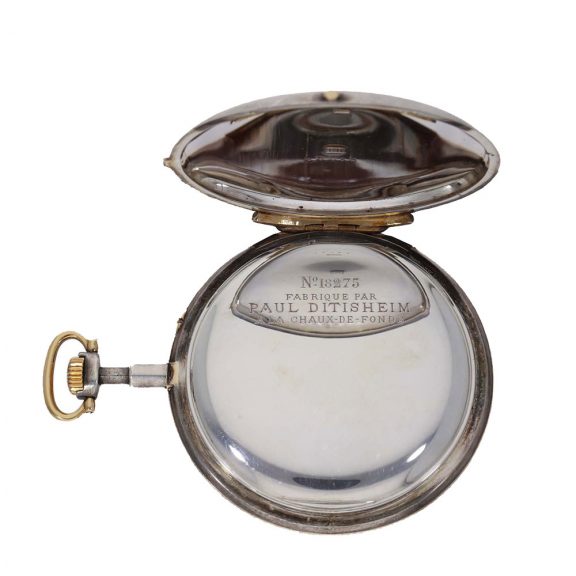
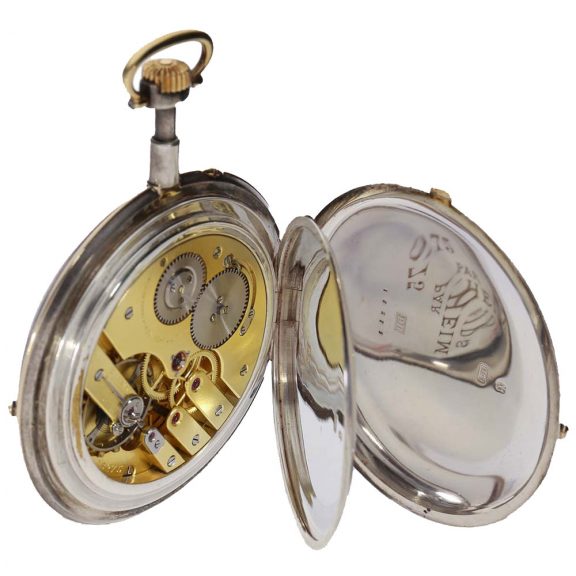
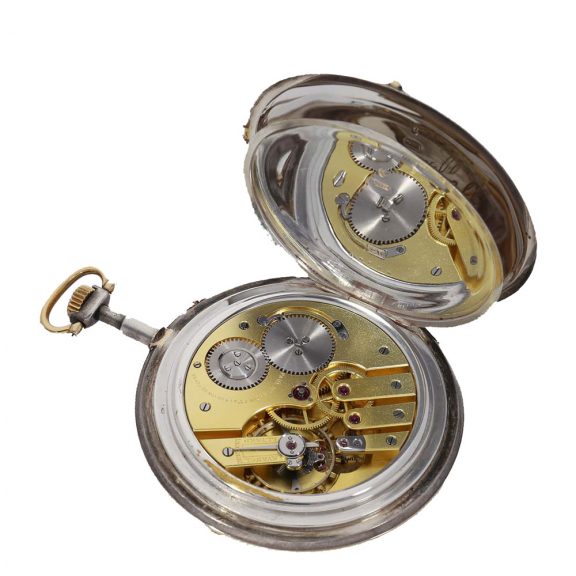
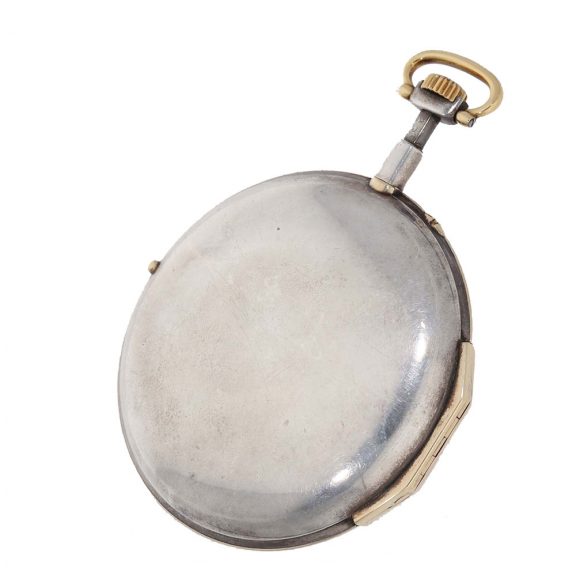
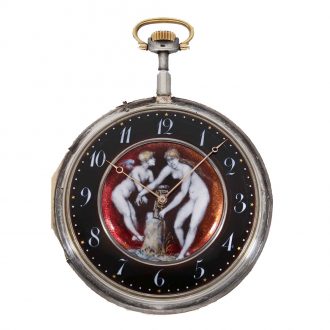
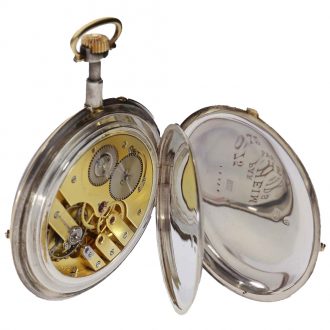
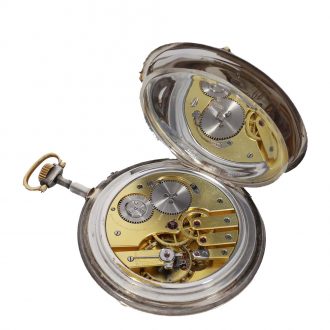
A unique lever pocket watch with fine enamel painting, probably made for the 1900 World’s Fair, by Paul Ditisheim in La Chaux-de-Fonds, Switzerland, circa 1910. This watch features a numbered case crafted from silver, featuring gold details. Its face shows a unique Art Nouveau enamel dial with white Arabic hour numerals on a black ground, outer minute divisions and gold moon hands, in the center a very rare enamel painting, in perfect condition, representing two ladies at a water pump, signed by Alfred Meyer. The numbered top quality movement is fitted with a lever escapement and chronometer balance.
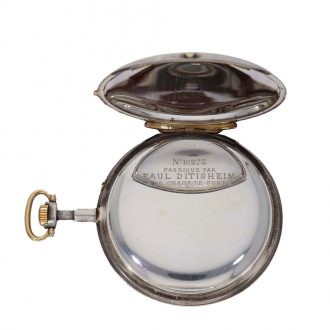
Cuvette and movement have matching numbers, and the dial, cuvette and movement are signed.
–
Diameter: 75 mm
–
Weight: 301 g
–
Signed: Fabriqué par Paul Ditisheim à La Chaux-de-Fonds
–
The size and design of this timepiece indicate that it is a one of a kind piece made for a World’s Fair. There appears to be no other Ditisheim pocket watch with such a special dial and in this size. The dial bears the signature of the famous enamel painter Alfred Meyer (Paris, 1832-1904). Only one other dial of this type is known to exist.
–
Alfred Meyer
Alfred Meyer was a highly accomplished and famous French enamel painter, ceramicist and writer who played a significant role in the revival of the art of enamel in the 19th century. Born in Paris in 1832, Meyer apprenticed to painters François Édouard Picot and Émile Lévy. From 1858 to 1871, he worked at the prestigious Manufacture Nationale de Sèvres, the French national porcelain factory.
–
Though trained as a painter, Meyer primarily dedicated his career to the decorative arts, particularly painted enamel on copper and porcelain. His work was known for its classical style and technical mastery, often drawing inspiration from Renaissance prototypes.
–
He first exhibited at the Salon in 1864 and was awarded a medal for his work there in 1866. He continued to exhibit at the Salon almost yearly throughout his career, eventually as an exempt artist, meaning he was no longer subject to jury approval.
–
Meyer was a co founder of the Société anonyme des artistes peintres, sculpteurs, graveurs, etc., an independent artists’ society. In 1874, he was one of the artists invited by Edgar Degas to participate in the First Impressionist Exhibition, where he displayed six works, five enamels and one drawing. However, his classical style and focus on decorative arts meant he was not a true impressionist painter and he did not participate in their later exhibitions.
–
He was a professor at the École Bernard Palissy in Paris, where he taught enamel painting. He was known for rediscovering and utilizing techniques from ancient Limousin enamellers and published a practical and scientific treatise on the subject in 1895, titled L’Art de l’émail de Limoges ancien et moderne. He created exquisite enamel pieces for renowned jewellers and houses such as Vever, Falize, Baugrand and Alphonse Fouquet. His work can be found in major museum collections, including the Victoria and Albert Museum in London and the Metropolitan Museum of Art in New York.
–
In 1904, Alfred Meyer died in Paris. His legacy endures through his masterly enamel work and his contribution to the written history and technical understanding of the art form.
Signed: Fabriqué par Paul Ditisheim à La Chaux-de-Fonds
Share this page: