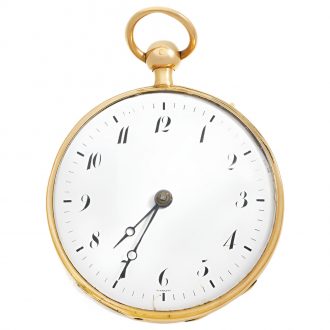
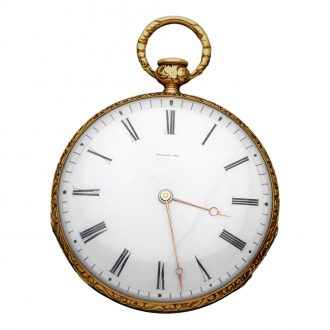
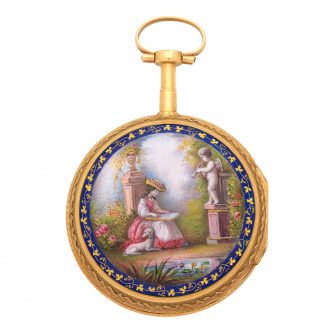
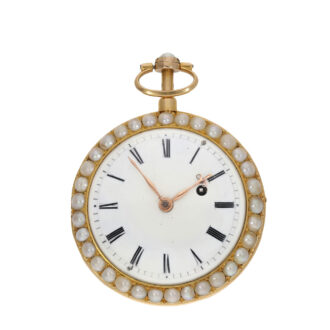
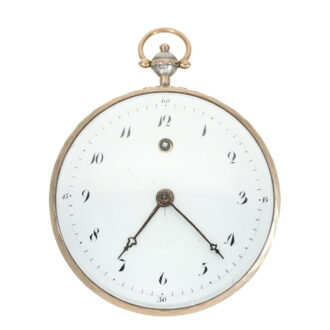
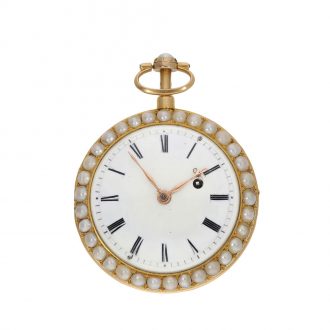
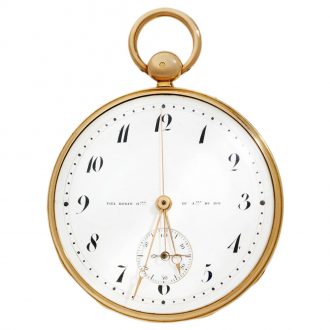
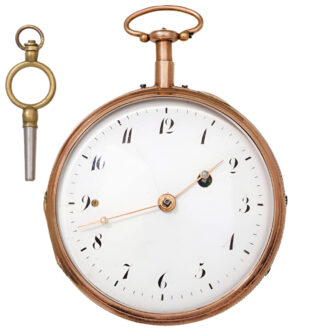
Very fine gold and enamel and pearl set French watch Circa 1800
- Kenmerk
- HA0028
- Diameter
- 40 mm
- Estimate
- € 2.250 - 4.000
- Price sold
- -
Very fine gold and enamel and pearl set French pocket watch
–
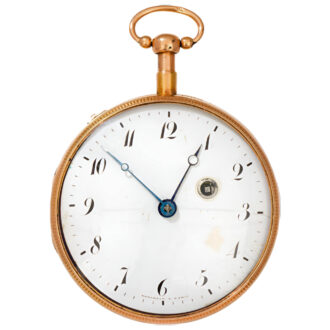
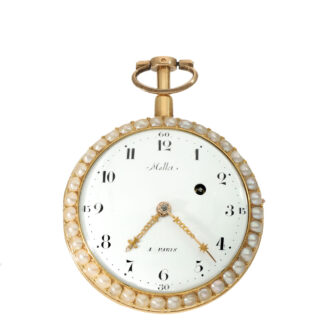
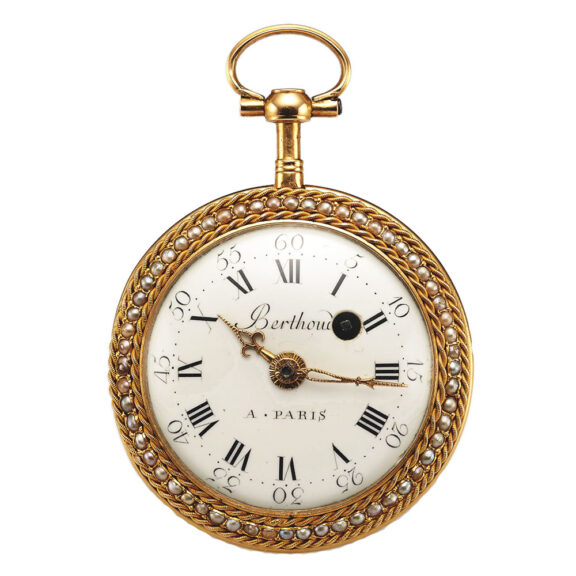
A very fine gold enamel and pearl set French pocket watch. Made by Berthoud à Paris circa 1800.
Two-body case, bassine, split pearl set bezel, the back decorated with translucent bronze guilloche enamel, gold paillon border with split pearls.
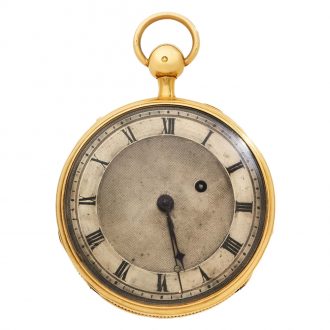
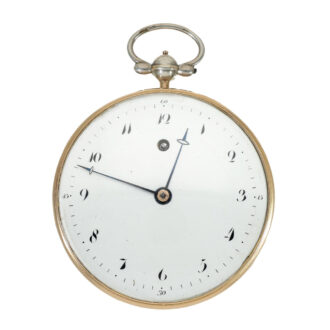
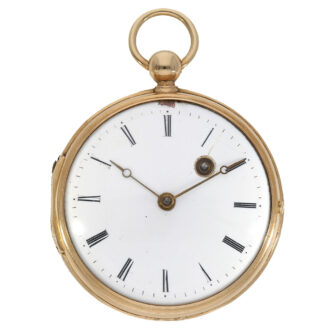
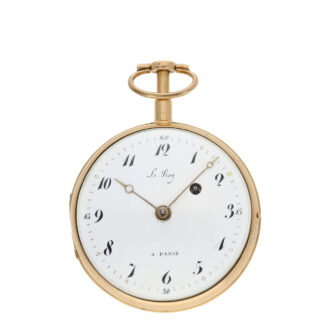
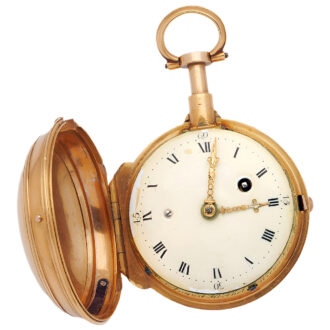
White enamel dial with radial Roman numerals, outer minute divisions, Arabic five minute numerals and a winding aperture at two o’clock. Gold fleur de lis hands.
Hinged gilt brass full plate movement with cylindrical pillars, fusee with chain, verge escapement with micrometric potence adjustment, three arm brass balance, flat balance spring, pierced and foliate chased continental type balance cock with polished steel end piece and a silver regulation dial.
Dial and movement signed.
–
Diameter: 40 mm
–
Signed: Bertoud, à Paris
–
Ferdinand Berthoud (born 18 March 1727 in Plancemont-sur-Couvet, Principality of Neuchâtel and died 20 June 1807 in Groslay, Val d’Oise), was a scientist and watchmaker. He became master watchmaker in Paris in 1753. Berthoud, who held the position of Horologist-Mechanic by appointment to the King and the Navy, left behind him an exceptionally broad body of work, in particular, in the field of marine chronometers.
–
Used in antique spring powered mechanical watches and clocks, a fusee (from the French fusée, wire wound around a spindle) is a cone shaped pulley with a helical groove around it, wound with a cord or chain which is attached to the mainspring barrel. Fusees were used from the 15th century to the early 20th century to improve timekeeping by equalizing the uneven pull of the mainspring as it ran down. Gawaine Baillie stated of the fusee: “Perhaps no problem in mechanics has ever been solved so simply and so perfectly.”
The origin of the fusee is not known. Many sources erroneously credit clockmaker Jacob Zech of Prague with inventing it around 1525. The earliest definitely dated fusee clock was made by Zech in 1525, but the fusee actually appeared earlier, with the first spring driven clocks in the 15th century. The idea probably did not originate with clockmakers, since the earliest known example is in a crossbow windlass shown in a 1405 military manuscript. Drawings from the 15th century by Filippo Brunelleschi and Leonardo da Vinci show fusees. The earliest existing clock with a fusee, also the earliest spring powered clock, is the Burgunderuhr (Burgundy clock), a chamber clock whose iconography suggests that it was made for Phillipe the Good, Duke of Burgundy about 1430, now in the Germanisches Nationalmuseum. The word fusee comes from the French fusée and late Latin fusata meaning a ‘spindle full of thread’.
Signed: Bertoud, à Paris
Share this page: