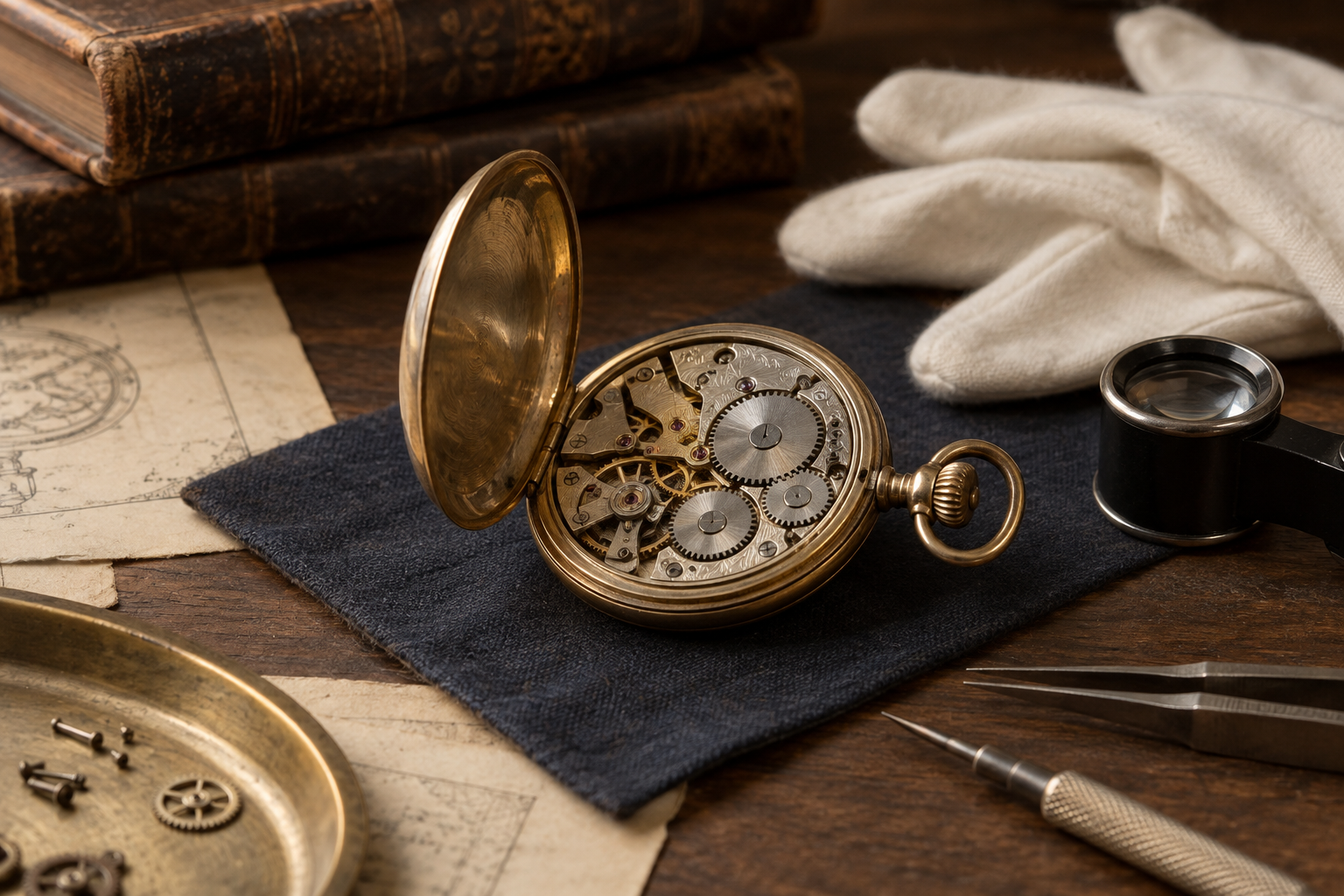
An antique pocket watch rarely tells its story in one place. A name on the dial may identify the retailer rather than the maker; a gold case can be younger than the movement it protects; and a serial number is only useful when it is connected to the correct manufacturer. Reliable identification is therefore an exercise in combining evidence.
This guide presents a practical order of work. It will help you describe a watch accurately, narrow its date and origin, and recognise the details that deserve specialist research. It also explains why one clue should never be treated as proof on its own.
Start with the watch as a complete object
Before opening anything, photograph the watch from the front, back and sides. Record its diameter without the pendant, its weight, the case material and the winding method. Note whether it is open-faced, hunter-cased or half-hunter, and whether the bow, pendant and case show consistent wear.
The dial offers the first visual clues. Roman or Arabic numerals, subsidiary seconds, enamel construction and the shape of the hands can all support a period estimate. They are not decisive by themselves: dials and hands were frequently repaired or replaced during a watch’s working life.
Read signatures carefully
A signature can appear on the dial, movement, cuvette or case. Record the wording exactly, including punctuation, place names and abbreviations. “Signed” should not automatically be translated as “made by.” In the nineteenth-century watch trade, retailers often placed their names prominently on watches assembled from components supplied by specialist workshops.
Compare the form of a signature with documented examples, but also examine how it was applied. Engraving that cuts through later plating, lettering inconsistent with the rest of the movement, or a famous name on an otherwise ordinary unsigned calibre warrants caution. An authentic signature is strongest when style, construction, location and provenance agree.
Examine the movement, not just the dial
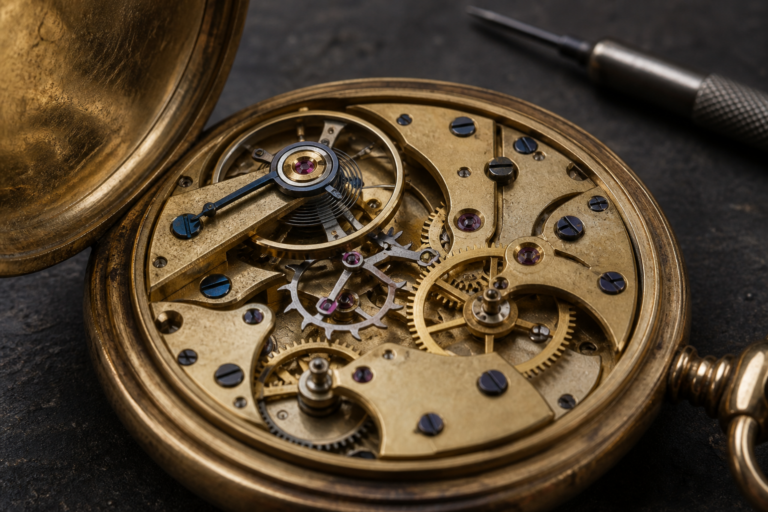
The movement is often the most informative part of an antique pocket watch. Bridge layout, balance position, winding system, jewelling and the form of the regulator can point to a national tradition and broad period. English full-plate and three-quarter-plate movements, Swiss bar movements and later bridge designs each reflect different manufacturing systems.
The escapement is particularly useful. A verge movement suggests a different technical context from a cylinder, lever or chronometer escapement. Our guide to pocket watch escapements explains the main families and the visual clues that distinguish them.
Never force a case or touch the balance. If the movement is not readily accessible, ask a watchmaker or specialist to open it. Scratches around the case lip and damaged hinges reduce both historical integrity and value.
Use case marks as a group of clues
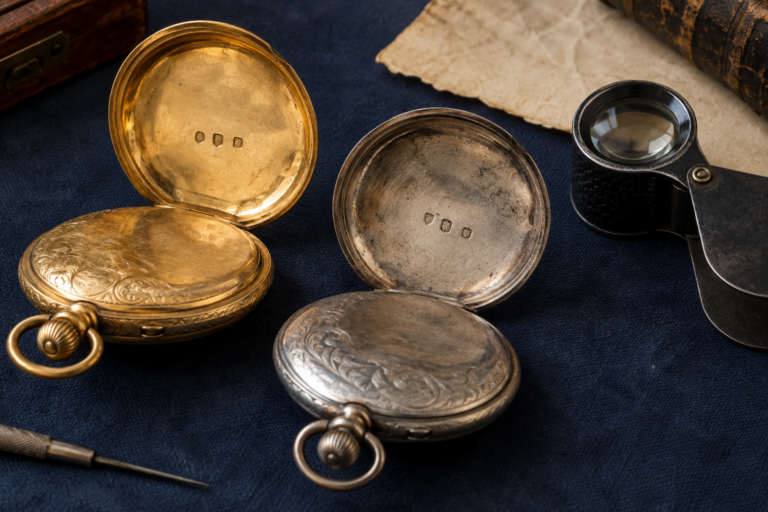
Marks inside the case can reveal metal fineness, an assay office, a date cycle, a sponsor or a case maker. Their meaning depends on the country and period. British hallmarking systems are structured differently from Swiss or French systems, and imported cases may carry more than one group of marks.
Photograph every mark in sharp side-light and keep its position visible. A single cropped symbol is easily misread. Then work from the general to the specific: identify the metal standard first, the jurisdiction second and only then the maker or date. See our detailed guide to gold and silver pocket-watch hallmarks.
Treat serial numbers as evidence, not universal dates
Serial numbers can be extremely useful when manufacturer archives or reliable published tables survive. They are not a universal calendar. The same number may appear on a movement, case and cuvette for different reasons, while some retailers used their own numbering systems.
Write down each number together with its exact location. A movement serial should be compared only with records for that movement maker. Matching case and movement numbers can support originality, but mismatched numbers do not automatically mean deception: cases wore out, tastes changed and movements were legitimately recased.
Separate date, origin and condition
Collectors often try to answer three questions at once: when was the watch made, where was it made and how original is it? Keeping these questions separate leads to better conclusions.
- Date: combine movement architecture, escapement, winding system, dial style and dated marks.
- Origin: consider movement tradition, inscriptions, case marks and documented trade relationships.
- Condition: look for replaced hands, hairline dial cracks, over-polished cases, missing screws, corrosion and modern alterations.
A watch can be historically important while showing honest repair. The key is to describe what is present rather than make an unsupported claim of complete originality.
Compare with documented watches
Good comparison objects are more valuable than generic price lists. Museum records can show movement layouts, case construction and inscriptions on securely catalogued watches. Auction records can add market context, but descriptions vary and should be checked against photographs and primary marks.
Use the Christies Watch database to compare watches by period, material, origin and escapement. Look for several examples that share a meaningful technical feature, not merely a similar dial colour or case shape.
A repeatable identification checklist
- Photograph the complete watch and all accessible details.
- Record diameter, weight, case type, winding method and visible condition.
- Transcribe every signature, number and hallmark exactly.
- Identify movement layout and escapement.
- Research marks using sources appropriate to their country and period.
- Compare the watch with multiple documented examples.
- State what is certain, probable and still unknown.
Build the identification from converging evidence
The most convincing identification is not the one with the boldest attribution. It is the one in which independent details point in the same direction. A movement type consistent with the proposed date, case marks consistent with the metal, and a signature supported by documented examples form a stronger conclusion together than any single clue.
That evidence-led approach also makes a database more useful. Future research can refine a cautious record; it is much harder to correct a confident claim whose underlying observations were never preserved.