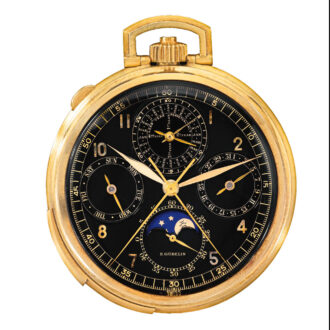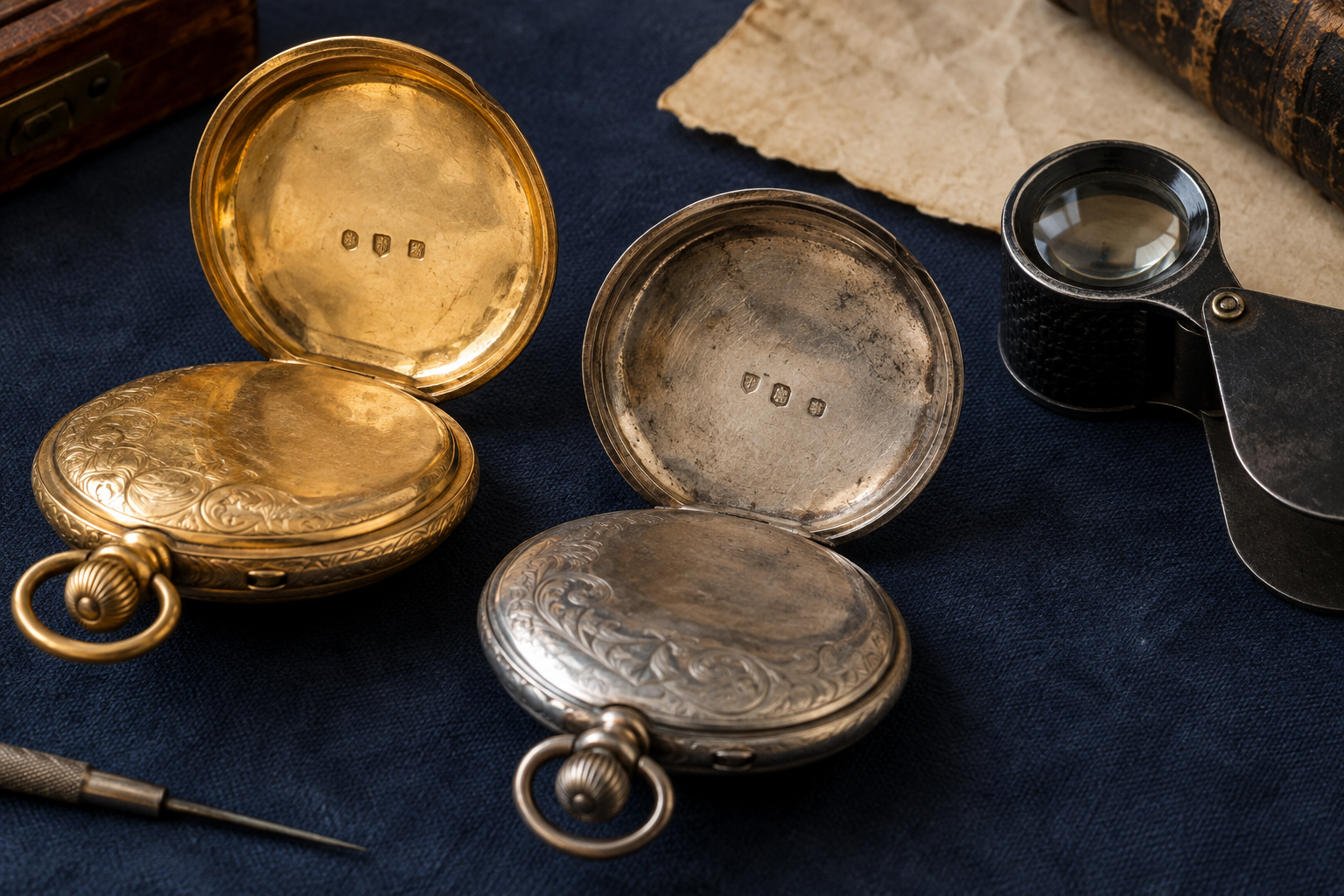
The small stamps inside a gold or silver pocket-watch case can reveal where an article was tested, the fineness of its metal and who submitted it for hallmarking. They can also be misread surprisingly easily. A worn leopard’s head, a sponsor’s initials and a date letter are different kinds of evidence; none should be interpreted without the rest of the mark group.
This guide focuses on a repeatable method for reading hallmarks. British examples provide the clearest framework, but the same principle applies internationally: identify the system first, then decode its individual symbols.
Hallmark, maker’s mark and movement signature are not the same
A hallmark is an officially controlled mark relating to precious metal. A sponsor’s or responsibility mark identifies the person or business that submitted an item, which may be a case maker, importer, wholesaler or retailer. A signature on the movement or dial belongs to the watch’s commercial and technical identity.
These names can differ without anything being wrong. Pocket-watch production was a networked trade. Movements, dials and cases were frequently supplied by different specialists and brought together for a particular market.
Photograph the complete mark group
Open only covers designed to be opened by the user, and never force a tight back. Use diffuse daylight or a movable lamp, a macro lens and a steady support. Photograph the entire inside surface before making close-ups. The order, shape and position of marks can be as important as the symbol itself.
Keep separate notes for marks on the outer back, inner cover or cuvette, bow and pendant. If the same group repeats, record that fact. If marks differ, do not immediately assume the watch is false: individual components may have been replaced or separately tested.
Step 1: identify the metal standard
Fineness describes the proportion of precious metal in an alloy. A numerical mark such as 750 indicates 750 parts of gold per thousand, equivalent to 18 carat. Silver standards use their own numerical or symbolic marks depending on jurisdiction and period.
Colour is not a reliable test. Rose, yellow and pale gold vary with alloying metals; silver can be plated; and brass can resemble aged gold in photographs. Treat the official standard mark, expert testing and construction together.
Step 2: identify the assay office or jurisdiction
In the British system, an assay-office mark identifies the office that tested the article. Official guidance describes a complete modern UK hallmark as including a sponsor’s mark, a fineness mark and an assay-office mark, with date letters and traditional fineness symbols available as optional elements. Historical requirements changed, so a period reference table is essential.
Other countries used different systems. Swiss precious-metal marks, French control marks and marks applied to imported goods should be researched with references for the correct jurisdiction. Similar-looking animals, shields and letterforms can have entirely different meanings.
Step 3: read the sponsor or responsibility mark
A sponsor’s mark usually combines initials within a distinctive punch shape. It identifies the registered sponsor, not necessarily the person who physically made every part of the case. Search both the initials and the surrounding shape, then confirm that the registration period is compatible with the watch.
Common initials are not unique across cities and decades. Attribution is stronger when the punch shape, assay office, date range and known business history all agree.
Step 4: interpret the date letter in context
British date letters run in cycles. The letter alone is insufficient because alphabets repeat. Typeface, shield shape and assay office distinguish one cycle from another. First identify the office and punch outline; then consult the corresponding cycle chart.
A case date is normally evidence for the case, not an automatic manufacturing date for the movement. A movement could have waited before casing or been recased later. When the date letter and movement style disagree, preserve both observations and investigate.
Gold marks commonly encountered on watch cases
Collectors frequently encounter cases described as 9, 14 or 18 carat, as well as continental numerical fineness marks. Do not convert every stamp mechanically. A number may be a case serial, design registration or internal workshop mark rather than fineness.
- Look for a recognised standard mark in its correct punch shape.
- Check whether an assay or control mark accompanies it.
- Distinguish solid gold from rolled gold, gold-filled and plated descriptions.
- Check bows and pendants separately; they may have a different composition.
Silver marks and imported cases
Silver pocket watches may carry sterling, Britannia or continental standards depending on where and when the case was tested. Imported watches can combine a foreign case with marks required by the destination market. That combination can be historically informative because it traces trade routes rather than simply complicating identification.
Nickel, German silver and other white base-metal alloys are not silver despite their appearance or names. If recognised precious-metal control marks are absent, describe the material cautiously until it is tested.
Common hallmarking mistakes
- Dating from one letter: repeated cycles make the office and shield essential.
- Calling the sponsor the watchmaker: case responsibility and movement manufacture are different roles.
- Ignoring recasing: a genuine old movement and genuine later case can coexist.
- Reading serials as standards: location and punch form matter.
- Overlooking rubbed marks: polishing can remove exactly the detail needed for identification.
A reliable research workflow
- Record the watch and every mark before cleaning or servicing.
- Group marks by component and transcribe letters and numbers.
- Identify the national system from recognised control symbols.
- Decode fineness and assay office.
- Match the complete date-letter cycle, not the letter alone.
- Research the sponsor mark within the compatible place and period.
- Compare the result with movement, dial, case style and provenance.
That final cross-check is crucial. Hallmarks are powerful because they are structured evidence, but they describe a precious-metal component. For a complete identification, combine them with the method in our antique pocket-watch identification guide and compare documented examples in the Christies Watch database.
Preserve uncertainty where evidence is incomplete
A responsible catalogue entry might read: “18-carat gold case, London assay, date letter consistent with 1895; sponsor mark partially rubbed.” That is more useful than forcing an uncertain maker attribution. Clear observations allow another researcher to revisit the conclusion as better references become available.