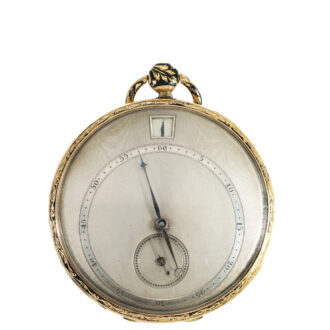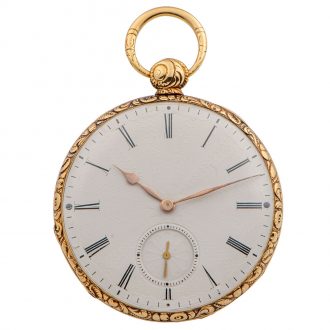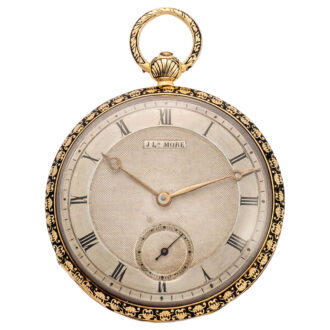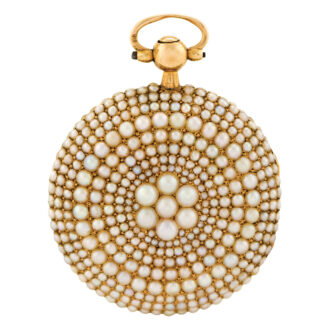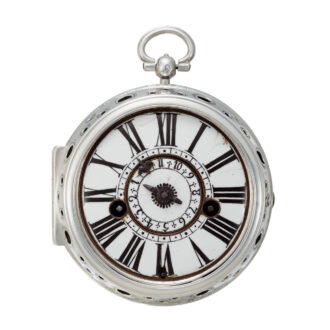
Important gold mirror image pair of duplex watches Circa 1830
- Kenmerk
- CH0859
- Diameter
- 58 mm
- Estimate
- € 200.000 - 400.000
- Price sold
- € 300.000
Gold and enamel open faced key winding centre seconds duplex watches
–
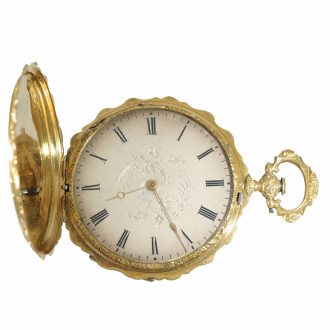
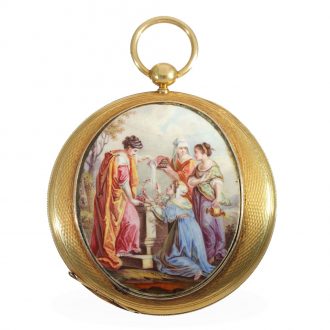
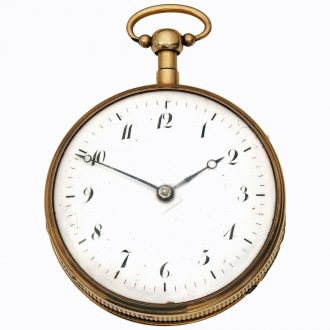
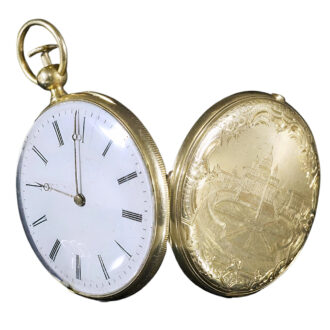
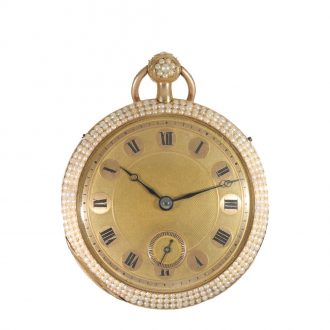
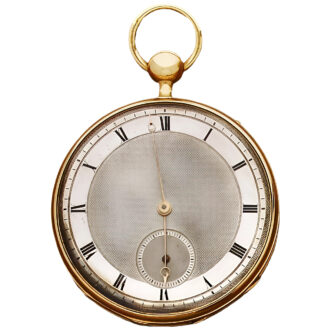
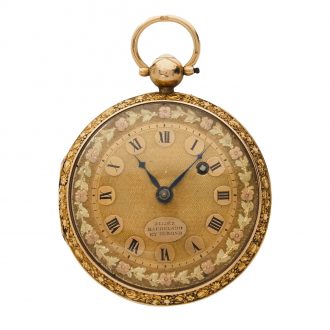
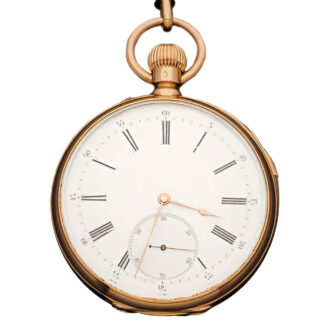
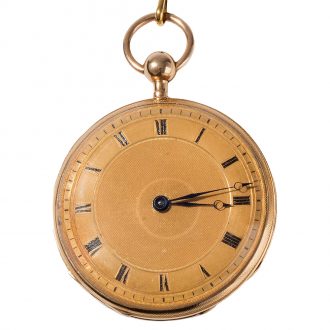
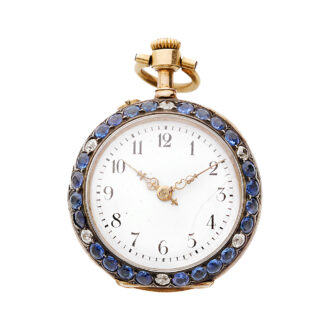
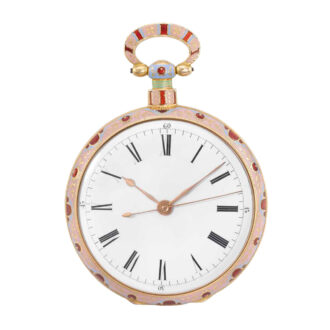
An exceptionally fine, rare and important pair of Swiss 18 carat gold and enamel open faced centre seconds watches, made by Vaucher in Fleurier for the Chinese market, circa 1830. The two watches are mirror images and carry the same number.
—
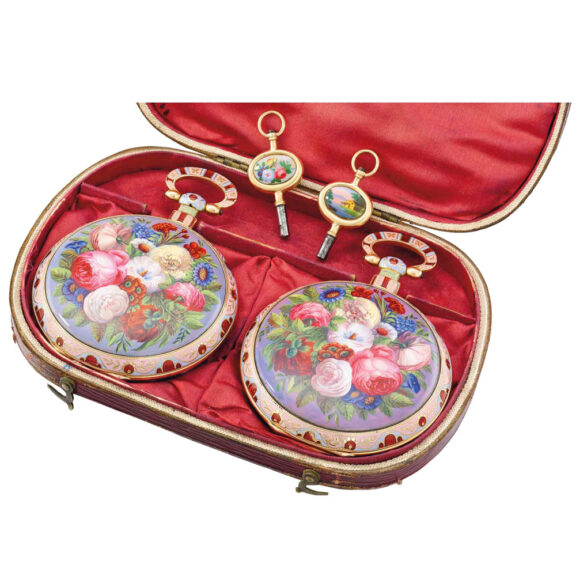
Each has a key winding movement in mirror polished and blued steel, with a duplex escapement and a bimetallic compensation balance with blued steel wedge shaped weights. Both movements are signed. Each watch has a hinged gold cuvette. The cuvette and movement rim of the first watch are numbered 160, and those of the second watch 160.
–
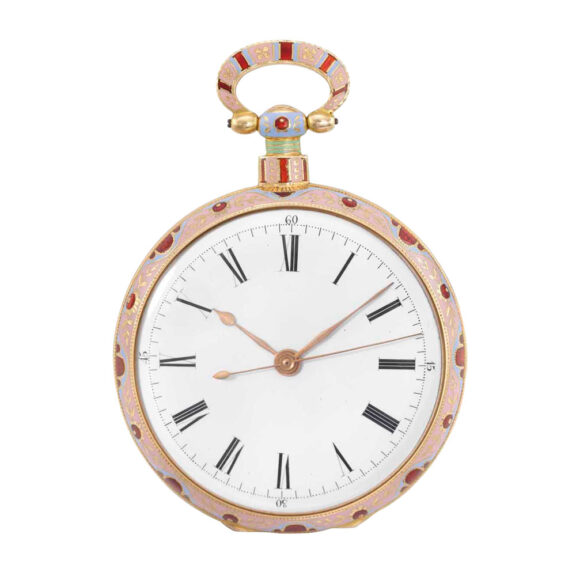
The white enamel dials have black Roman numerals for the hours, an outer minute track with Arabic numerals at 15, 30, 45 and 60, gold spade hands and a central seconds hand.
–
The watches have large round 18 carat gold cases. The bezels, casebands, pendants and bows are decorated with floral patterns in pink, light blue and translucent scarlet champlevé enamel, highlighted with gold foliage. The back of each watch is painted in polychrome enamel with a large bouquet of roses and summer flowers on a mauve ground. The two bouquets are mirror images so the watches face each other when placed side by side.
–
The pair comes with two matching gold keys, each decorated with a miniature polychrome enamel bouquet of flowers and a butterfly. The reverse of one key shows a lakeside landscape. The watches and keys are kept in their fitted presentation box lined with red silk.
–
Diameter: 58 mm (each)
–
Signed: Vaucher, Fleurier
–
Watches, snuff boxes, and other luxury objects exported to China were not made in a Chinese style. They followed the European styles that Chinese clients admired, such as Louis XV, Louis XVI, Directoire and Empire. Such objects were often made in pairs with mirror image decoration so they faced each other when displayed. Tradition gives two reasons. The first is the Chinese love of symmetry and the saying that good things come in pairs. The second is practical: if one watch had to go back to Europe for repair, which could take months, its twin was still there. Such pairs were often given as presents from Europeans to Chinese dignitaries.
–
This pair is particularly rare because the two watches carry the same number, the second with a dot after it. This numbering was typical of watchmakers in the Val-de-Travers, Vaucher in particular. The watches appear on a handwritten invoice of 18 January 1962 from the restorer Louis Cottier, who dated them to 1820–1830 and spent 61 hours servicing the movements. A comparable mirror image pair by Vaucher with a similar steel duplex movement is illustrated in “The Mirror of Seduction – Prestigious pairs of ‘Chinese’ watches” (Patek Philippe Museum, 2010), pp. 130–131, and the numbering with a dot is discussed on p. 128.
–
Charles-Henri Vaucher (born around 1793 in Couvet) played an important part in building up watch production for the Chinese market in Fleurier. Around 1820, he opened a branch in London that also supplied William Ilbery. In 1838 he sent watches, some of them enamelled, to Canton.
Signed: Vaucher Fleurier
Share this page: