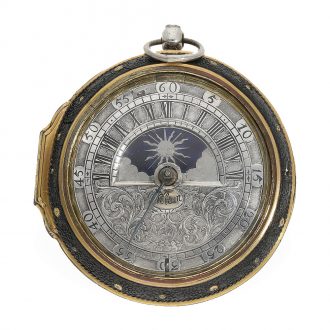
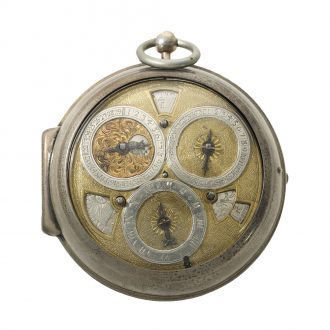
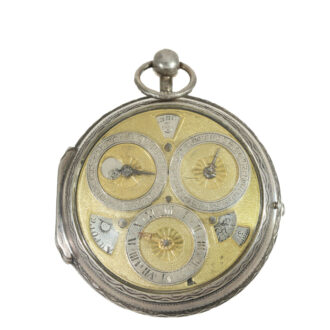
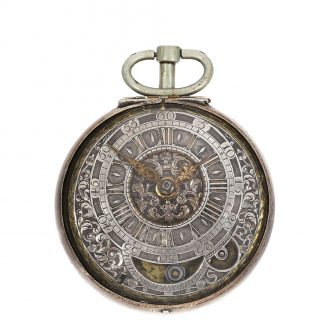
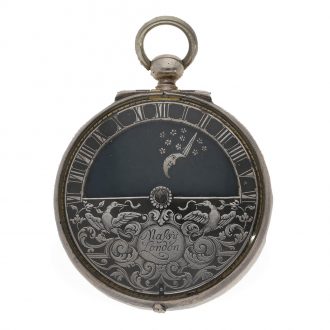
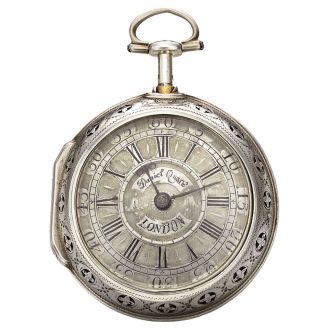
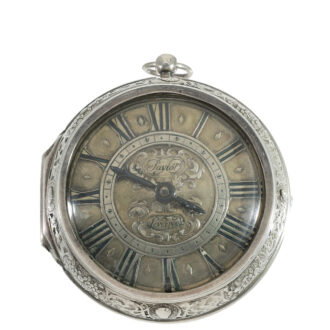
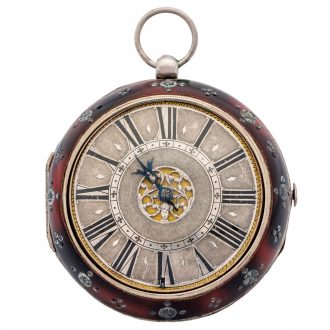
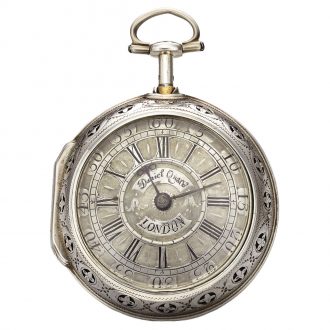
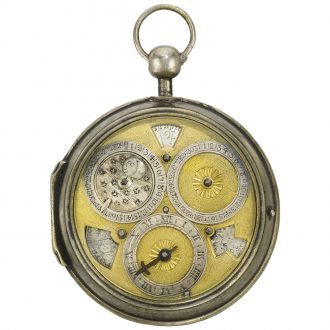
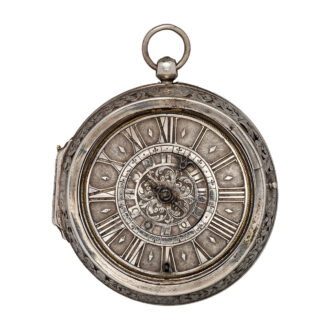
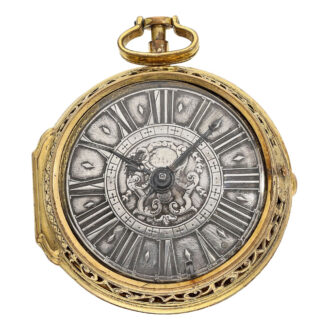
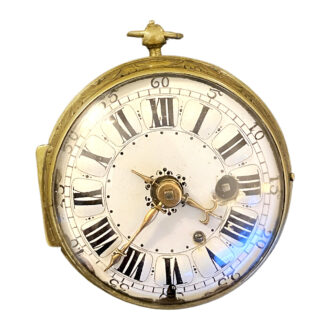
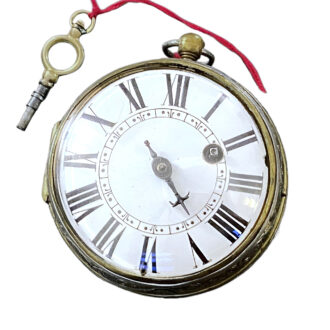
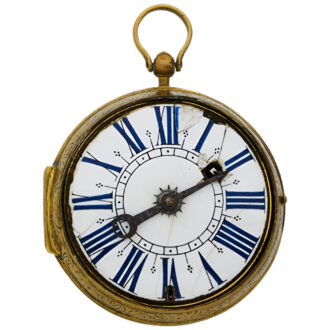
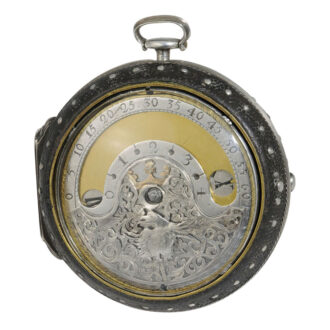
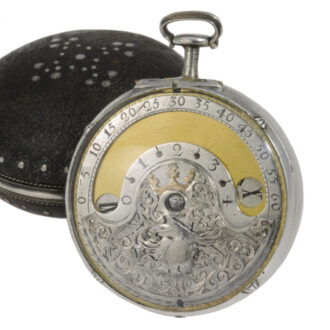
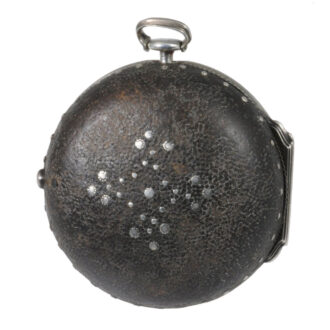
English leather covered verge with wandering hours Circa 1690
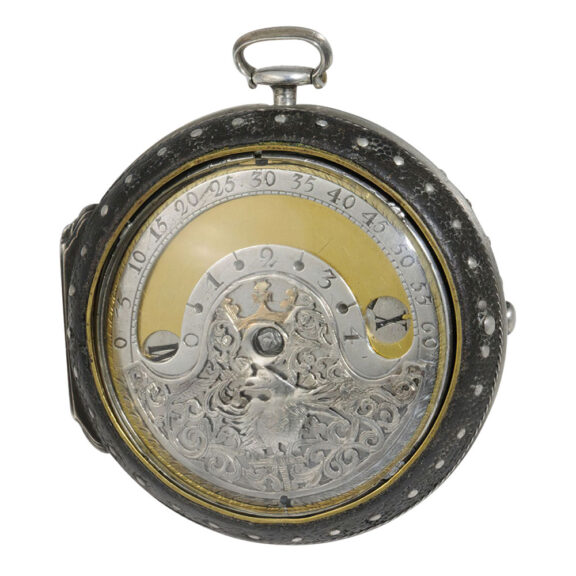
- Kenmerk
- DB0106
- Diameter
- 53 mm
- Estimate
- € 7.500 - 14.000
- Price sold
- € 10.000
Silver and leather covered verge in pair cases by Fromanteel
–
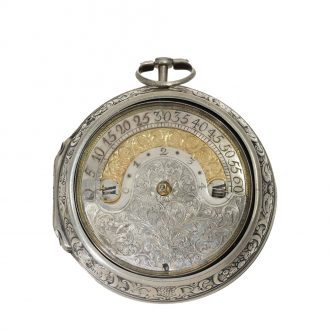
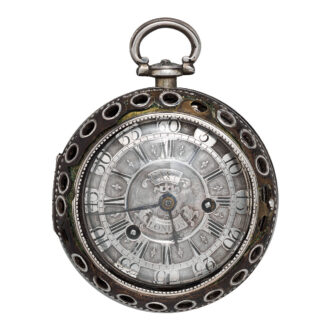
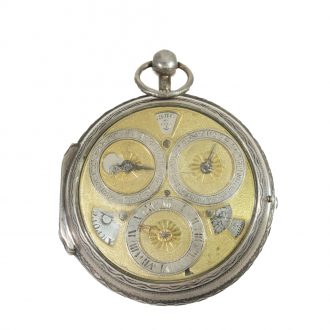
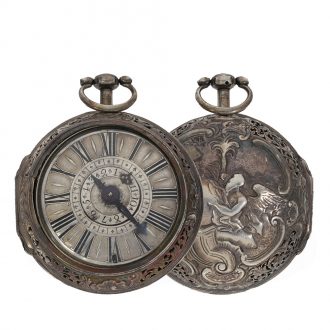
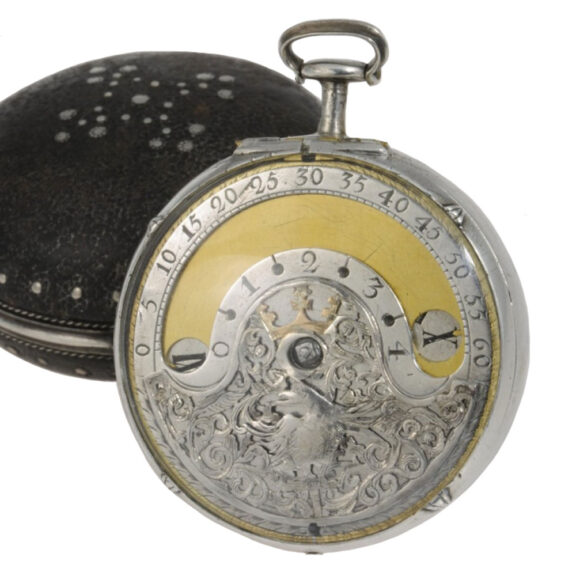
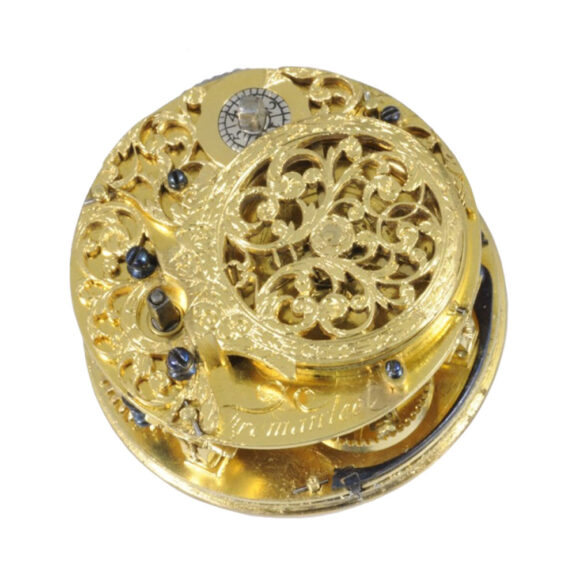
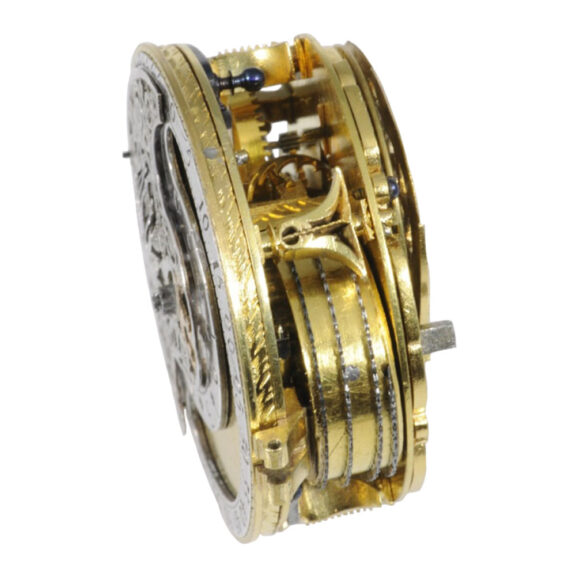
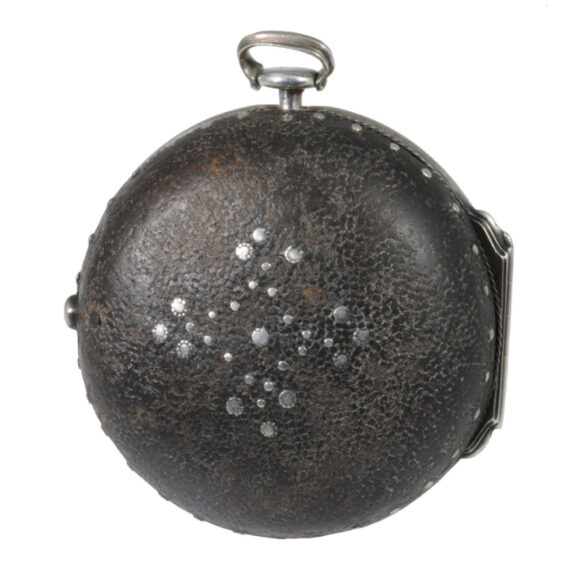
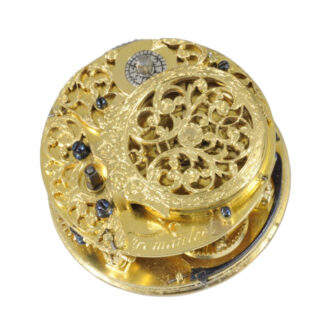
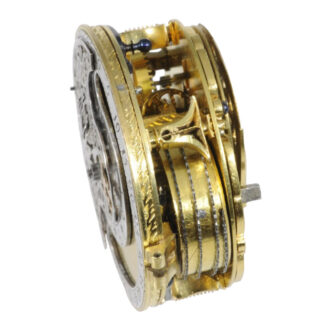
A rare English silver and leather pair cased verge pocket watch with wandering hours, circa 1690. Full plate movement, chain and fusee, three arm brass balance. Silver and gilded dial, a retrograde minute display in the upper part underneath an arc shaped cutout revealing a revolving gilt disc, a window displays the Roman hours, below a retrograde scale indicating the quarter hours, the lower part is chased and engraved with an eagle surrounded by fine volutes and foliate tendrils. A silver outer case is covered with leather and decorated with studs, the inner case is also silver.
Movement signed.
–
Diameter: 53 mm
–
Weight: 112 g
–
Signed: Fromanteel
–
This watch was most likely made by Abraham Fromanteel, son of the famous maker Ahasuerus Fromanteel. Ahasuerus Fromanteel was born in 1607 and died in 1693. He was the first clockmaker in England to produce pendulum clocks. His son Abraham was born circa 1646 in London. He trained as a watchmaker between 1662 and 1669 and became free of the Clockmakers’ company in 1680. Abraham is known to have worked in London, Amsterdam and Newcastle upon Tyne, where the Fromanteel family business had established branches. He died in 1730 at the age of 84.
–
A wandering hour complication displays the time by moving a pointer showing the hour across an arc showing the minutes. Watches with such a dial were first seen in the 17th century. In England, they were often commissioned by the King as a gift to visitors or as an appreciation of their loyalty to the government. One of the first watchmakers to adapt this design to a pocket watch was the British watchmaker Joseph Windmills. In 1656, the Campani brothers designed a clock for Pope Alexander XII, who used it as his bedtime alarm. It traditionally consists of a central three- or four armed cross with a disc or cylinder at the end of each arm which rotates to show the current hour and points to the minutes along an arc shaped track. The complication is fairly straightforward, as each of the 12 hours is evenly divisible by three or four, so each arm can show the same number of hours. Similarly, the dial is divisible according to the number of arms, so a three-armed system will show the minutes on a 120º track, while a four armed system uses 90º of the dial.
Signed: Fromanteel
Share this page: