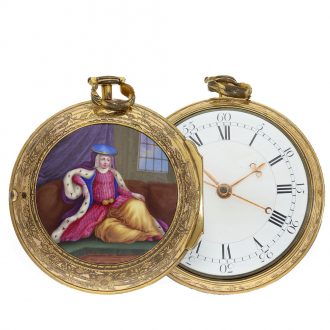
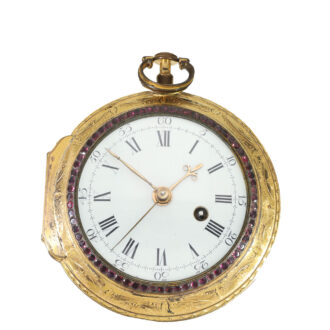
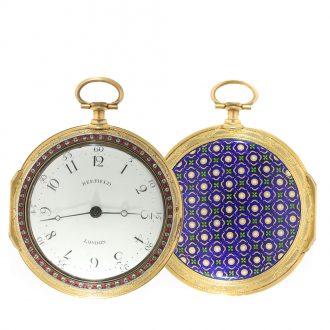
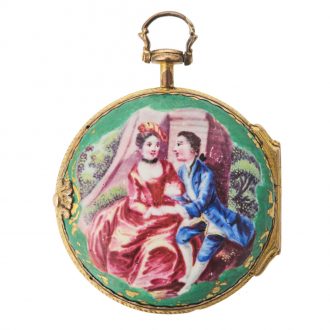
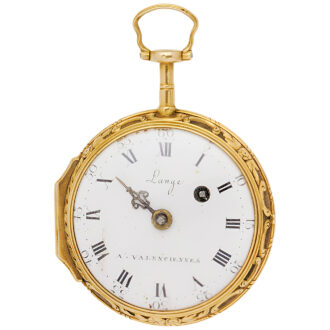
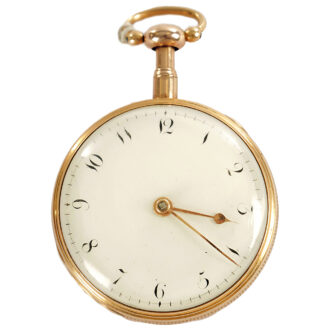
Rare English gilt cylinder watch with wandering hours Circa 1780
- Kenmerk
- DB0107
- Diameter
- 50 mm
- Estimate
- € 3.750 - 7.000
- Price sold
- € 4.400
Gilt open faced cylinder pocket watch by Johann Georg Thiell
–
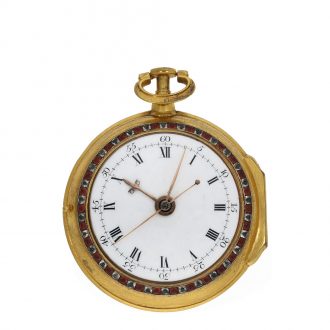
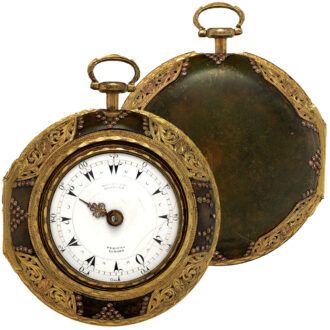
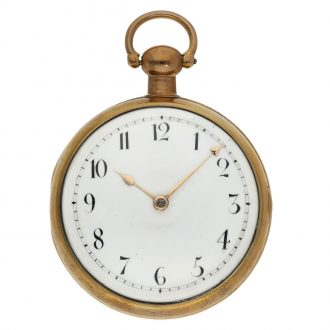
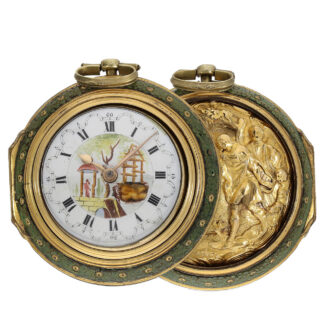
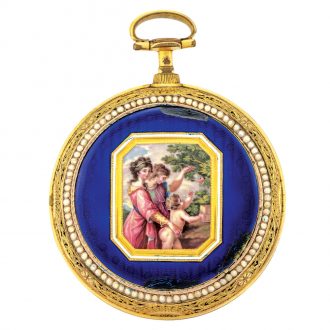
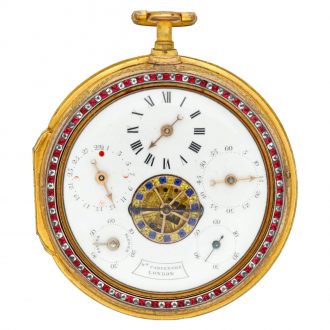
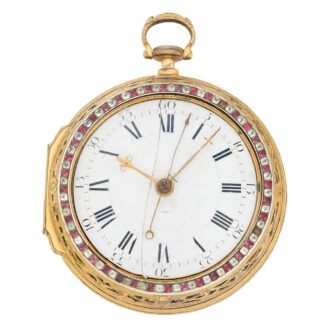
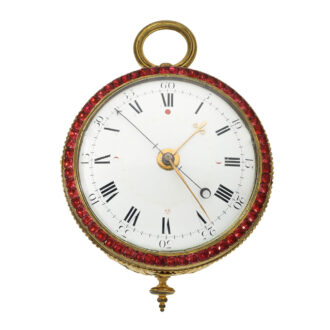
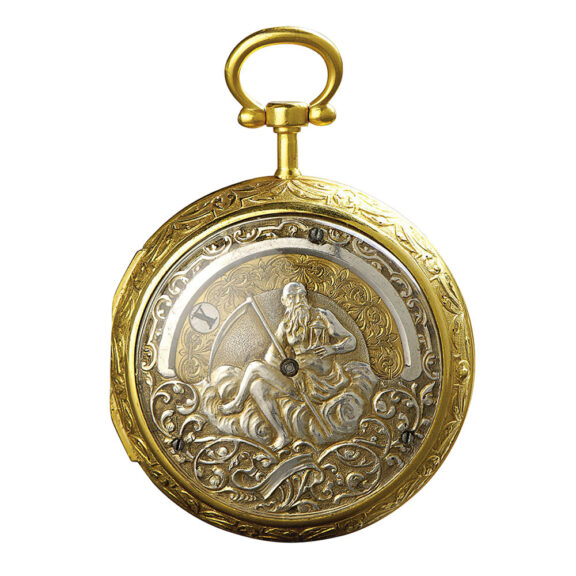
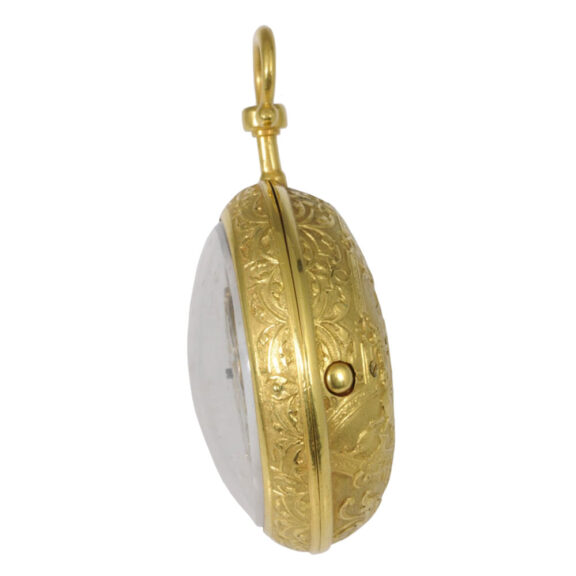
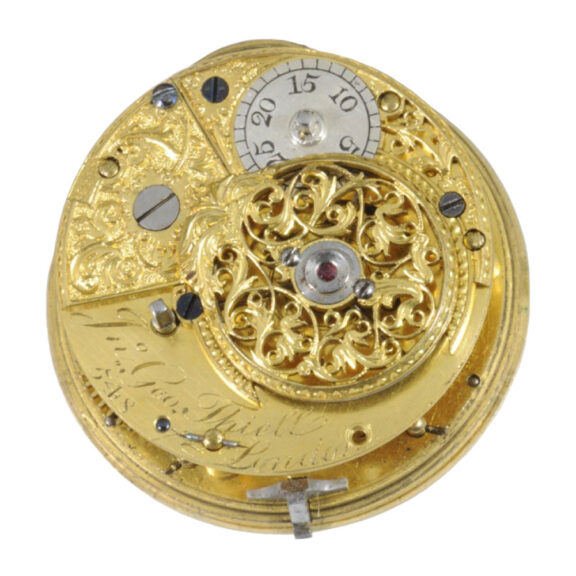
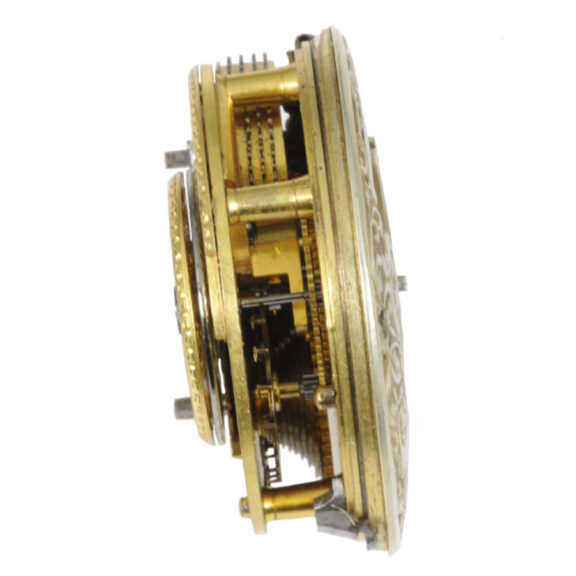
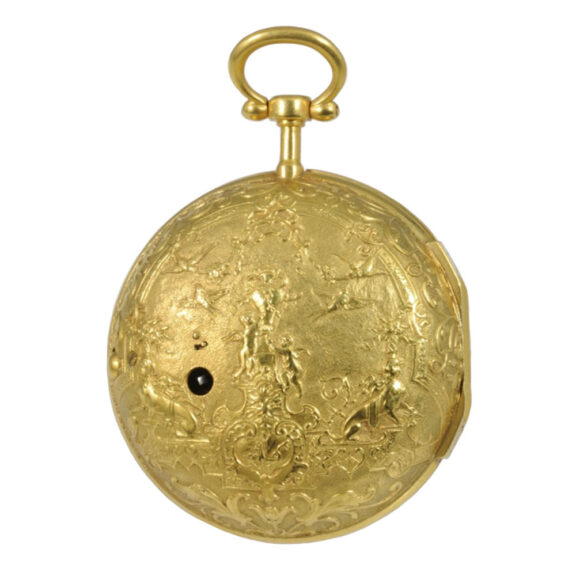
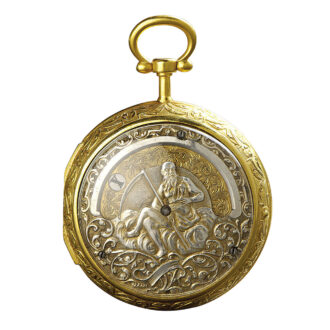
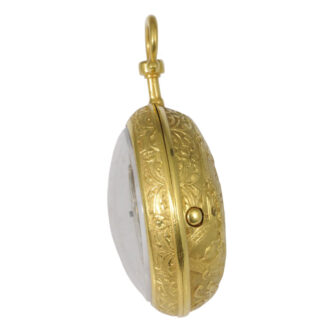
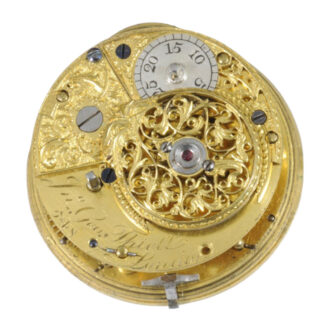
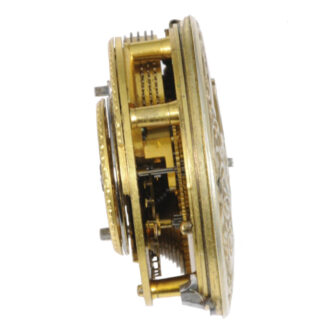
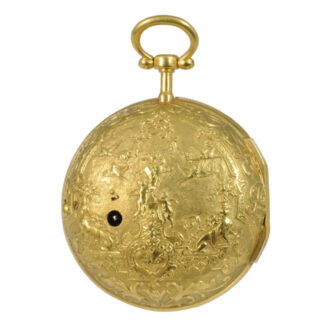
A rare English gilt open faced cylinder pocket watch with wandering hours, circa 1780. Full plate movement, chain and fusee, three arm steel balance. Silver and gilt dial with applied silver garlands on the outer border, an arc shaped cut out in the upper half displaying a rotating, lavishly engraved gilt disc with a window for the Roman hours, the lower half is decorated with the chased figure of Chronos, the god of time, he is depicted as a bearded old man holding a scythe and an hour glass. The baroque style case has an engraved and chased back featuring winged putti, sphinxes, swallows and flower garlands.
Movement signed and numbered.
–
Diameter: 50 mm
–
Weight: 96 g
–
Signed: Jn. Geo. Thiell London
–
Johann Georg Thiell (also Thiellen and Thiele) was born in Hamburg in 1714 and lived in Bremen. He was a watch- and chronometer maker. His chronometer No. 1 resides at the state museum in Stuttgart and was part of an exhibition at the Mathematisch Physikalischer Salon in Dresden in 2015. It is the oldest remaining German marine chronometer with an inverted design. In his book ‘Watchmakers & Clockmakers of the World’, G.H. Baillie mentions the watchmaker Thiell in London in 1768 in reference to a watch with a temperature compensation system with brass rods on a steel ground. Johann Georg Thiell died in 1784.
–
A wandering hour complication displays the time by moving a pointer showing the hour across an arc showing the minutes. Watches with such a dial were first seen in the 17th century. In England, they were often commissioned by the King as a gift to visitors or as an appreciation of their loyalty to the government. One of the first watchmakers to adapt this design to a pocket watch was the British watchmaker Joseph Windmills. In 1656, the Campani brothers designed a clock for Pope Alexander XII, who used it as his bedtime alarm. It traditionally consists of a central three- or four armed cross with a disc or cylinder at the end of each arm which rotates to show the current hour and points to the minutes along an arc shaped track. The complication is fairly straightforward, as each of the 12 hours is evenly divisible by three or four, so each arm can show the same number of hours. Similarly, the dial is divisible according to the number of arms, so a three armed system will show the minutes on a 120º track, while a four armed system uses 90º of the dial.
–
In sculpture and painting, a putto (plural: putti) is a plump child figure, almost always male and usually naked. If the child has wings, it is also called a cherub. Putti are mainly found in Renaissance, Baroque and Rococo art.
Signed: Jn. Geo. Thiell London
Share this page: