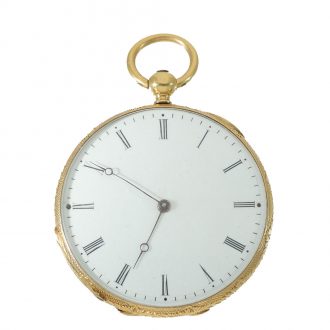
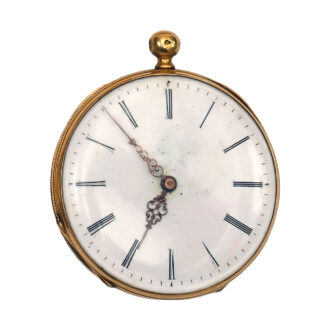
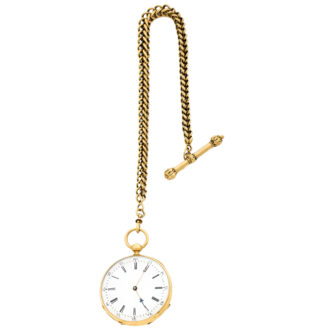
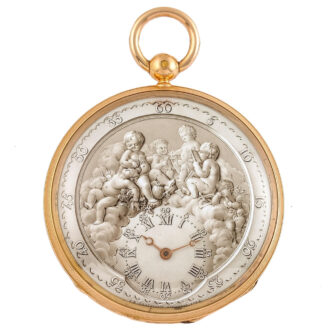
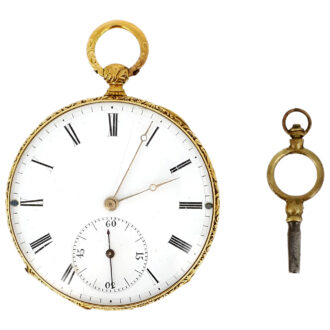
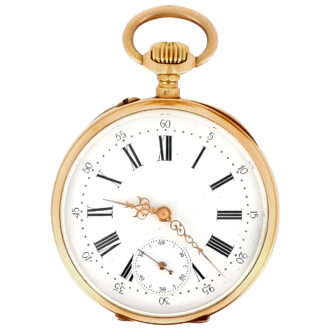
French split seconds chronograph lever chronometer Circa 1850
- Kenmerk
- DB0214
- Diameter
- 54 mm
- Estimate
- € 4.000 - 8.000
- Price sold
- -
Gold split seconds chronograph by Winnerl
–
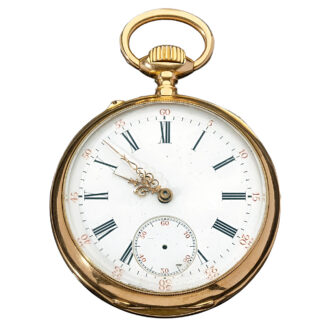
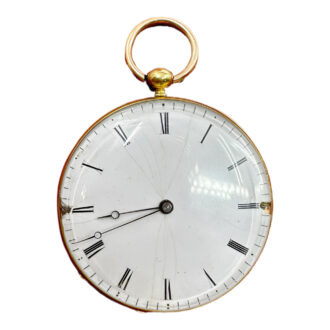
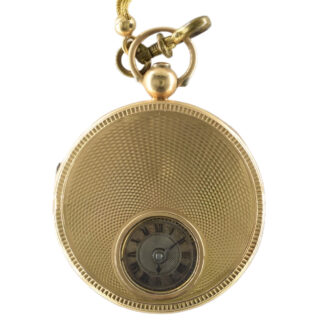
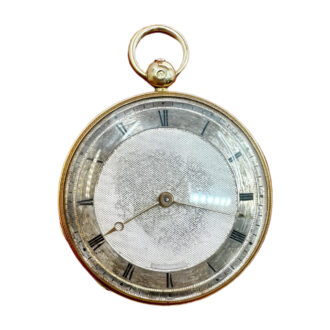
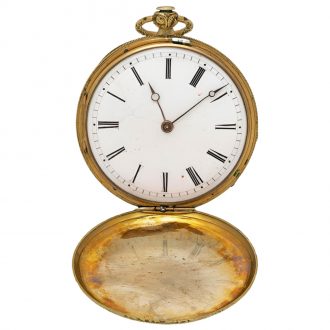
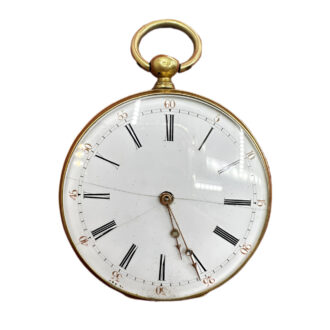
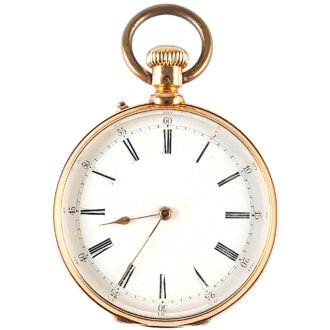
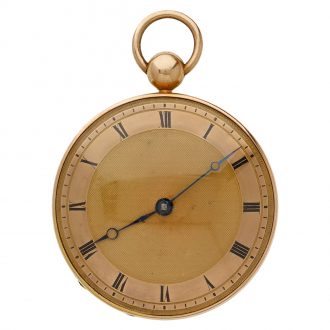
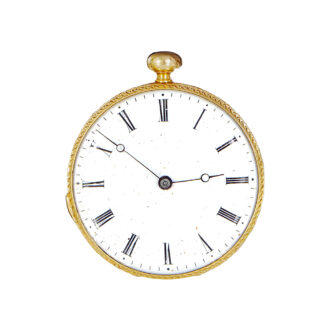
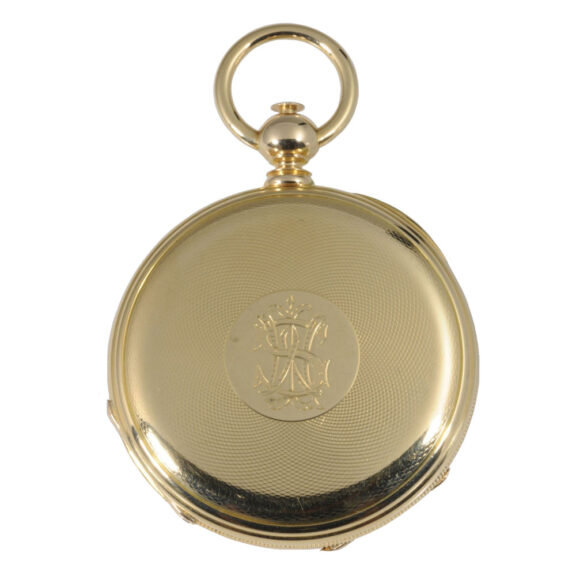
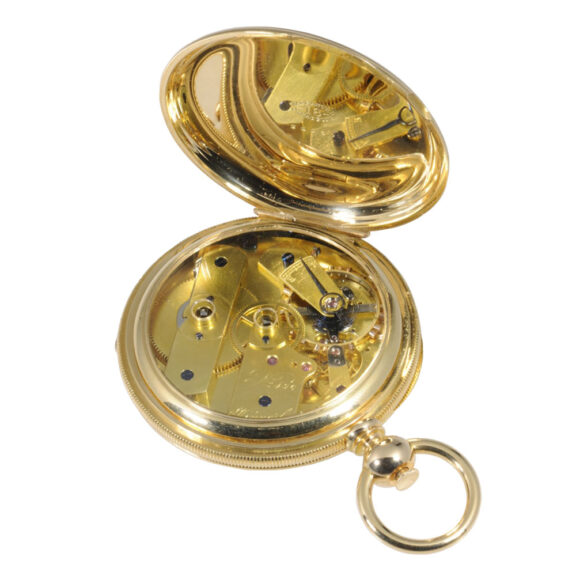
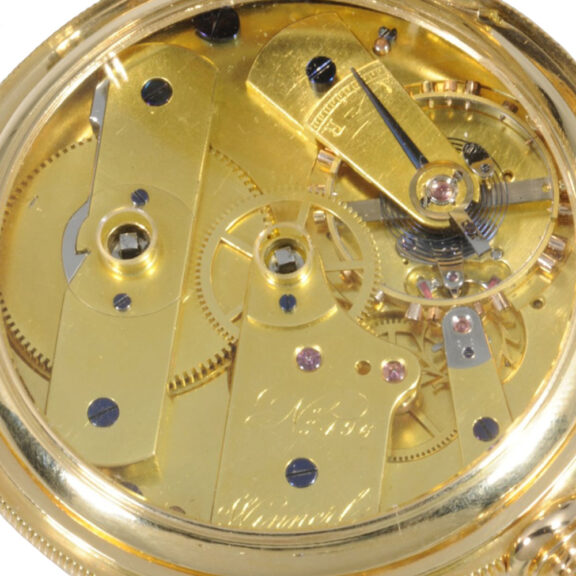
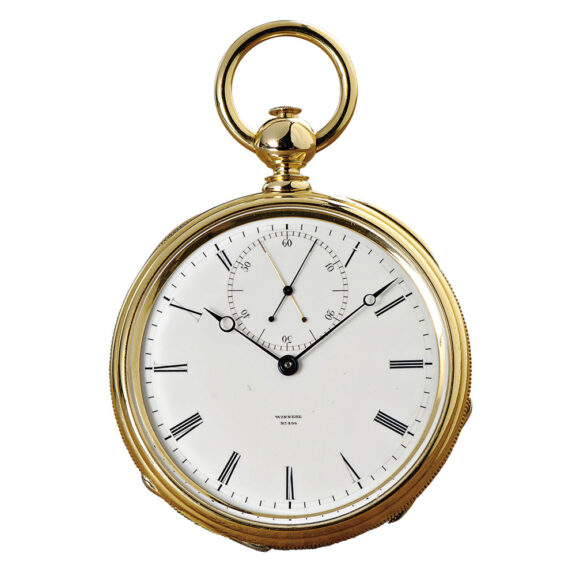
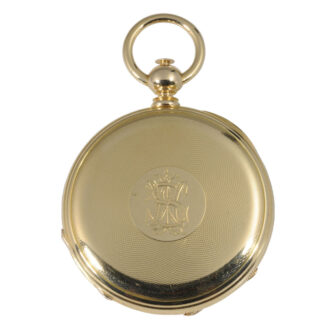
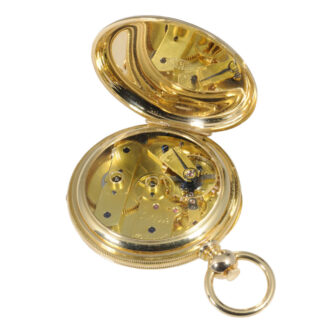
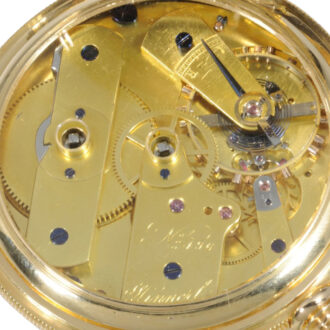
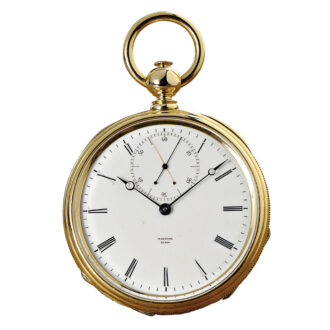
An early French 18 carat gold open faced lever chronometer with split seconds chronograph made for the American market, circa 1850. Glazed bridge movement, lever escapement, large gold screw compensation balance. White enamel dial with Roman hours, outer minute divisions, subsidiary seconds at 12 o’clock and a gold rattrapante hand. An engine turned case back with central monogram, plain bezels and reeded band.
Dial and movement signed and numbered, case numbered.
–
Diameter: 54 mm
–
Weight: 118 g
–
Signed: Winnerl
–
In the 1830s Joseph Thaddäus Winnerl invented the ‘second rattrapante’ (split-seconds chronograph), a mechanism that permitted disconnecting a seconds hand from the movement by the press of a button and resetting it later to the current second. In 1862, more than two decades later, Adolphe Nicole developed the first timepieces with a zero resetting function and laid the foundation for the modern split second chronographs we know today.
–
Joseph Thaddäus Winnerl was born on January 25th, 1799 in Mureg, Styria in Austria. He served as an apprentice for Georg Schmidt Fidel in Graz and qualified in 1816. At the beginning of 1823, Winnerl worked in Breslau and then for Kessels in Altona, for Urban Jürgensen in Copenhagen and from 1829 in Paris, where among others he worked for Breguet et fils. In 1831 he produced the first pocket watch with ‘seconde independante’ (independent seconds). Its centrally positioned seconds hand could be stopped and then started again independently from the clockwork any number of times, however, after the completion of the timekeeping, it would slowly go back to zero. Only then a new timing process could be initiated. In 1832 he started his own business in Paris. He produced marine chronometers, precision pocket watches and precision pendulum clocks. From 1835 to 1841 Ferdinand Adolph Lange worked for him. Winnerl specialized in marine chronometers and produced several timekeepers of outstanding quality. In 1844 the Société d’encouragement not only described and illustrated his pendulum clocks and seconds counters but also his publications on isochronism of the pendulum caused by the force of the suspension spring. In 1868 Winnerl created the first pendulum clock with an electric contact which was placed in the basement of the observatory in Paris – it is still there today. He used Thomas Reid’s escapement, which he modified so finely that it produced the most perfect results. Winnerl also worked on improving lever escapements, for example in large clocks. He was honoured with a number of awards for his creations and in 1844 he was made a Chevalier de la Légion d’Honneur, in 1855 an Officier. Winnerl retired from business in 1870 and sold his workshop to the watchmaker Bernard Callier. Winnerl died on January 27th, 1886.
Employees and apprentices:
Ferdinand Adolph Lange 1835 to 1840
Victor Gannery around 1838
Simon Vissière around 1840
Moritz Krille around 1845
Julien Hilaire Rodanet 1826 to 1837
Henri Robert Ekegrèn around 1850
Théodore-Marie Leroy
Signed: Winnerl
Share this page: