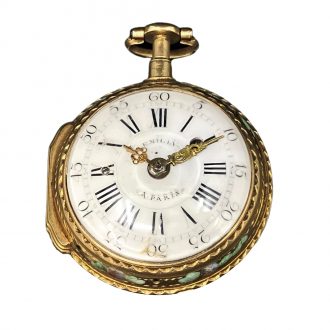
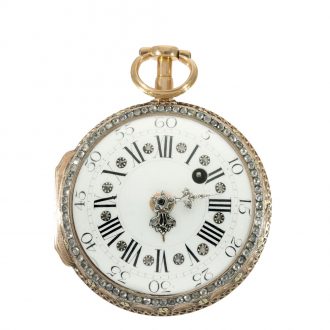
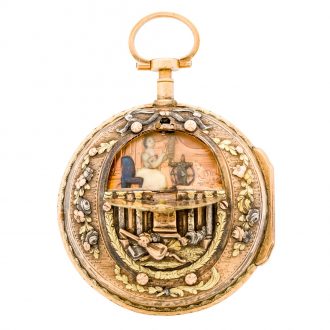
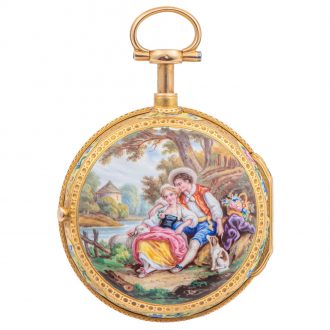
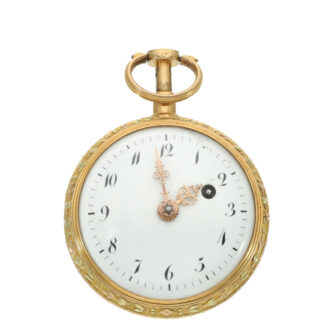
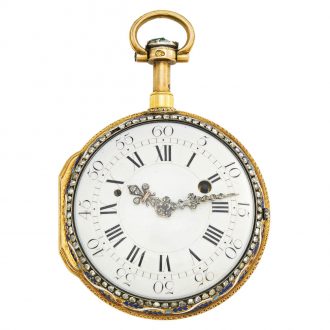
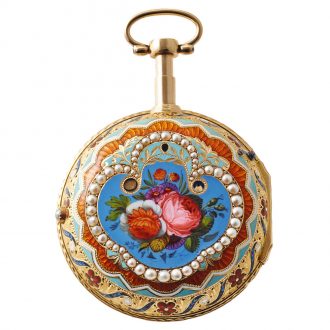
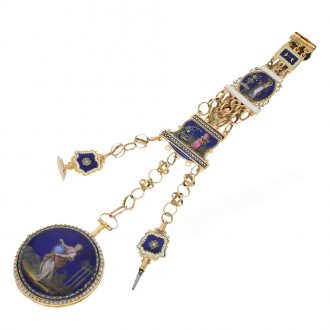
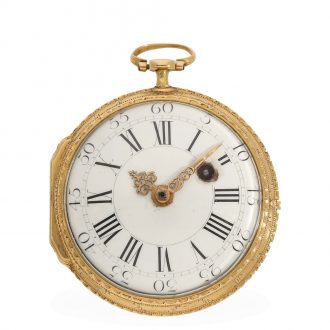
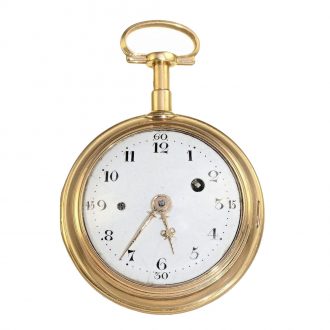
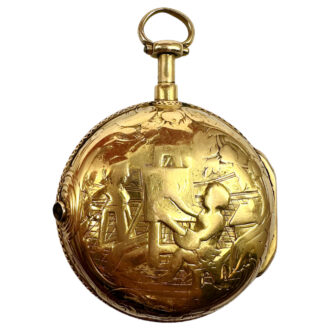
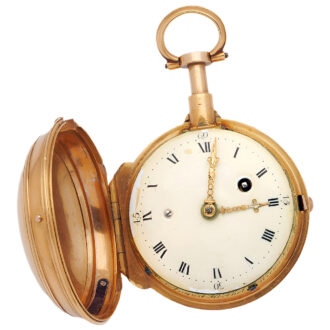
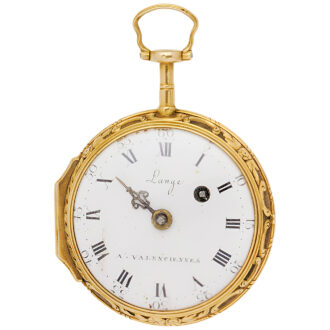
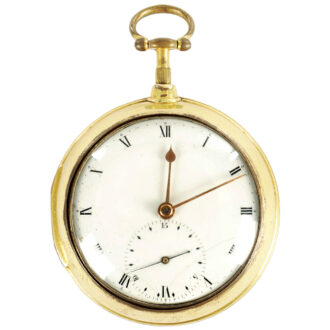
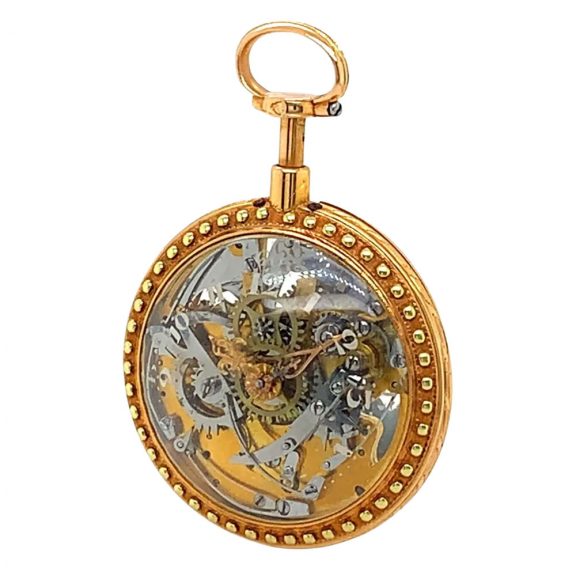
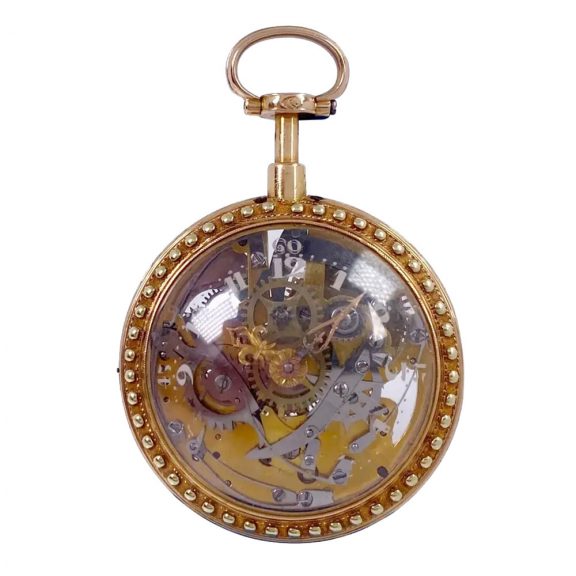
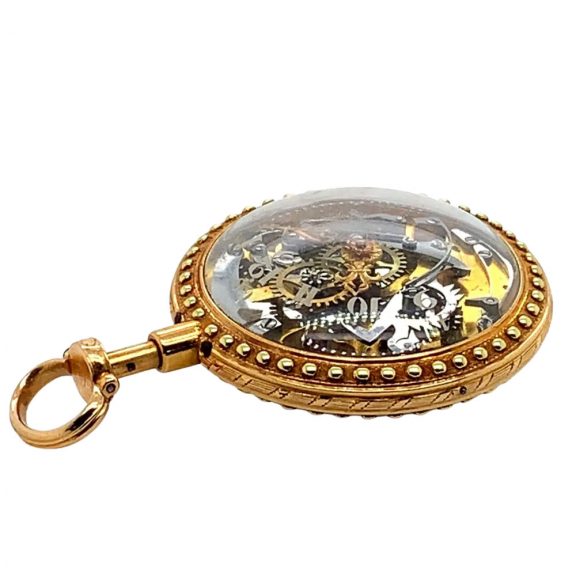
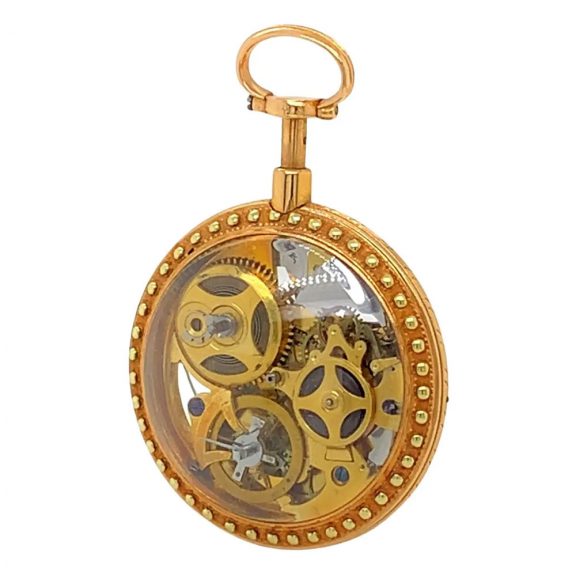
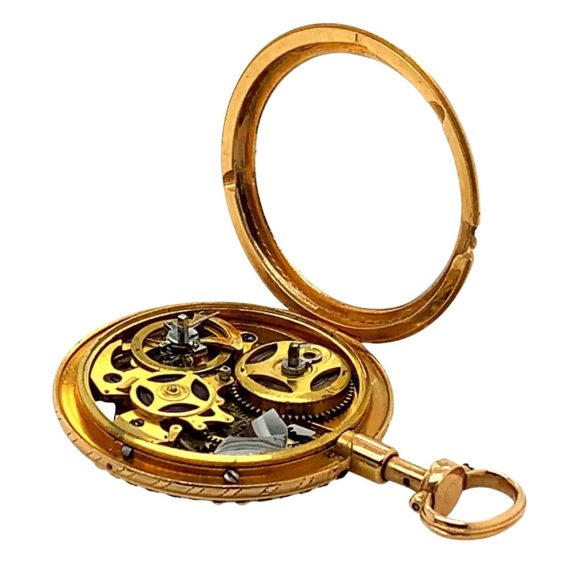
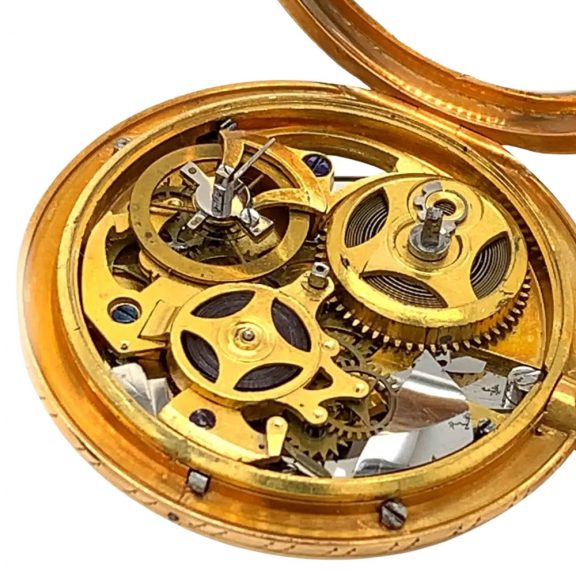
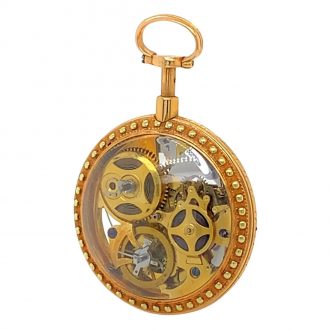
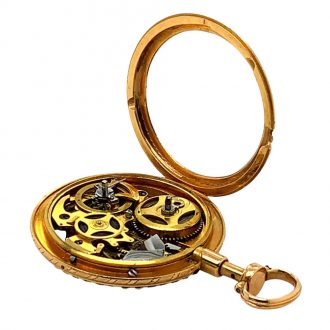
French skeletonized rose gold repeating à toc watch Circa 1770
- Kenmerk
- DB0760
- Diameter
- 38 mm
- Estimate
- € 3.000 - 6.000
- Price sold
- € 3.300
Gold skeletonized watch attributed to Jean-Antoine Lépine
–
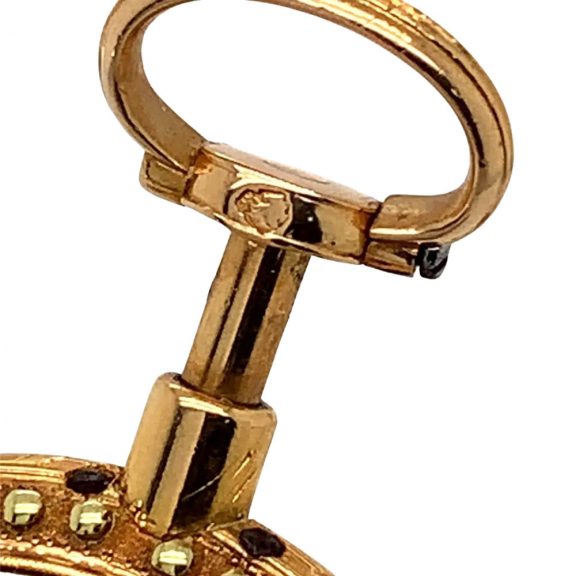
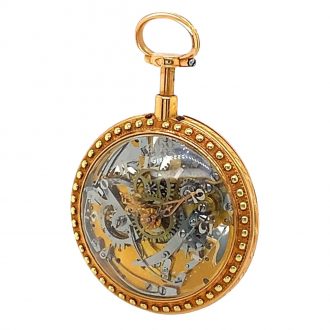
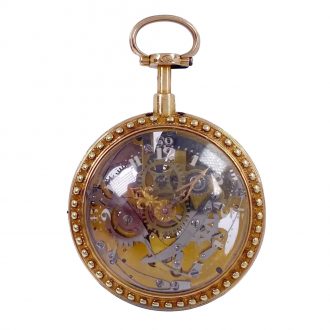
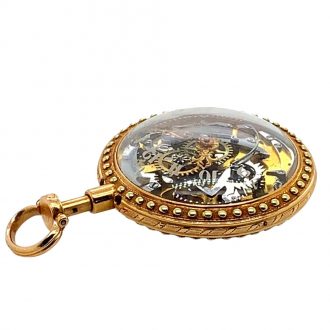
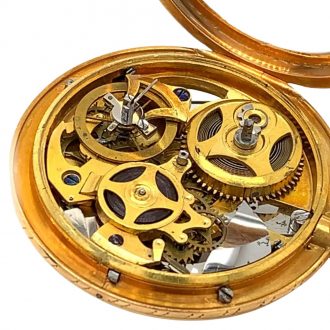
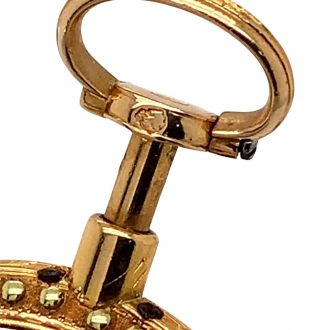
A technically very interesting French 18 carat rose gold quarter repeating à toc skeletonized pocket watch, circa 1770. Bridge movement, key winding, two hammers, an open barrel, a comma escapement and three arm brass balance. A skeletonized dial. The case is glazed on both sides, the dome on the front is engraved with Arabic numerals, an engraved band.
–
Diameter: 38 mm
–
Weight: 38 g
–
Signed: No name
–
The present watch shows all the structural features of the watches presented by Jean-Antoine Lépine from around 1770. Be it the peculiar shape of the striking bridge, the repetition mechanism or the comma escapement used. The clock probably served as a kind of showpiece as it allowed a view of the complicated clockwork from both sides.
–
Jean-Antoine Lépine (also L’Pine, LePine, Lepine or L’Epine) was born as Jean-Antoine Depigny on November 18th, 1720 in Challex, France. He was an influential watchmaker. Lépine contributed inventions which are still used in watchmaking today and was amongst the finest French watchmakers, who were contemporary world leaders in the field. Since his childhood the horologist showed an inclination towards mechanics, beginning his horological career and making fast progress, in particular, under the direction of Mr Decroze, manufacturer of Saconnex watches, in the suburbs of Geneva, Switzerland.
Lépine moved to Paris in 1744 when he was 24 years of age, serving as an apprentice to André-Charles Caron (1698–1775), at that time clockmaker to Louis XV. In 1756 he married Caron’s daughter and associated with him, under the name ‘Caron et Lépine’, between 1756 and 1769. Watches with a signature Caron et Lépine or equivalent are not known, apparently, Lépine was independent to a certain extent. As early watches were not numbered, it is uncertain when Lépine began to sign watches with ‘Lépine à Pari’s on the movement and partially ‘L’Epine à Paris’ on the dial.
On March 12th, 1762, he became maître horloger (master horologist) and probably since that year he was the teacher of Abraham-Louis Breguet, with whom he had a business relationship over many years. In the Breguet archive, many watches are recorded as delivered by Lépine. In 1765 or 1766 (precise date not known), he was appointed Horloger du Roi (Clockmaker to the King). In 1766 he succeeded Caron and appeared on the list of Paris clockmakers of that year as Jean-Antoine Lépine, Hger du Roy, rue Saint-Denis, Place Saint Eustache. Ten years later, in 1772, he established himself in the Place Dauphine, in 1778-1779, Quai de l’Horloge du Palais; then in the Rue des Fossés Saint Germain l’Auxerrois near the Louvre in 1781 and finally at 12 Place des Victoires in 1789. In 1782, his daughter Pauline married one of his workmen, Claude-Pierre Raguet (1753–1810), with whom he formed a partnership in 1792.
He was also associated for a certain period with the philosopher Voltaire, at his watch manufactory set up in 1770 at Ferney. It is not known the exact role he played in the Ferney Manufacture royale, either technical director and/or associate. However, most ebauches for his watches were made there, at least between 1778 and 1782. An unsigned memoir of 1784 reports that Lépine stayed in Ferney for 18 months and that he had watch movements made there with a value of 90,000 livres a year. As a clock- and watchmaker to Louis XV, Louis XVI and Napoleon Bonaparte, Lépine’s creations were well respected and in demand. He died at the age of 93 on May 31 in Paris, France.
Share this page: