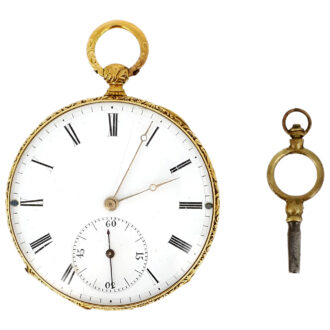
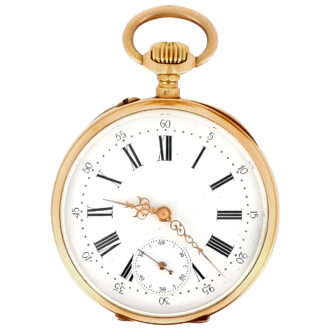
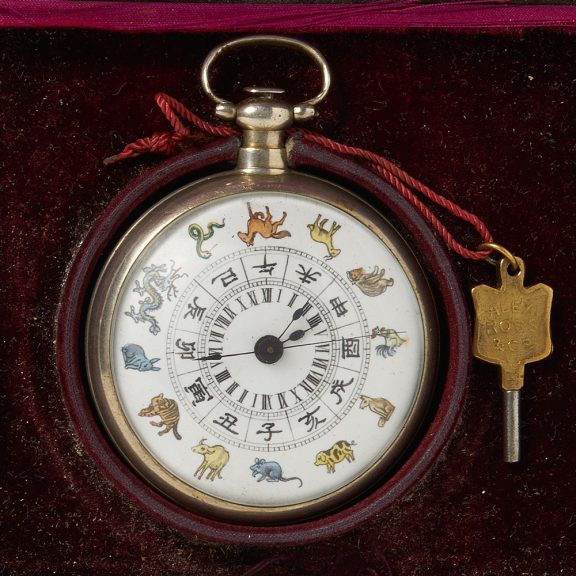
Swiss center seconds duplex for the Chinese market Circa 1840
- Kenmerk
- VB0006
- Diameter
- 56 mm
- Estimate
- € 2.500 - 4.500
- Price sold
- € 2.850
Silvery metal watch with zodiac signs by Bovet
–
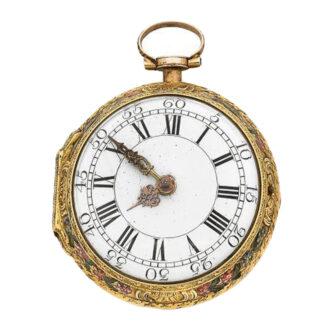
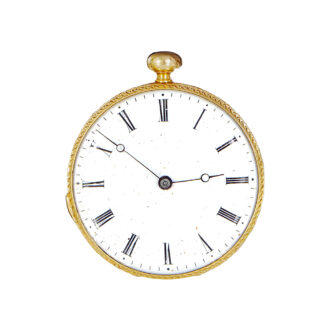
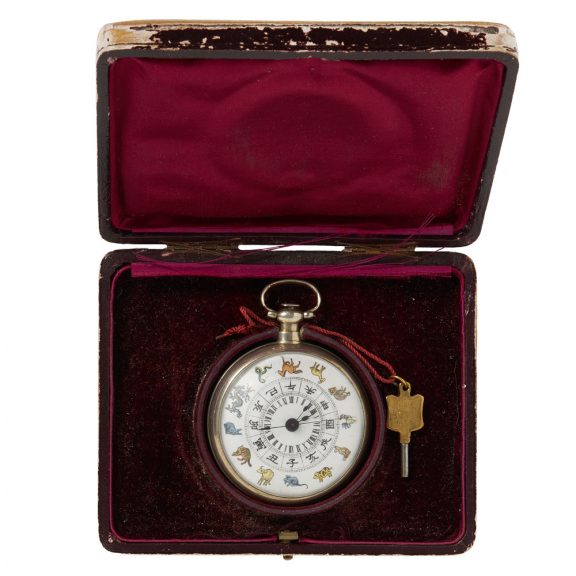
A Swiss metal open faced center seconds key wound duplex pocket watch made for the Chinese market, circa 1840. The glazed movement with a duplex escapement engraved with tendrils. White enamel dial with inner radial Roman hours, a minute track, Chinese characters, 12 outermost polychrome enamelled Chinese zodiac signs and black hands. A plain, numbered case. Movement signed. Accompanied by the, presumably, original, wood with leather presentation box and a winding key signed Alex. Ross & Co. and Qianxin Yanghang.
–
Diameter: 56 mm
–
Signed: Bovet Fleurier
–
Alexander Ross & Co. was a British trading company founded in 1898 in Hong Kong.
–
The House of Bovet. Bovet Fleurier SA is a Swiss brand of luxury watchmakers. It is most noted for its pocket watches made for the Chinese market in the 19th century.
–
Edouard Bovet was born in 1797 in Fleurier, Switzerland. As the son of local master watchmaker Jean-Frédéric Bovet he followed his father’s footsteps. Edouard had four brothers, Frédéric (born 1786), Alphonse (1788-1850), Gustave (1790-1835) and Charles-Henri (born 1802), and a sister, Caroline (born 1807).
–
Between 1807 and 1815, the watchmaking industry in Fleurier experienced a significant decline due to the Continental Blockade, forcing many watchmakers to pursue different careers. During this period, in 1814, after his apprenticeship, Edouard left Fleurier for London with two of his brothers Frédéric and Alphonse.
–
In 1818, Edouard joined Maison Magniac, a watch-dealing company in Canton, China. Therefore, he left London for China on April 20th, aboard the Orwell, ship of the India Company. Upon arriving in Canton on August 16th he quickly saw the trade potential with China and informed his brothers about expanding their business interests there. The brothers began establishing their company in January 1820, with Edouard in Canton, Frédéric and Alphonse in London and Gustave managing the workshops in Fleurier. The family business, Bovet Fleurier SA, was officially registered in London on May 1st, 1822, but operations were soon moved back to Fleurier, where their sister Caroline later joined the firm.
–
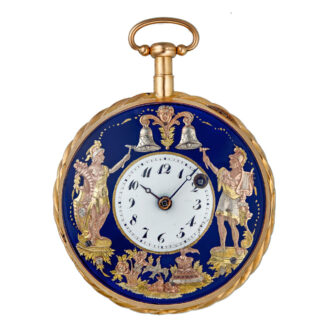
Bovet’s successful introduction of a new watch style for the Chinese market secured a dominant position in this export sector. Consequently, Bovet revitalised Fleurier’s watchmaking industry, ushering in a period of prosperity for the town. From the beginning, Edouard aimed to offer high quality, exceptional luxury timepieces of the finest materials and techniques, targeting wealthy Chinese clients. These watches featured a distinctive Chinese caliber with a duplex escapement and a glazed cuvette, allowing owners to admire the movement. Decorative painted enamel scenes, often depicting floral arrangements and pairs of doves, were popular. The Chinese market also demanded complementary pairs of watches with mirror image scenes.
–
In 1824, brother Charles-Henri joined Edouard in China, where he served as Bovet’s main representative from 1830 to 1836 before returning to Switzerland in 1839. Meanwhile, Edouard returned to Fleurier and established another factory in Besançon with Charles Lorimier, producing watches for the Chinese market alongside Bovet’s other products.
–
In 1840, Frédéric left London and returned home to Fleurier, where he managed the workshops that then employed 175 people.
–
In 1849 at age 52, Edouard Bovet died in Fleurier, leaving his legacy in China. At that time, Bovet was a synonym for watch and used as a trade currency.
–
During the Universal Exhibition held in Paris in 1855, Bovet won a the gold medal in the category ‘luxury’ for a pair of enamelled pocket watches commissioned by the Emperor of China.
–
Frédéric or Fritz (1824-1914), Alphonse (1828-1918), Gustave born in Shanghai (1835-1906) and Charles (born 1838), sons of Alphonse, the second eldest founding brother, continued the firm. They were joined by Louis (1818-1882), the son of Gustave the elder, who travelled to Canton in 1836 to work with his uncle Charles-Henri and was in 1838, joined by his childhood friend, Auguste Jeanneret, when Charles-Henri returned to Europe. In 1880, the firm was renamed Bovet Frères.
–
In 2001, Pascal Raffy, a passionate collector of Haute Horology, became the sole owner of Bovet Fleurier SA. To celebrate their mutual respect and admiration, the House of Bovet and Pininfarina established a partnership in 2007, to create luxury sports timepieces that unite their passion for design and engineering brilliance. Pascal’s daughter Audrey joined the firm in 2020.
Signed: Bovet Fleurier
Share this page: