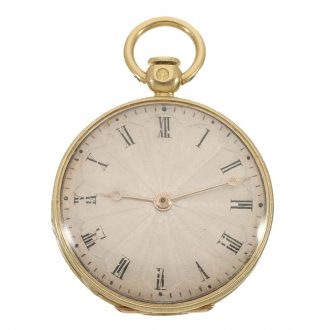
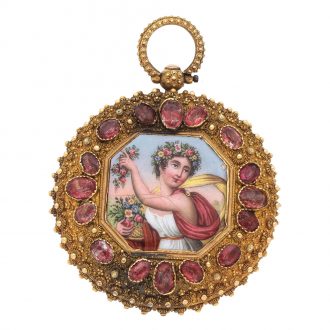
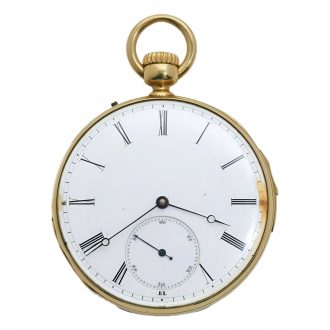
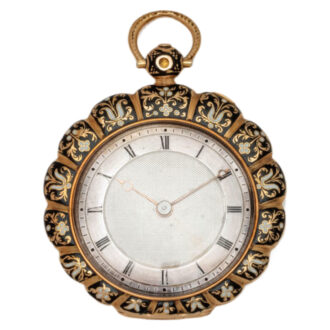
Small French gold and seed pearl set verge watch Circa 1830
- Kenmerk
- BB1008
- Diameter
- 30 mm
- Estimate
- € 750 - 1.500
- Price sold
- € 500
Gold fine ladies’ watch
–
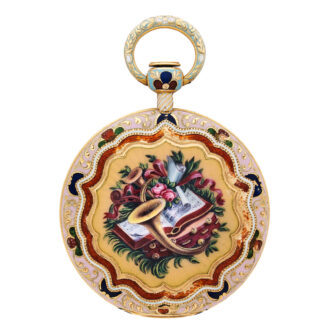
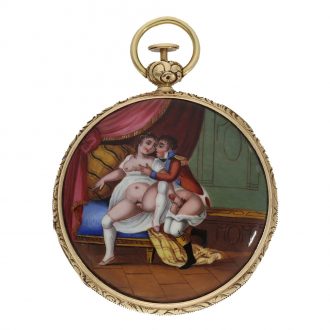
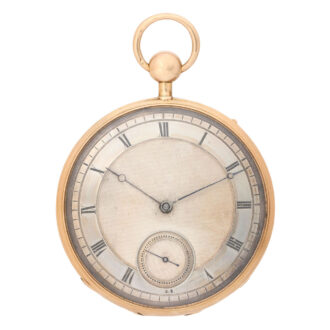
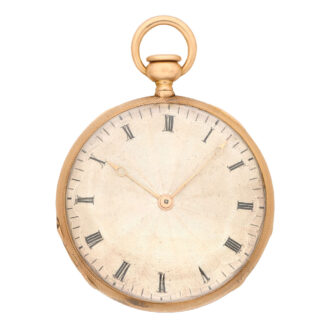
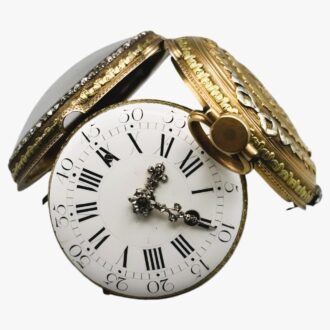
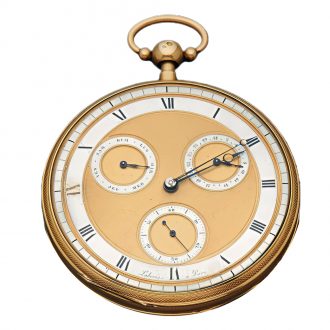
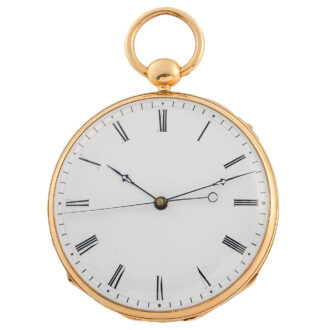
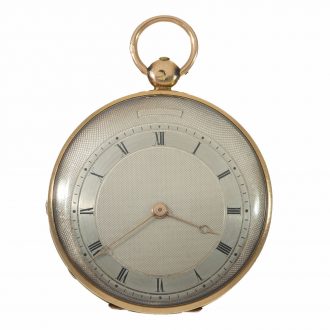
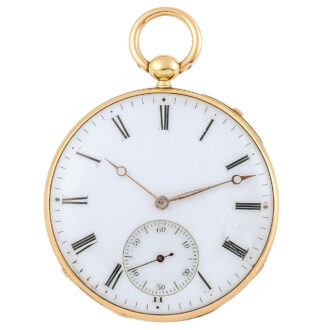
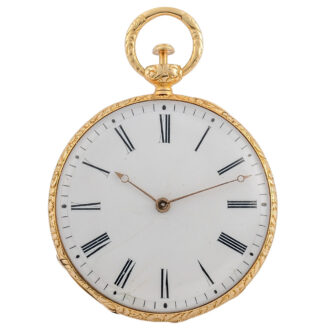
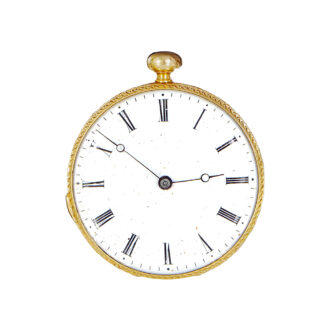
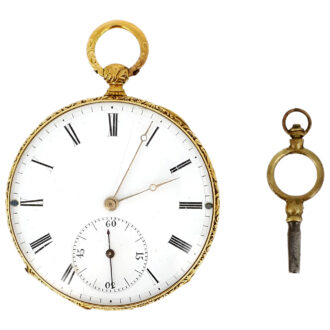
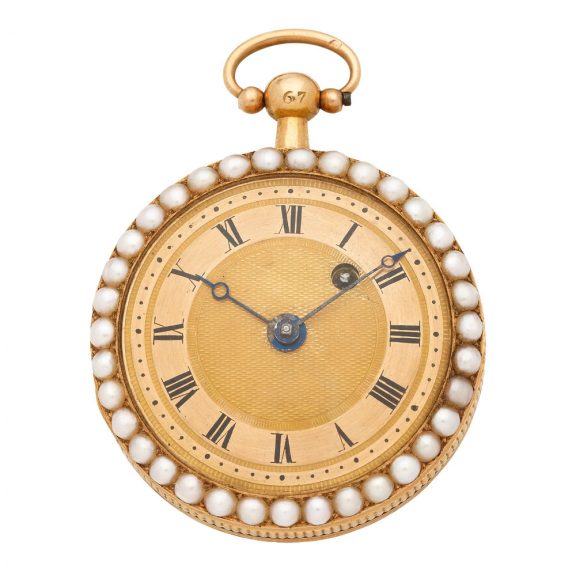
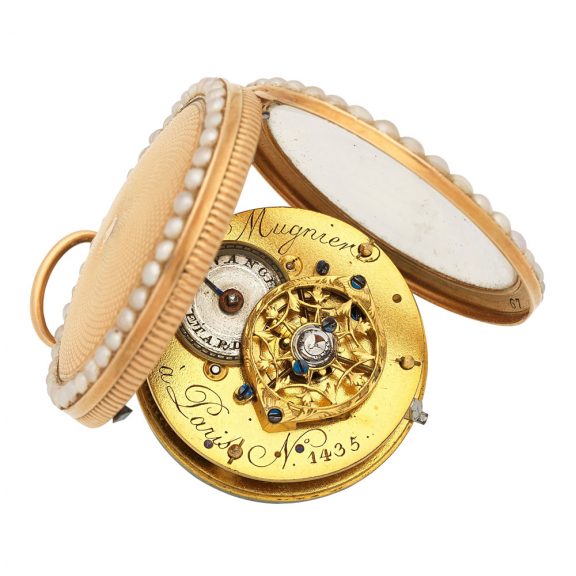
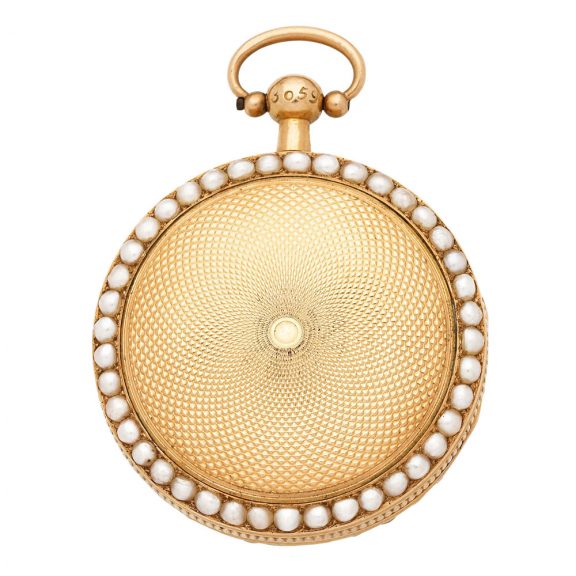
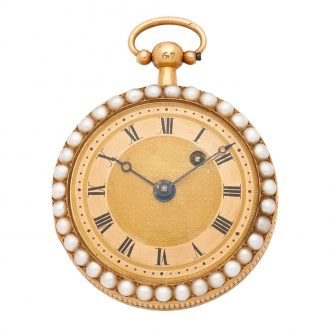
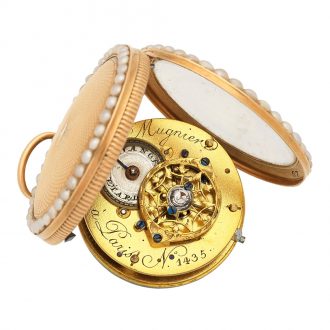
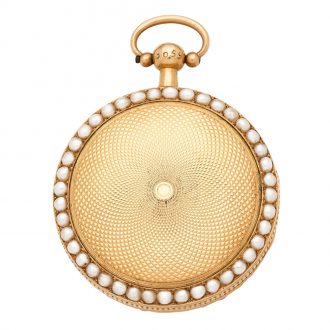
A French 18 carat gold and seed pearl set open faced key wind pocket watch made by Mugnier in Paris, circa 1830. The gilt full plate movement with a fusee verge escapement, pierced and engraved balance bridge, and silver regulation. Gilt dial with black Roman hour numerals on a brushed chapter ring, outer dot minute divisions on a brushed ground, a guilloché center and blued moon hands. An engine turned consular case with seed pearl set bezels. Movement signed and numbered.
–
–
A French 18 carat gold and seed pearl set open faced key wind pocket watch made by Mugnier in Paris, circa 1830. The gilt full plate movement with a fusee verge escapement, pierced and engraved balance bridge, and silver regulation. Gilt dial with black Roman hour numerals on a brushed chapter ring, outer dot minute divisions on a brushed ground, a guilloché center and blued moon hands. An engine turned consular case with seed pearl set bezels. Movement signed and numbered.
–
Diameter: 30 mm
–
–
Signed: Mugnier à Paris
–
Paris was a major center for horology in the 18th century, with a vibrant community of watchmakers of which the Mugniers were a part. Their origin is not known, but they may have emigrated from the Geneva area, where the family name is very common. Two of them became known as clock and watchmakers.
–
Etienne Mugnier the elder was a craftsman working at the Palais Royal, center of the city’s artistic life, in the 1780s. He had extensive mechanical skills, making not only clocks and watches, but also automatons. He was well established in the watchmaking world in Paris and close to the Le Roy family, who dominated French chronometry at that time. His daughter Jeanne-Emilie married Louis Charles Le Roy at the beginning of the 19th century.
–
The second was Charles Mugnier the younger. In 1799, Charles began his career working for Breguet and was known as one of his best watchmakers. He then established himself as an independent clock and watchmaker, having his own company in Rue Neuve-des-Petits-Champs, between 1807 and 1823.
–
The company was named Mugnier & Fils in the early 1830s. His style was deeply inspired by that of Breguet and he was one of the few, along with Charles Oudin, another Breguet pupil, to have been able to make watches of similar quality to his.
–
In 1812, Charles received an order for a watch from Napoléon I, which he completed in 1815 but could not deliver to the emperor, who had been deposed in the meantime. He further became the official watchmaker of Monsieur, Frère du Roi, the future King Charles X.
–
A directory published in Paris in 1812 mentions Charles among the ten most important clock and watchmakers of the city, specifying that “he manufactures haute horlogerie himself”. He took part in the Exhibition of Products of the French Industry in 1823 and received an honourable mention. His company can be found in directories until 1840.
–
Paris was a major center for horology in the 18th century, with a vibrant community of watchmakers of which the Mugniers were a part. Their origin is not known, but they may have emigrated from the Geneva area, where the family name is very common. Two of them became known as clock and watchmakers.
–
Etienne Mugnier the elder was a craftsman working at the Palais Royal, center of the city’s artistic life, in the 1780s. He had extensive mechanical skills, making not only clocks and watches, but also automatons. He was well established in the watchmaking world in Paris and close to the Le Roy family, who dominated French chronometry at that time. His daughter Jeanne-Emilie married Louis Charles Le Roy at the beginning of the 19th century.
–
The second was Charles Mugnier the younger. In 1799, Charles began his career working for Breguet and was known as one of his best watchmakers. He then established himself as an independent clock and watchmaker, having his own company in Rue Neuve-des-Petits-Champs, between 1807 and 1823.
–
The company was named Mugnier & Fils in the early 1830s. His style was deeply inspired by that of Breguet and he was one of the few, along with Charles Oudin, another Breguet pupil, to have been able to make watches of similar quality to his.
–
In 1812, Charles received an order for a watch from Napoléon I, which he completed in 1815 but could not deliver to the emperor, who had been deposed in the meantime. He further became the official watchmaker of Monsieur, Frère du Roi, the future King Charles X.
–
A directory published in Paris in 1812 mentions Charles among the ten most important clock and watchmakers of the city, specifying that “he manufactures haute horlogerie himself”. He took part in the Exhibition of Products of the French Industry in 1823 and received an honourable mention. His company can be found in directories until 1840.
Signed: Munier à Paris
Share this page: