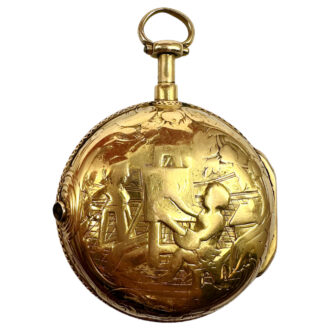
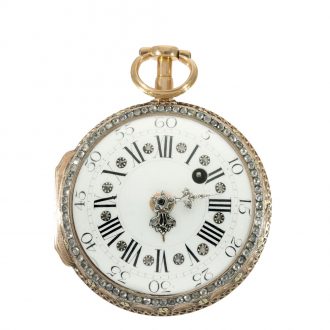
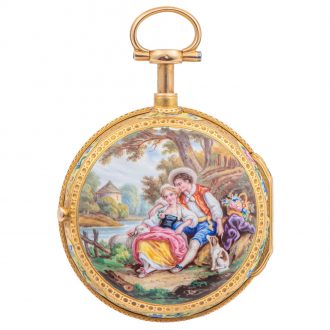
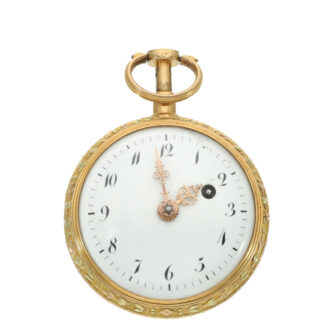
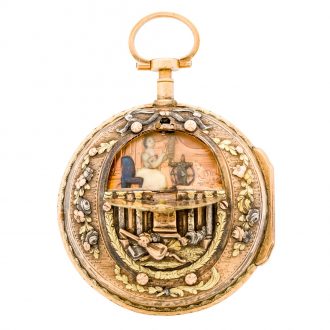
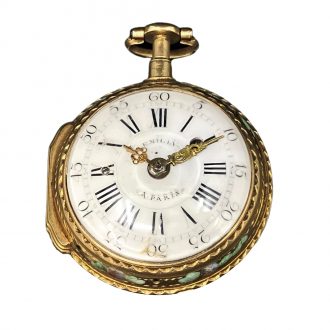
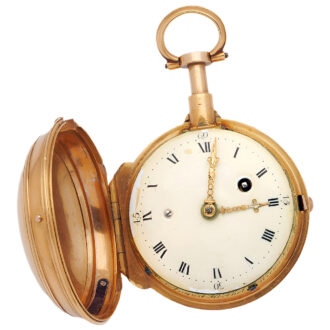
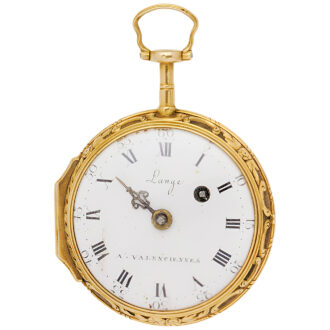
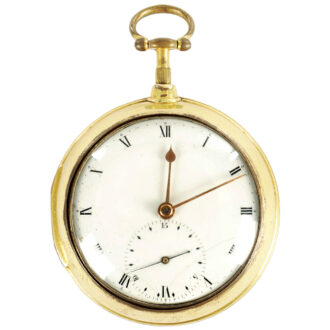
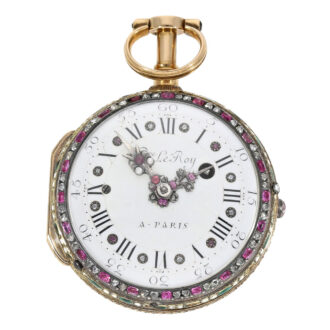
French decorative repeating à toc and à tact watch Circa 1770
- Kenmerk
- BC0223
- Diameter
- 39 mm
- Estimate
- € 5.500 - 11.000
- Price sold
- € 8.050
Gold, enamel, diamond and ruby-set verge watch by Pierre Le Roy
–
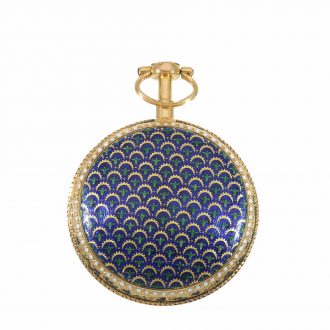
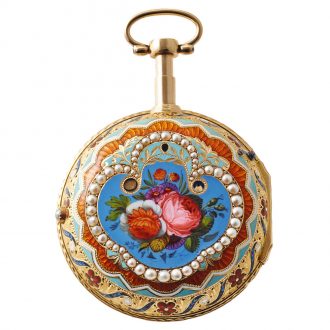
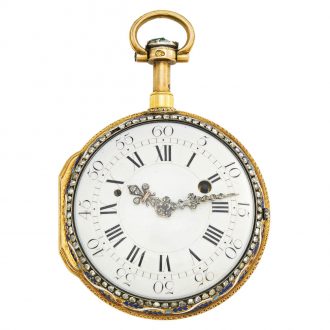
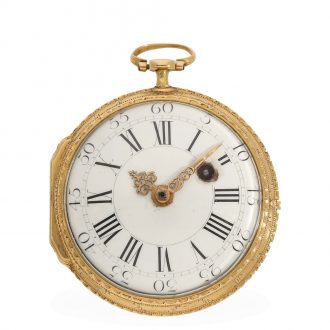
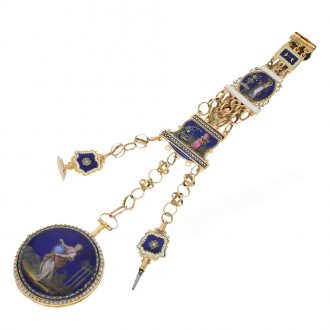
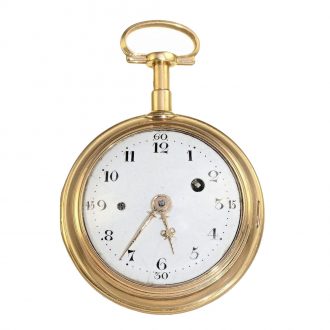
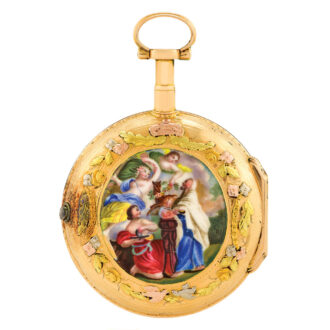
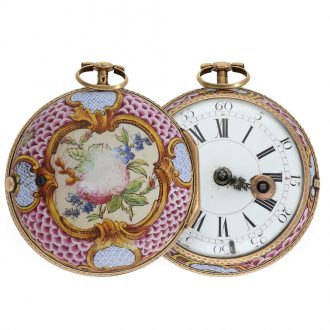
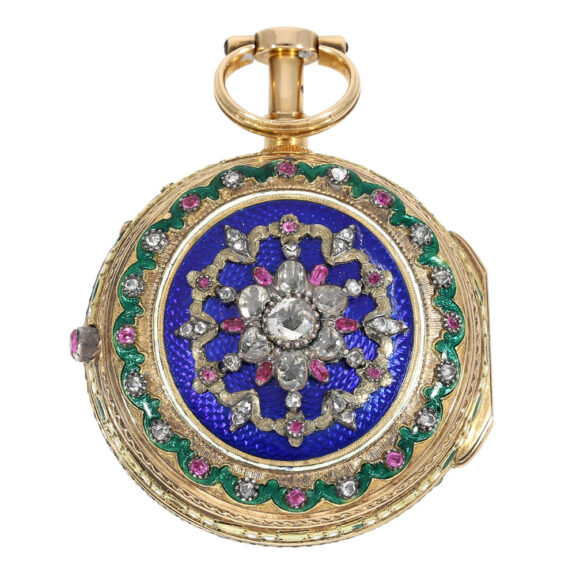
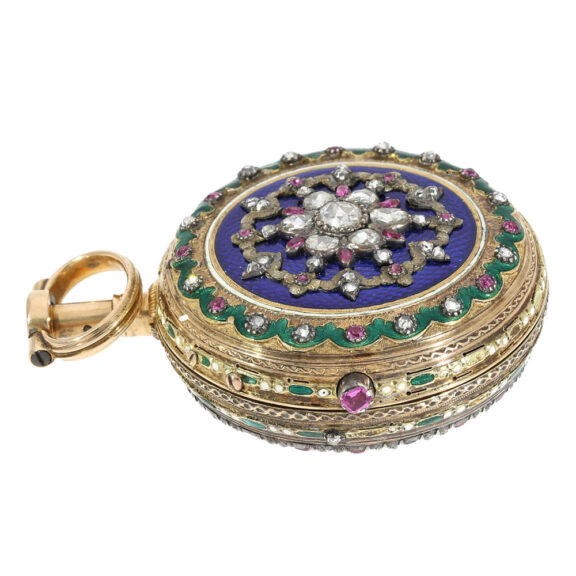
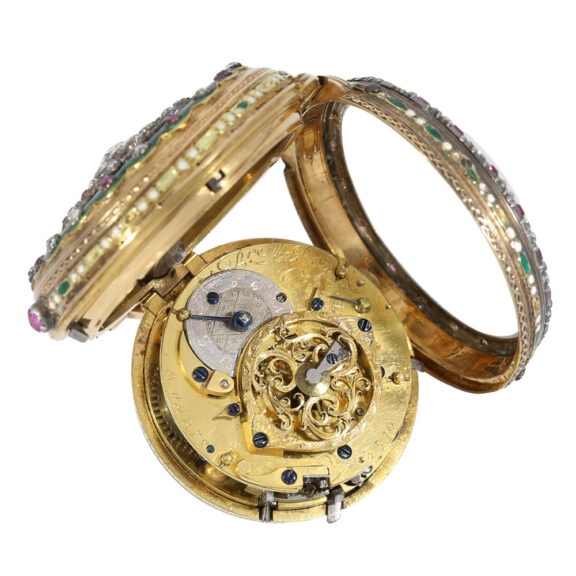
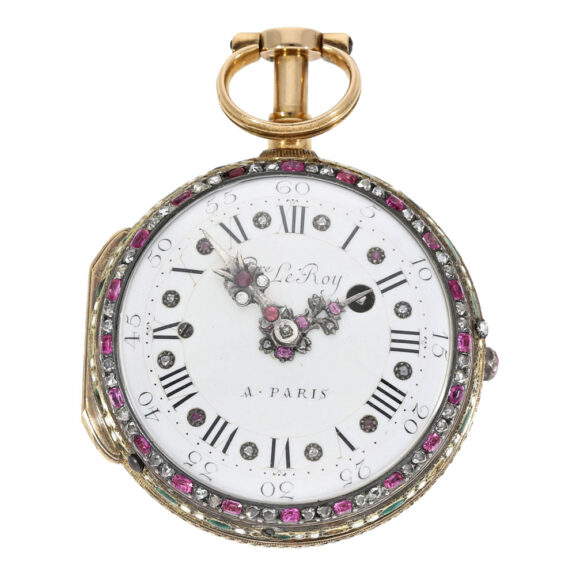
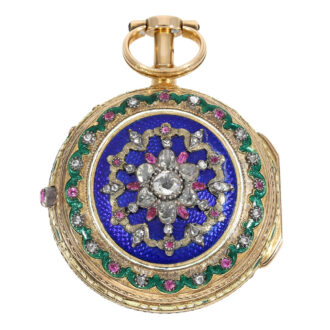
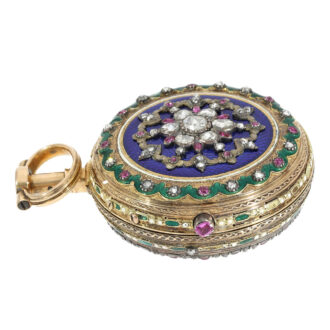
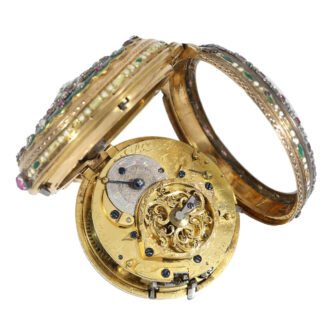
A French 18 carat gold, enamel, diamond and ruby-set open faced quarter repeating à toc and à tact pocket watch, circa 1770. Signed full plate movement, verge escapement, chain and fusee, two hammers, three-arm brass balance. White enamel dial with Roman hours, Arabic five-minute numerals, decorated with rubies and diamonds, original hands also ruby and diamond-set. The centre of the case back with translucent bright blue enamel ornamented with a rosette of diamonds and rubies in different sizes and shapes framed by a wavy translucent green enamel border set with alternating diamonds and rubies, the front bezel decorated to match, a rear bell.
–
Diameter: 39 mm
–
Weight: 61 g
–
Signed: Pre Le Roy A Paris
–
Comparable watches can be found in the collections of the Louvre and the Hermitage.
–
Pierre Le Roy was born in 1717 in Paris and died in 1785 in Vitry-sur-Seine. He was one of the most important French watchmakers and inventors. Together with Ferdinand Berthoud, Le Roy was a leader in the development of chronometer escapements. He invented a temperature compensation with a bimetallic balance with adjustable screws and the isochronous hairspring. His developments were the basis for today’s mechanical chronometers. Pierre Le Roy was born as the son of Julien Le Roy (1686-1759), who was Court Watchmaker to Louis XV. After his death, Pierre Le Roy became his successor. Jewelled watches such as this piece, made of gold, enamelled and set with precious jewels were mostly unique works for wealthy customers such as noble families and Royal houses all over the world.
–
Montre à toc. A ‘dumb’ repeater watch in which a hammer strikes the inside of the case to produce a muffled sound. Invented by Julian Le Roy in 1740.
Montre à tact. A type of watch made after 1795 by Abraham Louis Breguet to give time by touch. In the late eighteenth century it was considered impolite to consult one’s watch in company, a question of etiquette which the à tact watch helped to solve (the French tact, meaning touch, has given the English tact and tactful). Knobs representing the hours are positioned around the case with a large hand that could be turned until it met resistance. Its position in relation to the knobs gave the time. This kind of tactile watch is now mainly used by the blind and visually impaired.
Signed: Pre Le Roy A Paris
Share this page: